Religious
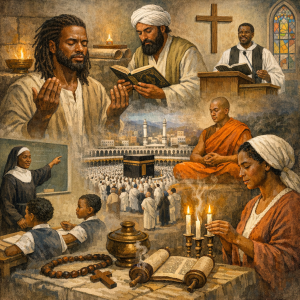
Primary Definition
Religious is an adjective meaning of, relating to, characterized by, or devoted to religion. It may describe a person, belief, practice, institution, ceremony, object, obligation, or way of life connected with worship, reverence for the sacred, faith in God or gods, ultimate moral commitments, or an organized tradition of belief and observance.
The word has several related uses:
- Personal: “a religious person” commonly means one who sincerely practices, professes, or orders life according to a faith or spiritual discipline.
- Institutional: “a religious organization,” “religious school,” or “religious order” identifies an entity formed for worship, teaching, charitable ministry, spiritual discipline, or the advancement of a faith tradition.
- Devotional or ceremonial: “religious observance” may include prayer, Sabbath keeping, fasting, pilgrimage, dietary discipline, sacred dress, worship services, rites, and holy days.
- Descriptive rather than confessional: A person may study, respect, or work with religious traditions without personally adhering to one. Conversely, a person may possess deep faith without using the label religious, especially where the word is understood to imply institutional affiliation or outward ritual.
Dictionary usage therefore distinguishes religious from merely moral, spiritual, philosophical, or political. Those categories can overlap, but they are not identical. A religious claim usually concerns a person’s relation to what he or she regards as sacred, divine, ultimate, transcendent, or binding in conscience. Merriam-Webster traces the English adjective through Middle English and Anglo-French to Latin religiosus. ([merriam-webster.com](https://www.merriam-webster.com/dictionary/religious?utm_source=openai))
Etymology and Origin
English religious came into use in the Middle English period, about the thirteenth century. It entered through Anglo-French religius and Old French religieux, ultimately from Latin religiosus. In Latin, religiosus could mean pious, devout, reverent toward the gods, scrupulous in sacred matters, or carefully observant of rites. It also had a specialized medieval use for a person who belonged to a monastic or other religious order. That older noun use survives in phrases such as “a religious” for a vowed member of a religious community. ([merriam-webster.com](https://www.merriam-webster.com/dictionary/religious?utm_source=openai))
The underlying Latin noun, religio, did not precisely equal the modern English word religion. In classical Roman usage, it often referred to reverence, conscientious observance, ritual obligation, sacred scruple, or restraint in dealing with divine matters. This is important: the word did not originally mean only an inward belief system or a modern denominational identity. It carried the practical sense of careful regard for duties regarded as sacred.
The ultimate derivation of religio is disputed. Cicero connected it with relegere, often explained as “to go over again,” “review,” or “observe carefully.” Later Christian writers, including Lactantius and Augustine, associated it with religare, “to bind” or “bind fast,” giving rise to the familiar interpretation that religion is a bond between humanity and God. The “binding” explanation has long been spiritually influential, but it should not be presented as settled historical linguistics. Modern etymological references describe the deeper origin as uncertain and identify the religare explanation as a later and popular etymology rather than a conclusively established one. ([etymonline.com](https://www.etymonline.com/word/religio-?utm_source=openai))
Accordingly, an interpretive statement such as “religion means re-binding oneself to God” may be useful in theology or devotional writing, but it is not the same thing as a proven linguistic definition. A careful dictionary treatment keeps the distinction clear: religious is historically derived from Latin religiosus; the precise prehistoric derivation of religio remains debated.
Cultural and Historical Context
In ancient societies, matters now separated into “religious,” “political,” “familial,” “legal,” and “cultural” spheres were often intertwined. Civic rites, family duties, oaths, burial customs, temples, festivals, and moral obligations could all be treated as sacred concerns. Roman religio belonged to this world of public and private observance. It should not be assumed that the Romans held the same modern idea of religion as a private set of beliefs voluntarily selected by an individual.
In medieval Europe, religious acquired particularly strong associations with monastic life, clergy, vows, convents, monasteries, and communities organized around a rule of worship and discipline. A “religious house” was not simply a building where religious ideas were discussed; it was commonly an organized community with recognized obligations, property, leadership, and charitable or educational functions.
Over time, English usage broadened. The word may now describe Judaism, Christianity, Islam, Hindu traditions, Buddhism, Sikhism, Indigenous traditions, new religious movements, and many other forms of sacred practice. It may also apply to nontheistic traditions or sincerely held beliefs that function in a person’s life with a seriousness comparable to conventional theistic faith.
Scholars nevertheless dispute whether religion is a timeless universal category. One important criticism is that the modern habit of classifying the world into separate “religions” developed under particular Western historical conditions and can distort traditions that do not divide life into “religious” and “secular” compartments. This criticism does not make the word useless; rather, it cautions readers to ask how a community describes itself and whether the label clarifies or oversimplifies its actual beliefs and practices. ([plato.stanford.edu](https://plato.stanford.edu/archives/sum2022/entries/concept-religion/?utm_source=openai))
Biblical / Torah Context
The English adjective religious does not appear as a controlling technical category in the Torah. The Torah instead speaks through concepts such as covenant, commandment, holiness, justice, worship, priesthood, faithfulness, remembrance, love of God, and obedience. Therefore, describing ancient Israel as “religious” can be broadly accurate in modern English, but the term should not erase the Torah’s own covenantal vocabulary.
Exodus presents Israel’s relationship with God as covenantal and communal. Exodus 19:5–6 describes Israel, upon faithful obedience to the covenant, as God’s treasured people, “a kingdom of priests and a holy nation.” This passage joins worship, communal identity, moral duty, and national calling; it is not merely a statement of private sentiment. ([voices.sefaria.org](https://voices.sefaria.org/sheets/329167?utm_source=openai))
Deuteronomy likewise portrays devotion to God as a whole-life obligation. The Shema calls Israel to hear that the LORD is one and to love the LORD with heart, soul, and might. The accompanying commands require instruction of children and continual remembrance in home and public life. In this Torah context, what modern English speakers might call “religious life” is inseparable from teaching, conduct, household practice, communal memory, and obedience to divine instruction. ([sefaria.org](https://www.sefaria.org/Deuteronomy.6.4-9?lang=en&utm_source=openai))
In the New Testament, James 1:26–27 gives a notably ethical test of being religious. The passage warns that outward profession without disciplined speech is empty and identifies “pure” religion with care for orphans and widows in distress and personal moral integrity. The passage does not reject worship or doctrine; rather, it rejects a merely verbal or ceremonial profession that lacks mercy and self-government. ([biblegateway.com](https://www.biblegateway.com/passage/?search=James+1%3A26-27&version=ESV&utm_source=openai))
Jewish, Christian, Muslim, and other religious traditions differ significantly in doctrine and authority. It is therefore inaccurate to use “religious” as though it meant uniquely Christian, or as though every religious tradition understands God, scripture, law, salvation, ritual, or community in the same way.
Legal Implications
Historical Common Law and Ecclesiastical Matters
In historical English legal development, religious matters were not governed solely by the common-law courts. Ecclesiastical courts exercised jurisdiction over various church-related matters, while common-law courts developed their own rules concerning property, contracts, offices, civil injuries, and public order. “Religious” was consequently a descriptive term with legal consequences in particular contexts, not a universal magic word that automatically removed a person or organization from ordinary law.
Neither the Latin origin of religious nor the historical presence of ecclesiastical courts proves that every modern religious claim is governed by “common law” rather than statutes or constitutional law. Modern legal questions must be analyzed by the applicable jurisdiction, constitution, statute, regulation, contract, and controlling judicial decisions.
United States Constitutional Law
In the United States, the Constitution addresses religion in more than one place. Article VI prohibits a religious test as a qualification for federal office. The First Amendment provides that Congress shall make no law respecting an establishment of religion or prohibiting the free exercise thereof. These provisions concern government power and religious liberty; they do not establish one preferred faith or authorize private persons to disregard all otherwise valid laws by describing themselves as religious. ([law.cornell.edu](https://www.law.cornell.edu/wex/religion_and_the_constitution?utm_source=openai))
Under modern Free Exercise doctrine, a valid and neutral law of general applicability will often be enforceable even when it incidentally burdens religious conduct. A law that targets religion, discriminates against religious practice, or is not generally applicable may receive more demanding constitutional review. The details are fact-specific, and constitutional doctrine has developed through many cases rather than through a single universal test. ([constitution.congress.gov](https://constitution.congress.gov/browse/essay/amdt1-4-3-4/ALDE_00013226/%5B%27th%27%2C%20%27amendment%27%5D?utm_source=openai))
Federal statutory law can provide protections beyond the constitutional baseline. The federal Religious Freedom Restoration Act states that the federal government generally may not substantially burden a person’s exercise of religion unless it satisfies a compelling-interest and least-restrictive-means test. RFRA was originally enacted to reach federal and state action, but the Supreme Court held its application to the states unconstitutional in City of Boerne v. Flores; its principal operation is therefore federal, while state protections may arise under state constitutions or state statutes. ([uscode.house.gov](https://uscode.house.gov/view.xhtml?edition=prelim&num=0&req=granuleid%3AUSC-prelim-title42-section2000bb-1&utm_source=openai))
Employment, Organizations, and Military Context
Under Title VII of the Civil Rights Act of 1964, “religion” includes religious observance, practice, and belief. Federal employment guidance recognizes protection for traditional and nontraditional beliefs, including sincerely held theistic and certain nontheistic moral or ethical beliefs. Employers may have duties of reasonable accommodation unless the requested accommodation would impose undue hardship on the conduct of the employer’s business. In Groff v. DeJoy (2023), the Supreme Court clarified that undue hardship requires a substantial burden in the overall context of the employer’s business, not merely a trivial cost. ([eeoc.gov](https://www.eeoc.gov/religious-discrimination?utm_source=openai))
Military and prison settings also involve religious-exercise questions, but courts have historically afforded substantial deference to institutional concerns such as discipline, readiness, security, and administration. The word religious does not eliminate those governmental interests, though statutes and constitutional protections may require accommodation in appropriate circumstances. ([constitution.congress.gov](https://constitution.congress.gov/browse/essay/amdt1-4-3-5/ALDE_00013227/?utm_source=openai))
Spiritual Meaning
In ordinary spiritual speech, to be religious may mean to live with reverence, prayer, humility, repentance, moral seriousness, worship, service, and conscious accountability before God or before an ultimate sacred reality. This use emphasizes inward disposition joined to outward practice.
Many believers distinguish religious from spiritual. Sometimes “religious” is used positively to mean faithful and disciplined. At other times it is used critically to mean formal, ritualistic, self-righteous, or externally observant without inward transformation. That criticism is not inherent in the word itself. Its meaning depends on context and on the speaker’s view of institutions, doctrine, ritual, and personal faith.
A balanced interpretation recognizes that outward forms may preserve memory, transmit teaching, unite communities, and direct people toward charity and worship. Yet forms alone do not establish sincerity, truth, justice, or holiness. The enduring spiritual question is whether professed belief is expressed in truthful speech, faithful conduct, mercy, and integrity.
Modern Usage
Modern English uses religious in both formal and informal settings. It may identify a person’s affiliation (“religious identity”), an accommodation request (“religious observance”), a nonprofit entity (“religious corporation”), a liberty claim (“religious freedom”), or a cultural subject (“religious art”). The word can be neutral and descriptive, respectful and affirming, or critical, depending on tone and context.
The term is also used figuratively: a person may be “religious about” exercise, punctuality, or a daily routine. In that expression, it means highly regular, devoted, or scrupulous. The figurative use borrows from the older sense of careful observance, but it does not necessarily imply worship or a faith tradition.
Modern legal and social usage increasingly recognizes that religion is not limited to major denominations, buildings, clergy, or belief in a single deity. At the same time, not every strongly held conviction is legally religious. Courts and agencies commonly distinguish religious or ultimate commitments from personal preferences and from merely political, social, or economic philosophies. ([eeoc.gov](https://www.eeoc.gov/laws/guidance/section-12-religious-discrimination?utm_source=openai))
Controversies / Criticisms
The principal controversy surrounding the word is definitional. Some people use religious broadly, including nearly any serious worldview or moral commitment. Others reserve it for traditions involving God, gods, worship, revelation, sacred texts, clergy, or formal rites. Neither approach supplies a definition that fits every historical, philosophical, or legal context.
A second controversy concerns the relationship between religious liberty and other legal interests. Disputes may involve public education, employment, health regulations, family law, public accommodations, taxation, military discipline, speech, or government funding. Such disputes cannot be resolved simply by asserting that one side is “religious” or “not religious.” The governing law requires attention to sincerity, governmental action, statutory language, constitutional protections, the rights of others, and the facts of the individual case.
A third controversy is rhetorical. Calling a practice “religious” may honor it as sacred, but it may also be used to marginalize it as irrational, foreign, or merely private. Conversely, calling an institution “religious” does not prove that all of its actions are benevolent, lawful, or consistent with its professed teachings. The word describes a relationship or character; it is not, by itself, a certificate of truth or immunity from criticism.
Conclusion
Religious is a broad and historically layered word. Its documented linguistic path runs from Latin religiosus, through French, into Middle English, carrying ideas of reverence, devoutness, careful observance, and sacred obligation. Its modern meaning includes personal faith, communal worship, moral discipline, institutional identity, and legally protected observance.
In legal use, the term must be read within the controlling constitutional, statutory, and judicial framework; it does not independently create a special status outside the law. In biblical and spiritual use, the term is most meaningful when joined to covenantal faithfulness, worship, justice, mercy, truthfulness, and disciplined conduct. Careful usage avoids both extremes: reducing religion to outward ceremony alone, or dismissing the enduring importance of religious conviction and practice in personal and public life.
Sources / Further Reading
- Merriam-Webster, “Religious.” https://www.merriam-webster.com/dictionary/religious
- Online Etymology Dictionary, “Religiosity” and related entries. https://www.etymonline.com/word/religiosity
- Legal Information Institute, Cornell Law School, “Religion and the Constitution.” https://www.law.cornell.edu/wex/religion_and_the_constitution
- Constitution Annotated, Library of Congress, “Overview of Free Exercise Clause.” https://constitution.congress.gov/browse/essay/amdt1-2-5-1/ALDE_00013221/
- United States Code, 42 U.S.C. § 2000bb-1, “Free Exercise of Religion Protected.” https://uscode.house.gov/view.xhtml?edition=prelim&num=0&req=granuleid%3AUSC-prelim-title42-section2000bb-1
- U.S. Equal Employment Opportunity Commission, “Religious Discrimination.” https://www.eeoc.gov/religious-discrimination
- Supreme Court of the United States, Groff v. DeJoy (2023). https://www.supremecourt.gov/opinions/22pdf/22-174_k536.pdf
- Sefaria, Deuteronomy 6:4–9. https://www.sefaria.org/Deuteronomy.6.4-9?lang=en
- Bible Gateway, James 1:26–27. https://www.biblegateway.com/passage/?search=James%201%3A26-27&version=ESV
- Stanford Encyclopedia of Philosophy, “The Concept of Religion.” https://plato.stanford.edu/archives/sum2022/entries/concept-religion/