Repellat eos qui ipsam atque.
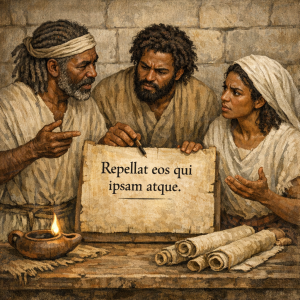
Primary Definition
The supplied five-word expression is not an established English legal term, a recognized maxim of common law, a complete Latin sentence, or a documented term of art in Roman law, canon law, biblical translation, military usage, or government. It is best classified as an incomplete or mechanically assembled Latin-like string.
Several of its individual words are genuine Latin forms, but their combination does not yield a stable, grammatical, or contextually complete proposition. The expression begins with a form of repellere, “to drive back,” “ward off,” “reject,” or “repel.” It then includes a masculine plural accusative pronoun, a relative pronoun normally introducing a clause, a feminine singular emphatic pronoun, and a conjunction meaning “and” or “and also.” The final conjunction leaves the reader expecting additional words, while the relative clause lacks the verb and structure needed to complete its thought.
Accordingly, no authoritative translation should be assigned to the expression as a whole. A word-for-word approximation may suggest something like “may he repel those who [do something to] herself, and …,” but that is not a translation of a coherent sentence. It is instead a demonstration of why Latin must be read through grammar, agreement, and context rather than by replacing each word with an English equivalent.
For dictionary purposes, the principal meaning of the entry is therefore descriptive: an apparently pseudo-Latin or placeholder-style phrase containing authentic Latin vocabulary but no ascertainable complete meaning. This conclusion is linguistic, not theological or legal. It does not imply that Latin itself is vague or mystical; rather, it recognizes that a language’s individual words do not automatically create a meaningful statement when arranged without complete syntax.
Component Parts
- repellat: a third-person singular form of repellere, “to repel,” “drive back,” “keep away,” or “reject.” Depending on context, it may be read as present subjunctive (“may he/she/it repel”) or future indicative (“he/she/it will repel”).
- eos: “those” or “them,” masculine plural accusative.
- qui: “who,” “which,” or “those who,” normally masculine plural nominative in this setting.
- ipsam: “herself,” “the very woman,” or “that very [feminine noun],” feminine singular accusative.
- atque: “and,” “and also,” or “and moreover.”
The grammatical difficulty is substantial. The relative pronoun is plural and ordinarily calls for a plural verb within its own clause. The emphatic pronoun is feminine singular accusative and would ordinarily serve as the object of a verb. No such verb appears. In addition, the final conjunction is unfinished. These features make it improper to present the expression as a Latin maxim, command, prayer, legal rule, or quotation.
Etymology and Origin
The only component with a particularly clear semantic center is the opening verb form, derived from repellere. Classical Latin dictionaries identify repellere as a compound verb formed from re-, carrying a sense of backward movement or return, and pellere, “to drive” or “push.” Its basic physical sense is to drive something back. From that literal meaning came related figurative senses: resisting an attack, preventing danger, rejecting a request, refuting an accusation, or excluding a person from access.
The history of the verb helps explain why a reader may instinctively associate the opening word with defense, rejection, or legal resistance. Yet the meaning of one word cannot repair the unfinished grammar of the larger expression. An etymology identifies the historical development of a word; it does not establish the meaning of a phrase that lacks a coherent construction.
The other elements are common Latin grammatical words. Eos belongs to the demonstrative-pronoun system associated with is, ea, id, meaning “that,” “he,” “she,” or “it,” according to form and context. Qui is a form of the relative pronoun qui, quae, quod. Ipse, ipsa, ipsum is an intensive pronoun, used to emphasize identity: “self,” “very,” or “the person in question.” Atque is a coordinating conjunction, often functioning much like et, “and,” though it can convey a closer or more emphatic connection.
No reliable evidence identifies the entire supplied expression as a surviving quotation from a classical author, a medieval legal formulary, a Roman inscription, the Vulgate, a Torah text, or a historical common-law source. The more responsible conclusion is limited: the phrase contains recognizable Latin forms, but its whole-text origin is unverified and its syntactical condition suggests generated or placeholder material rather than transmitted prose.
Cultural and Historical Context
Latin has long carried cultural authority in law, education, liturgy, medicine, science, diplomacy, and public ceremony. That authority has also made Latin—or material designed to look Latin—especially attractive for mottos, seals, decorative inscriptions, fictional documents, and placeholder text. A phrase may therefore appear serious or ancient merely because it uses Latin vocabulary. Appearance, however, is not proof of historical authenticity.
In classical Roman writing, a verb such as repellere could be used in military, political, social, and rhetorical settings. A city might repel an enemy; a person might repel an assault; an office-seeker might suffer rejection; an advocate might repel or refute an accusation. Such uses reflect the breadth of the genuine verb. They do not establish a fixed doctrine attached to the supplied expression.
The expression also resembles the kind of text commonly produced by automated filler-text systems. Modern publishing and web design often use pseudo-Latin placeholder copy because its letter patterns and word lengths visually resemble continuous prose without inviting readers to focus on the message. The best-known example, Lorem ipsum, is a corrupted and rearranged descendant of material associated with Cicero’s De finibus bonorum et malorum, rather than a coherent passage in the form usually displayed by designers.
That historical background supports an interpretive caution. It is reasonable to say that the supplied wording has the appearance of generated pseudo-Latin. It would be unreasonable, absent a traceable source, to declare that it is part of the traditional Lorem ipsum text, that it comes from Cicero, or that it has a secret historical meaning. The distinction matters because fabricated authority is often created by attaching a prestigious ancient origin to words that have not been verified.
Biblical / Torah Context
No direct biblical or Torah context has been established for the supplied expression. It is not a Hebrew phrase, is not an identified Greek New Testament phrase, and should not be treated as a quotation from the Latin Vulgate merely because its vocabulary is Latin.
The Torah was principally transmitted in Hebrew, with some related biblical material in Aramaic. The Hebrew Bible, Jewish interpretation, and later translations employ their own linguistic, textual, and theological frameworks. Latin translations of biblical material belong to a later history of translation and reception; they do not convert every Latin-looking expression into a biblical statement.
Likewise, Christian readers should distinguish a Vulgate citation from an isolated collection of Latin words. A genuine scriptural quotation can ordinarily be located by book, chapter, verse, manuscript tradition, or recognized edition. No such identifying context accompanies this expression. It therefore has no demonstrated biblical authority and should not be used to support a doctrinal claim, a spiritual command, or an interpretation of Torah or Scripture.
Legal Implications
The expression has no demonstrated legal force. It is not a common-law maxim, a rule of equity, a statutory phrase, a binding judicial holding, or a recognized formula of modern American law. It should not be cited in a pleading, affidavit, contract, administrative filing, courtroom argument, or private legal notice as though it creates rights, duties, jurisdiction, immunity, or a defense.
Historically, Latin influenced legal vocabulary in several distinct ways. Roman law developed in Latin; medieval European legal education preserved and adapted Latin terminology; ecclesiastical and civil institutions used Latin records; English lawyers retained many Latin maxims; and common-law courts inherited a legal culture that used Latin and Law French in formal records. These histories overlap, but they are not identical. Roman law is not common law, equity is not common law, statutes are not common law, and a Latin phrase is not law merely because it sounds formal.
In historical common law, legal effect arose from accepted custom, judicial decision, procedural practice, royal or parliamentary enactment, and later constitutional or statutory authority. In current United States law, legal effect ordinarily depends on enacted law, valid regulations, controlling judicial precedent, contractual assent, or recognized legal doctrine. A disconnected phrase has none of those attributes.
The genuine Latin verb behind the first word does have broad legal-adjacent significance. To “repel” can describe resisting force, excluding a trespasser, rejecting a claim, or refuting an allegation. But the legal consequences of resisting force depend on jurisdiction, facts, proportionality, statutory rules, and case law. Those consequences cannot be derived from the Latin verb itself. A translation is not a legal analysis, and a pseudo-Latin expression cannot substitute for competent legal authority.
Claims that ancient Latin wording can independently nullify contracts, defeat court jurisdiction, create sovereign status, or override statutes are contested at best and generally unsupported in ordinary legal practice. Courts decide legal issues by applicable authority and evidence, not by the ceremonial use of untranslated language. The dictionary’s interpretive conclusion is therefore straightforward: the phrase has no known legal status, and users should not attribute legal consequences to it without a verifiable source and jurisdiction-specific authority.
Spiritual Meaning
No inherent spiritual meaning can be established for the expression as a whole. Individual readers may associate the concept of repelling with resisting evil, refusing falsehood, guarding one’s household, or rejecting harmful conduct. Those are interpretive associations with the English idea of resistance, not meanings demonstrably encoded in the supplied wording.
In religious and spiritual study, context is essential. A meaningful prayer, blessing, liturgical formula, or sacred saying has an identifiable textual setting, a stable linguistic form, and an interpretive tradition. A fragmentary pseudo-Latin string does not acquire sacred authority through age-like appearance, unfamiliarity, or the use of an ancient language.
Where a person wishes to express a spiritual principle of protection, discernment, repentance, or resistance to wrongdoing, it is better to use a verified text from the relevant religious tradition or to state the principle plainly in one’s own language. This avoids attributing divine, biblical, Torah-based, or liturgical authority to language that cannot be responsibly translated as a complete statement.
Modern Usage
In modern settings, wording of this kind is most likely to appear as temporary website copy, content-management-system test data, auto-generated sample prose, design mock-up text, database seed content, or machine-generated text. Such strings may be built from Latin vocabulary without regard to classical grammar. Their intended function is visual or technical: to fill a space, test formatting, or simulate content before final copy is written.
This usage creates a practical editorial lesson. Placeholder material should be removed before publication, particularly from legal, educational, religious, medical, or governmental pages. A reader may mistake pseudo-Latin for a quotation, a corporate motto, a legal notice, or a doctrinal statement. Clear labeling as sample text prevents that misunderstanding.
When the expression is encountered in a document, the appropriate questions are practical: Who created the document? Is the wording part of a template? Is there an original source file? Does the surrounding text show other filler content? Was the phrase copied from an automated generator? These questions are more useful than attempting to derive a definitive ancient meaning from an incomplete string.
Controversies / Criticisms
The principal controversy surrounding Latin-like expressions of this kind is overinterpretation. A person may be tempted to assign a confident translation because each word resembles a dictionary entry. That method is unreliable. Latin depends on inflection, agreement, omitted but inferable elements, syntax, idiom, genre, and context. Without those features, literal word substitution can produce an English sentence that appears meaningful while concealing the fact that the Latin is unfinished.
A related criticism concerns appeals to antiquity. Ancient languages can be used responsibly in scholarship, law, faith, and education. They can also be used rhetorically to create an impression of authority where no authority exists. The presence of Latin does not prove that a statement is Roman, biblical, common-law, ecclesiastical, governmental, or legally operative.
There is also a narrower grammatical criticism. The supplied wording combines forms whose gender, number, and clause structure do not resolve into a complete thought. Any proposed translation that ignores the missing relative-clause verb and the trailing conjunction should be presented, if at all, as speculation rather than as a settled rendering.
Conclusion
The supplied expression should be understood as an incomplete Latin-like phrase rather than a definable legal, historical, biblical, or spiritual term. Its first word derives from a genuine Latin verb associated with driving back, resisting, rejecting, or repelling. The remaining words are also recognizable Latin forms. Yet their arrangement does not form a complete, reliable sentence, and no verified source establishes the expression as a maxim, quotation, rule, or sacred formula.
The sound interpretive standard is therefore restraint: preserve the genuine meanings of the individual Latin components, acknowledge the phrase’s likely placeholder or generated character, and decline to invent an authority, origin, translation, or legal consequence that the evidence does not support.
Sources / Further Reading
- Lewis and Short, A Latin Dictionary, entry for repello: https://atlas.perseus.tufts.edu/dictionaries/entry/urn%3Acite2%3Ascaife-viewer%3Adictionary-entries.atlas_v1%3Alat.ls.perseus-eng2-n41157/
- Scaife ATLAS / Perseus, elementary Latin dictionary entry for repello: https://atlas.perseus.tufts.edu/dictionaries/entry/urn%3Acite2%3Ascaife-viewer%3Adictionaries.v1%3Aelementary-latin-n14009/
- Berlin-Brandenburg Academy of Sciences and Humanities, Corpus Linguarum Latinarum, entry for ipse: https://cld.bbaw.de/lemma/lat/ipse
- Allen and Greenough, New Latin Grammar for Schools and Colleges, syntax of the verb: https://www.perseus.tufts.edu/hopper/text?doc=Perseus%3Atext%3A1999.04.0001%3Apart%3D2%3Asection%3D10
- Wikisource, Latin text of Cicero’s De finibus bonorum et malorum, Book I: https://la.wikisource.org/wiki/De_finibus_bonorum_et_malorum_-_Liber_Primus
- Project Gutenberg, works by Marcus Tullius Cicero: https://www.gutenberg.org/ebooks/author/128