Primary Definition
Yahshua Hamashiach is a modern Sacred-Name-style English rendering used by some believers for the figure more commonly called Jesus Christ. In the Ancient Israelite and Biblical Hebrew setting, the expression is intended to identify him as the one whose name is understood to proclaim that Yah saves, and as ha-mashiach, “the Anointed One” or “the Messiah.” The preferred sense of the full expression in this dictionary’s heritage context is therefore: “Yah’s salvation, the Anointed One.”
The phrase contains both a personal name and a title. Yahshua is a contemporary English spelling favored in some Sacred Name, Hebrew-roots, and Israelite-heritage communities. Hamashiach represents the Hebrew הַמָּשִׁיחַ (ha-mashiaḥ): ha- means “the,” while mashiaḥ means “anointed one.” Thus, Hamashiach is not a surname in the modern legal sense. It is a title expressing an office, calling, or claimed identity.
Dictionary precision requires an important distinction. The spellings directly attested in the Hebrew Scriptures are principally Yehoshua (יְהוֹשֻׁעַ) and the later shortened form Yeshua (יֵשׁוּעַ). Yahshua is not the standard academic transliteration of either form, nor is it the spelling found in the consonantal Hebrew text of the Torah or in the surviving Greek manuscripts of the Apostolic Writings. It is best described as a modern devotional or restorative rendering intended to foreground the element Yah. That intention may be spiritually meaningful to those who use it, but it should not be confused with direct manuscript proof that this exact English spelling was the historical everyday pronunciation.
Etymology and Origin
The Name Element
The ancient Hebrew name associated with this expression is Yehoshua. It combines a shortened theophoric element relating to the Creator’s covenant Name—written in the Hebrew Scriptures with the four consonants יהוה (YHWH)—with a form from the Hebrew root ישע (y-sh-ʿ), concerning saving, deliverance, rescue, or victory. In this site’s Ancient Israelite heritage language, Yah or Yahuah may be used for the Creator. The broad meaning conventionally given for Yehoshua is “Yah saves,” “Yahuah saves,” or “Yahuah is salvation.”
The Torah supplies a significant early occurrence. In Numbers 13:16, Hoshea son of Nun is called Yehoshua after Moses changes his name. The text does not give a detailed explanation of the name change, but the resulting name places deliverance under the authority and action of the Creator. Yehoshua, Moses’ successor, later becomes the Israelite leader associated with entering the land after the wilderness generation.
After the exile, a shorter form, Yeshua, is found in Biblical Hebrew and Aramaic-era texts, including Ezra and Nehemiah. The linguistic development from Yehoshua to Yeshua is widely recognized in Hebrew studies. In the Greek Septuagint, both Yehoshua/Joshua and later Yeshua forms were generally represented by Iēsous (Ἰησοῦς). From Greek, the name passed into Latin as Iesus, and then into English as Jesus.
Because ancient languages were written and transmitted through differing alphabets, a change in spelling does not necessarily indicate a change in the person meant. Greek lacked a direct equivalent for several Hebrew sounds, including the final ayin in Yehoshua/Yeshua. English “Jesus” is therefore the end product of Greek and Latin transmission, while “Yahshua” is a modern attempt to recover a Semitic-looking form. Neither point by itself establishes a person’s faithfulness, authority, or standing before the Creator.
The Title Element
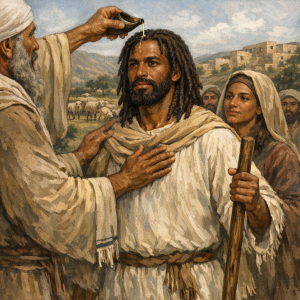
Mashiach derives from the Hebrew verb mashach, “to anoint.” In the ancient Israelite world, anointing with oil could mark a person or object as set apart for sacred service. The noun mashiach literally means “anointed one.” With the definite article, ha-mashiach means “the Anointed One” or “the Messiah.”
The English word Christ is not a personal last name. It comes from Greek Christos, the Greek translation of Hebrew mashiach. Accordingly, “Jesus Christ,” “Yeshua the Messiah,” and “Yahshua Hamashiach” are functionally parallel confessional expressions, although their historical languages, pronunciations, and theological associations differ.
Cultural and Historical Context
The earliest setting for the name is the world of ancient Israel: a Northwest Semitic-speaking people whose covenant texts, tribal memory, priesthood, kingship, and prophetic tradition were preserved in Hebrew Scripture. The name Yehoshua belonged first to multiple persons, not solely to the later teacher from Galilee. Most notably, Yehoshua son of Nun was Moses’ successor. Other biblical figures bore related forms, including Yehoshua/Jeshua the high priest in the post-exilic period.
In this setting, personal names often carried testimony, petition, or praise concerning the Creator. A name containing Yah did not make the bearer divine; it identified the Creator as the source, protector, judge, or deliverer invoked by the name. The name Yehoshua should therefore be read first as a Hebrew Israelite name within the Scriptural world, not as a later denominational formula.
During the Second Temple era, the land of Judea and Galilee stood amid powerful cultural currents: Hebrew scriptural tradition, Aramaic daily speech in many settings, Greek language and administration, local dynastic government, and Roman imperial control. The Greek-language Apostolic Writings call the central figure Iēsous and use Christos for Messiah. Those writings preserve claims about his teaching, execution, resurrection, and messianic status, but they do not provide an audio record or unambiguous phonetic transcript establishing the exact form of his name in daily Aramaic or Hebrew speech.
Later rabbinic Jewish traditions, Christian churches, Catholic usage, Eastern Christian traditions, Islamic references to Isa, and modern Sacred Name movements developed their own ways of referring to him. These later usages are historically important, but they must not be projected backward as though they constituted the original Ancient Israelite setting of the Torah.
Biblical / Torah Context
The Torah’s foundational use of mashiach does not initially refer to a future redeemer figure. It commonly concerns persons already consecrated for service. Leviticus 4:3, for example, speaks of “the anointed priest.” Priests were anointed for sacred responsibility, and later Scripture also speaks of kings as anointed. Saul is called the anointed of Yah in 1 Samuel 24:6, and David is likewise identified with the royal anointing tradition.
This background matters because “Messiah” originally denotes consecration and appointment, not automatically deity, a second person of a later theological formula, or a political program. The precise content of messianic expectation developed across centuries and varies among biblical passages and later interpretive communities. Some prophetic texts speak of an ideal Davidic ruler, restoration, justice, renewed covenant faithfulness, priestly cleansing, or the gathering of scattered Israel. Readers disagree about how, or whether, these texts apply to Yahshua.
In the Apostolic Writings, followers of Yahshua identify him as the Messiah. Matthew 1:21 makes an explicit wordplay between the name and salvation: the child is to be named Jesus because he will save his people from their sins. Luke, John, Acts, and the apostolic letters likewise employ messianic titles and present him as Master, teacher, servant, king, and redeemer in different contexts.
Master is often a more transparent English rendering than “Lord” when translating terms of address or authority. In ordinary English, lord historically means master, ruler, or one having authority. In Scripture, however, English “Lord” may translate different underlying terms: Hebrew Adon, Adonai, or the divine Name YHWH; Greek kyrios; and titles applied to human masters, rulers, or the Creator. Context must determine the intended sense. A reader should not assume that every occurrence of “Lord” carries precisely the same theological meaning.
Legal Implications
The expression Yahshua Hamashiach has no independent legal force in historical common law or in current civil law merely because it is spoken, written, invoked, or placed on a document. It does not create a separate legal jurisdiction, cancel statutes, defeat a court’s authority, alter citizenship, establish ownership, or exempt a person from otherwise applicable law. Religious conviction may be protected in many jurisdictions, but a religious title is not itself a legal defense.
In the Torah, anointing was associated with recognized religious and governmental offices. Priests, kings, and in some passages prophetic figures could be set apart by anointing. This is a matter of ancient covenantal and national order, not English common law. Biblical law, Roman law, later ecclesiastical law, equity, common law, and modern statutory law are distinct legal systems; they should not be blended without careful historical and jurisdictional analysis.
The execution of Yahshua, as presented in the Gospel narratives, occurred under Roman imperial power in a province governed through Roman structures. The narratives describe accusations carrying religious and political implications, including kingship. They are theological and literary sources, however; they are not surviving Roman court transcripts. Claims that one can reconstruct every procedural step of the case under Roman law, or use the reported trial as a modern legal precedent, go beyond the available evidence.
Modern believers may adopt “Yahshua Hamashiach” in worship, ministry, publishing, or personal expression. Civil law may recognize a chosen name if legal name-change requirements are met, but religious usage alone does not automatically change a person’s legal name. Questions involving contracts, identity documents, taxes, criminal charges, child custody, or court procedure require competent advice under the law of the applicable jurisdiction.
Spiritual Meaning
For those who use the expression devotionally, Yahshua Hamashiach joins salvation with consecrated mission. The name directs attention to deliverance as the work of Yah; the title declares that the bearer is understood to be appointed, anointed, and sent. Many believers understand the phrase to affirm that Yahshua is the promised Messiah of Israel, the righteous servant, sacrificial deliverer, risen Master, and future king.
Within this interpretation, the title is not a magical formula. Spiritual integrity is not secured by pronouncing one preferred form of a name while disregarding justice, mercy, repentance, truthfulness, and obedience to the Creator. Scripture repeatedly treats the Name of the Creator as holy and warns against empty, manipulative, or dishonest invocation. A Sacred Name should therefore be approached with reverence rather than used as a verbal device for superiority over others.
Other readers accept Yahshua as an important teacher, prophet, or historical figure but reject the claim that he is ha-mashiach in the fullest redemptive sense. The dictionary records that disagreement as a live theological division, not as a question settled merely by transliteration.
Modern Usage
“Yahshua Hamashiach” is used today especially among Sacred Name congregations, Hebrew-roots fellowships, Messianic believers, some Israelite-heritage communities, independent Torah-observant groups, and individual Christians seeking terminology they consider closer to Hebrew. Usage is not uniform. Variants include Yeshua HaMashiach, Yahushua HaMashiach, Yehoshua HaMashiach, and the conventional English “Jesus Christ.”
Academic writing generally prefers a standardized transliteration appropriate to the source language: Yehoshua for the older Hebrew form, Yeshua for the shorter later form, Iēsous for Greek, and “Jesus” in ordinary English prose. Devotional communities may make a different choice for reasons of reverence, identity, restoration, or conviction. Clear writing benefits from acknowledging which convention is being used and why.
Controversies / Criticisms
The principal linguistic controversy concerns the form Yahshua. Supporters often maintain that it preserves the Creator’s Name more visibly than “Jesus” and better expresses “Yah saves.” Critics respond that the exact spelling is not directly attested in the biblical Hebrew manuscripts and that it does not follow standard historical Hebrew vocalization for either Yehoshua or Yeshua. The cautious conclusion is that the theological intention behind the spelling is understandable, while the claim that it is the uniquely proven original pronunciation remains disputed.
A second controversy concerns exclusivity. Some advocates contend that only one pronunciation or spelling is acceptable in prayer or salvation. That proposition is a confessional claim, not a conclusion demonstrated by the surviving manuscripts. The Scriptural texts passed through Hebrew, Aramaic, Greek, Latin, Syriac, Arabic, and countless vernacular languages; the historical transmission itself shows that communities have named the same figure through different linguistic forms.
A third controversy concerns identity and ancestry. Ancient Israelite heritage should not be erased, replaced, or treated as incidental. At the same time, broad claims that every modern group possesses exclusive biological, legal, or covenantal entitlement by invoking the name Yahshua require independent historical, genealogical, and legal evidence. A sacred title cannot by itself prove descent, land title, national status, or immunity from civil authority.
Conclusion
Yahshua Hamashiach is a reverent modern expression centered on an ancient Hebrew Israelite name tradition and the biblical title “the Anointed One.” Its strongest documented linguistic background lies in Yehoshua and Yeshua, names meaning in substance that Yah saves, and in ha-mashiach, the Hebrew designation for the anointed one. The phrase carries profound spiritual significance for believers who confess Yahshua as the Messiah, while its exact preferred pronunciation and theological implications remain matters of debate among religious communities.
A sound use of the term distinguishes Scripture from later tradition, language study from devotional preference, and religious confession from civil-law claims. It also keeps the Ancient Israelite setting in view: salvation belongs to Yah, anointing signifies consecrated appointment, and the title Messiah must be understood before it is turned into a slogan.
Sources / Further Reading
- Society of Biblical Literature, Bible Odyssey, “Lord” — https://www.bibleodyssey.org/dictionary/lord/
- Sefaria, Numbers 13 — https://www.sefaria.org/Numbers.13?lang=bi
- Sefaria, Zechariah 3 — https://www.sefaria.org/Zechariah.3?lang=bi
- Encyclopedia.com, “Jesus (The Name)” — https://www.encyclopedia.com/religion/encyclopedias-almanacs-transcripts-and-maps/jesus-name
- Encyclopedia.com, “Joshua, Son of Nun” — https://www.encyclopedia.com/religion/encyclopedias-almanacs-transcripts-and-maps/joshua-son-nun
- Metropolitan Museum of Art, The World between Empires: Art and Identity in the Ancient Middle East — https://resources.metmuseum.org/resources/metpublications/pdf/The_World_between_Empires_Art_and_Identity_in_the_Ancient_Middle_East.pdf