Y
Primary Definition
Y is the twenty-fifth letter of the modern English alphabet and the penultimate letter in its ordinary sequence. Its uppercase form is Y; its lowercase form is y. In digital character standards, the uppercase character is designated LATIN CAPITAL LETTER Y at Unicode code point U+0059, while the lowercase character is U+0079.
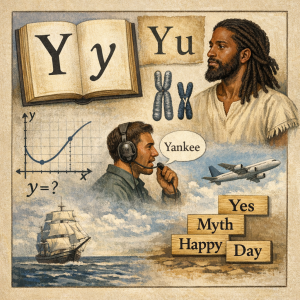
In English orthography, the letter has more than one ordinary sound-value. At the beginning of a syllable it commonly represents the consonantal glide /j/, as in yes, yoke, and beyond. In other positions it often represents a vowel sound, as in myth, happy, my, and day. Thus, the familiar classroom statement that it is “sometimes a vowel” is useful as a practical spelling rule, although strictly speaking vowel and consonant may describe either letters or the speech sounds represented by letters.
The letter also functions as a symbol rather than merely a spelling character. In mathematics and science, lowercase y often denotes an unknown, a dependent variable, or a vertical coordinate. In genetics, an uppercase form identifies the Y chromosome. In aviation, maritime communication, and military phonetic alphabets, it is represented by the code word Yankee. These are conventional uses adopted within particular disciplines; they do not alter the basic meaning of the character as a letter.
Etymology and Origin
The modern Roman-letter form descends from Greek upsilon, written Υ in uppercase and υ in lowercase. The Greek letter itself developed through the earlier alphabetic traditions from which Greek writing emerged. The Latin alphabet did not originally require this character for ordinary native Latin spelling. Latin later adopted the Greek-shaped letter, principally to reproduce Greek words and names more closely. It was therefore historically associated with learned, borrowed, and Hellenic vocabulary.
This history explains why the letter has long been called a “Greek I” in several European languages. French i grec, Italian i greca, and related expressions preserve the memory that the character entered the Latin alphabet through Greek learning. The English name, commonly spelled why or historically wye, has a less certain etymology than the visual form of the character itself. Etymological authorities identify the English letter-name as of obscure origin, while recognizing the graphic descent from upsilon.
The adoption of the character into Latin did not mean that Latin speakers always reproduced the Greek sound exactly. Ancient Greek upsilon had phonetic values that did not align neatly with native Latin pronunciation. Consequently, the letter’s visual lineage and its sound history must be kept distinct. A letter may be borrowed for spelling, prestige, transliteration, or etymological signaling even where its original phonetic value changes.
English inherited the Roman alphabet through Latin literacy and the subsequent development of Old and Middle English writing. Over centuries, the letter acquired a wide range of English spellings and pronunciations. It can signal a consonantal sound in young; a short vowel quality in symbol; a long vowel quality in cycle; or participate in vowel combinations such as ay, ey, and oy. Its history therefore illustrates a central truth of English spelling: letters are not fixed sounds, but written signs whose values depend on language, period, position, and word history.
Cultural and Historical Context
The letter has cultural importance beyond its place near the end of the alphabet. Its forked shape has made it a ready visual symbol for division, branching, choice, and convergence. A road or river splitting into two courses may be described as “Y-shaped,” and a junction of that form may be called a Y-intersection. This figurative use is documented in English from the early modern period.
Its alphabetic position has also encouraged its use as an emblem of what is late, final, unusual, or nearly unknown. Phrases involving the “X, Y, and Z” end of the alphabet often imply variables, uncertainty, or an abstract series. In algebra, the conventional pairing of x and y became especially influential: one is often assigned an input or horizontal coordinate, while the other is assigned an output or vertical coordinate. That convention is useful and widespread, but it is not a law of mathematics. Any valid symbol may be used if its meaning is clearly defined.
The “Ye Olde” Misreading
A recurring historical misunderstanding concerns the pseudo-archaic phrase Ye Olde. In many old English texts, what modern readers identify as a letter Y was actually a typographical substitute or visual approximation for the obsolete letter thorn (þ), a character representing a th sound. Thus, an old form resembling ye in this setting was frequently intended to be read as the, not as the pronoun ye pronounced “yee.”
This point requires care. English genuinely did have the pronoun ye, meaning “you” in certain plural or formal historical uses. But the decorative commercial phrase “Ye Olde Shoppe” commonly invokes the thorn-derived reading of the old. The modern habit of pronouncing every such example as “yee” is therefore historically unreliable. Archival and paleographical guidance warns readers not to confuse thorn with the Roman letter.
Biblical / Torah Context
The Latin letter under discussion does not occur as such in the Hebrew text of the Torah. The Torah is written in Hebrew characters, not in the Roman alphabet. Accordingly, claims that the Roman character itself carries a direct Torah-defined meaning should not be presented as a textual fact.
There is, however, a legitimate transliteration connection. Hebrew yod (י) is commonly represented by y in scholarly Romanization when it has a consonantal sound comparable to English y in yes. The divine name conventionally transliterated as YHWH begins with yod. Scholarly sources describe YHWH as the four-letter personal name of the God of Israel in the Hebrew Bible, often called the Tetragrammaton.
It is essential not to collapse those distinct systems. The initial Roman Y in YHWH is a transliteration device: it represents the Hebrew letter yod. It does not establish that the English letter is itself a Hebrew sacred character, nor does it prove that the graphic shape of the Roman character bears a scriptural message.
Jewish reading traditions surrounding the Tetragrammaton are significant. In many religious settings, the name is not pronounced as written; substitute readings such as Adonai or expressions such as “the Name” are used instead. Those practices concern the Hebrew divine name and its reverent treatment, rather than an independent sacred definition of the Roman letter.
Legal Implications
No general common-law definition: Neither English common law nor American common law gives the letter, standing alone, a universal legal meaning. A single alphabetic character does not inherently create a legal status, political capacity, jurisdiction, contract, obligation, exemption, or claim of right. Its legal meaning, if any, comes from the instrument, statute, rule, form, pleading, map, technical standard, or evidentiary record in which it appears.
At historical common law, written symbols were interpreted in context. Courts could consider the language of an instrument, customary usage, the parties’ apparent intent, and the surrounding facts. Equity likewise could examine substance, conduct, notice, and fairness in appropriate cases. Neither body of doctrine transformed an alphabetic character into a self-executing legal rule. Roman law has its own historical categories and should not be casually equated with common law; neither system supplies a general legal doctrine assigning independent legal force to this particular letter.
In modern legal drafting, letters are frequently used as labels: “Party A,” “Exhibit B,” “Schedule C,” or variables within a statutory formula. A letter can also identify a subsection, a parcel, a classification, an appendix, a witness, or a defined term. Such use is functional. The letter means what the controlling document says it means. If a contract defines “Company Y,” for example, the legal consequences arise from the definition, agreement, and applicable law—not from the character itself.
Current statutory and regulatory systems may use similar letters differently. A tax form, zoning code, administrative regulation, military form, securities filing, or judicial record can each assign its own meaning. The responsible method is to locate the exact authority, read its definitions section, determine the applicable jurisdiction and date, and distinguish binding text from informal shorthand. An isolated letter copied from a form or quoted without its governing document should not be treated as legal proof.
Scientific Evidence and Legal Proceedings
The letter can become legally relevant through the phrase Y chromosome. In biology, that phrase identifies a sex chromosome, not a legal category. Genetic evidence involving Y-chromosome markers may arise in forensic investigation or kinship analysis, but its admissibility and weight depend on the governing evidence rules, laboratory methods, statistical interpretation, chain of custody, expert testimony, and the facts of the particular case.
Moreover, an XY chromosome pattern is not a complete legal or social definition of a person. Biological sex traits, chromosomes, reproductive anatomy, gender identity, medical diagnosis, and the legal classifications adopted by particular statutes are related subjects but are not interchangeable. Courts and legislatures may address these matters differently according to the governing constitutional, statutory, and factual context.
Spiritual Meaning
The documented linguistic meaning of the character is alphabetic and conventional. It has no universally accepted spiritual meaning simply by virtue of being the twenty-fifth letter of English. Interpretations based on its forked shape—such as a path dividing, a choice between ways, a branch joining a trunk, or humanity raising its arms—may serve as personal symbols, teaching illustrations, or artistic metaphors. They should be identified as interpretive symbolism rather than established linguistic, biblical, or legal fact.
Similarly, some spiritual or esoteric writings attach meanings to yod, to the initials of divine names, or to the shapes of ancient letters. Such traditions may be meaningful within the communities that hold them, but they should not be confused with the history of the Roman letter or with a command found in the Torah. The careful reader distinguishes devotional interpretation from philology, and both from law.
Modern Usage
Modern use is extensive and context-sensitive. Common examples include:
- Alphabet and spelling: the ordinary English letter in words such as year, yellow, mystery, and joy.
- Mathematics: a variable or coordinate, especially on a Cartesian graph.
- Genetics: the Y chromosome and Y-linked genetic terminology.
- Communication: Yankee in the International Radiotelephony Spelling Alphabet and related military usage.
- Typography and computing: the standard Latin uppercase and lowercase characters encoded in ASCII-compatible Unicode text.
- Shapes and design: a Y-shaped branch, connector, road junction, pipe fitting, or structural configuration.
The surrounding field determines the intended meaning. A mathematical y, a chromosome label, and a phonetic-alphabet code word are not competing definitions; they are specialized applications of the same alphabetic sign.
Controversies / Criticisms
The principal controversies are usually not about the letter itself, but about overstatement. First, the statement that it is “a vowel” or “a consonant” can become misleading when stated without context. The character may represent either vowel-like or consonant-like sounds in English. The sound, not the printed shape alone, determines the phonetic classification in a particular word.
Second, the “Ye Olde” story is often simplified into a claim that the ordinary Roman letter permanently replaced thorn in English. The historical reality is more limited and more complicated: manuscript forms, printing practices, type availability, abbreviations, and later antiquarian styling all contributed. The genuine pronoun ye must also be distinguished from thorn-derived forms intended to mean the.
Third, symbolic claims deserve evidentiary discipline. It is not historically sound to assert, without reliable textual support, that the character originated in a particular religion, government, military order, legal system, or occult tradition. Its documented alphabetic descent is from Greek upsilon through Latin-script development. Later religious, governmental, military, and commercial uses are contextual adaptations, not proof of an original hidden function.
Conclusion
Y is a Roman-alphabet letter of Greek derivation whose English life has become broader than its original learned association with Greek spelling. It serves as both consonant and vowel letter, a mathematical convention, a technical label, a genetic designation, and a communications code. Its shape and scarcity in ordinary English words have encouraged metaphorical and symbolic uses, but those uses must be separated from historical fact.
For common-law purposes, the controlling principle is context. The character carries no independent legal power. Where it appears in a legal record, the reader must identify the governing document, jurisdiction, definition, and applicable law. Where it appears in biblical or spiritual discussion, the reader should distinguish the Roman letter from Hebrew yod, transliteration from original text, and faith-based interpretation from documented linguistic history.
Sources / Further Reading
- Unicode Consortium, Basic Latin Character Names List: https://www.unicode.org/charts/nameslist/n_0000.html
- Etymonline, Y: https://www.etymonline.com/word/Y
- Cambridge Dictionary, Y, y: https://dictionary.cambridge.org/us/dictionary/english/y
- Merriam-Webster, Is Y a Vowel or Consonant?: https://www.merriam-webster.com/grammar/why-y-is-sometimes-a-vowel-usage
- Library of Congress, Transcription and Spelling: Paleography: https://guides.loc.gov/paleography/transcription-spelling
- University of Nottingham, Letter Forms and Abbreviations: https://www.nottingham.ac.uk/manuscriptsandspecialcollections/researchguidance/medievaldocuments/letterformsandabbreviations.aspx
- Oxford Research Encyclopedia of Religion, Names of God in the Hebrew Bible: https://academic.oup.com/edited-volume/62249/chapter-abstract/551353129
- National Center for Biotechnology Information, Y Chromosome, Medical Subject Headings: https://www.ncbi.nlm.nih.gov/sites/entrez?Cmd=DetailsSearch&Db=mesh&Term=%22Y+Chromosome%22%5BMeSH+Terms%5D
- International Civil Aviation Organization, Annex 10: Radiotelephony Spelling Alphabet: https://www.icao.int/Meetings/anconf12/Document%20Archive/AN10_V2_cons%5B1%5D.pdf
- U.S. Army Training and Doctrine Command, TRADOC Pamphlet 600-4: https://adminpubs.tradoc.army.mil/pamphlets/TP600-4.pdf