Ruach Ha’qodesh (Holy Spirit)
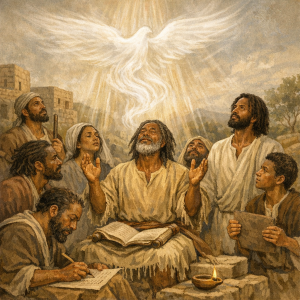
Primary Definition
Ruach Ha’qodesh is a transliteration of the Hebrew רוּחַ הַקֹּדֶשׁ, commonly rendered in English as “the Holy Spirit,” “the Holy Breath,” or, more interpretively, “the Spirit of holiness.” In its most direct Jewish scriptural and rabbinic sense, the term refers to God’s holy, life-giving, inspiring, revealing, or empowering presence and activity. It is associated especially with divine inspiration, prophecy, wisdom, moral renewal, and God’s communication with human beings.
The expression must be interpreted in its religious setting. In Jewish thought, Ruach Ha’qodesh ordinarily does not mean a second or third deity, nor necessarily a separate divine individual alongside God. It is commonly understood as the holy operation, presence, breath, power, or inspiration of the one God. Rabbinic sources use the term in connection with prophecy and inspired insight, while maintaining the fundamental Jewish confession of God’s unity.
In most Christian traditions, “the Holy Spirit” carries a more specific doctrinal meaning. The Holy Spirit is confessed as the third Person of the Trinity: fully divine, distinct in personal relation from the Father and the Son, yet one in divine being with them. Christians commonly use the Hebrew expression Ruach Ha’qodesh, particularly in Hebrew-speaking, Messianic, charismatic, or restorationist settings, but the use of a Hebrew term does not by itself settle the underlying theology. A Jewish, Messianic Jewish, Catholic, Orthodox, Protestant, Pentecostal, and non-Trinitarian reader may use the English phrase “Holy Spirit” while meaning importantly different things by it.
Accordingly, a careful dictionary definition distinguishes three related but non-identical uses: the biblical Hebrew language of God’s spirit; the rabbinic Jewish concept of divinely granted inspiration; and the later Christian doctrine of the Holy Spirit within Trinitarian theology.
Etymology and Origin
The phrase consists of two Hebrew words. Ruach (רוּחַ) has a broad range of meanings, including wind, breath, moving air, spirit, disposition, vitality, and invisible force. The word can describe an ordinary wind, a person’s inward disposition, the breath of life, or God’s active power. Its meaning depends on context. Ha is the Hebrew definite article, “the.” Qodesh (קֹדֶשׁ) means holiness, sacredness, or that which is set apart for God.
Thus, the literal form means “the spirit of holiness” or “the holy spirit.” English capitalization—“Holy Spirit”—often signals a theological interpretation rather than a feature inherent in Hebrew grammar. Hebrew manuscripts do not use capital letters to distinguish divine names from ordinary nouns.
Several English spellings appear in religious and academic writing: Ruach HaKodesh, Ruach ha-Kodesh, Ruah ha-Qodesh, and Ruach Ha’qodesh. The differences chiefly reflect competing transliteration conventions. The apostrophe in “Ha’qodesh” is sometimes used to mark a consonantal distinction or a preferred transliteration style; it does not create a separate word or doctrine. “Holy Ghost,” frequent in older English Christian Bibles and liturgies, is historically an English equivalent of “Holy Spirit,” not a reference to a departed human spirit.
The precise phrase appears in the Hebrew Bible in passages such as Psalm 51:11–13 and Isaiah 63:10–11, depending on verse numbering and translation. Closely related expressions are more common: Ruach Elohim (“Spirit/wind of God”), Ruach YHWH (“Spirit of the LORD”), and “my spirit.” Genesis 1:2, for example, refers to Ruach Elohim moving or hovering over the waters. Translators and interpreters have differed over whether that passage should be rendered “Spirit of God,” “wind from God,” or with another expression reflecting the range of ruach.
Cultural and Historical Context
In the ancient Israelite world, breath and wind provided powerful images for invisible life and power. Breath was visibly absent at death but necessary for life; wind could be gentle, renewing, destructive, and beyond human control. Biblical writers therefore used ruach language to speak of God’s creative action, the animation of living beings, the granting of skill, the empowerment of leaders, and prophetic utterance.
In the Tanakh, God’s spirit may “come upon” a person for a particular task. Judges, kings, artisans, and prophets are described as receiving divine empowerment. Bezalel, the artisan associated with the tabernacle, is said to be filled with God’s spirit in wisdom, understanding, knowledge, and craftsmanship (Exodus 31:1–5). The spirit is therefore not confined to ecstatic speech or prediction; it is also connected with wise workmanship, just governance, courage, and obedience.
After the biblical period, Jewish rabbinic literature developed Ruach Ha’qodesh into a prominent term for divine inspiration. It could describe prophetic inspiration, exceptional spiritual perception, or insight connected with holiness and Torah. Rabbinic usage is not entirely uniform. In some texts, the term functions almost as a reverent way of referring to God’s activity; in others, it describes a gift received by a person. The diversity should not be flattened into a single modern formula.
A well-known rabbinic tradition holds that after the last biblical prophets—often named as Haggai, Zechariah, and Malachi—the Holy Spirit ceased in Israel in a particular prophetic sense, although a bat qol, or heavenly voice, remained available in some accounts. This is a theological and literary claim within rabbinic Judaism, not a proposition that secular historical method can prove or disprove. Other Jewish mystical and devotional traditions continued to speak extensively about Ruach Ha’qodesh as spiritual inspiration or elevated awareness.
The early Christian movement emerged from this Jewish linguistic and scriptural environment. The Greek New Testament generally uses pneuma hagion, literally “holy spirit,” as the Greek counterpart to the Hebrew expression. Early Christians applied Spirit language to Jesus’ conception, baptism, ministry, resurrection faith, Pentecost, prophecy, gifts, holiness, and the formation of the church. Over the following centuries, Christian creeds and councils gave more precise conceptual expression to the doctrine that the Holy Spirit is fully divine and personally distinct within the Trinity.
Biblical / Torah Context
The Torah and the Tanakh
The phrase Ruach Ha’qodesh is not a central formula in the Five Books of Moses, but the underlying concept of God’s ruach is deeply present there. Genesis depicts God’s ruach in relation to the creation waters. God breathes life into the human being in Genesis 2:7, although that verse uses “breath of life” rather than the technical phrase Ruach Ha’qodesh. The connection is interpretive: both passages use breath imagery to describe life as dependent upon God.
Numbers describes elders receiving a share of the spirit associated with Moses, and it portrays Balaam as speaking under divine influence. Exodus connects God’s spirit with Bezalel’s wisdom and artistic ability. These texts establish important biblical themes: divine spirit may equip people for service; it may be distributed in differing ways; and it is not merely an inward feeling detached from practical duty.
The Psalms and Prophets bring the language closer to the later expression. Psalm 51 petitions God not to take away “your holy spirit.” Isaiah 63 remembers Israel’s rebellion and grief toward God’s holy spirit. Ezekiel uses divine spirit language in promises of restoration, including the promise that God will put “my spirit” within the people and move them toward faithful obedience (Ezekiel 36:26–27). Joel foretells an outpouring of God’s spirit upon a broad range of people—sons, daughters, old, young, male servants, and female servants (Joel 2:28–29 in many English editions; 3:1–2 in Hebrew numbering).
Jewish Interpretation
Within Jewish interpretation, these passages affirm God’s nearness and power without compromising divine unity. Ruach Ha’qodesh may be associated with prophecy, holiness, wisdom, and moral transformation, but it is not ordinarily framed as an independent divine person in the way classical Christian theology frames the Holy Spirit. Jewish commentators and philosophers have differed over the mechanisms of prophecy and inspiration. Some spoke more figuratively; others developed philosophical accounts involving human intellect, preparedness, and divine overflow or influence.
Christian Interpretation
Christians read many of these Tanakh passages in continuity with the New Testament. Acts 2, for example, presents the events of Pentecost as related to Joel’s promise of an outpoured spirit. Trinitarian Christians regard the Spirit active in creation and the prophets as the same Holy Spirit revealed in the life of Jesus and the church. This is a Christian theological reading of Israel’s Scriptures; Judaism does not generally accept the Christian conclusion that these texts reveal the Trinity.
Legal Implications
Ruach Ha’qodesh is not a technical term of English common law, American statutory law, Roman law, commercial law, military law, or governmental administration. It creates no civil office, legal status, private right, governmental immunity, property interest, or authority to disregard otherwise applicable law. Nor does a claim that one has received guidance from the Holy Spirit, standing alone, establish a legally enforceable command against another person.
It is important to distinguish a theological use of “Person” from a legal use of “person.” In Trinitarian Christian doctrine, the Holy Spirit is called a divine Person. In civil law, a legal person is an entity capable of holding rights and duties—for example, a natural human being or a corporation. The doctrinal claim is metaphysical and theological; it does not mean that the Holy Spirit is a corporation, party to a contract, litigant, or legal person under civil law.
Historically, English common law dealt with churches, ecclesiastical offices, trusts, charitable gifts, religious corporations, and disputes over church property. It did not purport to define the inner reality of the Holy Spirit as a matter of ordinary civil doctrine. In the United States, the First Amendment’s Religion Clauses generally bar government from establishing religious doctrine and protect free exercise subject to constitutional limits. Courts may decide certain disputes involving religious organizations by using neutral legal principles, such as deeds, corporate charters, contracts, and statutes, but they ordinarily may not decide which theological teaching about the Holy Spirit is true.
This limitation is illustrated by Serbian Eastern Orthodox Diocese v. Milivojevich (1976), in which the United States Supreme Court emphasized that civil courts may not resolve quintessentially religious controversies concerning faith, doctrine, or internal church government. The case does not make every action by a religious institution legally immune. Rather, it reflects the constitutional distinction between adjudicating secular legal questions and choosing among competing theological claims.
No distinctive military or governmental origin is documented for the term itself. Its origins are Hebrew religious and scriptural, not Roman military, governmental, or commercial. Assertions that the phrase is inherently a legal formula, a secret governmental designation, or a device for changing civil jurisdiction are unsupported by the ordinary sources of Hebrew language, biblical studies, and common-law jurisprudence.
Spiritual Meaning
Spiritually, Ruach Ha’qodesh names the conviction that holiness is not merely external ritual, inherited identity, or abstract belief. In Jewish religious life, the term may point toward divine inspiration that calls a person to humility, repentance, justice, wisdom, faithful study, prayer, and observance of God’s commandments. It is connected with the possibility that God’s will can illuminate human judgment without reducing human beings to passive instruments.
In Christian spirituality, the Holy Spirit is commonly associated with conversion, sanctification, prayer, gifts for service, discernment, comfort, conviction of sin, unity, and the formation of holy character. Christian traditions differ about charismatic gifts such as prophecy, healing, tongues, and miracles. Some teach that certain extraordinary gifts were primarily foundational to the apostolic age; others teach that they remain available to believers. Both positions exist within Christianity, and neither should be represented as the unanimous view of all Christians.
Across traditions, responsible spiritual interpretation generally includes caution. A claimed inspiration should be tested against the moral character of the tradition, Scripture as received by that community, sound judgment, accountability, and the consequences of the action proposed. Invoking divine guidance should not be used to silence questions, evade responsibility, manipulate others, or justify wrongdoing.
Modern Usage
Today, Ruach Ha’qodesh appears in Jewish prayer, Torah study, rabbinic and mystical writings, Hebrew-language Christian worship, Messianic Jewish communities, biblical teaching, music, and interfaith discussion. Many Jews employ the expression in continuity with rabbinic ideas of divine inspiration. Many Christians use it as a Hebrew designation for the Holy Spirit. In Messianic Jewish settings, it frequently serves as a bridge term intended to stress the Jewish setting of the New Testament and the continuity of biblical vocabulary.
Modern speakers should avoid assuming that Hebrew terminology automatically makes a belief or practice ancient, exclusively Jewish, or theologically identical to rabbinic Judaism. A Hebrew word may be used accurately by people who disagree sharply about doctrine. Context matters: the speaker’s community, scriptural interpretation, creed, and intended meaning are more informative than the transliteration alone.
Controversies / Criticisms
The principal controversy concerns theology. Rabbinic Judaism generally rejects the Christian doctrine that the Holy Spirit is a distinct divine Person within a triune Godhead. Classical Trinitarian Christianity affirms that doctrine as essential to its understanding of God. The disagreement is real and should not be obscured by treating shared biblical vocabulary as proof of theological agreement.
Another controversy concerns historical interpretation. Christians may understand passages about God’s spirit in the Tanakh as anticipations of the Holy Spirit’s later Trinitarian revelation. Jewish interpreters generally regard those same passages within the unipersonal monotheism of Israel’s Scriptures and later Jewish tradition. These are competing faith-based readings, not merely minor translation preferences.
The use of Hebrew terms in Christian or Messianic contexts can also be criticized when it becomes a claim of borrowed ethnic authority, when it inaccurately represents Jewish belief, or when it implies that contemporary Jews who reject Christian claims have abandoned their own Scriptures. Conversely, some believers use Hebrew terms respectfully to acknowledge the Jewish language and setting of the biblical texts. The appropriate evaluation depends on accuracy, honesty, and conduct toward living Jewish communities.
Finally, religious claims of direct spiritual leading can be abused. History contains examples of leaders invoking divine authority to seek money, sexual access, political obedience, or freedom from accountability. Such abuse does not by itself disprove sincere religious experience, but it makes discernment, transparency, and ethical safeguards essential.
Conclusion
Ruach Ha’qodesh is a Hebrew religious expression rooted in the biblical language of wind, breath, spirit, holiness, divine power, and inspiration. In Jewish tradition, it is chiefly associated with the one God’s holy presence and prophetic or moral inspiration. In Trinitarian Christianity, it is the Hebrew-language counterpart of “Holy Spirit,” understood as the third Person of the Trinity. These meanings overlap in vocabulary and biblical heritage but must not be treated as identical.
For legal purposes, the term has no independent common-law definition or civil force. Courts may protect religious exercise and adjudicate secular disputes involving religious bodies, but they do not properly decide the truth of competing doctrines concerning Ruach Ha’qodesh. A sound use of the term therefore requires both theological clarity and intellectual humility: respect for its Hebrew origins, care not to confuse spiritual language with legal authority, and honesty about the distinct traditions that employ it.
Sources / Further Reading
- Encyclopaedia Judaica, “Ru’aḥ ha-Kodesh,” via Encyclopedia.com: https://www.encyclopedia.com/religion/encyclopedias-almanacs-transcripts-and-maps/ruah-ha-kodesh
- Sefaria Library, Tanakh and rabbinic texts: https://www.sefaria.org/texts/Tanakh
- Sefaria Library, Sha’ar Ruach HaKodesh: https://www.sefaria.org/Sha%27ar_Ruach_HaKodesh.1
- United States Conference of Catholic Bishops, Catechism of the Catholic Church, discussion of the Holy Spirit: https://www.usccb.org/sites/default/files/flipbooks/catechism/182/
- Library of Congress, Constitution Annotated, First Amendment religion clauses: https://constitution.congress.gov/browse/essay/amdt1-3-1/ALDE_00013071/
- United States Supreme Court, Serbian Eastern Orthodox Diocese v. Milivojevich, 426 U.S. 696 (1976): https://supreme.justia.com/cases/federal/us/426/696/