Holy Spirit
Primary Definition
In its broad religious sense, the Holy Spirit is the holy, life-giving, revealing, and active presence or power of God. The precise meaning depends upon the religious tradition and the scriptural or theological setting in which the term is used.
In Jewish usage, Ruach ha-Kodesh commonly concerns God’s holy inspiration, prophetic influence, wisdom, or active presence. It is not ordinarily understood in normative Jewish theology as a separate divine person alongside God. In classical Christian doctrine, by contrast, the Holy Spirit is confessed as fully divine: the third Person of the Trinity, distinct from the Father and the Son while sharing the one divine being. Some Christian bodies which reject Trinitarian doctrine understand the Holy Spirit principally as God’s power, presence, or operative force rather than as a distinct divine Person.
The expression must therefore be interpreted with care. It is not a generic legal term, a civil office, a governmental department, a military rank, or an incorporated entity. It names a theological reality and, in many communities, a subject of prayer, worship, moral discernment, prophecy, sacramental life, and personal spiritual experience.
Etymology and Origin
Hebrew Background
The principal Hebrew word associated with “spirit” is ruach (רוּחַ). Its basic range includes wind, breath, moving air, life-breath, disposition, and spirit. This broad range is significant: ancient Hebrew speech connects invisible movement, breath, life, and divine activity without treating those meanings as mechanically identical. Context determines whether ruach means an ordinary wind, a human disposition, a created spirit, or God’s own empowering presence.
The phrase commonly rendered “Holy Spirit” is ruach ha-kodesh (רוּחַ הַקֹּדֶשׁ), literally “spirit of holiness” or “the holy spirit.” Closely related biblical expressions include “the Spirit of God,” “the Spirit of the LORD,” “Your holy spirit,” and “His holy spirit.” The exact English title Holy Spirit should not obscure this variety of Hebrew expressions. The Hebrew Bible often describes God’s Spirit without using the exact phrase “Holy Spirit.”
Greek and English Development
The principal Greek term is pneuma (πνεῦμα), which, like ruach, can mean breath, wind, or spirit. In the Greek Septuagint, the ancient translation of the Hebrew Scriptures, pneuma commonly translates ruach. The New Testament consequently uses Greek vocabulary already shaped by the language of Israel’s Scriptures.
The New Testament phrase pneuma hagion means “Holy Spirit” or “holy spirit.” Older English Bibles frequently used Holy Ghost. In earlier English, ghost could mean spirit generally; the change to “Holy Spirit” in most modern translations is chiefly a change in English usage, not a claim that the underlying Greek has changed.
Thus, the English term carries a layered history: Hebrew imagery of breath and wind; Greek language of pneuma; Jewish reflection on divine inspiration; and Christian theological development concerning the Spirit’s relation to the Father and the Son. Scholarly summaries stress that ruach and pneuma each have wider meanings than the later technical Christian term alone. Oxford Bibliographies: “Holy Spirit”.
Cultural and Historical Context
In the ancient Near Eastern setting, breath and wind naturally served as images for invisible but real power. Wind cannot ordinarily be seen directly, yet its effects are visible; breath marks living beings; and both can be gentle or overwhelming. Biblical writers used this ordinary human vocabulary to speak of divine creation, animation, wisdom, empowerment, judgment, and renewal.
In the Hebrew Scriptures, God’s Spirit is associated with creation, leadership, craftsmanship, prophecy, courage, and renewal. The Spirit is said to come upon particular persons for particular tasks: judges, kings, prophets, artisans, and servants of God. These passages should not be reduced to one uniform later doctrinal formula. They show a developing scriptural pattern in which God acts personally and effectively among individuals and communities.
During the Second Temple period and in later rabbinic literature, Ruach ha-Kodesh became an important expression for divine inspiration and prophetic insight. Jewish sources may speak of the Holy Spirit in ways that are vivid or even personifying, but mainstream Jewish theology does not thereby affirm the later Christian doctrine of a triune God. It is historically inaccurate to treat Jewish use of Ruach ha-Kodesh as simply an incomplete version of Nicene Christian Trinitarian doctrine. The traditions share scriptural vocabulary and historical roots, but they interpret that vocabulary differently. See Encyclopaedia Judaica, “Ru’aḥ ha-Kodesh”.
Early Christians inherited Jewish scriptural language and applied it to the life of Jesus, the apostolic community, baptism, prophecy, healing, holiness, and the formation of the church. The Book of Acts especially presents the Spirit as empowering public witness across linguistic and ethnic boundaries at Pentecost. Christian reflection eventually produced more explicit doctrinal language. The Niceno-Constantinopolitan Creed of A.D. 381 calls the Holy Spirit “the Lord, the giver of life,” who “proceeds from the Father” and is worshiped and glorified with the Father and the Son.
This historical development matters. The doctrine of the Trinity was not created by a single English word or by a civil decree. It developed through sustained interpretation of Scripture, worship, theological dispute, and ecumenical councils within the ancient church. Christians who accept the doctrine regard the councils as articulating apostolic faith; historians may describe the same process as doctrinal development. Those are different kinds of claims and should not be confused.
Biblical / Torah Context
Torah and the Hebrew Bible
The Torah opens with the ruach Elohim, often translated “Spirit of God,” moving or hovering over the waters in Genesis 1:2. The phrase can be translated or interpreted in more than one way, including “wind from God” in some scholarly discussions; the larger creation account nevertheless presents God as the source of ordered life and creation. The passage should not be used as a simplistic proof text without recognizing the linguistic range of ruach.
Other Torah passages portray God’s Spirit as enabling human service. Bezalel is filled with the Spirit of God for artistic and skilled work on the tabernacle (Exodus 31:1–5). Elders receive a share of the spirit that rests upon Moses for the work of leadership (Numbers 11:16–30). These passages connect divine Spirit with practical responsibility, wisdom, communal order, and service—not merely private religious emotion.
The exact expression “Your holy spirit” appears in Psalm 51:11 in many English translations, while Isaiah 63:10–11 refers to God’s “holy spirit.” Prophetic texts also anticipate a broad outpouring of God’s Spirit, notably Joel 2:28–29, where sons and daughters, old and young, servants and free persons are included in the prophetic vision. In Ezekiel 36:26–27, God promises a new heart and spirit and declares that He will put His Spirit within His people, linking divine renewal with obedient living.
New Testament Context
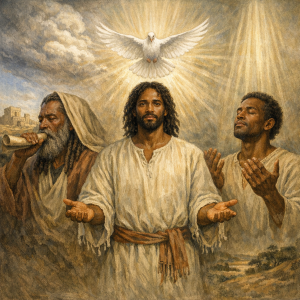
The New Testament uses the Holy Spirit language frequently. The Spirit is associated with Jesus’ conception, baptism, wilderness testing, teaching, ministry, death, resurrection hope, and the commissioning of disciples. The Gospels describe the Spirit descending at Jesus’ baptism in dove-like form, but the narrative image should not be confused with a claim that the Spirit is literally a bird.
In John’s Gospel, Jesus speaks of the Spirit as the Advocate, Helper, or Counselor (Paraklētos), who teaches, reminds, testifies, and guides. Acts 2 presents Pentecost as a public event of empowerment for witness, using wind and fire imagery and connecting the event to Joel’s prophecy. Paul’s letters associate the Spirit with adoption, freedom, moral transformation, prayer, unity amid diverse gifts, and the resurrection of the body.
Christian interpreters commonly point to passages in which the Spirit speaks, teaches, intercedes, can be resisted, and distributes gifts as support for the Spirit’s personal agency. Nontrinitarian interpreters read many of the same texts differently, emphasizing the biblical use of personification and the foundational meanings of breath, power, and divine action. The textual data are shared; the theological conclusions remain disputed among religious communities.
Legal Implications
There is no independent common-law definition of the Holy Spirit comparable to legal definitions of contract, trespass, corporation, agency, or property. English common law historically operated in societies where Christianity was influential, and ecclesiastical courts addressed many religious matters. That history does not transform a theological term into a common-law person, sovereign, office, or source of civil jurisdiction.
In the United States, references to the Holy Spirit ordinarily arise in legal settings only as expressions of religious belief, worship, institutional identity, or claimed religious practice. The relevant legal framework is constitutional and statutory, not a separate “Holy Spirit law.” The First Amendment’s Establishment and Free Exercise Clauses limit governmental establishment of religion and protect religious exercise, subject to the legal rules that courts apply in particular cases. Article VI also forbids religious tests for federal office. Cornell Legal Information Institute, “Religion and the Constitution”.
A court generally does not decide whether a claimed message came from the Holy Spirit, whether a doctrine is spiritually true, or which interpretation of Scripture is correct. Civil courts may, however, decide ordinary legal questions involving religious organizations when they can do so through neutral principles of law—for example, questions concerning contracts, property, employment rules, nonprofit governance, or statutory protections. Constitutional limits are especially important where adjudication would require a court to resolve an internal theological controversy.
Claims that the Holy Spirit itself creates private governmental authority, cancels statutes, exempts a person from all civil law, or supplies a separate common-law jurisdiction are not accepted principles of United States law. Religious conviction may be sincere and constitutionally protected, but sincerity alone does not make a theological assertion legally dispositive. The distinction between spiritual authority within a faith community and enforceable civil authority is essential.
Spiritual Meaning
For believers, the Holy Spirit commonly signifies God’s nearness and active work rather than an abstract topic. Jewish traditions may speak of divine inspiration, prophetic insight, sanctification, wisdom, and the presence of God. Christian traditions commonly speak of conviction of sin, regeneration, sanctification, prayer, spiritual gifts, consolation, discernment, unity, and empowerment for service.
Many Christians understand the Spirit’s work as producing moral fruit rather than merely extraordinary experiences. Galatians 5 associates life in the Spirit with love, joy, peace, patience, kindness, goodness, faithfulness, gentleness, and self-control. First Corinthians 12–14 places gifts such as prophecy, healing, tongues, teaching, and discernment within a larger requirement of love and orderly communal life. Accordingly, a claim of spiritual guidance is traditionally tested against Scripture, moral character, wisdom, truthfulness, and accountability to a faithful community.
Experiences described as being “led by the Spirit,” “filled with the Spirit,” or “moved by the Spirit” are personal and may be deeply meaningful to the persons involved. They are not automatically verifiable as public facts. Responsible religious practice ordinarily distinguishes personal conviction from a claim to infallible authority over other people.
Modern Usage
In contemporary English, “Holy Spirit” is the standard form in most Bible translations, churches, theological writings, and ecumenical statements. “Holy Ghost” remains familiar in historic liturgies, older Bible translations, hymns, legal names of churches, and traditional devotional speech.
Within Roman Catholic, Eastern Orthodox, Anglican, Lutheran, Reformed, and many evangelical traditions, the Holy Spirit is confessed as the third Person of the Trinity. Pentecostal and charismatic movements particularly emphasize baptism in or filling with the Spirit, spiritual gifts, healing, prophecy, and expressive worship. Other Christians accept the Spirit’s work but interpret miraculous gifts differently, including whether certain gifts continue in the same form in the present age.
The phrase also appears outside formal theology in personal testimony, counseling, music, political speech, literature, and popular culture. Such uses range from reverent to metaphorical. Care is needed not to assume that every use carries the same doctrinal meaning.
Controversies / Criticisms
The principal controversy is doctrinal. Trinitarian Christians affirm that the Holy Spirit is fully God and personally distinct from the Father and the Son. Judaism and nontrinitarian religious groups reject that formulation. This disagreement is not resolved by merely noting that the Hebrew noun ruach is grammatically feminine or that Greek pneuma is grammatically neuter. Grammatical gender is a feature of language and does not, by itself, settle theological questions about personhood or deity.
A major historic Christian dispute concerns the filioque, Latin for “and the Son.” The original 381 creed states that the Spirit proceeds from the Father. Western churches later added that the Spirit proceeds “from the Father and the Son,” while Eastern Orthodox churches maintain the original wording and object both to the unilateral addition and to aspects of the Western theological formulation. Roman Catholic teaching recognizes the continuing disagreement while explaining the Latin position; Orthodox-Catholic dialogue has also acknowledged the long-standing church-dividing character of the dispute. Catechism of the Catholic Church, paragraphs 243–248; Orthodox Church in America, agreed statement on the Filioque.
Another controversy concerns claims of direct revelation. Critics warn that leaders may use “the Spirit told me” to avoid scrutiny, override conscience, manipulate followers, or validate harmful conduct. Religious communities themselves often answer that genuine spiritual claims must be tested and cannot rightly contradict truth, justice, humility, or the community’s authoritative standards. The concern is not whether spiritual experience exists, but whether a claimed experience is being used irresponsibly or coercively.
Conclusion
The Holy Spirit is a central religious term rooted in the biblical languages of breath, wind, life, and divine activity. In Jewish thought, it commonly refers to God’s holy inspiration and presence; in classical Christianity, it names the divine third Person of the Trinity; and in nontrinitarian Christian traditions, it is often understood as God’s active power or presence. These interpretations overlap in vocabulary but differ substantially in doctrine.
For legal purposes, the term has no separate common-law force and does not create an exemption from civil law. Its legal significance arises through protections for religious belief, worship, association, and institutional autonomy. For spiritual purposes, it remains a living term through which many people describe divine guidance, renewal, holiness, comfort, truth, and service. A careful dictionary definition should preserve both realities: the term’s profound religious importance and the need to distinguish theology, personal testimony, historical development, and enforceable law.
Sources / Further Reading
- Oxford Bibliographies in Biblical Studies, “Holy Spirit” — https://academic.oup.com/reference/62341/reference-article-abstract/554094135
- Encyclopaedia Judaica, “Ru’aḥ ha-Kodesh” — https://www.encyclopedia.com/religion/encyclopedias-almanacs-transcripts-and-maps/ruah-ha-kodesh
- Bible Gateway, Encyclopedia of the Bible, “Holy Spirit” — https://www.biblegateway.com/resources/encyclopedia-of-the-bible/Holy-Spirit
- Vatican, Catechism of the Catholic Church, paragraphs 232–267 — https://www.vatican.va/content/catechism/en/part_one/section_two/chapter_one/article_1/paragraph_2_the_father.html
- Orthodox Church in America, “Pentecost: The Descent of the Holy Spirit” — https://www.oca.org/orthodoxy/the-orthodox-faith/worship/the-church-year/pentecost-the-descent-of-the-holy-spirit
- Cornell Legal Information Institute, “Religion and the Constitution” — https://www.law.cornell.edu/wex/religion_and_the_constitution