Female
Primary Definition
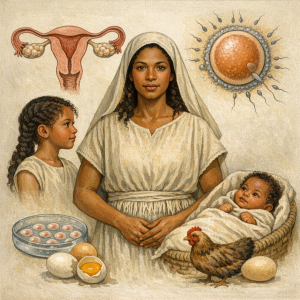
Female in the English construct is and animal and is a noun and adjective ordinarily denoting the sex organized, in the normal reproductive pattern of a sexually reproducing species, around the production of eggs or ova rather than sperm. When used of human beings, female commonly identifies a person of the female sex; in ordinary age-specific usage, girl refers to a female child and woman to an adult human female.
This is principally a biological classification, not a statement of ability, social role, personality, legal capacity, morality, or worth. A female person need not presently produce ova, be fertile, menstruate, become pregnant, or have particular physical traits in order to be female. Age, menopause, congenital variation, illness, injury, surgery, and infertility can affect reproductive organs or functions without changing the underlying sex classification ordinarily used in biology and medicine.
In animals and other sexually reproducing organisms, female is used in the same reproductive sense. In technical fields, the word can also describe a receiving, socketed, or receptive component—such as a “female connector”—by analogy to sexual anatomy. That mechanical usage is figurative and does not create a separate biological meaning.
Dictionary definitions vary in wording. Some emphasize the capacity to bear young or produce eggs; others emphasize membership in the sex associated with ovaries, ova, and female reproductive anatomy. The most precise general definition is functional and class-based: female identifies the reproductive sex whose developmental organization is directed toward producing the larger gamete, the ovum. In human life, sex is ordinarily recognized through an interrelated pattern of reproductive anatomy, developmental pathway, and genetics. Chromosomes are important evidence in most cases, but “XX” is not a complete standalone definition because naturally occurring differences of sexual development can produce atypical chromosomal, gonadal, hormonal, or anatomical patterns. ([pmc.ncbi.nlm.nih.gov](https://pmc.ncbi.nlm.nih.gov/articles/PMC8348944/?utm_source=openai))
Etymology and Origin
Female entered English in the Middle English period through Anglo-French and Old French forms such as femele and femelle. Those forms derive from Medieval Latin femella, meaning a young woman or girl, itself a diminutive related to Latin femina, meaning woman. The word therefore has a documented Latin-to-French-to-English linguistic history. ([merriam-webster.com](https://www.merriam-webster.com/dictionary/female?utm_source=openai))
A frequent popular claim says that female means “fe-male,” as though it were a form of “male,” or that it literally means a deficient, lesser, or subordinate male. That claim is false as etymology. The modern English spelling was influenced by the sound and appearance of male, but the two words do not descend from the same root. Female comes through femella and femina; male has a different historical development. A word’s resemblance to another English word is not proof of its origin or of a hidden legal or spiritual meaning. ([merriam-webster.com](https://www.merriam-webster.com/dictionary/female?utm_source=openai))
The word originally referred chiefly to a girl or woman, but its adjective and broader zoological uses became firmly established in English. Modern English applies female both to humans and to nonhuman organisms. In formal scientific, demographic, medical, and legal writing, it may function as a neutral classificatory term. In personal reference, however, many English speakers prefer woman or girl where age and humanity are central, because those terms usually sound more personal and less clinical.
Cultural and Historical Context
Across many societies, female sex has been associated with pregnancy, childbirth, nursing, kinship, inheritance, household labor, and the continuation of families and communities. These associations are historically significant, but they do not mean that every female has the same capacities, duties, desires, occupation, or social role. A biological category is not a complete social destiny.
In older English legal and social usage, women’s status was often addressed through categories such as wife, widow, daughter, heiress, feme sole, and feme covert rather than through the single word female. Under the historic common-law doctrine of coverture, a married woman’s separate legal identity and property rights were substantially restricted in many respects. That doctrine was a historical legal arrangement, not an inherent consequence of femaleness, and it was progressively displaced by married women’s property statutes and later equality law.
The distinction between sex and gender became more prominent in twentieth- and twenty-first-century scholarship, medicine, public policy, and ordinary language. In many present contexts, sex refers to biological classification, while gender can refer to social roles, expression, identity, or a legal category. Usage is not perfectly uniform: people and institutions sometimes use female as a gender designation and sometimes use it strictly for sex. Careful writing should therefore identify the intended meaning rather than assume that every reader uses the terms identically.
Biblical / Torah Context
The English word female is not a Hebrew Torah word and should not be treated as though its English etymology controls the meaning of Scripture. In Genesis 1:27, the Hebrew text uses zakar for “male” and neqevah for “female,” stating that humankind was created male and female. The passage immediately connects humanity’s creation with fruitfulness, multiplication, and stewardship. ([biblegateway.com](https://www.biblegateway.com/passage/?search=Genesis+1%3A27&version=NIV%3BNKJV%3BNET&utm_source=openai))
Within the Torah, male-and-female language is used not only of human beings but also of animals, particularly in passages concerning created kinds, reproduction, sacrificial animals, ritual classifications, and genealogical or household order. In that textual setting, the terms ordinarily identify sexual class rather than modern theories of personality or social identity.
Jewish and Christian readers have drawn several theological conclusions from Genesis. A central traditional reading is that both male and female are included in humanity’s creation in the image of God and therefore possess inherent human dignity. This conclusion should be distinguished from later social customs that gave unequal authority or legal rights to men and women. Scripture has been interpreted in different ways across Jewish and Christian traditions concerning family roles, marriage, leadership, inheritance, modesty, and public life; no single modern political program can simply be assumed from the word female alone.
Legal Implications
Common Law and Historical Legal Usage
In the common-law tradition, law develops in significant part through judicial decisions and precedent, whereas statutes are enacted by legislatures. “Female” is not a free-floating common-law term that automatically carries one universal definition across every jurisdiction and every legal question. Its legal meaning depends upon the text at issue, the jurisdiction, the historical period, the facts, and binding judicial authority. ([law.cornell.edu](https://www.law.cornell.edu/wex/common_law?utm_source=openai))
Historically, sex classifications affected marriage, legitimacy, inheritance, property, citizenship, public office, jury service, voting, criminal responsibility, and family law. Some distinctions reflected reproductive realities; others imposed broad civil disabilities upon women. American constitutional amendments, state constitutional provisions, statutes, and court decisions substantially changed this legal landscape. Accordingly, an assertion that a historical common-law rule still governs current law must be tested against later legislation and binding case law.
Roman law is relevant to the linguistic background only in the limited sense that the English word ultimately derives from Latin. Roman civil law was not English common law. It is inaccurate to cite a Latin root, a Roman legal maxim, or an old English legal form as though it automatically establishes current American law.
Statutes, Regulations, and Cases
Modern United States law does not contain one all-purpose definition of female applicable to every federal and state legal setting. Congress may define terms for a particular statute; agencies may define them for a particular regulation; and state legislatures may adopt their own definitions. The federal Dictionary Act, for example, provides general rules of construction but does not itself supply a universal definition of “female.” ([law.cornell.edu](https://www.law.cornell.edu/uscode/text/1/1?utm_source=openai))
A current federal regulatory example appears in 2 C.F.R. § 603.20, which defines “female” for that regulation as a person of the sex characterized by a reproductive system whose biological function is producing eggs, with stated qualifications for maturity, disruption, and congenital anomaly. That definition is authoritative within the scope of that regulation; it should not be overstated as a complete statement of all American law. ([law.cornell.edu](https://www.law.cornell.edu/definitions/index.php?def_id=e5134168dd212db554b0924ccbf7550d&height=800&iframe=true&term_occur=999&term_src=Title%3A2%3ASubtitle%3AB%3AChapter%3AVI%3APart%3A603%3A603.20&width=840&utm_source=openai))
In employment law, the United States Supreme Court held in Bostock v. Clayton County (June 15, 2020) that firing an individual merely for being homosexual or transgender violates Title VII’s prohibition of employment discrimination because of sex. Bostock interpreted Title VII; it did not create a general dictionary definition of “female,” decide every question involving sex-separated facilities or programs, or displace every state law. Legal analysis must remain attentive to the statute and issue actually before the court. ([supremecourt.gov](https://www.supremecourt.gov/opinions/19pdf/590us2r44_6kgn.pdf?utm_source=openai))
Sex classifications may arise in medical research, health records, prisons, athletics, privacy accommodations, family law, vital records, anti-discrimination law, and sex-based civil-rights claims. The appropriate legal question is often not merely “What does female mean?” but also: What law governs? Does it define the word? What governmental interest is asserted? What constitutional or statutory protections apply? What facts are legally material? These questions may have different answers in different jurisdictions.
Spiritual Meaning
In spiritual and religious reflection, female may be understood as a created sex associated with bodily life, kinship, motherhood, generational continuity, receptivity, strength, wisdom, nurture, and covenantal community. Such associations can have profound meaning for believers. They are interpretive and devotional applications, however, rather than scientific definitions or automatically binding legal rules.
A sound spiritual approach avoids two errors. First, it should not reduce a female person to reproduction, sexuality, or a prescribed temperament. Second, it should not deny the significance of embodied sex merely because human identity includes intellect, spirit, relationships, vocation, and moral agency. A person’s dignity is not measured by fertility, marital status, appearance, conformity to stereotypes, or usefulness to others.
Modern Usage
As an adjective, female remains standard in phrases such as “female patient,” “female athlete,” “female reproductive system,” “female employee,” and “female witness,” especially where sex is material to the discussion. As a noun, it is common in biology, wildlife science, medicine, data collection, and law: “the female of the species,” “adult females,” or “female participants.”
When referring to an individual human being outside a technical context, writers should consider whether woman, girl, mother, or another accurate personal term is clearer and more respectful. “Female” used as a bare noun can sound impersonal when it replaces ordinary human terms, particularly in conversation. Context, audience, and purpose matter.
In medical and scientific work, precision is especially important. Researchers may need to record sex-related variables because anatomy, hormones, metabolism, disease presentation, medication effects, and reproductive capacity can affect research findings and clinical care. The National Institutes of Health directs researchers to account for sex as a biological variable in relevant vertebrate-animal and human studies. ([orwh.od.nih.gov](https://orwh.od.nih.gov/sex-as-biological-variable?utm_source=openai))
Controversies / Criticisms
Contemporary disagreement concerning the word commonly arises from the relationship between biological sex, gender identity, sex-based rights, language, and anti-discrimination law. One position maintains that female should retain a sex-based biological meaning because that meaning is necessary for clarity in medicine, reproductive health, demographic data, sex-based statistics, and some legal classifications. Another position emphasizes that gender identity and lived social identity are important to personal dignity and equal treatment, and argues that language should be used in ways that avoid needless exclusion or humiliation.
These concerns need not be resolved by denying either biology or human dignity. Biological sex classifications are meaningful in many contexts, while gender identity is also recognized in many social, medical, and legal discussions. The terms answer different questions and may overlap in ordinary use without being identical in every setting.
Claims that the word female has a secret legal definition, a hidden commercial meaning, or an inherently derogatory origin are generally unsupported when presented without jurisdiction-specific primary authority or credible historical sources. Likewise, claims that no biological distinction can be drawn between female and male disregard the reproductive basis by which the categories are ordinarily defined. Complex or atypical individual cases warrant accuracy, privacy, and humane treatment; they do not justify careless use of either science or law.
Conclusion
Female is an anciently rooted English term for the sex associated with ova and the female reproductive developmental pattern. Its origin lies in Latin femina and femella, not in the word male. In biology it identifies a reproductive sex; in Torah and biblical translation it commonly renders Hebrew terminology for female sex; in law it has no single universal common-law definition but takes meaning from applicable constitutional text, statutes, regulations, and cases.
Clear use of the term requires attention to context. Biological discussion should be scientifically accurate. Legal discussion should identify the governing jurisdiction and authority. Spiritual discussion should distinguish faith-based interpretation from enforceable law. Personal discussion should preserve the dignity of the individual. Properly understood, the term is descriptive, not a measure of human value.
Sources / Further Reading
- Merriam-Webster, “Female”: https://www.merriam-webster.com/dictionary/female
- Oxford Learner’s Dictionaries, “Female”: https://www.oxfordlearnersdictionaries.com/us/definition/english/female_2
- National Center for Biotechnology Information, “Considering Sex as a Biological Variable in Basic and Clinical Studies”: https://pmc.ncbi.nlm.nih.gov/articles/PMC8348944/
- National Institutes of Health, “Sex as a Biological Variable”: https://orwh.od.nih.gov/sex-as-biological-variable
- Legal Information Institute, “Common Law”: https://www.law.cornell.edu/wex/common_law
- Legal Information Institute, 1 U.S.C. § 1: https://www.law.cornell.edu/uscode/text/1/1
- Legal Information Institute, 2 C.F.R. § 603.20 definition of “Female”: https://www.law.cornell.edu/definitions/index.php?def_id=e5134168dd212db554b0924ccbf7550d
- Supreme Court of the United States, Bostock v. Clayton County: https://www.supremecourt.gov/opinions/19pdf/17-1618_hfci.pdf
- Bible Gateway, Genesis 1:27: https://www.biblegateway.com/passage/?search=Genesis%201%3A27&version=NIV%3BNKJV%3BNET