Mrs
Primary Definition
Mrs. is an English courtesy title placed before a woman’s surname, or before her given name and surname together. In prevailing modern American and British usage, it ordinarily identifies a married woman, and it is also commonly retained by many widowed or divorced women who choose to continue using it. It is pronounced “MISS-iz” or, in some regional speech, “MIZ-iz.” The period after the abbreviation is customary in American English (Mrs.) but is often omitted in British style (Mrs).
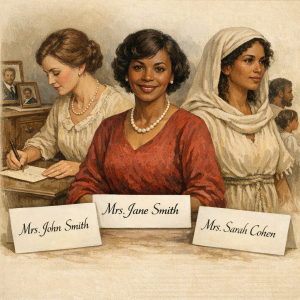
The title is a form of social address, not a personal name in itself. Thus, in “Mrs. Jane Smith,” “Jane Smith” is the person’s name and “Mrs.” is the courtesy title. A woman may use the title with a spouse’s surname, a birth surname, a prior surname, a hyphenated surname, or another surname she lawfully uses. The title alone does not establish what surname a woman uses, whether she has changed her name, the identity of her spouse, or the legal validity of a marriage.
In ordinary etiquette, the title is traditionally used with a surname: “Mrs. Smith.” It may also be used with a woman’s own full name: “Mrs. Jane Smith.” The older form “Mrs. John Smith,” using the husband’s given and family name, was once conventional in formal correspondence for a married woman whose husband was John Smith. That convention has substantially declined because it can obscure the woman’s own given name and does not suit every family’s naming practice.
“Mrs.” should be distinguished from Miss, traditionally associated with an unmarried woman or girl, and Ms., a marital-status-neutral title generally used when marital status is unknown, irrelevant, or deliberately not stated. A respectful modern practice is to use the title and name a person uses for herself, or to use no title where the setting permits.
Etymology and Origin
The written form Mrs. is an abbreviation of mistress. This fact explains the otherwise surprising letter r in a word pronounced “missis.” Historically, mistress was the feminine counterpart of master, not inherently a reference to marriage and not originally a reference to an extramarital sexual relationship. It could signify a woman with authority, skill, household standing, property, servants, apprentices, or social rank.
The deeper linguistic family runs through Middle English mistress, Old French maistresse, and ultimately Latin magister, meaning a chief, director, teacher, or person of authority. The masculine English title Mr. likewise developed from master. The modern titles therefore preserve a historical relationship between master and mistress, even though their present-day meanings and social associations have diverged sharply.
Dictionary evidence places the use of Mrs. in English by the late sixteenth century; Merriam-Webster records a first known use around 1574. The abbreviation did not preserve the full pronunciation of mistress. Instead, English speech developed a shortened pronunciation resembling “missis,” while the spelling remained linked to the older word. The informal noun missus, meaning “wife,” arose from the same spoken tradition but is not identical in register or meaning to the formal title.
It is important not to read the present meaning backward into every historical document. A seventeenth-century or early eighteenth-century reference to “Mrs. Anne Brown” may identify an adult woman of recognized standing without proving that she was married. In historical records, the title can be evidence of social position, household authority, maturity, occupation, property, or respectability, depending on the document and period. It is not, by itself, conclusive proof of marital status.
Cultural and Historical Context
From Status and Authority to Marital Convention
In early modern England, mistress and its abbreviated forms were used more broadly than the modern title. Historian Amy Erickson’s research emphasizes that “Mrs.” was often applied to adult women of relatively higher social or economic standing, including some unmarried women. A woman who managed a household, operated a business, employed servants, possessed property, or occupied a recognized rank might receive the designation. By contrast, many poorer women were addressed simply by a given name, a kinship description, or a reference to their husband.
During the eighteenth and nineteenth centuries, English usage moved toward a more rigid distinction: Miss increasingly became the ordinary title for unmarried women, while Mrs. became increasingly associated with married women. The change was cultural and linguistic rather than the result of one universal act of Parliament or a single common-law rule defining the title. Social etiquette, printing practices, class expectations, household arrangements, and changing ideas about womanhood all contributed to the shift.
The later sexual meaning of mistress has caused many people to assume that Mrs. originated as a label for a wife in contrast to a lover. That is historically mistaken. The older word had several senses, including female head of a household, teacher, employer, or woman exercising authority. The sexual sense became especially prominent in later usage, while the abbreviation Mrs. remained the conventional courtesy title for married women.
Marriage, Names, and Identity
In English-speaking custom, marriage was often accompanied by a wife’s adoption of her husband’s surname. That custom became widespread, but the title and the surname are separate matters. A woman can be married without using her spouse’s surname, and a woman who uses a spouse’s surname is not necessarily required to use “Mrs.” The historical formula “Mr. and Mrs. John Smith” reflected a particular social convention of marital unity and household representation; it was not a universal statement that the wife lacked an individual identity.
Nevertheless, the convention developed within societies where women’s legal and economic independence was often restricted. For that reason, historical titles and naming practices sometimes reveal unequal social structures. A careful reading should avoid two opposite errors: treating every traditional use of “Mrs.” as proof of oppression, or treating the title’s familiar politeness as proof that past legal inequalities did not exist. A word may be courteous in ordinary usage while also carrying historical associations shaped by older systems of rank, sex, and family order.
Biblical / Torah Context
There is no Hebrew, Aramaic, or Greek biblical word that is the direct equivalent or origin of the English abbreviation “Mrs.” The title is English and post-biblical in development. Neither the Torah nor the New Testament establishes “Mrs.” as a religious office, covenantal title, sacramental designation, or legal requirement for married women.
Biblical and Torah texts use kinship terms, personal names, genealogies, household descriptions, and social designations appropriate to their ancient Near Eastern, Jewish, Greek, and Roman settings. English Bible translators may use “Mrs.” in explanatory notes, modern dialogue, educational materials, or adaptations, but such use is a translator’s or editor’s convention rather than part of the original scriptural languages.
Marriage is significant in biblical and Torah traditions, but that significance should not be confused with a later English form of address. A reader may reasonably see “Mrs.” as a culturally respectful way to identify a married woman in modern English. It is not accurate, however, to claim that use of the title is commanded by Scripture, derived from the Torah, or necessary to honor a biblical marriage.
Legal Implications
Courtesy Title, Not Legal Status
In common-law analysis, “Mrs.” is ordinarily a courtesy title rather than a legal status, rank, office, or grant of authority. It does not itself create a marriage, prove a marriage, dissolve a marriage, change a surname, confer property rights, establish citizenship, determine inheritance, or make one person legally responsible for another. Legal consequences arise from applicable marriage law, family law, property law, contract law, probate law, and statutes—not from the presence or absence of this title on a letter, account, or form.
Accordingly, a person should not assume that an institution’s use of “Mrs.” is legal proof of marriage. It may be useful as contextual evidence when considered with reliable records, but it is generally weak evidence standing alone. Marriage certificates, court judgments, vital records, sworn testimony, statutory presumptions, and other admissible evidence carry different legal weight depending on the jurisdiction and issue.
Historical Common Law and Coverture
Historically, English common law recognized the doctrine commonly called coverture. Under its traditional formulation, a married woman, described in legal terminology as a feme covert, faced serious restrictions on independent property ownership, contracting, litigation, and control of earnings. The doctrine was related to a legal theory of marital unity, under which husband and wife were often treated as one legal unit for many purposes. It was not created by the word “Mrs.,” nor did the title itself make a woman the property of her husband.
The language of marital unity did, however, coexist with customary forms such as “Mrs. John Smith,” and this historical setting helps explain why some people regard that form as burdensome or outdated. The more precise legal conclusion is that the title was a social usage operating within a broader legal and cultural environment; it was not the source of coverture.
Over time, Married Women’s Property Acts and related reforms in England, the United States, and other common-law jurisdictions dismantled major features of coverture. In the United States, the timing and details differed by state. Modern statutes generally recognize married people as separate legal persons who may own property, contract, sue, be sued, earn income, and hold legal rights in their own names. Current law must always be checked in the relevant jurisdiction; historic common-law descriptions cannot simply be treated as present law.
Common-Law Marriage and Misuse of the Term
“Mrs.” also has no automatic connection to “common-law marriage.” Common-law marriage is a distinct legal doctrine concerning whether a marriage exists without a formal ceremony or license under the law of a particular jurisdiction. In the United States, most states do not permit the formation of new common-law marriages, though some recognize marriages formed earlier under their own law or recognize valid common-law marriages from another jurisdiction. Merely calling oneself “Mrs.,” using a partner’s surname, cohabiting, or being introduced as spouses does not alone establish a common-law marriage.
Nor should the title be confused with Roman-law classifications, ecclesiastical titles, military rank, governmental office, or nobility. “Mrs.” is not a military rank and conveys no command authority. It is not a title of nobility, such as Duchess or Countess, and does not confer an honor, office, jurisdiction, or governmental privilege.
Names on Forms and Records
Administrative systems often request a title as a matter of correspondence or customer preference. That practice does not necessarily mean the title forms part of a person’s legal name. For example, current British passport guidance distinguishes ordinary titles such as Mr., Mrs., Miss, and Ms. from a person’s name, while treating some titles of nobility differently. In the United States, agencies and businesses may have their own form conventions, but official identity generally depends upon the name shown in the relevant record and the documentation required by the governing authority.
For contracts, court papers, deeds, identity documents, and financial records, a person should use the name required by the institution and should not rely on a courtesy title to resolve inconsistencies. Where a name change is at issue, the controlling question is the governing law and the documentary record, not whether “Mrs.” appears before the name.
Spiritual Meaning
“Mrs.” has no inherent spiritual power, religious jurisdiction, sacramental effect, or independent moral quality. It is a conventional English title. Its spiritual meaning, if any, arises from the intention and beliefs of the person using it rather than from the letters themselves.
For some married women, the title may express commitment, family identity, continuity, gratitude, or a chosen public acknowledgment of marriage. For others, it may carry unwanted assumptions about marital status, gender roles, or surname conventions. A spiritually responsible use of language should therefore respect conscience, truthfulness, and the expressed preference of the person addressed. Courtesy is best shown not by imposing a title, but by using a person’s chosen form of address when known.
Modern Usage
In contemporary English, “Mrs.” remains common in schools, neighborhoods, formal invitations, customer correspondence, and traditional social settings. It is frequently used when a woman has indicated that she prefers it. In professional settings, “Ms.” is often selected when marital status is unknown or irrelevant, because it avoids making an assumption that is not ordinarily made about men addressed as “Mr.”
Usage varies by country, generation, profession, region, and family custom. Some women use “Mrs.” with their birth surname; some with a spouse’s surname; some after divorce or widowhood; and some not at all. A woman with a professional title may prefer “Dr.,” “Professor,” “Judge,” “Reverend,” “Captain,” or another applicable designation in settings where that title is relevant. None of those choices invalidate the others.
The plural form is traditionally Mesdames, abbreviated Mmes., borrowed from French. In ordinary modern writing, however, writers frequently avoid the plural title by recasting the sentence: “Mrs. Adams and Mrs. Brown” instead of “the Mesdames Adams and Brown.”
Controversies / Criticisms
The principal criticism of “Mrs.” is that it marks a woman’s marital status in a way that “Mr.” ordinarily does not mark a man’s. Critics argue that this distinction can invite unnecessary assumptions concerning age, sexuality, social role, availability, or dependence upon a husband. The modern spread of “Ms.” reflects an effort to provide women a title parallel in function to “Mr.” by leaving marital status unstated.
Others value “Mrs.” as a voluntary and meaningful title that recognizes marriage, family connection, personal history, or preference. These positions are not necessarily incompatible. The central practical issue is not whether one title must replace all others, but whether individuals are free to choose a respectful form of address without coercion or false legal claims.
Another recurring but unsupported claim is that “Mrs.” proves that a woman has surrendered her legal identity or become property of a husband. That claim confuses historical legal doctrines, older naming customs, and a present-day courtesy title. Historical coverture was real and legally consequential, but the abbreviation itself neither created that doctrine nor carries such legal effect under modern law merely by being used.
Conclusion
“Mrs.” is a longstanding English courtesy title whose written form preserves its origin in mistress, once a broader word for a woman of authority or standing. Its modern association with married women developed over time through social custom, not through a single biblical rule or a universal legal enactment. The title has historical connections to changing ideas about household authority, class, marriage, surnames, and women’s legal status, but it is not itself a legal status or proof of marriage.
In present use, the soundest rule is accuracy and respect: recognize the title as a matter of personal and social usage, distinguish it from legal identity and marital proof, and use the form of address a person chooses where that preference is known.
Sources / Further Reading
- Merriam-Webster, “Mrs. Definition & Meaning” — https://www.merriam-webster.com/dictionary/Mrs.
- Oxford Advanced Learner’s Dictionary, “Mrs” — https://www.oxfordlearnersdictionaries.com/us/definition/english/mrs
- University of Cambridge, “Mistress, Miss, Mrs or Ms: untangling the shifting history of titles” — https://www.cam.ac.uk/research/news/mistress-miss-mrs-or-ms-untangling-the-shifting-history-of-titles
- Amy Erickson, “Mistresses and Marriage: or, a Short History of the Mrs,” University of Cambridge Repository — https://www.repository.cam.ac.uk/items/7d19264e-1f0d-495d-84d2-51deff2ae4e1
- Cornell Legal Information Institute, “Common Law Marriage” — https://www.law.cornell.edu/wex/common_law_marriage
- National Archives, “The Equal Rights Amendment – A 100 Year History” — https://reagan.blogs.archives.gov/2023/08/25/the-equal-rights-amendment-a-100-year-history/
- GOV.UK, “Titles” passport guidance — https://www.gov.uk/government/publications/titles-included-in-passports/titles-accessible