El-Elohiym/El-Elohim
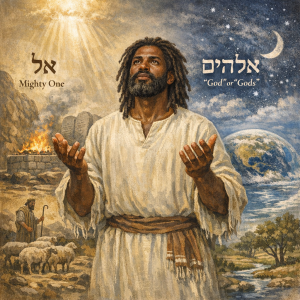
Primary Definition
El-Elohiym, more commonly transliterated El-Elohim, is a modern combined expression built from two related Biblical Hebrew divine terms: El (אֵל) and Elohim (אֱלֹהִים). It should not automatically be treated as one original Hebrew word, one fixed ancient title, or one personal name. In the Ancient Israelite and Biblical Hebrew setting, the terms must first be read according to their grammar, context, and referent.
El broadly denotes a mighty one, deity, power, or God. In many passages it refers to the Creator, Yah, especially when joined with descriptive titles such as El Elyon, “Mighty One Most High,” or El Shaddai, traditionally rendered “God Almighty.” In other contexts, el can refer more generally to a god or powerful being. The word itself does not identify the referent without context.
Elohim is a grammatically plural-form Hebrew noun. Depending on grammar and context, it may mean “gods,” divine beings, or—in numerous passages concerning the Creator of Israel—a singular referent conventionally translated “God.” Genesis opens with Bereshit bara Elohim: “In the beginning, Elohim created.” The verb bara, “he created,” is masculine singular. Thus, whatever theological conclusions readers may draw from other passages, the ordinary grammatical reading of Genesis 1:1 treats Elohim there as a singular acting subject.
Accordingly, the most careful dictionary definition is: El-Elohiym/El-Elohim is a modern devotional or interpretive pairing of Hebrew terms associated with might, deity, authority, and the Creator; its precise meaning depends on whether the writer intends El, Elohim, or a contextual title for Yah. The hyphenated form is useful as a modern label, but it is not proof that ancient manuscripts used a single compound name spelled or pronounced exactly this way.
Etymology and Origin
The consonantal root family behind El, Eloah, and Elohim belongs to the Northwest Semitic linguistic world. Related words appear across Semitic languages: Hebrew El, Aramaic Elah, Ugaritic il, and Arabic ilah. These cognates show that words for deity, divine power, or a mighty being were shared among related ancient languages. Shared vocabulary, however, does not mean that every culture held the same theology or used every title in the same manner.
El is generally understood as the shorter and older form in Hebrew. It can function as a common noun, a title, or a component in personal and place names. Biblical examples include Isra-el, commonly understood as a name involving El; Beth-el, “house of El/God”; and Dani-el, “El/God is my judge.” Such names demonstrate that El could convey an acknowledgment of divine authority, judgment, protection, or strength.
Eloah (אֱלוֹהַּ) is a singular form found especially in poetic and later Biblical Hebrew material, notably in Job. Elohim bears the common masculine plural ending -im. Yet a Hebrew plural ending does not settle meaning by itself. Hebrew uses plural forms in several ways: for numerical plurality, intensity, abstraction, extension, or honor. The correct translation therefore requires attention to verbs, adjectives, pronouns, surrounding nouns, and the argument of the passage.
When elohim refers to multiple gods, it may receive plural grammar. For example, the Torah uses the term for the gods of the nations and for household gods. When it refers to Yah as the Creator and covenant authority, it commonly takes singular verbal agreement. This grammatical pattern is documented fact; the precise historical reason that a plural-form noun so often functions as singular remains debated among scholars.
Older explanations frequently call this usage a “plural of majesty” or “plural of excellence.” Others prefer descriptions such as an intensive plural, abstract plural, or conventional singular title with plural morphology. A responsible study should not claim that one explanation has conclusively removed all scholarly questions. What is clear in the text is that morphology and syntax must be read together. It is linguistically unsound to insist that every occurrence of Elohim means either “one God” or “many gods” without examining its grammar and immediate context.
The spelling Elohiym reflects a transliteration preference in which y represents the Hebrew letter yod (י) in the ending -im. Elohim is the more common academic and English spelling. Neither spelling changes the underlying Hebrew word. Likewise, ancient Hebrew manuscripts were primarily consonantal; later scribal vocalization traditions supplied the vowel signs reflected in the familiar pronunciation ’elohim.
Cultural and Historical Context
The earliest context for these terms is the ancient Near East, particularly the Northwest Semitic world in which the ancestors of Israel lived and in which Biblical Hebrew developed. In ancient Ugaritic texts from the second millennium BCE, El appears as the name or title of a high deity within a Canaanite pantheon. That evidence is historically important because it shows that El was not an isolated Hebrew invention. It does not follow, however, that the Biblical authors simply adopted Ugaritic religion unchanged, or that every Biblical use of El refers to the Ugaritic deity.
The Hebrew Scriptures preserve both linguistic continuity with the surrounding Semitic environment and a distinct covenantal witness concerning Yah, the Elohim of Israel. Biblical texts use inherited words such as El and Elohim while repeatedly distinguishing Yah from idols, territorial gods, images, and rival objects of worship. Deuteronomy’s call to hear that Yah is one expresses a central Israelite confession of exclusive covenant loyalty. The term Elohim therefore cannot be interpreted apart from the larger Biblical argument about worship, allegiance, justice, covenant, and the rejection of idolatry.
Some Biblical passages preserve titles that may reflect older regional religious language: El Elyon in Genesis 14, El Shaddai in Genesis, and El Olam in Genesis 21. In the received Biblical presentation, these titles are directed toward the Creator worshiped by the patriarchs and identified with Yah. Historical-critical scholars debate how particular titles developed, whether they arose in distinct local traditions, and how they became associated with Yah. Those debates concern reconstruction of history; they do not erase the way the canonical Hebrew text itself identifies and frames the terms.
The expression “God of gods,” Hebrew Elohei ha-elohim, appears in Deuteronomy 10:17 and Psalm 136:2. It is not identical to the modern hyphenated expression “El-Elohim,” but it illustrates Biblical use of this word family to proclaim Yah’s supremacy over every alleged divine authority. In the Ancient Israelite heritage setting, this is a declaration of the Creator’s unmatched authority, not a license to make the phrase mean whatever a later system requires.
Biblical / Torah Context
Genesis and the Creator
Genesis 1 repeatedly uses Elohim with singular verbs: Elohim creates, speaks, sees, separates, blesses, and rests from the work of creation. The passage presents a sovereign Creator who orders the heavens, earth, seas, living creatures, and humankind. The grammar strongly supports a singular referent in this chapter. The plural form of the noun should therefore not be used as a shortcut to deny the singular grammatical presentation of the Creator in Genesis 1.
Genesis 2:4 introduces the combined designation יהוה אלהים, conventionally transliterated YHWH Elohim. In this dictionary’s Ancient Israelite heritage context, Yah is used for the Creator’s personal covenant name, while recognizing that the exact ancient vocalization of the four Hebrew consonants YHWH is disputed. The phrase identifies Yah with Elohim: Yah is not merely one power among independent powers but the Creator and covenant authority portrayed in the narrative.
El as Title and Confession
El appears in prayers, poetry, blessings, and names. Genesis 33:20 contains the altar-name El Elohe Israel, often translated “El, the Elohim of Israel” or “God, the God of Israel.” This is closer to an actual Biblical construction involving both word forms than the modern expression “El-Elohim.” Its force is confessional: the Mighty One is identified as the Elohim of Israel.
In Exodus 15:2, the song at the sea says, “Yah is my strength and song.” The short form Yah is directly preserved in the Hebrew text. Other passages use El in connection with divine strength, salvation, judgment, and refuge. These uses should not be reduced to a bare abstract definition such as “power.” Hebrew words have semantic ranges, and Biblical meanings arise from sentences and narratives, not merely from assigning one English gloss to every occurrence.
Elohim Applied Beyond the Creator
The Torah also uses elohim in other senses. It may refer to gods worshiped by other peoples, as in commandments prohibiting service to other elohim. It can refer to household gods, as in the account of Laban’s teraphim. A small number of legal and poetic passages have generated debate about whether elohim refers to God, judges, or other authoritative beings. Exodus 21:6 and 22:8–9 are especially discussed because translations differ. The disputed passages demonstrate why dictionary users must not impose one fixed English rendering on every occurrence.
Some readers appeal to the plural wording “Let us make humankind” in Genesis 1:26 as proof that Elohim always denotes a plurality of divine persons or physical beings. That conclusion exceeds the grammar of the noun alone. Proposed interpretations include a heavenly court, divine deliberation, a literary plural, or theological readings developed in later traditions. Genesis 1:27 immediately returns to singular language: Elohim creates humankind “in his image.” The text’s grammatical complexity should be acknowledged rather than used to manufacture certainty where interpreters disagree.
Legal Implications
El and Elohim are not legal terms of art in English common law, Roman law, equity, military law, statutory law, or the modern law of the United States. They create no legal status, sovereign capacity, exemption from civil law, jurisdictional defense, or special standing merely because a person uses them in speech, a signature, a declaration, or a religious document.
Historical common law developed rules concerning oaths, blasphemy, church establishment, religious corporations, and religious observance in particular jurisdictions, but it did not supply a universal legal definition of Elohim. Roman and later ecclesiastical legal systems also used their own religious vocabulary and institutional categories; those systems should not be projected backward into Biblical Hebrew or treated as the origin of this Hebrew term.
In current United States constitutional law, persons may use Hebrew sacred names and hold religious beliefs under the protections associated with free exercise and free expression, subject to generally applicable law and the facts of a particular case. Courts are not ordinarily authorized to decide whether a theological claim is true or false; questions may instead concern sincerity, conduct, fraud, contractual language, evidence, or statutory rights. Religious vocabulary should therefore be used carefully and honestly, not as a substitute for legal authority or competent legal advice.
Spiritual Meaning
Within an Ancient Israelite heritage reading, El and Elohim direct attention to Yah as the source of life, creation, judgment, covenant faithfulness, deliverance, and righteous authority. Their spiritual importance is not chiefly that they provide hidden codes or verbal formulas. Rather, they appear in a scriptural witness that calls people to reject idols, walk in justice, remember deliverance, honor covenants, and serve the Creator with reverence.
The term El can emphasize might and strength; Elohim, when applied to Yah, can emphasize the Creator’s supreme authority. Yet Biblical spirituality does not separate authority from character. The Elohim who creates is also portrayed as hearing the oppressed, judging wrongdoing, commanding honesty, defending the vulnerable, and requiring faithful conduct. A spiritually responsible use of the term should therefore resist both empty repetition and the use of sacred language to dominate, deceive, or elevate oneself above others.
Modern believers may prefer Yah, Yahuah, Yahweh, the Most High, Creator, El, or Elohim in prayer and study. Such choices involve conviction, translation practice, and community tradition. The written Hebrew text securely preserves YHWH, El, Eloah, and Elohim; the precise ancient vocalization of YHWH is not universally recoverable. It is appropriate to state a preferred pronunciation as a devotional or interpretive choice without claiming that all other readers are linguistically disproven.
Modern Usage
Today, Elohim is used in Bible translations, Hebrew study, academic scholarship, liturgy, music, sacred-name movements, Messianic communities, Christian theology, rabbinic discussion, and popular spiritual writing. Later Jewish and rabbinic practice developed reverential reading customs for divine names and has significantly shaped the way many modern readers encounter Biblical Hebrew. Those later practices are historically important, but they are chronologically later than the Torah’s original Ancient Israelite setting.
Christian theological traditions have often connected the plural form of Elohim with Trinitarian doctrine. That is a later theological interpretation rather than a definition compelled by the Hebrew noun’s plural ending. Conversely, some modern writers assert that Elohim always means a group of flesh-and-blood beings, extraterrestrials, judges, or multiple gods. Those claims likewise fail when they disregard singular verbal agreement and the varying Biblical contexts of the word.
In ordinary English, “Lord” can obscure Hebrew distinctions because it may translate YHWH, Adon, Adonai, and sometimes other titles. Where Adon or Adonai is under discussion, the basic English sense is “Master” or ruler. “Lord” historically carries that sense in English, but readers should not confuse Adon/Adonai with El/Elohim. They belong to different Hebrew word families and serve different functions.
Controversies / Criticisms
The principal controversy concerns plurality. It is true that Elohim has plural morphology. It is also true that, when the Hebrew Bible uses it for Yah, it frequently governs singular verbs and descriptions. Both facts must remain in view. Claims that the word is “only plural” or “never plural” are each incomplete.
A second controversy concerns etymology. Popular sources often offer confident concrete definitions—such as “ox and staff,” “strong leader,” “oath-bound one,” or “powers”—based on reconstructed pictographs or root theories. Such explanations may be meaningful within particular teaching systems, but they are not equally established in mainstream historical linguistics. The documented lexical range supports references to deity, a god, gods, divine beings, and, in context, the Creator. More elaborate symbolic definitions should be identified as interpretive rather than presented as uncontested ancient fact.
A third controversy arises when interpreters use the words to support political, racial, legal-sovereignty, anti-Semitic, anti-Christian, or anti-Muslim claims. The Biblical Hebrew terms themselves do not authorize hostility toward peoples or convert theological disagreement into a legal or ethnic hierarchy. Historical study should distinguish Ancient Israelite language and religion from later communities without denying the later history or dignity of those communities.
Conclusion
El-Elohiym/El-Elohim is best understood as a modern combined label referring to the Biblical Hebrew divine terms El and Elohim. In the Torah and wider Hebrew Scriptures, El may denote a mighty one or the Creator, while Elohim may refer to the Creator, gods, divine beings, or other referents according to context. When used of Yah in passages such as Genesis 1, Elohim commonly carries singular grammar and identifies the Creator as the acting subject.
The term’s enduring value lies in its connection to the Ancient Israelite witness concerning Yah: the Creator is mighty, sovereign, just, and worthy of exclusive faithfulness. Sound study requires more than appealing to an English gloss or a plural ending. It requires careful attention to the Hebrew text, grammar, historical setting, and the difference between documented evidence, theological interpretation, and modern speculation.
Sources / Further Reading
- University of Iowa, Bible & Archaeology, “RTL Words: ELOHIM” — https://bam.sites.uiowa.edu/RTL/rtl-words-elohim
- Yale University Open Courses, “Canaanite Religion as a Background for Patriarchal and Early Israelite Religion” — https://oyc.yale.edu/sites/default/files/canaanite-religion.pdf
- TheTorah.com, “YHWH Is Elohim, Not the Ancestral Spirits” — https://www.thetorah.com/article/yhwh-is-elohim-not-the-ancestral-spirits
- Religious Studies Center, “Usage of the Title Elohim” — https://rsc.byu.edu/vol-14-no-1-2013/usage-title-elohim
- Mechon Mamre, Hebrew Bible text — https://www.mechon-mamre.org/p/pt/pt0.htm
- Gesenius’ Hebrew Grammar, public-domain editions and reference materials — https://archive.org/search?query=Gesenius%20Hebrew%20Grammar
- Cornell Legal Information Institute, “Religion and the Constitution” — https://www.law.cornell.edu/wex/religion_and_the_constitution
- United States v. Ballard, 322 U.S. 78 (1944) — https://supreme.justia.com/cases/federal/us/322/78/