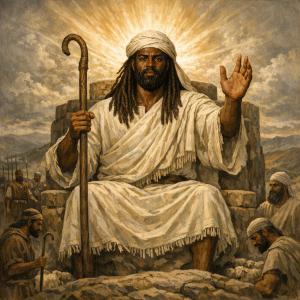
Primary Definition
Adonai (Biblical Hebrew: אֲדֹנָי; commonly transliterated Adonai or Adonay) is a title derived from the Hebrew noun adon (אָדוֹן), meaning master, ruler, superior, or one possessing authority. In its Ancient Israelite and Biblical Hebrew setting, Adonai designates the Creator as the supreme Master—the One whose authority exceeds that of every household master, king, judge, governor, military commander, landholder, or other human authority.
The English word Lord is its traditional translation, but Master more directly communicates the basic Hebrew sense. In older English, lord could mean a master, ruler, or person exercising dominion. Modern readers should not automatically import later English titles of nobility, feudal landholding, or parliamentary rank into the Biblical Hebrew term.
Adonai has two historically related functions:
- An original Biblical Hebrew title: The consonantal Hebrew text itself contains forms of adon and Adonai describing the Creator as Master.
- A later substitute reading: In post-biblical reading tradition, Adonai became the customary spoken substitute for יהוה, the four-letter name represented as YHWH. In this dictionary’s Ancient Israelite heritage terminology, the Creator may be called Yah or Yahuah; Yahweh is the most common academic reconstruction, while the complete ancient pronunciation remains disputed.
The two functions must not be confused. Adonai is fundamentally a title of mastery; יהוה is the written personal or covenant name. A reader may therefore see יהוה in the Hebrew text while hearing Adonai in a later traditional recitation.
Adonai must also be distinguished from adoni (אֲדֹנִי), ordinarily “my master” or “my lord.” The latter may address a king, official, husband, household master, respected stranger, angelic messenger, or other superior. The received Masoretic vocalization distinguishes the divine title אֲדֹנָי, with a long vowel in its final syllable, from the closely related form אֲדֹנַי, “my masters.” The underlying ancient consonants were written without the full medieval vowel system, so grammar, context, and transmitted reading tradition are all relevant. ([biblia.com](https://biblia.com/books/lbd/article/NAMES%245FOF%245FGOD%245FOT.ID.D7.90.D6.B8.D7.93.D7.95.D6.B9.D7.9F%245FAND%245F.D7.90.D6.B2.D7.93.D6.B9.D7.A0.D6.B8.D7.99))
Etymology and Origin
Adonai belongs to the Biblical Hebrew vocabulary of authority. Its base noun, adon, is found in the wider Northwest Semitic linguistic world and denotes a master, patron, ruler, owner, or person having recognized authority. Biblical Hebrew applies adon to ordinary human relationships as well as to the Creator. Abraham’s servant calls Abraham his master; Joseph is described as exercising authority in Egypt; householders and kings may also be called adon. When the title is applied to Yah/Yahuah, human mastery becomes the analogy for an authority understood as universal and supreme.
The form Adonai is morphologically related to a plural form of adon with a first-person possessive element. At a mechanically literal level it resembles “my masters” or “my lords.” In its established divine use, however, it functions grammatically and semantically as a singular title: “my Master,” “the Master,” or “the Sovereign Master.”
Older grammars commonly classify this construction as a “plural of majesty,” “plural of excellence,” “plural of intensity,” or “plural of fullness.” These descriptions are attempts to explain why a plural-looking noun may denote one supreme referent. They should not be confused with the later European “royal we,” in which one monarch speaks of himself with a plural pronoun.
Documented fact: Biblical sentences normally treat divine Adonai as referring to one Master. Interpretive analysis: The form may emphasize fullness, supremacy, or excellence of authority. Disputed claim: The morphology alone does not prove either a plurality of gods or the later Christian doctrine of the Trinity. Those conclusions require theological arguments extending beyond the lexical form itself.
The evidence therefore supports a development from an ordinary Semitic title of mastery to a specialized Ancient Israelite designation of the Creator. Only at a later historical stage did the title acquire its additional role as a standing oral replacement for the written name יהוה.
Cultural and Historical Context
Ancient Israelite Usage
In the world reflected by the Hebrew Scriptures, authority was expressed through households, clans, elders, judges, kings, priests, officials, landholders, and military leaders. The word adon belonged to that recognizable social vocabulary. Calling Yah/Yahuah Adonai transferred the language of human mastery to the Creator while also declaring that every human master remained subordinate to a higher authority.
This did not make Adonai a royal title created by English, Roman, Greek, or medieval institutions. Its origin is Hebrew and Northwest Semitic, not feudal, Catholic, parliamentary, or imperial. Greek Kyrios and Latin Dominus were later translations of the idea “Master” or “Lord”; they were not the source of the Hebrew word.
Development of the Substitute Reading
The precise date on which Israelites or Judeans began regularly substituting Adonai for יהוה cannot be fixed with certainty. The change appears to have been gradual. During the Second Temple period, increasing reverence and concern about misuse restricted pronunciation of the divine name according to setting, office, and occasion.
Ancient manuscripts demonstrate that scribes treated the name differently from surrounding words. Some Dead Sea Scrolls written primarily in the standard square script use older Paleo-Hebrew letters specifically for the divine name. This proves exceptional scribal treatment, although it does not by itself establish exactly what a reader pronounced. ([deadseascrolls.org.il](https://www.deadseascrolls.org.il/learn-about-the-scrolls/languages-and-scripts?locale=en_US))
Later rabbinic testimony remembers a distinction between Temple and non-Temple practice. Mishnah Sotah 7:6 states that the priestly blessing used the name “as written” in the Temple but a substitute designation outside it. This source is later than the biblical period and should not be projected backward as though it were a Torah-era statute, but it preserves evidence of a remembered transition from open pronunciation to restricted usage. ([sefaria.org](https://www.sefaria.org/Mishnah_Sotah.7.6?with=English+Explanation+of+Mishnah&utm_source=openai))
Greek textual evidence is complex. The dominant Greek biblical tradition uses Kyrios, “Master” or “Lord,” where the Hebrew has יהוה, but some ancient Greek manuscripts preserve Hebrew letters or another representation of the name. Scholars disagree over which convention stood in the earliest Greek translations. The evidence establishes that multiple manuscript practices existed; it does not justify sweeping claims that every ancient Greek copy used one uniform method. ([journals.sagepub.com](https://journals.sagepub.com/doi/pdf/10.1177/0309089207080558))
During the early medieval period, the Masoretes added vowel signs and reading instructions to the inherited Hebrew consonantal text. Vowel signs associated with the substitute reading alerted readers to say Adonai when encountering יהוה. When written Adonai immediately preceded יהוה, the traditional substitute for יהוה became Elohim, “God,” to avoid the awkward repetition “Adonai Adonai.”
Biblical / Torah Context
The Torah and Prophets establish the ancient foundation of the word before any later liturgical usage is considered. Genesis 15:2 and 15:8 preserve Abram’s address Adonai YHWH, commonly printed in English as “Lord GOD.” In this expression, Adonai is the title “Master,” while YHWH is the written name of Yah/Yahuah. The two words are therefore related in reference but not identical in lexical function.
Exodus 4:10 and 4:13 use Adonai as Moses responds to the Creator’s command. The title fits the narrative relationship: the Master commissions, and the servant is responsible to answer. Isaiah 6:1 likewise depicts Adonai seated upon a high and exalted throne, joining mastery with kingship, judgment, holiness, and prophetic commission.
Other passages use forms of adon to describe the Creator as “Master of all the earth,” as in Joshua 3:11 and 3:13. Deuteronomy 10:17 declares Yah/Yahuah to be “Master of masters,” placing all lesser powers beneath the Creator’s authority. Psalm 8:1 combines the written name with a possessive form of the title: “YHWH, our Master.”
Psalm 110:1 illustrates the importance of reading Hebrew forms carefully. Its first expression is the written divine name יהוה; the second is adoni, “my master,” not the specially pointed divine title Adonai. Later Jewish and Christian interpretations differ over the identity and status of the second figure, but a dictionary must first preserve the lexical distinction rather than allowing an English translation to erase it.
Deuteronomy 6:4, the declaration later known as the Shema, contains יהוה in the written Torah, not Adonai. Its familiar recitation with Adonai reflects the later substitute-reading tradition. The spoken title should not be mistaken for the consonantal word actually preserved at those locations in the Torah.
Exodus 20:7 and Deuteronomy 5:11 prohibit bearing or taking the name of Yah/Yahuah falsely, emptily, or wrongfully. These commandments supplied an important basis for caution concerning the divine name. Nevertheless, historical development should not be reduced to a claim that one verse immediately caused all Israelites to stop pronouncing it. Temple practice, scribal reverence, fear of profanation, changing interpretations of Leviticus 24, and later legal tradition all contributed.
In later halakhah, Adonai written with the intention of designating the Creator is treated as a sacred name. Talmudic discussions distinguish sacred divine designations from identical or similar expressions referring to human masters or angelic figures. That system is Jewish religious jurisprudence; it is not English common law, Roman civil law, equity, or modern statutory law. ([sefaria.org](https://www.sefaria.org/Shevuot.35?utm_source=openai))
Legal Implications
Adonai has no independent technical meaning in historical English common law. It does not create a title of nobility, civil office, military rank, proprietary estate, trust, lien, diplomatic immunity, citizenship status, contract, or exemption from governmental jurisdiction. Writing or speaking the word cannot by itself withdraw a person from statutes, court authority, taxation, licensing rules, or other generally applicable law.
English legal history used lord in feudal, manorial, proprietary, ecclesiastical, and parliamentary senses. Those institutions are historically separate from the Biblical Hebrew title. Translating Adonai as “Lord” does not establish that Ancient Israelite theology originated in English land tenure or Roman government.
The term has an indirect relationship to the history of legal oaths. Traditional common-law theory often described an oath as an appeal to God as witness to the truth, accompanied by an expectation of divine judgment for falsehood. Blackstone connected judicial oaths with belief in divine oversight and future accountability. Anglo-American law later expanded the use of affirmations and abandoned many religious tests that had excluded persons whose beliefs did not fit established oath formulas. ([cambridge.org](https://www.cambridge.org/core/journals/law-and-history-review/article/testimonial-exclusions-and-religious-freedom-in-early-america/89A2453C29244C41964DDC5A8BE89DC8?utm_source=openai))
Current United States federal law does not require a witness or public officer to invoke Adonai or any other divine title. Article VI of the United States Constitution permits an “Oath or Affirmation” and prohibits religious tests for federal public trust. Federal Rule of Evidence 603 requires an oath or affirmation in a form designed to impress the duty of truthfulness upon the witness’s conscience; no particular sacred name, book, or verbal formula is mandatory. ([constitution.congress.gov](https://constitution.congress.gov/browse/article-6/clause-3/?utm_source=openai))
Accordingly, inserting Adonai into a document does not give it greater secular legal force. Conversely, a person should not be compelled to pronounce the title contrary to conscience as a condition of testimony. The legal consequences of an oath, affirmation, contract, declaration, or false statement arise from constitutions, statutes, evidentiary rules, contract law, and applicable cases—not from a supposed hidden power in the Hebrew word.
Spiritual Meaning
Spiritually, Adonai expresses a relationship between the supreme Master and the accountable servant. To call the Creator “Master” is to confess that human desire, wealth, military force, political office, religious rank, and popular approval are not the highest standards of right.
The title does not merely announce power. Within the biblical witness, the Master’s rule is repeatedly associated with truth, justice, mercy, covenant faithfulness, correction of oppression, honest judgment, and protection of the poor, widow, orphan, and stranger. A ruler who invokes divine authority while practicing cruelty or fraud contradicts the accountability contained in the title.
From the interpretive perspective of the Common Law Dictionary, Adonai may symbolize a moral authority above every earthly institution. No king, legislature, judge, commander, corporation, priest, pastor, or religious organization can rightly claim the unlimited mastery attributed to Yah/Yahuah. This is theological and philosophical analysis, not a secret rule of secular law.
Modern Usage
In modern Jewish worship, Adonai remains the principal spoken replacement for יהוה during formal prayer, blessings, and scriptural recitation. In ordinary conversation, many use HaShem, “the Name,” rather than casually pronouncing Adonai. Practices differ among Orthodox, Conservative, Reform, Karaite, academic, and other communities.
Many English Bibles print “LORD” in small capitals when the Hebrew contains יהוה and “Lord” when the Hebrew contains written Adonai. “Lord GOD,” with “GOD” in small capitals, commonly represents Adonai YHWH. Translation conventions vary and should be checked in each edition’s preface.
The form “Jehovah” arose through a later combination of the consonants YHWH with substitute-reading vowels. It has a significant devotional and literary history, but most academic Hebraists do not regard it as the original pronunciation. “Yahweh” is the dominant scholarly reconstruction. “Yahuah” is used in some Ancient Israelite heritage and Sacred Name communities. Because the original consonantal spelling does not preserve a complete vowel sequence, claims of absolute certainty should be identified as disputed.
Christian writers and musicians also use Adonai as a Hebrew title for God. In 2008, the Roman Catholic Congregation for Divine Worship directed that the Tetragrammaton not be pronounced in Catholic liturgical celebrations and that it be represented by equivalents of Adonai or Greek Kyrios, such as English “Lord.” This is a Catholic liturgical directive, not a rule binding all Christians or other religious communities. ([usccb.org](https://www.usccb.org/prayer-and-worship/the-mass/frequently-asked-questions/the-name-of-god-in-the-liturgy?utm_source=openai))
Controversies / Criticisms
Substitution or Restoration
Traditional Jewish practice regards the substitution of Adonai as an authoritative act of reverence. Sacred Name advocates often argue that replacing יהוה with “Lord” conceals the Creator’s revealed name and weakens the distinction between a personal name and a title. Historical study can document the development of both positions but cannot, by linguistic evidence alone, decide which community’s religious obligation is correct.
The Pronunciation of יהוה
Yahweh, Yahuah, Yehovah, and other vocalizations have defenders. The short form Yah is directly represented in biblical expressions and names, but it does not conclusively settle every vowel in the longer form. Academic reconstruction, inherited liturgical restraint, and restorationist pronunciation should therefore be clearly distinguished.
The Plural-Form Debate
Some interpreters regard the form of Adonai as evidence of majesty or fullness; some Christians see an intimation of plurality within the divine nature; and some historical-critical interpretations relate plural divine expressions to ancient Near Eastern religious development. The documented grammatical fact is that divine Adonai ordinarily functions as singular. Larger theological conclusions remain interpretive or disputed.
“Master” and Domination
Modern readers may object that “Master” or “Lord” evokes slavery, patriarchy, aristocracy, colonial government, or oppressive hierarchy. Those associations reveal a genuine translation problem. “Sovereign” stresses ruling authority but weakens the personal master-servant relationship; “the Eternal” emphasizes duration rather than mastery. No single English equivalent reproduces every ancient Hebrew association.
Conclusion
Adonai began within the Ancient Israelite and Biblical Hebrew world as a title derived from adon, “master.” It identifies Yah/Yahuah as the supreme Master and places all human authority beneath divine judgment. It is not originally a Jewish rabbinic, Greek, Roman, Catholic, feudal, military, or governmental title, although later communities and translations gave it important additional functions.
Over time, Adonai also became the principal spoken substitute for the written name יהוה. Proper interpretation must distinguish the original title, the written divine name, and the later reading convention. The word creates no secret civil status or exemption from law. Its enduring force is moral and spiritual: every human master, ruler, judge, commander, and institution remains accountable to the higher standard of the Creator, the Master whose authority is joined to justice, truth, mercy, and faithful judgment.
Sources / Further Reading
- Lexham Bible Dictionary, “Adon and Adonai”: https://biblia.com/books/lbd/article/NAMES%245FOF%245FGOD%245FOT.ID.D7.90.D6.B8.D7.93.D7.95.D6.B9.D7.9F%245FAND%245F.D7.90.D6.B2.D7.93.D6.B9.D7.A0.D6.B8.D7.99
- Gesenius, Hebrew Grammar: https://en.wikisource.org/wiki/Gesenius%27_Hebrew_Grammar
- Sefaria, Genesis 15: https://www.sefaria.org/Genesis.15?lang=bi
- Sefaria, Exodus 4: https://www.sefaria.org/Exodus.4?lang=bi
- Sefaria, Isaiah 6: https://www.sefaria.org/Isaiah.6?lang=bi
- Israel Antiquities Authority, “Languages and Scripts” in the Dead Sea Scrolls: https://www.deadseascrolls.org.il/learn-about-the-scrolls/languages-and-scripts?locale=en_US
- Martin Rösel, “The Reading and Translation of the Divine Name in the Masoretic Tradition and the Greek Pentateuch”: https://doi.org/10.1177/0309089207080558
- Sefaria, Mishnah Sotah 7:6: https://www.sefaria.org/Mishnah_Sotah.7.6?lang=bi
- Sefaria, Shevuot 35a–b: https://www.sefaria.org/Shevuot.35?lang=bi
- Congress.gov, Constitution Annotated, Article VI, Clause 3: https://constitution.congress.gov/browse/article-6/clause-3/
- Legal Information Institute, Federal Rule of Evidence 603: https://www.law.cornell.edu/rules/fre/rule_603
- Jud Campbell, “Testimonial Exclusions and Religious Freedom in Early America,” Law and History Review: https://www.cambridge.org/core/journals/law-and-history-review/article/testimonial-exclusions-and-religious-freedom-in-early-america/89A2453C29244C41964DDC5A8BE89DC8
- United States Conference of Catholic Bishops, “The Name of God in the Liturgy”: https://www.usccb.org/prayer-and-worship/the-mass/frequently-asked-questions/the-name-of-god-in-the-liturgy
- United States Conference of Catholic Bishops, “Letter to the Bishops’ Conferences on the Name of God”: https://www.usccb.org/resources/name-god