Mary
Primary Definition
Mary is an English feminine personal name. It is the customary English form of Maria, a Latin and Greek rendering of the Semitic name variously written Miryam, Mariam, or Maryam. In English-speaking societies, the name has long been associated most prominently with Mary, the mother of Jesus in the New Testament. It is also connected to Miriam, the sister of Moses and Aaron in the Torah.
As a dictionary matter, Mary is primarily a proper name: it identifies a particular person rather than describing a category of thing. A personal name may carry family, religious, historical, linguistic, and cultural associations, but the name by itself does not establish a person’s nationality, legal capacity, religion, marital status, governmental office, or spiritual condition.
Mary has numerous related forms across languages and cultures, including Maria, Marie, Mariah, Maryam, Mariam, Miriam, Marija, María, Máire, and Màiri. Familiar English diminutives and derivatives include Molly, Polly, Mae, Mamie, and, in some historical usage, Marian.
The meaning of the ancient root is not settled. Popular name books often assign meanings such as “bitter,” “beloved,” “rebellious,” “wished-for child,” “drop of the sea,” or “star of the sea.” These should not be treated as one certain literal translation. The better documented conclusion is that the ancient name has an uncertain etymology and that many proposed meanings arose through later linguistic interpretation, religious symbolism, or devotional tradition.
Etymology and Origin
The English form Mary came through Latin Maria and Greek forms such as Mariam and Maria. Those forms represent the Hebrew Bible name Miryam (Miriam), borne by the sister of Moses and Aaron. The same or closely related Semitic form appears in the New Testament for several women, including the mother of Jesus and Mary Magdalene.
The path of the name may be stated simply:
- Biblical Hebrew: Miryam or Miriam;
- Aramaic and related Semitic usage: forms commonly represented as Mariam or Maryam;
- Greek: Mariam and Maria;
- Latin: Maria;
- English: Mary.
The exact origin of Miryam remains disputed among scholars. Some proposals connect it with a Hebrew root associated with bitterness or rebellion. Others propose an Egyptian origin related to ideas such as love or belovedness, which is linguistically plausible because several biblical names associated with the Exodus setting have been examined for possible Egyptian connections. Still other explanations are based on later wordplay rather than strict historical derivation.
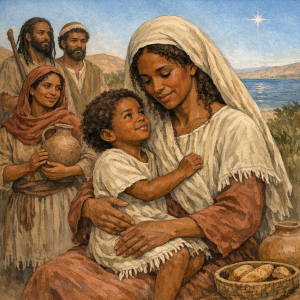
One especially influential later interpretation is stella maris, Latin for “star of the sea.” In Christian devotional usage, this title refers to Mary as a guide toward Christ, often using the image of a star guiding travelers across dangerous waters. It is spiritually important in Western Christian tradition, but it is not a secure literal translation of the oldest Hebrew form. Likewise, “sea of bitterness” and “drop of the sea” are historically influential interpretations, not settled lexical facts.
A careful dictionary definition therefore distinguishes between etymology and association. Mary is historically connected to Miriam; its ancient root is uncertain; and the name later accumulated layers of theological, poetic, and cultural meaning.
Cultural and Historical Context
The widespread use of Mary in Europe and the Americas cannot be explained merely as a linguistic development. Its extraordinary cultural influence resulted chiefly from Christianity, especially reverence for Mary, the mother of Jesus. As Christianity spread through the Roman world, Europe, and later colonial and immigrant communities, forms of the name became common across many languages.
Mary was used by queens, saints, writers, reformers, workers, immigrants, and ordinary families. The name therefore acquired both regal and domestic associations. Historical figures include Mary I of England, Mary II of England, Mary Queen of Scots, Mary Wollstonecraft, Mary Shelley, Mary McLeod Bethune, Mary Church Terrell, and many others. The recurrence of the name across social classes and nations reflects its broad religious and familial appeal rather than a single political or legal origin.
In English-speaking culture, Mary has often represented familiarity, respectability, maternal affection, and continuity with prior generations. Common expressions such as “Mary Jane,” “Mary Sue,” “Mary Ann,” “Mary had a little lamb,” and “Hail Mary” show that the name also developed secular, literary, sporting, and colloquial uses. These uses have distinct meanings depending on context and should not be confused with the personal name itself.
For much of United States naming history, Mary was among the most frequently given names for girls. Social Security Administration records, which begin with 1880 birth-year data, allow the public to trace its long prominence and later decline in relative popularity as parents increasingly chose a wider variety of names. A decline in ranking or frequency does not diminish the name’s historical importance; it instead illustrates a broader modern trend toward greater diversity in personal naming.
The name also remains important outside Christian-majority societies. Maryam is a widely used form in Muslim communities, while Miriam remains significant in Jewish communities. Thus, Mary and its cognates belong not solely to one nation or denomination, but to a broad family of Jewish, Christian, Muslim, and secular naming traditions.
Biblical / Torah Context
Miriam in the Torah
The earliest major biblical bearer of the related name is Miriam, the sister of Moses and Aaron. In Exodus, she watches over the infant Moses after he is placed among the reeds, helps arrange for his mother to nurse him, and later leads women in celebration after Israel’s passage through the sea. Exodus 15 describes her as “Miriam the prophetess,” identifying her as a woman with a recognized religious role in Israel’s foundational deliverance narrative.
Miriam’s story is not merely ceremonial. Numbers 12 recounts a conflict in which Miriam and Aaron speak against Moses, followed by Miriam’s punishment and restoration. The account presents both her significance within Israel and the seriousness of challenging divinely appointed leadership. Jewish interpretation has developed Miriam’s character in many directions: as prophetess, sister, leader, caretaker, and participant in Israel’s liberation.
For Torah-based study, it is important not to collapse Miriam automatically into the later New Testament Mary. They are historically connected through the name’s linguistic family, but they are distinct persons in distinct scriptural settings.
Mary in the New Testament
The New Testament uses Greek forms of the Miriam/Mary name for several women. The most prominent is Mary, the mother of Jesus. The Gospels portray her in connection with the annunciation, the birth and childhood of Jesus, the wedding at Cana in John’s Gospel, the crucifixion, and the early community of believers in Acts.
Luke especially presents Mary as one who receives God’s word in faith. Her response to the angel—often translated, “Let it be to me according to your word”—became central to Christian reflection on obedience, trust, and willing participation in God’s purpose. Luke also places on her lips the Magnificat, a hymn praising God’s mercy, justice, and faithfulness to the humble and poor.
Other New Testament women called Mary include Mary Magdalene; Mary of Bethany, sister of Martha and Lazarus; Mary the mother of James and Joses; and Mary the mother of John Mark. Because the name was common, readers should avoid assuming that every New Testament reference to “Mary” identifies the same woman.
Maryam in the Qur’an
Mary is also honored in Islam as Maryam, mother of Jesus—known in Arabic as Isa. The Qur’an gives Maryam a distinctive and honored place, including a chapter named after her, Surah Maryam. Islamic teaching affirms her chastity, devotion, and miraculous motherhood, while differing from Christian doctrines concerning the divinity of Jesus and certain later Marian teachings.
This shared reverence makes Mary/Maryam an important point of continuity, as well as theological difference, among Abrahamic religious traditions.
Legal Implications
In law, Mary is ordinarily a personal or given name used to identify a natural person. It is not, by itself, a legal classification. The name does not create a separate legal entity, a trust, an estate, a corporation, a governmental office, or a special jurisdiction.
At common law, a person’s name was generally understood as a means of identification, and a person could acquire or change a name through ordinary use and reputation, provided the change was not made for fraud or other unlawful purpose. That historical principle should be distinguished from present administrative law. Modern governments, banks, courts, employers, passport agencies, licensing bodies, and record systems commonly require documentary proof or a court order to update official records. The precise rules vary by jurisdiction.
A name appearing in capital letters, such as MARY SMITH, is ordinarily a typographical or administrative convention. It does not, without more, prove that a document refers to a different legal person, a corporation, or a “strawman.” Claims that capitalization alone divides a human being from a separate legal entity are not accepted principles of ordinary American law.
Marriage, Surnames, and Coverture
Historically, the common-law doctrine of coverture severely limited a married woman’s separate legal identity. William Blackstone famously described husband and wife as one person in law, with the wife’s legal existence substantially absorbed into that of the husband for many purposes. This doctrine affected property rights, contracts, litigation, earnings, and family authority.
Coverture was a historical legal doctrine, not a rule inherent in the name Mary or in womanhood itself. During the nineteenth and twentieth centuries, married women’s property acts, constitutional developments, and later statutes dismantled many of its restrictions. Modern law in the United States generally recognizes adult women as independent legal persons who may own property, contract, sue, be sued, vote, work, and hold names independently of a husband.
The widespread custom of a woman taking a husband’s surname upon marriage developed through social practice and legal convention, but it should not be overstated as an absolute common-law command applicable everywhere. Today, rules concerning surname changes, children’s names, vital records, identification documents, and court-approved name changes are principally governed by state statutes, regulations, and administrative procedures rather than a single universal rule of common law.
Practical Legal Meaning
For legal purposes, a person named Mary should use the name that appears on the relevant official record unless and until that record is lawfully corrected or changed. A discrepancy among a birth certificate, passport, Social Security record, marriage certificate, deed, court pleading, or bank account can create practical problems of identification. Such questions are document-specific and jurisdiction-specific; they are not resolved by etymology, spiritual interpretation, or capitalization theories.
This discussion is general historical and dictionary information, not legal advice. A person dealing with an actual name-change petition, identity record, inheritance matter, criminal case, contract, or property dispute should consult the applicable statutes, court rules, and qualified counsel in the relevant jurisdiction.
Spiritual Meaning
Spiritually, Mary has no single meaning shared by all people who bear the name. Meaning may arise from faith, family memory, personal character, or cultural inheritance. In Jewish reflection, the related name Miriam may evoke prophetic courage, deliverance, song, and leadership. In Christian reflection, Mary commonly evokes humility, faithfulness, receptivity to God, motherhood, compassion, and steadfastness amid suffering. In Islamic reflection, Maryam evokes purity, devotion, trust in God, and honored motherhood.
Roman Catholic and Eastern Orthodox traditions give Mary, the mother of Jesus, a particularly prominent place in devotion. Catholic teaching honors her as the Mother of God, meaning that Jesus Christ—whom Christians confess to be truly God and truly human—was born of her in his humanity. Catholic and Orthodox devotion may include feasts, hymns, icons, intercessory prayer, and titles such as Theotokos, “God-bearer.”
Many Protestant traditions honor Mary as the mother of Jesus and an example of faithful discipleship while rejecting or limiting forms of Marian devotion they believe lack sufficient biblical warrant. These differences are theological disputes within Christianity and should not be represented as mere disagreements about the definition of a name.
The dictionary’s interpretive analysis is that Mary’s enduring spiritual force comes less from any provable literal translation of ancient syllables than from the lives, narratives, and religious memories attached to Miriam, Mary, and Maryam across generations.
Modern Usage
Mary remains a recognized feminine given name throughout the English-speaking world. It may be used alone, as part of a compound name, or as a middle name. Examples include Mary Anne, Mary Beth, Mary Catherine, Mary Jane, Mary Jo, and Mary Lou. In some families, it is given to preserve the memory of a relative or religious ancestor.
The name is also used in titles and ordinary speech. “Hail Mary” may refer to a Christian prayer, a long and low-probability forward pass in American football, or any last-chance effort. “Mary Jane” may refer to a shoe style, a compound personal name, or, in some slang contexts, cannabis. “Mary Sue” is a modern literary criticism term for an unrealistically idealized fictional character. These expressions are context-dependent and do not alter the definition of Mary as a personal name.
Modern bearers may choose Mary for traditional, religious, familial, aesthetic, or purely personal reasons. No person named Mary should be presumed to hold a particular religious belief or cultural identity.
Controversies / Criticisms
The principal linguistic controversy concerns meaning. Assertions that Mary “definitely means” bitter, rebellious, beloved, sea of sorrow, wished-for child, or star of the sea go beyond what the evidence securely establishes. These interpretations may have value in devotional, literary, or family settings, but they should be identified as proposed or traditional meanings rather than certain translations.
A second area of controversy concerns Marian doctrine. Catholic, Orthodox, Protestant, and other Christian communities differ over titles, prayers, the perpetual virginity of Mary, the Immaculate Conception, the Assumption, and the proper degree of devotion. Those disagreements concern theology and church tradition, not whether Mary is an historically significant name.
A third concern is the misuse of names in pseudo-legal theories. A personal name may be important evidence of identity, but it is not a magical instrument that removes a person from statutes, courts, contracts, taxation, or lawful obligations. Historical common-law principles must be read together with enacted statutes, constitutional law, court decisions, and current procedural rules.
Conclusion
Mary is an ancient and influential feminine name whose English form descends through Greek and Latin from the biblical name Miriam. Its precise original etymology remains uncertain, despite many traditional explanations. Its historical importance arises from its place in the Torah, New Testament, Qur’an, Christian devotion, Jewish tradition, Muslim reverence, family naming practices, and the cultural history of many nations.
In common-law and modern legal settings, Mary is simply a personal name used for identification. It does not independently create rights, duties, status, or jurisdiction. Its deepest meanings are therefore found not in unsupported legal claims or forced translations, but in the documented history, faith traditions, and lived identities associated with the name.
Sources / Further Reading
- Social Security Administration, Popular Baby Names: https://www.ssa.gov/OACT/babynames/ ([ssa.gov](https://www.ssa.gov/OACT/babynames/index.html?TB_iframe=true&height=512.1&width=921.6&utm_source=openai))
- Social Security Administration / Data.gov, Baby Names from Social Security Card Applications—National Data: https://catalog.data.gov/dataset/baby-names-from-social-security-card-applications-national-data ([catalog.data.gov](https://catalog.data.gov/dataset/baby-names-from-social-security-card-applications-national-data?utm_source=openai))
- Jewish Encyclopedia, Miriam: https://www.jewishencyclopedia.com/articles/10874-miriam.html ([jewishencyclopedia.com](https://www.jewishencyclopedia.com/articles/10874-miriam.html?utm_source=openai))
- The Holy See, Catechism of the Catholic Church: Mary, Mother of Christ, Mother of the Church: https://www.vatican.va/content/catechism/en/part_one/section_two/chapter_three/article_9/paragraph_6_mary_-_mother_of_christ%2C_mother_of_the_church.html ([vatican.va](https://www.vatican.va/content/catechism/en/part_one/section_two/chapter_three/article_9/paragraph_6_mary_-_mother_of_christ%2C_mother_of_the_church.html?utm_source=openai))
- The Holy See, Catechism of the Catholic Church: Conceived by the Power of the Holy Spirit and Born of the Virgin Mary: https://www.vatican.va/content/catechism/en/part_one/section_two/chapter_two/artcile_3/paragraph_2_conceived_by_the_power_of_the_holy_spirit_and_born_of_the_virgin_mary.html ([vatican.va](https://www.vatican.va/content/catechism/en/part_one/section_two/chapter_two/artcile_3/paragraph_2_conceived_by_the_power_of_the_holy_spirit_and_born_of_the_virgin_mary.html?utm_source=openai))
- JSTOR, Married Women and the Law: Coverture in England and the Common Law World: https://www.jstor.org/stable/j.ctt32b7jq ([jstor.org](https://www.jstor.org/stable/j.ctt32b7jq?utm_source=openai))
- American Name Society, Manners Make Laws: Married Women’s Names in the United States: https://ans-names.pitt.edu/ans/article/download/1041/1040/2084 ([ans-names.pitt.edu](https://ans-names.pitt.edu/ans/article/download/1041/1040/2084?utm_source=openai))
- New Advent, Catholic Encyclopedia: The Name of Mary (historical reference; consult critically because it is not a modern linguistic authority): https://www.newadvent.org/cathen/09753a.htm ([newadvent.org](https://www.newadvent.org/cathen/09753a.htm?utm_source=openai))