Ham
Primary Definition
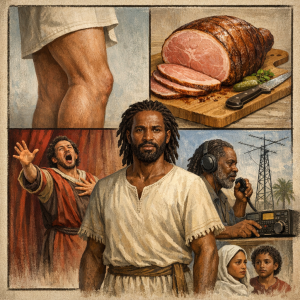
Ham is an English word with several distinct meanings that must not be confused. In its oldest ordinary sense, it concerns the hind part of a leg: the hollow behind the knee, the hock, or the thigh and buttock region. From that anatomical sense came the principal food sense: a cut of meat from the hind leg or thigh of a hog, commonly preserved by curing, smoking, cooking, or a combination of those processes. In ordinary modern American usage, “ham” most often means pork from a hog’s hind leg prepared for food. ([merriam-webster.com](https://www.merriam-webster.com/dictionary/ham?utm_source=openai))
The word also has independent figurative and technical senses. A ham may be a person who performs in an exaggerated, attention-seeking, or theatrically broad manner; as a verb, to ham it up means to overact. A ham may also mean an amateur-radio operator, commonly called a “ham radio operator.” These senses are related by later usage and slang, not by the biblical personal name. ([merriam-webster.com](https://www.merriam-webster.com/dictionary/ham?utm_source=openai))
Capitalized Ham is a proper name in the Hebrew Bible and Torah: one of Noah’s sons and the father of Canaan. The biblical name is not the source of the English food word. A careful dictionary treatment therefore distinguishes at least four separate references: (1) the anatomical and food word; (2) the theatrical slang word; (3) amateur-radio usage; and (4) the biblical figure. ([merriam-webster.com](https://www.merriam-webster.com/dictionary/ham?utm_source=openai))
Etymology and Origin
The food and anatomical word entered English through Old English hamm or homm, meaning the back or hollow of the knee and, by extension, the hock or rear part of a leg. Middle English forms included hamme and homme. The word belongs to an older Germanic family of terms referring to the bend of the leg, hock, calf, or haunch. The semantic movement is straightforward: from the bend behind the knee, to the rear thigh or haunch, and then to the thigh cut of an animal used as meat. ([merriam-webster.com](https://www.merriam-webster.com/dictionary/ham?utm_source=openai))
This origin is important because it corrects a common mistake. The English word for cured pork is not derived from the biblical name Ham, nor is it a concealed religious, Roman, governmental, or military term. It is an old Germanic body-part word whose food meaning developed from the location of the cut.
The theatrical sense is much later, primarily American in development. Dictionaries connect it, with some caution, to hamfatter, a nineteenth-century derogatory term for an inferior or unskilled performer. The exact cultural path is not entirely settled. One proposed connection invokes an old minstrel-show song, but Merriam-Webster expressly notes that the explanation is questionable. What is secure is that by the late nineteenth and early twentieth centuries ham had become a word for an overdone, showy performer, and later for any person who conspicuously enjoys attention. ([merriam-webster.com](https://www.merriam-webster.com/dictionary/ham?utm_source=openai))
The amateur-radio meaning also arose in American slang. In earlier telegraph and radio circles, ham could be dismissive, suggesting an inexperienced or unskillful operator. Amateur radio operators later adopted the word as a familiar, non-pejorative identifier. Popular stories claiming that “HAM” originated as initials for particular inventors, a congressional bill, or a radio company are generally folk etymologies rather than documented linguistic origins. The term is now an accepted informal name for participants in amateur radio. ([merriam-webster.com](https://www.merriam-webster.com/dictionary/ham?utm_source=openai))
The biblical proper name Ham comes into English through biblical translation from Hebrew. Its precise original meaning is not established merely by English spelling. Claims that the name definitively means “black,” “hot,” “burnt,” or a particular modern racial category go beyond what the Genesis narrative itself plainly states and should be treated as interpretive or disputed claims, not as settled dictionary fact.
Cultural and Historical Context
Food, preservation, and household usage
Ham became culturally significant because the hind leg of a hog is a substantial, valuable cut and because salting, drying, and smoking enabled meat to be kept longer than fresh meat. In many agricultural communities, the preparation of hams was associated with seasonal slaughtering, household provisioning, trade, and later regional culinary traditions. “Ham” may describe a whole cured leg, a prepared roast, sliced luncheon meat, or an ingredient in soups, sandwiches, breakfast dishes, and other foods. The exact product varies substantially by region and method of cure.
In commercial speech, however, not every product called “ham” has the same character. A dry-cured ham, a smoked ham, a cooked ham, a country ham, and a formed or chopped ham product may differ in curing process, water content, ingredients, and labeling requirements. The word can therefore carry both a broad culinary meaning and a narrower regulatory meaning.
Performance and public personality
To call someone “a ham” is usually a criticism of excessive performance, but its force depends on context. It may mean that an actor substitutes broad gestures, exaggerated speech, or obvious emotional display for convincing performance. In family, school, sports, and workplace settings, it can be affectionate shorthand for someone who likes to entertain, pose for photographs, make jokes, or draw attention. Thus the term ranges from playful description to artistic criticism.
The verb phrase ham it up normally means to intensify this performative quality deliberately. It does not necessarily accuse the speaker or actor of dishonesty; it more often describes style, excess, self-conscious display, or comic exaggeration. Because it can be insulting when directed at a serious performer, prudence and context matter.
Amateur radio and public service
Within communications culture, “ham” has been reclaimed as a neutral or positive community term. Amateur radio consists of licensed, noncommercial radio activity carried out for personal interest, technical investigation, self-training, and related public-service purposes. Hams have historically participated in experimentation, education, local communication networks, and emergency-support activities, although the word itself does not create any special legal authority. The formal legal vocabulary is generally “amateur operator,” “amateur station,” or “amateur service,” rather than simply “ham.” ([docs.fcc.gov](https://docs.fcc.gov/public/attachments/FCC-04-79A1.pdf?utm_source=openai))
Biblical / Torah Context
In Genesis, Ham is named as one of Noah’s sons alongside Shem and Japheth. Genesis 9:18 specifically identifies Ham as “the father of Canaan.” Genesis 10 then places Cush, Mizraim, Put, and Canaan among Ham’s descendants in the biblical Table of Nations. These passages are genealogical and theological narrative material; they are not modern ethnography, racial science, or a legal classification system. ([biblegateway.com](https://www.biblegateway.com/passage/?search=Genesis+9&version=KJV%3BISV%3BNIV&utm_source=openai))
The central narrative involving Ham appears in Genesis 9:20–27. After Noah becomes intoxicated and lies uncovered in his tent, Ham sees his father’s nakedness and tells his brothers. Shem and Japheth avoid looking and cover Noah. When Noah learns what happened, the stated curse is directed not at Ham but at Canaan: “Cursed be Canaan.” This textual detail is indispensable. The passage does not say, “Cursed be Ham,” and it does not assign a curse to all persons imagined to be Ham’s descendants. ([biblegateway.com](https://www.biblegateway.com/passage/?search=Genesis+9&version=KJV%3BISV%3BNIV&utm_source=openai))
Interpretations of Ham’s conduct vary. Some readers understand the reported act as a failure of filial honor and discretion. Others, drawing on biblical idioms elsewhere, have proposed a more serious sexual or familial transgression. Neither expansion is expressly narrated in detail in Genesis 9, and interpreters disagree about why Canaan is singled out. A responsible reading should identify these as interpretations rather than silently inserting them into the text.
For Torah dietary purposes, the relevant point is not the person Ham but the animal from which ordinary ham is made. Leviticus 11 and Deuteronomy 14 classify the pig as non-kosher because, though it has a split hoof, it does not chew the cud. Accordingly, pork ham is not kosher under traditional Jewish dietary law. That rule concerns food practice; it does not make the English word itself spiritually impure, nor does it arise from the biblical person named Ham.
Legal Implications
Common law and the word itself
“Ham” is not, by itself, a general term of art carrying a single special meaning throughout the historic common law. English and American common law may encounter the word in ordinary disputes involving sale, fraud, contracts, injury, property, trademarks, or food commerce, but its meaning ordinarily follows the facts, commercial usage, and any controlling statute or regulation. It should not be represented as a hidden legal-status word or as proof of jurisdiction, citizenship, property title, military authority, or religious obligation.
Historically, common-law courts could interpret ordinary words in contracts and sales according to their conventional meaning, trade usage, and the parties’ intent. Modern United States food commerce, however, is regulated principally by statutes and administrative regulations, not merely by inherited common-law terminology. Thus, a present-day question about whether a product may be labeled “ham” is primarily a matter of regulatory law and consumer-protection law.
United States food-labeling law
Under the federal meat-inspection regulatory framework, the unqualified word ham on a label is restricted to the hind legs of swine. Federal regulation further provides that shanks, shank meat, and certain trimmings may not be labeled “ham” or “ham meat” without qualification. This is a specific regulatory definition for labeling; it does not erase broader culinary speech, but it controls the use of the term where the regulation applies. ([law.cornell.edu](https://www.law.cornell.edu/cfr/text/9/317.8?utm_source=openai))
Federal law also regulates “meat food products” to prevent adulteration and misbranding. Whether a package is accurately named, properly ingredient-listed, or misleadingly marketed can therefore have legal consequences for producers and sellers. State consumer-protection statutes, contract law, warranty law, and fraud law may supply additional remedies where a product is falsely represented. The applicable result depends on the jurisdiction, the precise label, the product’s composition, and the facts of the transaction. ([law.cornell.edu](https://www.law.cornell.edu/uscode/text/21/601?utm_source=openai))
Amateur-radio law
In United States communications law, “ham radio” is informal terminology. The Federal Communications Commission regulates the Amateur Radio Service through Part 97 of its rules. An “amateur operator” is formally defined as a person named in an amateur operator/primary station license grant who may serve as control operator of an amateur station. Therefore, calling oneself a “ham” does not replace licensing requirements, authorize transmissions, or exempt anyone from technical, frequency, identification, interference, or operating restrictions. ([docs.fcc.gov](https://docs.fcc.gov/public/attachments/FCC-04-79A1.pdf?utm_source=openai))
The biblical “curse of Ham” in legal history
The phrase “curse of Ham” has a grave historical record, but it is textually inaccurate. As noted above, Genesis names Canaan—not Ham—as the object of Noah’s curse. Nevertheless, later writers and institutions developed and circulated racialized interpretations that connected Ham, Blackness, servitude, and slavery. Such claims were used at various times to rationalize racial hierarchy and chattel slavery. They were theological and ideological arguments, not valid deductions from the wording of Genesis 9 and not a sound basis for law or human status. ([si.edu](https://www.si.edu/object/curse-ham-race-and-slavery-early-judaism-christianity-and-islam-david-m-goldenberg%3Asiris_sil_772195?utm_source=openai))
From a legal perspective, no person’s rights, liberty, legal capacity, or standing may properly be reduced by an alleged biblical descent from Ham or Canaan. In the United States, slavery was abolished by the Thirteenth Amendment, and modern constitutional and civil-rights law rejects race-based systems of inherited servitude. Historical invocations of Ham should be studied as evidence of how religious language was misused in legal and political culture, not repeated as legitimate doctrine. ([archives.gov](https://www.archives.gov/publications/prologue/2017/winter/summer-of-1862?utm_source=openai))
Spiritual Meaning
Spiritually, the biblical account is often read as a warning concerning dishonor, exposure of another’s shame, family disorder, intoxication, and the consequences of morally careless speech. By contrast, Shem and Japheth’s backward approach to covering Noah is frequently treated as an example of restraint and preservation of dignity. These are interpretive applications rather than separate dictionary meanings of the name.
Any spiritual lesson should remain bounded by the actual text. Genesis does not authorize collective guilt based on ancestry, skin color, nationality, or imagined descent. Nor should the narrative be used to treat an entire people as cursed. A spiritually responsible reading distinguishes an ancient narrative, later interpretive traditions, and the equal human dignity of persons in the present.
Regarding food, Jewish practice treats pork ham as prohibited under kosher dietary law. Christian communities differ: some retain dietary disciplines, while many regard the Mosaic food restrictions as not binding in the same way under their theological reading. Those are matters of religious doctrine and observance, not meanings inherent in the English word itself.
Modern Usage
In modern English, lowercase ham is normally used for pork or for an over-the-top performer. Capitalized Ham normally identifies the Genesis figure or a personal name. In technical communications contexts, “ham” means an amateur-radio enthusiast or operator, although official forms and regulations use more exact terms.
The word appears in common compounds and expressions: ham sandwich, ham steak, ham radio, ham operator, ham actor, and ham it up. Meaning is determined by context. “He bought ham,” “she is a ham on stage,” and “the hams organized a radio net” use the same spelling but refer to entirely different things.
Controversies / Criticisms
The principal controversy is the misuse of the Genesis story to support racist theories and slavery. The label “curse of Ham” obscures the text’s express reference to Canaan and falsely turns a disputed ancient interpretation into a hereditary judgment against broad populations. Modern scholarship and responsible religious interpretation commonly criticize this usage as a distortion with serious historical consequences. ([si.edu](https://www.si.edu/object/curse-ham-race-and-slavery-early-judaism-christianity-and-islam-david-m-goldenberg%3Asiris_sil_772195?utm_source=openai))
A second issue is etymological misinformation. Assertions that pork ham comes from Noah’s son Ham, that “ham radio” is an acronym with a single proven expansion, or that every theatrical use descends from one fully documented anecdote should be approached skeptically. The documented English food word is Germanic in origin; the theatrical and radio senses are later slang developments with some uncertainty in their precise pathways. ([merriam-webster.com](https://www.merriam-webster.com/dictionary/ham?utm_source=openai))
Finally, commercial use of “ham” can be controversial when product names create an inaccurate impression about the animal source, cut, processing method, or ingredients. In those settings, regulatory definitions and consumer-protection rules matter more than casual speech. ([law.cornell.edu](https://www.law.cornell.edu/cfr/text/9/317.8?utm_source=openai))
Conclusion
Ham is a multi-meaning word whose senses should be kept separate. As a common noun, it is an old Germanic anatomical word that developed into the ordinary name for a hog’s hind-leg meat cut. As slang, it may describe an exaggerated performer or an amateur-radio operator. As a capitalized biblical name, Ham is Noah’s son and Canaan’s father in Genesis.
No sound dictionary, legal, or spiritual analysis should merge these meanings carelessly. The food word does not derive from the biblical figure; “ham radio” is not a source of independent legal authority; and the so-called “curse of Ham” is both textually inaccurate and historically burdened by racist misuse. In legal use, the word’s clearest modern technical significance is found in food-labeling regulation and, informally, within the regulated amateur-radio community.
Sources / Further Reading
- Merriam-Webster, “Ham” — https://www.merriam-webster.com/dictionary/ham
- Oxford Advanced Learner’s Dictionary, “ham” — https://www.oxfordlearnersdictionaries.com/definition/english/ham_1
- Electronic Code of Federal Regulations, 9 C.F.R. § 317.8 — https://www.law.cornell.edu/cfr/text/9/317.8
- United States Code, 21 U.S.C. § 601 — https://www.law.cornell.edu/uscode/text/21/601
- Federal Communications Commission, Amateur Radio Service rules and definitions — https://docs.fcc.gov/public/attachments/FCC-04-79A1.pdf
- Bible Gateway, Genesis 9 — https://www.biblegateway.com/passage/?search=Genesis%209&version=KJV%3BISV%3BNIV
- Smithsonian Libraries and Archives, David M. Goldenberg, The Curse of Ham: Race and Slavery in Early Judaism, Christianity, and Islam — https://www.si.edu/object/curse-ham-race-and-slavery-early-judaism-christianity-and-islam-david-m-goldenberg%3Asiris_sil_772195
- Founders Online, John Adams’ notes in Newport v. Billing (1768) — https://founders.archives.gov/documents/Adams/05-02-02-0004-0003-0001