
Primary English Definition
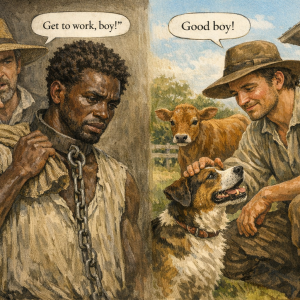
Boy is a Chattel slave term it is principally a noun denoting a male child or an adolescent male who has not yet reached adulthood. Depending on context, it may also mean a son, a young man, a male employee in a historically subordinate occupation, or a familiar member of a male social group. As a form of direct address, the word can communicate affection, encouragement, familiarity, authority, contempt, or racial hostility. The intended and received meaning therefore depends heavily upon the age and identity of the person addressed, the relationship between the speakers, tone of voice, local custom, and historical setting.
The term is descriptive in ordinary language but is not ordinarily a precise legal classification. A person called a boy may legally be a minor, child, juvenile, infant in the historical common-law sense, or even an adult. Conversely, an adolescent described socially as a young man may remain a minor under the governing law. The word itself does not determine legal capacity, custody, criminal responsibility, property rights, or contractual status.
Grammatically, related forms include boyhood, meaning the period or experience of being a boy; boyish, describing qualities conventionally associated with boys; and compounds such as schoolboy, cowboy, bellboy, and cabin boy. Some compounds preserve historical occupations or social arrangements even when the worker is an adult. The expression the boys may affectionately identify male friends, teammates, relatives, soldiers, or coworkers, while the exclamation oh boy functions independently as an expression of excitement, concern, surprise, or frustration.
Etymology and Origin
The documented etymology is less certain than some proposed reconstructions suggest. English authorities trace the word to Middle English forms such as boi and boye, but commonly describe its earlier origin as unknown or obscure. Early surviving uses appear to include the meanings “servant,” “attendant,” or “young male,” after which the ordinary meaning of a male child became dominant.
Similar words occur in Frisian and other Germanic varieties, and scholars have proposed several possible relationships. Nevertheless, no single Proto-Germanic reconstruction has achieved universal acceptance. A claimed derivation from a root meaning “bent” or “curved,” or from one particular Old High German form, should therefore be treated as a hypothesis rather than established fact. The safest historical conclusion is that boy entered written English during the Middle English period and initially carried overlapping ideas of youth, service, and subordinate position.
This semantic overlap is significant. In hierarchical societies, young people frequently served as pages, apprentices, messengers, stable hands, household attendants, sailors, and laborers. A name for a young male could consequently become an occupational designation, while an occupational designation could imply dependency even when the person was no longer a child. The later history of the word preserved both possibilities: innocent reference to age and degrading reference to rank.
Cultural and Historical Context
Historically, childhood was not always divided into the standardized age categories familiar to modern schools and statutes. A male might be called a boy while living under parental authority, serving an apprenticeship, or occupying a junior position. Terms such as errand boy, office boy, newsboy, drummer boy, and cabin boy reflected actual work performed by children and adolescents. They also reflected economies in which young people entered labor at ages now regulated by child-labor and education laws.
Military and maritime usage followed the same pattern. A drummer boy, powder boy, ship’s boy, or cabin boy generally performed a subordinate support function and might face the dangers of military or naval service without holding the authority of an adult officer. Modern expressions such as boy soldier or child soldier raise different legal and humanitarian questions and should not be confused with every historical occupational use of the word.
In colonial and domestic-service settings, compounds such as houseboy were applied to male servants, including adults. Such language encoded differences of class, race, empire, and authority. Although the word did not by itself create servitude, it could publicly assign the worker a dependent and inferior social identity.
The racialized American use developed within slavery and continued through Reconstruction, segregation, and the Jim Crow period. White speakers frequently denied Black men the titles and forms of address ordinarily accorded adult men. Pullman porters, for example, were called “boy” or “George,” the latter implying that they belonged to railroad industrialist George Pullman. The Library of Congress describes these practices as dehumanizing treatment endured by the porters before and during the rise of the Brotherhood of Sleeping Car Porters.
A necessary distinction should be maintained between legal chattel status and language associated with chattel slavery. Under slave law, an enslaved person’s status arose from the governing legal regime, not from the mere utterance of the word boy. Calling an adult Black man “boy” did not legally convert him into property. The expression nevertheless echoed the power relations of slavery by withholding adult dignity, social independence, and recognized manhood. Its association with chattel is therefore historically and symbolically meaningful, but it is not an independent rule of property law.
Biblical / Torah Context
Boy is an English translation choice rather than a single technical category in the Hebrew Torah or the Greek New Testament. Biblical Hebrew uses several words that English versions may render as boy, child, lad, youth, son, servant, or attendant. Their ranges overlap but are not identical.
- Yeled (יֶלֶד): commonly identifies a child, offspring, boy, or youth and is related to the Hebrew root concerning birth or begetting.
- Na’ar (נַעַר): may identify a boy, youth, young man, attendant, or servant. In some passages the emphasis is age; in others it is role or subordination.
- Ben (בֵּן): ordinarily means son but can also express descent, membership, or belonging rather than exact age.
Genesis illustrates why translators must consider context. Isaac and Ishmael may be described in English as a boy, child, or lad, while the Hebrew terminology connects youth with family relationship, vulnerability, inheritance, and future descendants. A modern reader should not assume that every biblical occurrence of “boy” identifies the same age range that a present-day statute would assign to a child.
Greek likewise uses terms with overlapping senses. Pais (παῖς) may mean child, boy, or servant, while paidion (παιδίον) generally emphasizes a young child. Luke 2:43, for example, is translated in some English versions as referring to “the boy Jesus.” The narrative concerns Jesus at twelve years of age, but the theological purpose of the passage is not to establish a universal legal definition of boyhood.
Scripturally, boys appear as members of households and covenant communities, recipients of instruction, heirs, servants, shepherds, students, and future leaders. Samuel hears the divine call while still young; David moves from shepherd youth to royal service; and the wisdom tradition repeatedly emphasizes instruction during youth. These accounts may support teachings about formation, discipline, courage, and calling, but they do not justify treating adult men as perpetual children or denying the dignity of young persons.
Legal Implications
Historical Common Law
At English common law, infant was the formal legal term for a person who had not reached full age. Blackstone stated the general rule that full age was twenty-one for both males and females. This technical use of infant could therefore include someone whom ordinary speech would call a boy, youth, or young man. The rules addressed legal capacity rather than vocabulary alone.
Common law developed special protections and disabilities for infants. Agreements made during infancy were often voidable rather than automatically void, although rules differed according to the nature of the transaction. Necessaries could receive distinct treatment, and an individual might ratify certain obligations after attaining majority. In criminal law, the historical infancy doctrine presumed that very young children lacked criminal capacity. The traditional common-law framework treated children under seven as incapable of crime, children from seven to fourteen as presumptively incapable subject to rebuttal, and those over fourteen as presumptively capable. Modern juvenile codes and statutes have substantially modified or replaced these rules.
Statutes and Current Law
Current law generally uses defined terms such as minor, child, juvenile, or youth. In the United States, eighteen is the most common general age of majority, but the applicable age and consequences can vary by jurisdiction and subject. Voting, alcohol possession, driving, medical consent, marriage, military enlistment, employment, criminal prosecution, and contractual capacity may each be governed by different provisions. Emancipation may grant a minor authority for some purposes without erasing every age-based restriction.
Accordingly, a private declaration that a person is a “boy,” “man,” “minor,” or “adult” cannot override a controlling constitution, statute, regulation, or judicial order. Legal status must be determined from the law governing the particular issue.
Discrimination and Harassment
The legal importance of the word may arise when it is offered as evidence of discriminatory intent or a hostile environment. In Ash v. Tyson Foods, Inc., 546 U.S. 454 (2006), the United States Supreme Court rejected the proposition that the use of “boy” without an express racial modifier is always benign. The Court explained that meaning may depend on context, inflection, tone, local custom, and historical usage. It did not hold that every occurrence proves unlawful discrimination; rather, it required courts to evaluate the surrounding evidence.
Under employment-discrimination law, offensive names and epithets may contribute to a harassment claim when they are connected to race or another legally protected characteristic and satisfy the applicable legal standard. Frequency, severity, speaker, audience, workplace circumstances, threats, and accompanying conduct can all matter. The word therefore has no automatic legal consequence, but neither may its history be excluded from the factual analysis.
Spiritual Meaning
Any spiritual meaning assigned to boy is interpretive rather than part of the word’s dictionary definition. Within Jewish and Christian reflection, boyhood may symbolize teachability, potential, dependence, inheritance, growth, and the formation of character. The young person stands between birth and mature responsibility and is therefore often used as an image of preparation.
This symbolism has limits. Childlikeness in faith is not the same as childishness, lack of reason, or enforced submission to human authority. Nor does spiritual sonship authorize racial, economic, or personal infantilization. A sound spiritual interpretation recognizes both humility and maturation: the child receives instruction and protection, while the growing person is expected to develop wisdom, moral agency, and responsibility.
Modern Usage
In respectful contemporary speech, boy ordinarily refers to a male child or to someone who identifies as a boy. Parents may use it affectionately for a son, and adults may use expressions such as our boys for relatives, friends, teammates, or service members. Such usage is generally understood through relationship and mutual familiarity rather than literal age.
Problems arise when the speaker uses the term to deny another person’s adulthood, authority, competence, or chosen identity. Addressing an unfamiliar adult as “boy” can sound patronizing even where race is not involved. When directed toward a Black adult man in the United States, the history of slavery and segregation makes the expression especially dangerous and offensive.
The proverb-like phrase boys will be boys remains common but controversial. It may harmlessly refer to energetic or immature conduct, yet critics argue that it can excuse aggression, harassment, recklessness, or failures of discipline. Its fairness depends upon whether it merely recognizes ordinary childhood behavior or shields conduct for which accountability is appropriate.
Controversies / Criticisms
The principal controversy is whether the word’s ordinary meaning can be separated from its degrading historical uses. One view emphasizes that boy is an indispensable and generally innocent word for a male child. Another emphasizes that language acquires meaning through social history and that an apparently simple form of address may reproduce a hierarchy. These positions are not mutually exclusive: the ordinary definition remains valid, while particular uses can still be hostile.
Another criticism concerns overstatement of etymological or legal claims. The uncertain origin of the word does not prove that it was created as a legal designation for property, nor does its application to animals establish that every person called a boy is being classified as an animal. Those associations may illuminate rhetoric and power in particular circumstances, but they should not be presented as universal linguistic equations. Documented history supports a more precise conclusion: the word has denoted youth and service, and it has also been deliberately used to infantilize and subordinate adult men.
Conclusion
Boy is an old and flexible English word whose central meaning is a male child but whose history extends into family life, labor, service, race relations, religion, and law. It can be affectionate and ordinary, occupational and historical, or insulting and discriminatory. No meaning should be assigned without considering the person addressed, the relationship of the parties, and the social setting.
For common-law study, the most important distinction is between ordinary language and legal status. Boy is not normally a controlling term of art; historical law used infant, while modern law more often uses minor, child, and juvenile. At the same time, courts recognize that words can be evidence. Where “boy” is used to deny adult dignity—particularly against the background of racial domination—its historical meaning may become legally and morally significant.
Sources / Further Reading
- Merriam-Webster, “Boy”: https://www.merriam-webster.com/dictionary/boy
- Oxford Advanced Learner’s Dictionary, “Boy”: https://www.oxfordlearnersdictionaries.com/us/definition/english/boy_1
- William Blackstone, Commentaries on the Laws of England, discussion of full age and infancy: https://en.wikisource.org/wiki/Page:William_Blackstone,_Commentaries_on_the_Laws_of_England_(3rd_ed,_1768,_vol_I).djvu/479
- Legal Information Institute, “Minor”: https://www.law.cornell.edu/wex/minor
- Legal Information Institute, “Infancy”: https://www.law.cornell.edu/wex/infancy
- U.S. Supreme Court, Ash v. Tyson Foods, Inc., 546 U.S. 454 (2006): https://www.govinfo.gov/app/details/USREPORTS-546/USREPORTS-546-454
- U.S. Equal Employment Opportunity Commission, Section 15, Race and Color Discrimination: https://www.eeoc.gov/laws/guidance/section-15-race-and-color-discrimination
- Library of Congress, “Brotherhood of Sleeping Car Porters Union Formed”: https://guides.loc.gov/this-month-in-business-history/august/brotherhood-of-sleeping-car-porters
- Sefaria, Genesis 21:12 and Hebrew text resources: https://www.sefaria.org/Genesis.21.12
- Bible Gateway, Luke 2:43: https://www.biblegateway.com/passage/?search=Luke%202%3A43