Black People
Primary Definition
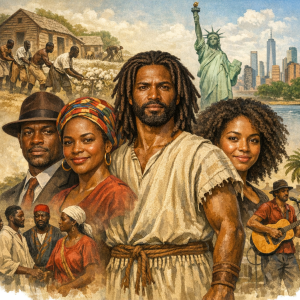
Black people is a broad social, cultural, historical, and governmental expression referring to persons who identify, or are identified by others, as belonging to populations associated with African ancestry and the African diaspora. In ordinary modern English, the term most often concerns identity, community, ancestry, and shared experiences of racialization rather than a scientifically discrete biological division of humanity.
The expression is not perfectly interchangeable with African American. In the United States, African American commonly refers to Americans whose ancestry and historical identity are connected to Africa, especially descendants of persons enslaved in the United States. Black is often broader: it may include African Americans, recent African immigrants, Afro-Caribbean people, Afro-Latino people, and other persons of African descent. Individual preference, nationality, ethnicity, and context should therefore be respected.
Federal statistical terminology has changed over time. The United States Office of Management and Budget’s 2024 standards retain Black or African American as a minimum race-or-ethnicity reporting category. Such categories are administrative tools for statistics, civil-rights enforcement, and program evaluation; they do not establish biological races or determine an individual’s legal rights merely by assigning a label. ([spd15revision.gov](https://spd15revision.gov/content/spd15revision/en/2024-spd15.html?utm_source=openai))
From a common-law dictionary perspective, the expression should not be treated as a title of inferior or superior legal status. A person’s complexion or assigned racial category does not, in contemporary American law, change that person’s fundamental legal personality. The relevant legal questions ordinarily concern citizenship, jurisdiction, individual rights, discrimination, evidence, and the particular statute or constitutional provision involved.
Etymology and Origin
The adjective black descends through Middle English blak from Old English blæc, meaning dark or of the color of soot or coal. Etymologists connect it with Germanic words associated with burning or a burned appearance. English used the adjective for dark-skinned persons long before the modern racial systems of Europe and the Americas were fully formed. The noun referring to an African or dark-skinned person is documented in early modern English, although older records contain inconsistent spelling and terminology. ([etymonline.com](https://www.etymonline.com/word/black?utm_source=openai))
Color words became social classifications through historical usage, government recordkeeping, colonial expansion, slavery, and later theories of race. The modern racial meaning is therefore not simply the literal description of a skin color. Human complexions occur across a wide range, and many people called Black are not literally black in color. The word functions as a conventional identity term shaped by history.
English-language labels have repeatedly changed. Terms such as colored, Negro, Afro-American, Black, and African American have each appeared in institutions, journalism, organizations, and public surveys. Some older words remain in the historical names of organizations or documents but may be offensive or inappropriate when applied to people today. American survey terminology moved substantially from colored to Negro, then toward Black and African American. ([pewresearch.org](https://www.pewresearch.org/social-trends/2010/01/25/racial-labeling-in-survey-questions/?utm_source=openai))
Cultural and Historical Context
The expression encompasses extraordinary diversity. Africa contains many nations, peoples, languages, religions, and cultural traditions. The African diaspora likewise includes communities formed through voluntary migration, forced migration, the transatlantic slave trade, colonialism, and movement among Africa, Europe, the Caribbean, Latin America, North America, and other regions. A racial umbrella must not erase distinctions among Yoruba, Akan, Igbo, Somali, Ethiopian, Haitian, Jamaican, Afro-Brazilian, Afro-Cuban, African American, and numerous other identities.
In British North America and the United States, racial categories became closely connected to hereditary chattel slavery. Colonial legislatures enacted slave codes and other positive laws regulating the status of enslaved and free persons of African descent. These systems restricted movement, family life, property, testimony, education, labor, and access to courts. Free Black communities nevertheless existed throughout the colonial and early national periods and participated in trades, religious institutions, abolitionism, education, military service, and civic life. ([loc.gov](https://www.loc.gov/classroom-materials/immigration/african/africans-in-america/?utm_source=openai))
After the Civil War and emancipation, Reconstruction amendments and legislation promised citizenship and civil equality. Those promises were resisted through Black Codes, racial violence, disfranchisement, segregation, and the system later called Jim Crow. Black communities responded by establishing schools, churches, mutual-aid societies, newspapers, businesses, professional associations, labor organizations, and civil-rights movements. ([archives.gov](https://www.archives.gov/education/lessons/brown-v-board/timeline.html?utm_source=openai))
During the twentieth century, the New Negro movement, Harlem Renaissance, modern Civil Rights Movement, Black Power movement, and “Black is beautiful” movement altered public language and cultural identity. The adoption of Black as a self-affirming name rejected the idea that blackness was shameful. It emphasized political agency, cultural achievement, natural hair, varied complexions, historical memory, and solidarity. This development did not produce a single ideology: integrationists, nationalists, socialists, conservatives, liberals, religious leaders, and other groups offered different understandings of Black identity and political action. ([loc.gov](https://www.loc.gov/pictures/item/tgm001071/?utm_source=openai))
Military and Governmental Context
Black men and women have served in American military conflicts from the colonial era onward, often while being denied equal civil rights. More than 180,000 Black men served in the United States Colored Troops during the Civil War. Later units included the Buffalo Soldiers, segregated World War formations, the Tuskegee Airmen, and many other combat and support organizations. ([history.army.mil](https://history.army.mil/Publications/Publications-Catalog/Freedom-by-the-Sword/?utm_source=openai))
On July 26, 1948, President Harry S. Truman issued Executive Order 9981, declaring equality of treatment and opportunity in the armed forces without regard to race, color, religion, or national origin. Implementation met resistance and occurred gradually, but the order became a major governmental step toward military integration. ([archives.gov](https://www.archives.gov/milestone-documents/executive-order-9981?utm_source=openai))
Biblical / Torah Context
The Torah and the wider Hebrew Bible do not employ the modern English racial category Black as a classification equivalent to contemporary American or European usage. Biblical texts refer to peoples, lands, lineages, kingdoms, tribes, and nations, including Egypt, Cush, Canaan, and others. Translating those ancient identities directly into modern racial categories is historically uncertain and can create misleading conclusions.
A particularly important distinction concerns the so-called “curse of Ham.” In Genesis 9:25–27, Noah’s words are directed against Canaan, not against every descendant of Ham. The passage does not state that black skin is a curse, does not identify all African peoples as Canaanites, and does not create a perpetual divine command to enslave people of African descent. Interpretations connecting the passage to Black skin and hereditary African servitude developed through later traditions and were employed by some defenders of slavery. Such racial interpretations are widely rejected as unsupported by the actual wording and historical setting of the text. ([americanbible.org](https://www.americanbible.org/engage/bible-resources/articles/the-alleged-curse-on-ham/?utm_source=openai))
Accordingly, claims that the Torah establishes Black people as an accursed or naturally servile class are disputed theological constructions, not a plain statement of Genesis. The dictionary’s interpretive conclusion is that using this passage to deny another person’s dignity, liberty, or legal personality reverses the moral responsibility of the reader: an obscure ancient narrative becomes a pretext for a system imposed by later human authorities.
Legal Implications
Historical Common Law and Positive Law
Historical English common law did not create “Black” as a comprehensive legal status. The most famous common-law authority concerning an enslaved African in England is Somerset v. Stewart (1772). Lord Mansfield held that James Somerset could not be forcibly removed from England for sale abroad because the claimed power of enslavement lacked sufficient support in English positive law. The precise reach of the decision remains debated, and it did not abolish slavery throughout the British Empire, but it stands for the important proposition that a condition as severe as slavery could not simply be presumed or introduced through private assertion. ([heritagecollections.parliament.uk](https://heritagecollections.parliament.uk/stories/the-transatlantic-slave-trade/?utm_source=openai))
This history must be distinguished from colonial and American law. Racial slavery in the colonies was sustained through legislation, local practice, property rules, enforcement institutions, and judicial decisions. It was not merely a neutral inheritance from an unchanging universal common law. The relevant sources included slave codes, statutes governing descent and status, restrictions on free Black persons, and constitutional compromises.
United States Constitutional Development
In Dred Scott v. Sandford (1857), the United States Supreme Court denied federal citizenship to Dred Scott and broadly asserted that persons descended from enslaved Africans were not included as citizens under the Constitution as the majority interpreted it. The decision is now repudiated and was displaced by the Civil War amendments. The Thirteenth Amendment abolished slavery and involuntary servitude except as punishment for crime; the Fourteenth established birthright citizenship, due process, and equal protection; and the Fifteenth prohibited denial of voting rights on account of race, color, or previous condition of servitude. ([archives.gov](https://www.archives.gov/milestone-documents/dred-scott-v-sandford?utm_source=openai))
Later constitutional and statutory developments attacked segregation and racial exclusion. Brown v. Board of Education (1954) held state-mandated racial segregation in public schools unconstitutional. The Civil Rights Act of 1964 addressed discrimination in public accommodations, federally assisted programs, and employment. The Voting Rights Act of 1965 prohibited racially discriminatory voting practices, while the Fair Housing Act of 1968 addressed discrimination in housing. ([archives.gov](https://www.archives.gov/milestone-documents/brown-v-board-of-education?utm_source=openai))
Current Civil-Rights Meaning
Modern federal law generally uses race and color as protected characteristics, not as grants of different grades of personhood. Title VII prohibits covered employers from discriminating because of race or color. It can apply to intentional unequal treatment, racial harassment, certain unjustified practices having a discriminatory impact, and discrimination based on association or perceived race. Color discrimination is related to but distinct from race discrimination and may occur between members of the same racial community. ([eeoc.gov](https://www.eeoc.gov/laws/guidance/section-15-race-and-color-discrimination?utm_source=openai))
Section 1981 of Title 42 guarantees all persons equal rights concerning contracts and specified legal protections. Its historical wording compares those rights with those enjoyed by white citizens, reflecting its Reconstruction-era purpose, but its operative protection extends to all persons within United States jurisdiction. ([law.cornell.edu](https://www.law.cornell.edu/uscode/text/42/1981?utm_source=openai))
Government classifications expressly based on race are ordinarily subject to demanding constitutional review. In 2023, the Supreme Court’s decision in Students for Fair Admissions v. Harvard substantially restricted the use of race in civilian college admissions. That decision did not erase laws forbidding discrimination, nor did it make racial identity legally irrelevant in every setting. The legality of any race-conscious policy depends on the governing constitutional provision, statute, governmental purpose, remedy, and factual record. ([supremecourt.gov](https://www.supremecourt.gov/opinions/22pdf/20-1199_hgdj.pdf?os=ios&utm_source=openai))
Spiritual Meaning
No complexion carries an inherent spiritual rank. The idea that physical darkness signifies moral corruption is a metaphorical association found in some languages and literature, but applying that symbolism to human populations is neither a necessary theological conclusion nor a sound rule of interpretation.
Within many Black religious traditions, Black identity has instead become associated with survival, communal responsibility, liberation, justice, remembrance, and hope. Black churches historically served not only as places of worship but also as centers of education, mutual aid, leadership development, political organization, and civil-rights activity. Black theology and other liberation-oriented traditions commonly interpret spiritual freedom as requiring opposition to systems that degrade human beings.
These meanings are interpretive and diverse rather than universal. Black people may practice Christianity, Judaism, Islam, African traditional religions, other faiths, blended traditions, or no religion. A racial identity does not establish any person’s beliefs, morality, character, or spiritual condition.
Modern Usage
In contemporary edited English, Black is commonly capitalized when referring to a racial, ethnic, or cultural identity. The Associated Press adopted this convention in 2020, distinguishing the identity term from the lowercase color word. Capitalization is a style convention rather than a rule of substantive law, and practices may vary by institution and individual preference. ([apstylebook.com](https://www.apstylebook.com/blog_posts/15?utm_source=openai))
Good usage recognizes that Black is an adjective and a broad collective identity, not a complete description of any person. Writers should avoid unnecessary racial labeling, stereotypes, and assumptions about nationality, politics, income, religion, speech, education, or family history. When a person’s more precise identity is relevant and known, terms such as African American, Nigerian American, Haitian American, Jamaican, Afro-Latino, or multiracial may provide greater accuracy.
Federal and research data often distinguish between people identifying as Black alone and those identifying as Black in combination with another race or ethnicity. The 2020 Census recorded extensive diversity within the category, including African American, Caribbean, and sub-Saharan African identities. These classifications depend substantially on self-identification and should not be mistaken for proof of a uniform origin or experience. ([census.gov](https://www.census.gov/library/stories/2023/10/2020-census-dhc-a-black-population.html?utm_source=openai))
Controversies / Criticisms
The principal criticism of the expression is its breadth. It can unite communities affected by anti-Black discrimination and connected through diaspora, while simultaneously obscuring differences in language, nationality, class, migration history, culture, and political outlook. Some persons prefer Black because it recognizes a global racialized experience; others prefer a national or ethnic designation. African American may be too narrow for Black persons who are not American or whose families entered the United States through recent migration.
Another controversy concerns whether race is biological. Contemporary genetics does not support dividing humanity into sharply bounded, pure racial types. Human genetic variation is complex, overlapping, continuous, and shaped by migration and population mixing. Race nevertheless has real social and legal consequences because institutions and individuals have classified and treated people according to perceived ancestry and appearance. Saying that race is socially constructed does not mean that racial discrimination or its consequences are imaginary. ([pmc.ncbi.nlm.nih.gov](https://pmc.ncbi.nlm.nih.gov/articles/PMC6218810/?utm_source=openai))
Colorism presents a related problem. Discrimination based on lighter or darker complexion may operate both between and within racial groups. Consequently, the label Black does not mean that every member is treated identically or has the same experience.
Finally, collective language can become essentialist when it presents millions of individuals as if they shared one voice or character. Surveys show that many Black Americans regard racial identity as highly important, while others give it less importance or combine it with religious, national, regional, political, or multiracial identities. A responsible definition therefore acknowledges both historical solidarity and individual autonomy. ([pewresearch.org](https://www.pewresearch.org/race-ethnicity/2022/04/14/black-americans-personal-identity-and-intra-racial-connections/?utm_source=openai))
Conclusion
The expression identifies a broad and internally diverse body of people connected by African descent, diasporic history, self-identification, or social racialization. Its present meaning developed through language, migration, slavery, law, resistance, cultural affirmation, and governmental classification. It is neither a scientifically exact biological division nor a lawful basis for inferior personhood.
Historically, legal systems imposed disabilities on persons classified as Black; constitutional amendments, civil-rights statutes, judicial decisions, and community action later challenged those systems. The enduring common-law principle relevant to the term is that severe restraints upon liberty cannot properly arise from complexion, ancestry, custom, or private assertion alone. In modern usage, precision, respect for self-identification, and recognition of individual legal equality are essential.
Sources / Further Reading
- Online Etymology Dictionary, “Black”
- U.S. Office of Management and Budget, 2024 Statistical Policy Directive No. 15
- U.S. Census Bureau, Race and Ethnicity Definitions
- U.S. Census Bureau, Detailed Black Population Data
- National Museum of African American History and Culture, “Black is Beautiful”
- National Archives, Dred Scott v. Sandford
- National Archives, Brown v. Board of Education
- National Archives, Executive Order 9981
- U.S. Equal Employment Opportunity Commission, Race and Color Discrimination Guidance
- Legal Information Institute, 42 U.S.C. § 1981
- UK Parliament, Transatlantic Slave Trade and the Somerset Case
- English Heritage, Somerset v. Stewart
- David M. Goldenberg, The Curse of Ham: Race and Slavery in Early Judaism, Christianity, and Islam
- Pew Research Center, Black American Identity and Intra-Racial Connections
- Associated Press Stylebook, “The Decision to Capitalize Black”