Boffuem = the two of them
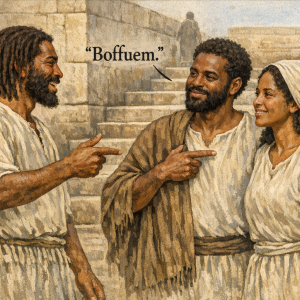
Primary Definition
Boffuem is a nonstandard phonetic spelling representing a compressed pronunciation of both followed by a plural object pronoun. It refers collectively to exactly two previously identified people, objects, choices, ideas, or courses of action. The expression may function as a pronoun-like answer, an object within a sentence, or an emphatic declaration that the speaker accepts, wants, includes, or refers to both members of a pair.
The most widely documented spelling is boffum. Other informal spellings include boffem, bofum, bowfum, and boff ’em. Boffuem should therefore be understood as an orthographic variant rather than as a separately established word with a different meaning.
Typical uses include:
- As a complete answer: When offered one of two desirable alternatives, a speaker may answer, “Boffuem,” meaning that neither option is being rejected.
- As the object of a verb: “Bring boffuem” refers to bringing both identified persons or things.
- As an emphatic choice: The word can humorously reject an either-or question by choosing the entire pair.
- As a collective reference: It may identify two persons as a unit, as in “I spoke to boffuem.”
The term belongs primarily to informal speech, eye-dialect writing, social media, music, humor, and dialogue intended to reproduce conversational pronunciation. It is not ordinarily appropriate in formal academic prose, legislation, contracts, judicial opinions, or other documents requiring standardized spelling.
Etymology and Origin
Formation from Existing English Words
Boffuem is best analyzed as a phonetic contraction rather than an acronym or a borrowing from another language. Its development can be explained through two ordinary processes in spoken English: the alteration of the final consonant in both and the reduction of the following pronoun.
The final sound in standard pronunciations of both is the voiceless dental fricative represented in the International Phonetic Alphabet as /θ/. In several English dialects, that sound may be realized as /f/, especially at the end of a word. Linguists call this process TH-fronting. Under that pattern, both may sound approximately like boff. TH-fronting is documented in varieties of African American English, Southern American speech, Cockney, Estuary English, and other regional or social varieties. It is therefore inaccurate to treat every use as belonging exclusively to one community.
The second portion reflects the common reduction of them to ’em, em, or an unstressed sound resembling um. Such reduction is not new. The form ’em has a long history in English and is not simply a modern texting abbreviation. Etymological sources explain that it is at least partly descended from Middle English hem, an older plural object pronoun, although speakers later came to understand it as a shortened form of them.
When the two reduced forms are spoken together, the phrase may be heard as two syllables: boff-um. Informal writers then represent that sound with whatever spelling seems most intuitive. The spelling boffum is the most visible online, while Boffuem uses an unusual final letter sequence to represent the same unstressed syllable.
Deeper History of “Both”
The underlying word both is ancient. Merriam-Webster traces it through Middle English bothe to an Old English construction involving bā, a form meaning the pair collectively, and a form of the definite article. Related forms occur throughout the Germanic language family, including German beide, Dutch beide, and Old Norse báðir. The basic meaning—one member and the other member considered together—has remained remarkably stable.
No reliable evidence establishes a single inventor of boffum or Boffuem. Informal pronunciations often exist for generations before being written down, and similar spellings can arise independently. Online slang dictionaries record boffum in the early twenty-first century, while later publications, social-media posts, and music made the spelling more visible. Such records document use; they do not necessarily identify the word’s first speaker or original community.
Cultural and Historical Context
The term illustrates the difference between a language and its written standard. Spoken language naturally joins words, weakens unstressed syllables, and substitutes sounds according to regional patterns. A spelling such as Boffuem makes those normally invisible processes visible on the page.
The expression is frequently associated with African American English and Southern speech because final TH-fronting and pronoun reduction occur in those linguistic environments. A 2022 scholarly personal essay about language, race, and professional identity specifically listed boffum among vernacular forms the author had felt pressured to avoid when “speaking for success.” This example demonstrates that pronunciation is not merely mechanical; listeners may attach assumptions about intelligence, education, class, region, and race to otherwise intelligible speech.
African American English is a group of systematic language varieties, not careless or random English. Its pronunciation and grammar vary by speaker, age, location, situation, and social network. Some speakers use forms resembling boffum, while many do not. The form also appears outside African American communities. Labeling it exclusively “Black slang,” “Southern slang,” or “internet slang” oversimplifies its history.
The expression often carries a humorous implication of abundance. A question presents two alternatives, but the answer refuses the expected limitation and claims the pair. In this use, Boffuem can communicate enthusiasm, appetite, confidence, indecision, or playful greed. Tone and context determine whether the answer sounds celebratory, practical, flirtatious, or excessive.
Biblical / Torah Context
Boffuem is not a biblical Hebrew, Aramaic, or Greek term, nor is there evidence that it originated in Scripture. Its relevance to the Bible and Torah is limited to the ordinary concept of two persons or things being considered together.
Biblical Hebrew can express this concept with forms derived from the number two. In Genesis 3:7, the Hebrew expression sheneihem identifies Adam and the woman collectively when their eyes are opened. In Genesis 22:6 and again in Genesis 22:8, Abraham and Isaac are described with the expression sheneihem yachdav, indicating that both walked together. English translations render these constructions in several ways, including “both,” “the two,” or a reference to the pair acting together.
These passages demonstrate that collective reference to two participants is an ancient and ordinary linguistic category. They do not provide an etymology for the modern slang spelling. Any claim that Boffuem is a sacred Hebrew code, a lost biblical word, or a special scriptural title would require evidence not presently available.
Interpretively, the biblical examples also show that naming a pair collectively does not erase individual responsibility. Adam and the woman are described together in Genesis 3, yet the narrative also addresses their actions individually. Abraham and Isaac travel together in Genesis 22, but they occupy distinct roles. Thus, “both” may express unity of action without asserting sameness of identity, authority, intention, or moral responsibility.
Legal Implications
Boffuem is not a recognized legal term of art in historical English common law, Roman law, equity, American statutory law, military law, or contemporary legal doctrine. It does not create a special form of joint ownership, joint liability, agency, marriage, partnership, conspiracy, or contractual obligation.
In an informal conversation relevant to a dispute, however, the expression may become evidence of what a speaker intended. If a person responds with this word after being offered two identified items, the natural contextual interpretation is that the response concerns the pair. Whether that response creates legal consequences depends on ordinary rules governing offer, acceptance, intent, capacity, consideration, consent, authentication, and the surrounding circumstances. Slang alone neither creates nor defeats a contract.
The term may also appear in witness testimony, recorded conversations, text messages, social-media evidence, police interviews, or court transcripts. A careful transcriber should preserve what was actually said while avoiding an unsupported interpretation. If the sound is uncertain, a transcript may require a notation, contextual clarification, or review of the recording. Lawyers and courts should not assume that vernacular pronunciation demonstrates confusion or lack of credibility.
In formal instruments, the spelling should be avoided because it can create needless uncertainty. A will, deed, release, settlement, military order, statute, regulation, or contract should identify the two persons or things expressly. Even the standard word both can become ambiguous when more than two possible antecedents have been mentioned. Precision may require names, item numbers, legal descriptions, defined terms, or separate clauses.
From a common-law interpretive perspective, context controls. Courts traditionally examine words in relation to the entire instrument and the circumstances legally permitted to be considered. An informal expression should not be isolated from the question it answered, the objects it concerned, or the parties’ subsequent conduct.
Spiritual Meaning
The word has no inherent mystical or sacramental power. Nevertheless, it can serve as a metaphor for inclusion, reconciliation, and resistance to false dilemmas. Human beings are often told that they must select one virtue at the expense of another: justice or mercy, truth or compassion, courage or humility. In many spiritual traditions, mature judgment seeks the proper union of complementary goods rather than an unnecessary rejection of one.
This “both-and” interpretation must be used carefully. Some alternatives are genuinely incompatible, and moral discernment cannot always be replaced by inclusion. One cannot honestly choose mutually exclusive duties merely by declaring a desire for each. The spiritual value of the expression therefore lies not in refusing every choice, but in asking whether the supposed opposition is real.
As a symbol of relationship, the term may also point to shared action. Two people may walk, labor, testify, suffer, or celebrate together while remaining distinct persons. Unity need not require the destruction of individuality.
Modern Usage
Modern use occurs mainly in speech-like writing. The term is suited to text messages, captions, memes, comedy, fictional dialogue, and informal conversation. It is especially effective as a short response to a forced choice:
- food or drink selections where the speaker wants each option;
- two people being discussed as a pair;
- two purchases or destinations;
- two qualities that may coexist;
- a joking refusal to practice restraint.
Usage does not always preserve standard grammar. Some speakers treat the expression as an object, while others use it where standard English would employ a subject phrase. That flexibility is common when a spoken contraction begins to function as a standalone slang item.
The spelling boffum gained additional public visibility in 2025 through Saweetie and J White Did It’s single “boffum.” The official visualizer was released on July 17, 2025, and the recording repeatedly used the word as an answer selecting both available alternatives. The song did not originate the expression; online slang records and informal written examples predate it by many years. Its release instead helped move an existing vernacular form into broader popular culture.
Capitalization is optional and normally follows sentence position. Because the word is not standardized, there is no universally authoritative spelling. Writers who want immediate comprehension may place the standard wording nearby on first use. Writers reproducing an individual speaker’s exact style may retain the speaker’s preferred spelling.
Controversies / Criticisms
Dialect and Stereotyping
Phonetic spellings can preserve cultural voice, humor, and authenticity, but they can also become instruments of ridicule. Historically, eye dialect has often been used to portray regional, working-class, immigrant, or Black speakers as unintelligent even when their meaning is perfectly clear. The ethical significance of Boffuem therefore depends partly on who is using it, why it is being used, and how the represented speakers are treated.
It is reasonable to identify the form as nonstandard in formal written English. It is not reasonable to conclude that a speaker who uses it lacks intelligence, logic, or command of language. Many speakers move between vernacular and standardized forms according to audience and setting, a practice commonly called style-shifting or code-switching.
Uncertain Origin Claims
User-submitted dictionaries provide evidence that a slang form circulated, but their definitions are not proof of its ultimate origin. Dates attached to online submissions establish only that someone recorded the term by that date. They do not establish that the submitter invented it. Claims assigning the word to one city, celebrity, racial group, or internet community should therefore be treated cautiously unless supported by earlier recordings and specialized linguistic research.
Confusion with Unrelated Words
Boffuem should not be confused with boff, a separate slang word that has carried meanings involving sexual activity, a blow, laughter, or performance. It is also unrelated to historical uses of similarly spelled words in West African religious descriptions. Visual resemblance by itself does not establish a shared origin. The present term is most convincingly explained internally from English pronunciation.
Formal Acceptability
Critics may dismiss the form as a misspelling, while supporters may regard it as a legitimate representation of living speech. Both observations contain part of the truth. It is nonstandard when measured against conventional edited English, yet it is meaningful and patterned within the contexts where speakers use it. Dictionary description records how language functions; it does not require every recorded form to be suitable for every setting.
Conclusion
Boffuem is an informal phonetic contraction referring collectively to both members of an identified pair. Its form is readily explained through TH-fronting, reduction of the plural object pronoun, and fusion in rapid speech. Although especially visible in African American, Southern, internet, and popular-music contexts, it should not be assigned an exclusive racial or regional origin without stronger historical evidence.
The word has no independent biblical, mystical, military, governmental, or common-law authority. Its importance lies instead in what it reveals about spoken English: language compresses familiar phrases, dialects follow systematic sound patterns, and informal expressions can carry cultural identity as well as literal meaning. Used with awareness of context, Boffuem is a concise and often playful way to reject an unnecessary either-or choice.
Sources / Further Reading
- Merriam-Webster, “Both: Definition and Word History” — https://www.merriam-webster.com/dictionary/both
- Online Etymology Dictionary, “Both” — https://www.etymonline.com/word/both
- Online Etymology Dictionary, “’Em” — https://www.etymonline.com/word/%27em
- Betsy Sneller, “A Phonotactic Analysis of /th/-Fronting in AAVE Production Data,” University of Pennsylvania — https://www.ling.upenn.edu/~esnell/pdfs/Sneller-LSA-2015.pdf
- University of Hawaiʻi, Language Varieties Network, “African American Vernacular English” — https://www.hawaii.edu/satocenter/langnet/definitions/aave.html
- Bible Hub, Genesis 3:7 Hebrew Text Analysis — https://biblehub.com/text/genesis/3-7.htm
- Bible Hub, Genesis 22:6 Interlinear — https://biblehub.com/interlinear/genesis/22-6.htm
- Urban Dictionary, “Boffum” user-submitted usage records — https://www.urbandictionary.com/define.php?term=boffum
- Saweetie, “boffum” official visualizer — https://www.youtube.com/watch?v=jPwyOgkXhbk