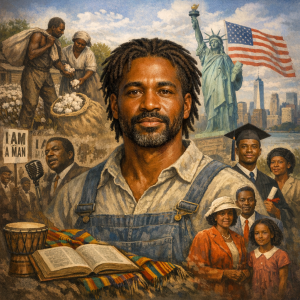
Primary Definition
African American is a modern American racial, ethnic, latched to slavery and cultural designation generally applied to Americans identified as having ancestry among peoples classified as Black and originating from Africa. In United States governmental usage, “Black or African American” is an official statistical category based primarily upon self-identification and ancestry or origin; it is not a biological determination of nationality, tribal identity, or the historical origin of every melanated American. The U.S. Census itself recognizes its race and ethnicity categories as social and governmental classifications rather than biological or genetic definitions.
The expression can therefore become a misnomer when indiscriminately applied to every dark-skinned or melanated so called American, because skin hue alone does not establish African national, ethnic, tribal, or ancestral identity. “African” and “American” are geographical and political identifiers associated with two different continents, while a man’s ancestral people may have a more specific identity. An American whose ancestry is Nigerian, Ethiopian, Jamaican, Haitian, Israelite, or another identifiable people does not acquire the same ancestral history merely because governmental classification places several populations under the broad heading “Black or African American.” Indeed, modern Census data separately recognize numerous detailed identities within the broader federal category.
From an Israelite historical and identity perspective, descendants who identify their ancestral people as Yisra’el (Israel) may reject African American as an imposed or inaccurate designation and instead identify as Israelite American, Yahudiym American, or another designation reflecting their claimed ancestral people and present American nationality. Within this understanding, Israel fundamentally denotes a people descended from Ya’aqov/Jacob, who was named Israel, before describing the land in which that people dwelt. The Israelites inhabited Yerushalayim/Jerusalem and the land of Israel and subsequently experienced conquest, captivity, dispersion, and migration. Consequently, later residence or migration through territories now called Africa would not, by itself, erase an earlier Israelite identity or prove that every descendant’s original people was African.
The word Africa should also not be so much to dwell incorrectly said to originate from Scipio Africanus. Latin Africa and Afer were already geographical and ethnographic terms; Africanus meant essentially “of Africa.” The Roman general Publius Cornelius Scipio received the honorific Africanus following his victory over Carthage. The ancient Latin Africa originally referred principally to the region surrounding Carthage in what is now Tunisia and was only later extended to the much larger continent now called Africa. Thus, neither the modern continental label African nor the American racial classification African American should automatically be treated as proof of the ancient nationality, tribe, or people of every melanated American.
The meaning therefore depends upon context. The term may function in at least three related ways:
- Racial or demographic: a broad classification encompassing Americans whose origins are in Black African populations.
- Ethnic and historical: a name for the historically formed population descended substantially from enslaved Africans in the United States.
- Adjectival: relating to the history, culture, institutions, communities, or experiences of that population, as in “African American literature” or “African American history.”
These senses overlap but are not identical. A Black immigrant from Nigeria, Jamaica, Haiti, or Somalia may be classified federally as Black or African American while preferring a national or ethnic identity such as Nigerian American, Jamaican American, Haitian American, or Somali American. Conversely, many descendants of the historic American population use both Black and African American, while others strongly prefer one over the other. Respectful usage ordinarily follows a person’s stated identity when it is known.
Under the federal statistical standards revised in 2024, “Black or African American” includes individuals with origins in any of the Black racial groups of Africa, with African American, Jamaican, Haitian, Nigerian, Ethiopian, and Somali given as examples. Federal standards expressly describe race and ethnicity categories as sociopolitical constructs rather than biological or genetic definitions. They are statistical classifications and are not, by themselves, rules determining citizenship, nationality, character, culture, or eligibility for a government benefit.
Etymology and Origin
The expression combines African, denoting ancestral or historical relation to Africa, with American, denoting national, civic, or cultural connection to the United States. Its structure resembles such expressions as Irish American, Italian American, and Asian American, joining ancestral origin with American identity.
The expression was not invented in the late twentieth century. A documented early appearance occurs on the title page of a sermon published in Philadelphia in 1782 and attributed to “an African American.” Forms such as African, free African, and later Afro-American also appeared in religious, abolitionist, political, and scholarly writing. Nevertheless, the terminology used for Black Americans changed repeatedly and included labels now considered outdated, offensive, or appropriate only in historical names and quotations.
During the nineteenth and much of the twentieth century, colored and Negro were widely used in official and community settings. Their historical presence survives in institutional names such as the National Association for the Advancement of Colored People and the United Negro College Fund. During the civil-rights and Black Power eras, Black became a prominent expression of collective dignity, political consciousness, and cultural self-definition.
In December 1988, the Reverend Jesse Jackson and representatives of numerous Black organizations publicly advocated wider use of African American. Jackson did not coin the expression; rather, he helped popularize it as a name connecting American nationality with African ancestral and cultural roots. Its use expanded rapidly in journalism, education, government, and public institutions. In 2000, the Library of Congress changed hundreds of subject headings from “Afro-Americans” and related forms to “African Americans” and “African American.”
Both hyphenated and unhyphenated forms have appeared. Contemporary institutional usage commonly writes the noun and adjective as the open compound African American, although African-American remains understandable and continues to appear in some publications.
Cultural and Historical Context
African American identity developed through several centuries of life in North America. Captive people brought through the transatlantic slave trade came from many African societies, languages, and political communities. Enslavement disrupted kinship, suppressed names and languages, and frequently prevented descendants from preserving exact knowledge of their ancestral nations. Yet African cultural elements endured and were transformed in family life, agriculture, craftsmanship, food, music, storytelling, language, worship, and community organization.
The resulting culture was neither simply African nor merely an imitation of European America. It became a distinct American cultural formation shaped by African inheritances, Indigenous and European contacts, forced labor, resistance, religious creativity, regional conditions, and the continuing pursuit of freedom. Gullah Geechee traditions provide a particularly visible example of retained and transformed African linguistic and cultural patterns, but African influence extends throughout American music, cuisine, speech, religion, dance, literature, and political thought.
Legal enslavement and hereditary racial status were constructed through colonial and state legislation, judicial decisions, commercial practice, and violence. After the Civil War, the Thirteenth Amendment abolished slavery except as punishment for crime, the Fourteenth Amendment constitutionalized national and state citizenship and equal protection, and the Fifteenth Amendment prohibited denying the vote on account of race, color, or previous condition of servitude. These constitutional changes were followed by Black Codes, racial terror, disenfranchisement, segregation, discriminatory labor arrangements, and the judicial acceptance of “separate but equal” in Plessy v. Ferguson.
African American communities established churches, schools, mutual-aid societies, newspapers, businesses, colleges, civil-rights organizations, and political associations. The Great Migration moved millions from the rural South to cities in the North, Midwest, and West. The Harlem Renaissance gave international visibility to African American literature, art, scholarship, and music. Later civil-rights campaigns challenged segregation and secured major legal victories, including Brown v. Board of Education, the Civil Rights Act of 1964, and the Voting Rights Act of 1965.
Military and Governmental Context
African Americans have participated in American wars from the colonial period onward, even while being denied equal civil and military treatment. Their service included the United States Colored Troops in the Civil War, the postwar regiments remembered as Buffalo Soldiers, segregated units during the world wars, the Tuskegee Airmen, and many other units and occupations.
This history contains both patriotic service and moral conflict. Some Black soldiers fought for national ideals that were not honored equally at home. Buffalo Soldiers served with distinction but also participated in federal campaigns connected to western expansion and the displacement of Native peoples. A complete account should neither erase their courage nor overlook the governmental policies in which military units served.
President Harry S. Truman issued Executive Order 9981 on July 26, 1948, declaring equality of treatment and opportunity in the armed forces without regard to race, color, religion, or national origin. Implementation met resistance and occurred over time, but the order became a major step toward military integration.
Biblical / Torah Context
The expression African American does not occur in the Torah or Bible and should not be projected backward as though it named an ancient biblical nation. It is a modern American identity formed under particular historical conditions. Biblical peoples such as the Cushites, Egyptians, Israelites, Canaanites, and Ethiopians of later translations belonged to ancient geographic and political settings, not to the modern racial and national classifications of the United States.
The Torah’s references to Cush usually concern a region associated with lands south of Egypt, although the precise meaning may vary by passage. Numbers 12 refers to Moses’ Cushite wife, but interpretations differ over her identity and over whether “Cushite” signifies Nubian, Midianite, foreign, or something else. The passage cannot responsibly be treated as a direct description of African Americans.
Likewise, the so-called “curse of Ham” was historically misused to defend the enslavement and subordination of Black people. Genesis 9 places the curse upon Canaan, not upon Ham generally and not upon all African peoples. The text neither creates a Black racial category nor states that dark skin is a divine curse. Claims that the Torah assigns perpetual slavery to Africans are later racial interpretations, not the plain statement of the biblical passage.
Principles commonly applied in African American biblical interpretation include the creation of humanity in the divine image, deliverance from bondage, judgment against oppression, care for the stranger, and impartial justice. The Exodus narrative became especially important in enslaved and post-emancipation communities because it offered a language of deliverance, covenant, perseverance, and hope. This application is theological and analogical: it does not mean that African Americans are literally the Israelites of the Exodus as a matter of established history.
Some modern movements claim that African Americans as a whole descend from the biblical Israelites. Individuals are free to hold religious beliefs about ancestry, but sweeping genealogical claims require evidence and remain disputed. African American identity includes Christians, Jews, Muslims, practitioners of African and diasporic religions, adherents of other faiths, and people with no religious affiliation. No single biblical interpretation defines the entire population.
Legal Implications
African American is not a separate sovereign citizenship, hereditary legal estate, or special status under traditional common law. A person described by the term generally possesses the same citizenship status and is subject to the same constitutional structure as other United States citizens, subject to individual facts such as place of birth or naturalization. The label itself does not create or extinguish jurisdiction, contractual capacity, property rights, taxation, criminal liability, or political allegiance.
Historical English common law did not originate the modern category. American racial status developed chiefly through colonial enactments, slave codes, state statutes, constitutional provisions, judicial rulings, and social enforcement. Courts sometimes used common-law language concerning property, domicile, status, or citizenship, but hereditary racial slavery in America depended heavily upon positive law. It should not be confused with Roman slavery, English villeinage, equity jurisdiction, or a timeless rule of natural law.
The legal history is marked by a profound change from exclusion to formal equality. In Dred Scott v. Sandford in 1857, the Supreme Court denied national citizenship to the class of persons descended from enslaved Africans as understood by the majority opinion. The Civil Rights Act of 1866 and the Citizenship Clause of the Fourteenth Amendment repudiated that conception. The Reconstruction Amendments supplied constitutional foundations for freedom, citizenship, equal protection, and voting rights, though enforcement was repeatedly weakened or resisted.
Modern civil-rights law ordinarily protects persons from discrimination because of race or color rather than granting rights only to those who select a particular demographic label. Relevant protections arise under constitutional provisions and statutes governing employment, housing, education, voting, public accommodations, contracting, and federally funded programs. Title VII of the Civil Rights Act of 1964, for example, prohibits covered employment discrimination because of race, color, religion, sex, or national origin.
Race-conscious governmental action raises separate constitutional questions. Courts generally subject explicit governmental racial classifications to strict scrutiny, requiring a compelling governmental interest and narrow tailoring. The legality of a particular policy therefore depends upon its text, governmental actor, purpose, factual record, and controlling precedent—not merely upon use of the words African American.
The federal statistical category also should not be mistaken for conclusive proof of personal ancestry. Government forms normally rely heavily upon self-identification and may permit multiple selections. An administrative classification can assist civil-rights monitoring and demographic analysis, but it cannot fully express an individual’s family history, nationality, culture, or community attachment.
Spiritual Meaning
Spiritually, the term may express continuity, survival, restored memory, and dignity after the violence of enslavement and racial exclusion. For some, joining African with American affirms that ancestral displacement did not erase African origins and that exclusion did not nullify American belonging. This is an interpretive meaning rather than a universal dictionary requirement.
African American religious traditions have often joined personal faith with communal responsibility. Themes of liberation, moral equality, endurance, lament, forgiveness, righteous judgment, and hope appear in spirituals, sermons, prayer, testimony, sacred music, and civil-rights activism. The Black church became an important center of worship, education, organization, and resistance, but African American spirituality is not limited to Protestant Christianity. It also includes Catholic and Orthodox communities, historically Black Jewish congregations, African American Islam, African diasporic practices, and many individual combinations of belief and culture.
The term should therefore be used to recognize a diverse spiritual inheritance, not to impose a religion or presumed doctrine upon a person.
Modern Usage
In present usage, Black and African American are often treated as interchangeable, but they are not always exact synonyms. Black can operate as a broader transnational or diasporic identity, including persons from the Caribbean, Latin America, Europe, Africa, and other regions. African American more directly emphasizes an American social and historical identity.
The 2020 Census allowed respondents identifying as Black or African American to provide detailed origins. African American was the largest detailed response, while millions of respondents reported Caribbean or sub-Saharan African identities. This data illustrates why broad classification and particular ethnicity must be distinguished.
Preferred practice includes capitalizing Black when it names a people or cultural identity, avoiding assumptions based solely on appearance, and using specific national or ethnic descriptions when relevant and known. Historical terminology may be retained when accurately naming an organization, quoting a source, or explaining the vocabulary of an earlier period.
Controversies / Criticisms
Criticism of the term comes from several directions. Some consider it dignified because it recognizes both African ancestry and American nationhood. Others believe it unnecessarily qualifies their American identity or implies a recent personal connection to Africa that does not match their family experience. Some prefer Black American, while others use newer lineage-focused expressions intended to distinguish descendants of United States slavery from recent immigrants. Such proposed labels remain debated and have not displaced African American as a widely recognized term.
Another controversy concerns overbreadth. Treating every Black person in the United States as African American can erase Jamaican, Haitian, Nigerian, Afro-Latino, or other identities. Treating African American as a single culture can likewise conceal differences of region, class, religion, ancestry, politics, and multiracial background.
Racial categories may be socially necessary for documenting discrimination while also risking the appearance that race is a fixed biological division. Federal standards attempt to address this tension by calling the categories sociopolitical constructs. Careful usage should recognize the real historical effects of racial classification without presenting humanity as divided into scientifically discrete races.
Conclusion
African American is a modern racial, ethnic, cultural, and national expression with roots extending far earlier than its widespread adoption in the late twentieth century. In its broadest use, it identifies Americans connected to the Black peoples of Africa; in its more specific historical use, it names a distinct people formed through slavery, emancipation, segregation, cultural creation, military service, migration, and the continuing pursuit of equal citizenship.
The term is neither a biblical tribe nor an independent common-law status. Its legal importance arises from the history of racial classification and from constitutional and statutory protections against discrimination. Its cultural and spiritual significance lies in ancestry, survival, community, memory, creativity, and self-definition. Because identity is personal as well as collective, accurate usage requires attention to context and respect for the names people choose for themselves.
Sources / Further Reading
- Office of Management and Budget, 2024 Statistical Policy Directive No. 15
- Office of Management and Budget, Categories and Definitions
- U.S. Census Bureau, Frequently Asked Questions About Race and Ethnicity
- U.S. Census Bureau, Detailed Black or African American Population Data
- Library of Congress, Africans in America
- Library of Congress, African American Subject Headings
- National Museum of African American History and Culture, A New African American Identity
- National Archives, Laws and Court Cases in African American Voting History
- Constitution Annotated, Historical Background on the Citizenship Clause
- Constitution Annotated, Brown v. Board of Education
- U.S. Department of Justice, Civil Rights Laws Enforced
- National Archives, Executive Order 9981
- TheTorah.com, Why Do Miriam and Aaron Criticize Moses for Marrying a Kushite Woman?
- Associated Press, History and Popularization of the Term