Lord/the Lord
Primary Definition
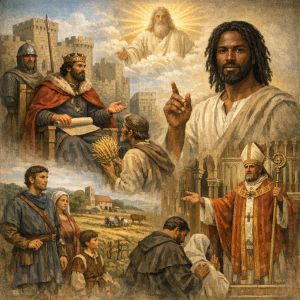
Lord is a title and relational term denoting a person recognized as having authority, mastery, rule, ownership, rank, or honor over others, a household, land, an institution, or a defined sphere of responsibility. Its exact meaning depends heavily on context. In ordinary historical English, a lord could be the master of a household, the holder of land, a feudal superior, a nobleman, a ruler, or a person addressed with special respect. In religious use, the Lord commonly refers to God; in Christian Scripture and worship, it may refer specifically to Jesus Christ.
The word therefore does not identify one fixed office or legal status. It is a general term of superiority and recognized authority. A person might historically be a lord because of land tenure, noble rank, political appointment, ecclesiastical office, or social custom. God is called the Lord not because He occupies a human feudal office, but because the title communicates sovereignty, rightful authority, judgment, protection, covenant, and dominion.
Capitalization is significant. Lowercase lord ordinarily refers to a human title, rank, or superior. Uppercase or small-cap LORD in many English Bibles is a translation convention used for the Hebrew divine name represented by the four consonants YHWH. Ordinary type Lord may translate other Hebrew and Greek terms meaning master, ruler, owner, or sovereign. Thus, readers should not assume that every English occurrence of “Lord” represents the same original-language word or the same theological claim.
Etymology and Origin
The English word has a distinctly Germanic and household-based origin. It comes from Old English hlaford, an altered form of an earlier expression commonly explained as hlaf-weard: “loaf-guardian” or “keeper of the bread.” The elements are related to hlaf, meaning loaf or bread, and weard, meaning guard, keeper, or watchman. In its earliest social setting, the term pointed to the head of a household who was responsible for provisioning, protecting, and governing those dependent upon that household.
This origin is important because it shows that the original English sense was not merely domination. Authority was joined to duty: the household head had practical responsibility for food, order, protection, and the welfare of retainers. Over time, as social organization became more stratified, the word widened to include a master, ruler, landholder, feudal superior, husband, nobleman, and finally a formal title of honor.
By the Middle English period, forms such as laverd and loverd developed into the modern word lord. The related word lady also reflects the early household and bread-making world, although scholars have treated portions of its proposed etymology with caution. The contrast is nevertheless culturally revealing: English social vocabulary preserved memories of food production, hospitality, household governance, and dependence.
The English word should not be confused with the origins of biblical Hebrew or Greek terms translated as “Lord.” English Bible translators selected Lord because it could convey authority and mastery, but Hebrew adon, Adonai, and the divine name YHWH, as well as Greek kyrios, have their own histories and ranges of meaning. Translation creates an important connection, but it does not erase linguistic distinctions.
Cultural and Historical Context
In medieval Europe, “lord” became closely associated with feudal relationships. A lord commonly held an estate or manor and received services, payments, loyalty, or other incidents of tenure from tenants. A tenant might hold land “of” a superior lord, and a chain of obligations could extend upward toward the king as lord paramount. This arrangement was neither identical to modern private ownership nor a universal system applied in precisely the same way everywhere. It was a historically changing set of land, service, jurisdictional, and political relationships.
A lord’s authority could include economic power, local influence, rights connected to courts, military obligations, and responsibilities for defense. Yet the popular picture of an all-powerful lord ruling every aspect of a tenant’s life is too simple. Rights and duties varied by custom, charter, tenure, locality, period, and the status of the persons involved. Medieval English law developed through royal courts, local custom, legislation, ecclesiastical jurisdiction, feudal incidents, and later the doctrines of common law and equity. “Lord” was one component of that complex legal order, not a complete description of it.
Military service was genuinely relevant to the feudal meaning. Landholding relationships could carry obligations to provide armed service or payments in lieu of service. The disputes leading to Magna Carta in 1215 were tied in part to feudal grievances and royal financial demands, including scutage, a payment associated with military service. But Magna Carta was not originally a modern declaration of equal rights for all people. It was a feudal charter negotiated principally between King John and powerful barons, although later generations drew broader constitutional principles from it, including the idea that rulers are subject to law.
“Lord” also became a title of social honor. In the British peerage tradition, it may be used in relation to certain nobles and officeholders. It can appear in such titles as Lord Chancellor, Lord Lieutenant, Lord Mayor, or Lord of the Manor. Those offices are not interchangeable. A Lord Mayor, for example, is a civic office; a Lord Lieutenant is a ceremonial representative of the Crown in a county or area; and a Lord of the Manor is connected historically with a manor and its associated rights. The word alone does not disclose the legal powers of the office.
Biblical / Torah Context
In the Torah and the wider Hebrew Bible, English translations use “lord” for several different Hebrew words and names. Adon can mean master, owner, or lord in a human sense. It may be used for a person with authority, such as a ruler, master, or superior. Adonai, often rendered “Lord,” is a reverential divine title expressing sovereignty and mastery.
Particular care is required with YHWH, the tetragrammaton, the personal covenant name of the God of Israel. Jewish reading tradition generally avoids pronouncing the name and substitutes Adonai, “Lord,” when reading Scripture aloud. Many English Bible translations therefore print LORD in small capitals where the Hebrew text has YHWH. This convention distinguishes the divine name from Lord in ordinary type, which may translate Adonai or another term. The exact ancient pronunciation of YHWH is uncertain; “Yahweh” is widely used in scholarship, while “Jehovah” arose historically through a later form influenced by the substitution practice surrounding Adonai.
The Torah’s portrayal of God as Lord is not limited to raw power. It is connected to creation, deliverance, covenant, justice, mercy, and moral accountability. In the Exodus narrative, God’s self-disclosure to Moses is inseparable from the liberation of Israel from Egyptian bondage. The divine lordship presented in Scripture stands in contrast to the merely human lordship of kings, masters, and landholders, all of whom remain accountable to God.
The expression “Lord of lords” emphasizes that no earthly ruler, national god, king, master, or authority is ultimate. Deuteronomy 10:17 connects that supreme authority with impartial judgment and rejection of bribery. In that setting, divine sovereignty is ethically active: it provides a basis for justice rather than a license for human rulers to act without restraint.
New Testament Context
The principal Greek word translated “Lord” in the New Testament is kyrios. In ordinary Greek usage it could refer to an owner, master, or respected superior. In the Greek translation of the Hebrew Scriptures known as the Septuagint, kyrios was commonly used where the Hebrew text contained YHWH. That translation history gave the word exceptional theological weight for Greek-speaking Jews and early Christians.
For Christians, calling Jesus “Lord” became a central confession. The title can carry meanings of respect, mastership, risen authority, and divine identification in light of Old Testament language applied to Christ. Christian theology does not treat this as a mere courtesy title. At the same time, Jewish and Christian readings differ in their understanding of Jesus, and a responsible dictionary entry should not collapse those distinct faith commitments into a single interpretation.
Legal Implications
Historically, lord had legal significance in English land law and constitutional development. Under feudal tenure, a lord could stand in a legal relationship to tenants holding land from him. A manor could have manorial customs and incidents, and a lord of the manor could possess rights associated with the manor. These were historical property and jurisdictional arrangements, not simply an honorary form of address.
However, historical common law must be distinguished from current law. The common law is a body of law developed through judicial decisions and inherited legal principles; it is not a private system that allows an individual to choose which enacted laws, courts, taxes, licenses, or criminal rules will apply. Common law also operated alongside legislation, equity, canon law, local custom, royal prerogative, and, in earlier periods, aspects of feudal law. Roman-law concepts influenced portions of European legal development, but English common law was not simply Roman law under another name.
In England and Wales, major twentieth-century property reforms greatly changed the practical legal significance of manorial relationships. The Law of Property Acts addressed copyhold tenure and manorial incidents, while surviving interests became limited, exceptional, or chiefly historical. A modern claim to be “lord of a manor” may have historical, property-related, or ceremonial significance in a particular case, but it does not by itself confer general governmental power, criminal jurisdiction, immunity from law, ownership of all land in a locality, or authority over residents.
The term also has an institutional legal history in the United Kingdom. For centuries, the House of Lords exercised a final appellate judicial role in many cases. That judicial function transferred to the separate Supreme Court of the United Kingdom on October 1, 2009. “Law Lords” were judges serving in the former appellate system; the phrase does not mean that every member of the House of Lords was a judge or that a person may become a judge by adopting the title.
In the United States, neither the federal government nor the states may grant titles of nobility under Article I of the Constitution. This prohibition does not forbid people from using “lord” casually, religiously, artistically, or as part of a foreign title; rather, it prevents American governments from creating a hereditary aristocratic legal order of nobility. It also does not alter the binding force of federal, state, tribal, or local law.
Common-Law Claims and Personal Status
Some modern movements assert that declaring oneself a “lord,” “sovereign,” “natural man,” or similarly styled person removes one from statutory jurisdiction or restores an alleged superior common-law status. Such assertions are contested in public discourse but are not accepted rules of American law. Federal courts have repeatedly characterized sovereign-citizen-style theories claiming exemption from government statutes and court proceedings as frivolous. A title, spelling convention, signature format, religious declaration, or assertion of common-law standing does not by itself defeat a court’s jurisdiction or create immunity from lawful obligations.
Individuals may sincerely hold religious beliefs about God’s ultimate authority over human government. Those beliefs may inform conscience, political advocacy, worship, or moral resistance. In legal proceedings, however, a court ordinarily decides jurisdiction and legal rights under the applicable constitution, statutes, procedural rules, treaties, and binding precedent—not by a party’s personal adoption of a spiritual or feudal title.
Spiritual Meaning
Spiritually, “the Lord” expresses the conviction that ultimate authority belongs to God rather than to the state, wealth, institutions, family heads, military power, or individual self-will. In Jewish and Christian thought, this claim is meant to relativize human power: rulers may exercise real authority, but they are not absolute. They remain morally answerable for justice, truthfulness, mercy, and the treatment of the vulnerable.
For believers, acknowledging the Lord commonly implies trust, worship, obedience, repentance, gratitude, and a duty to order one’s conduct under divine moral authority. It should not be reduced to a verbal formula or used as a tool for coercing others. The biblical pattern repeatedly joins acknowledgment of God’s lordship to care for the poor, honesty in judgment, rejection of idolatry, and accountability of rulers.
Interpretively, the ancient “loaf-guardian” background of the English word can offer a useful illustration: rightful authority includes stewardship and provision. That is an interpretive analogy, not a claim that the biblical names of God literally derive from English bread imagery. Biblical theology rests on Hebrew, Aramaic, and Greek texts, while the English etymology belongs to the later history of the translation word.
Modern Usage
Modern English uses “lord” in several ways. It may be a formal British title; an element in the name of an office; a historical description of a landholder or noble; a reverent name for God; a Christian designation for Jesus; or an informal expression of surprise, frustration, praise, or emphasis. In fantasy literature and popular culture, it often describes a ruler, warlord, or powerful being. These uses should not be confused with each other.
In legal writing, precision is essential. “Lord,” “Lordship,” “Lord of the Manor,” “Lord Chancellor,” “Lord Justice,” and “House of Lords” refer to distinct historical or institutional matters. In religious writing, typography may preserve translation distinctions: LORD often signals YHWH, while Lord may signal Adonai, kyrios, or a contextual equivalent. Readers should consult the translation’s preface and footnotes rather than derive doctrine solely from capitalization.
Controversies / Criticisms
The word carries unavoidable associations with hierarchy, inherited privilege, patriarchy, landlord power, and class inequality. Critics argue that lordship language can normalize domination or obscure the injustices of feudal and colonial social orders. Those concerns have historical force: systems of land tenure and aristocratic privilege often concentrated wealth and power in relatively few hands.
Religious use is also debated. Some reject masculine titles for God or find “Lord” difficult because of associations with slavery, monarchy, or authoritarian rule. Others retain the title because it is deeply rooted in Scripture, liturgy, and confession, while emphasizing that divine lordship differs from abusive human domination. The disagreement concerns theology, language, translation, and lived experience; it should not be dismissed as merely grammatical.
A further controversy arises when historical terminology is used to make unsupported legal claims. Invoking Magna Carta, common law, a supposed ancestral title, biblical authority, or private declarations of sovereignty cannot substitute for evidence of a valid legal right. Historical sources should be read in their period context, and present legal claims should be evaluated under current applicable law.
Conclusion
“Lord” is an ancient English word whose meaning developed from household guardianship into a broad language of mastery, rank, landholding, political authority, honor, and worship. In biblical translation, it serves several distinct functions: it may render a human superior, the divine title Adonai, the Greek kyrios, or, in small capitals, the covenant name YHWH.
Its historical legal importance is real, especially in feudal tenure, manorial history, British constitutional institutions, and the development of common-law vocabulary. Yet historical lordship is not a source of personal exemption from modern law. In its strongest spiritual sense, “the Lord” points beyond human status and power to divine sovereignty, justice, covenant faithfulness, and the moral accountability of every earthly authority.
Sources / Further Reading
- Etymonline, “Lord” — https://www.etymonline.com/word/lord
- National Archives, “Magna Carta” — https://www.archives.gov/exhibits/featured-documents/magna-carta
- National Archives, “Magna Carta and Its American Legacy” — https://www.archives.gov/files/exhibits/featured-documents/magna-carta/legacy.html
- UK Parliament, “Judicial Role of the House of Lords” — https://www.parliament.uk/about/living-heritage/evolutionofparliament/houseoflords/judicialrole/
- UK Parliament, Erskine May, “Judicial Function of the House of Lords” — https://erskinemay.parliament.uk/section/4532/judicial-function-of-the-house-of-lords/
- Legislation.gov.uk, Law of Property Act 1925 — https://www.legislation.gov.uk/ukpga/Geo5/15-16/20/pdfs/ukpga_19250020_en.pdf
- National Archives, Constitution of the United States: A Transcription — https://www.archives.gov/founding-docs/constitution-transcript
- Bible Gateway, “The Lord, the Name, the Tetragrammaton” — https://www.biblegateway.com/learn/bible-101/about-the-bible/original-language-of-the-bible/
- Bible Gateway, “Lord (Christ), Encyclopedia of the Bible” — https://www.biblegateway.com/resources/encyclopedia-of-the-bible/Lord-Christ
- U.S. Government Publishing Office, Askew v. Chief of Police — https://www.govinfo.gov/content/pkg/USCOURTS-ca5-22-10914/pdf/USCOURTS-ca5-22-10914-0.pdf