The Torah
Primary Definition
Torah (Hebrew: torah, תּוֹרָה) means instruction, teaching, direction, or authoritative guidance. In the Ancient Israelite and Biblical Hebrew setting, its basic sense is broader than a modern statute book. Torah is instruction that shows a people the way in which they are to walk before the Creator, Yah/Yahuah, and with one another. English translations frequently render the word as law, especially where commands, judgments, and covenant obligations are in view; that rendering is sometimes appropriate, but it can narrow the word’s fuller meaning of divinely given teaching. ([oxfordlearnersdictionaries.com](https://www.oxfordlearnersdictionaries.com/us/definition/english/torah?utm_source=openai))
In its most specific and common scriptural sense, “the Torah” denotes the five foundational books traditionally associated with Moses: Genesis, Exodus, Leviticus, Numbers, and Deuteronomy. These books contain creation and ancestral narratives, the deliverance from Egypt, covenant formation, priestly duties, moral commands, civil judgments, feast instructions, land-related provisions, wilderness history, blessings, warnings, and Moses’ final teachings. Thus, Torah is not simply a list of rules. It is a covenantal body of instruction set within a historical account of a people called, delivered, taught, corrected, and directed.
The Biblical Hebrew word may also refer to a particular instruction rather than to the entire five-book collection. A priestly ruling, a ritual procedure, parental teaching, or a specific divine command can be called torah. The later use of the definite expression “the Torah” for the five books is therefore a development from a word that originally had a wider range of meanings. ([sefaria.org](https://www.sefaria.org/The_Torah%3B_A_Women%27s_Commentary%2C_Women_and_Interpretation_of_the_Torah?utm_source=openai))
Dictionary distinction: Torah is not identical to English common law, Roman law, modern legislation, or a national constitution. It is an Ancient Israelite covenantal instruction tradition. Some portions contain legal rules; other portions provide narrative, worship instructions, genealogies, songs, blessings, warnings, and moral teaching that give those rules their meaning and setting.
Etymology and Origin
Torah is derived from the Hebrew verbal root yarah (ירה), commonly understood in this context as “to point out,” “show,” “direct,” or “instruct.” The word therefore carries the image of guidance: instruction points a person toward a proper path rather than merely threatening punishment for departing from it. Standard English dictionaries accordingly identify its Hebrew background as “instruction,” “doctrine,” or “law,” from a verb meaning to show, direct, or instruct. ([oxfordlearnersdictionaries.com](https://www.oxfordlearnersdictionaries.com/us/definition/english/torah?utm_source=openai))
The word should not be reduced to an etymological slogan. Words acquire meaning from actual usage, and the Torah itself uses the term in settings that include command, priestly teaching, covenant obligation, judgment, and wisdom. Still, translating every occurrence as “law” may cause readers to imagine a modern legislative code divorced from worship, family life, agriculture, land, sanctuary, and covenant loyalty. “Instruction” often better preserves the breadth of the Hebrew term.
The Greek-speaking world commonly rendered Torah with nomos, meaning law. From that translation history came the widespread English designation “the Law,” as well as the Greek-derived word Pentateuch, meaning “five scrolls” or “five-volume work.” “Pentateuch” describes the five-book form; “Torah” is the older Hebrew designation and emphasizes the books’ character as instruction. The two terms often identify the same collection, but they do not carry precisely the same associations.
In this dictionary’s Ancient Israelite heritage context, the origin of Torah must be located first in the Biblical Hebrew world of Israel and Judah—not in later institutions or labels. The text presents Torah as instruction from Yah/Yahuah communicated through Moses to Israel in a covenantal setting. Academic historical study asks additional questions about composition, transmission, editing, and manuscript development; those questions concern the formation of the written Pentateuch and should not be confused with the text’s own claim about the source and authority of its instruction.
Cultural and Historical Context
Torah emerged in an ancient Near Eastern world in which law, worship, kingship, household order, land, farming, debt, kinship, and military defense were closely connected. Ancient Israelite life was not organized according to the modern separation between “religion” and “public law.” The Torah addresses worship of Yah/Yahuah, but it also addresses judges, witnesses, servants, injuries, property, weights and measures, harvests, dietary practices, family obligations, debt relief, and care for vulnerable persons. Its instructions were therefore communal as well as personal.
The foundational narrative sequence matters. The Torah portrays Israel as delivered from Egyptian bondage before receiving the covenantal commands at Sinai. Instruction follows deliverance; it is not presented merely as an abstract system by which people purchase favor. The covenant establishes a people’s obligations to the One who has acted on their behalf. In that framework, obedience is connected with remembrance, gratitude, justice, holiness, and communal faithfulness.
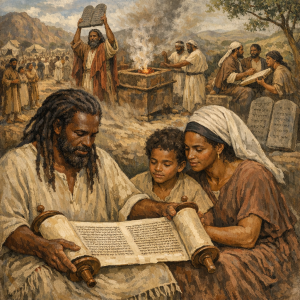
Deuteronomy depicts Torah as written, entrusted to Levitical priests and elders, and publicly read so that men, women, children, and the resident stranger might hear, learn, reverence Yah/Yahuah, and do its words. The passage also describes the written Torah as a covenant witness. This presentation shows that Torah was not conceived solely as private spiritual advice: it was to be taught publicly and embodied in the life of the people. ([mechon-mamre.org](https://www.mechon-mamre.org/e/et/et0531.htm?utm_source=openai))
Torah also had a pedagogical character. It was to be learned, spoken of, remembered, and transmitted across generations. Its narrative portions tell Israel who they are; its commands teach how a covenant people should live. Its repeated concern for the fatherless, widow, poor, resident stranger, honest judgment, truthful witness, and limits upon power demonstrates that instruction was not confined to ritual performance.
Textual Preservation and Development
The Torah’s textual history is ancient and complex. The Dead Sea Scrolls include biblical manuscripts in Hebrew and preserve evidence both of continuity with later traditional forms of the Hebrew Bible and of textual variation during periods before complete standardization. Fragments of every book of the Hebrew Bible except Esther were found at Qumran, including manuscripts of Torah books and an early copy of Deuteronomy containing the Decalogue. ([deadseascrolls.org.il](https://www.deadseascrolls.org.il/featured-scrolls?utm_source=openai))
Traditional Israelite and later Jewish belief commonly attributes the Torah to Moses. Modern historical-critical scholarship, by contrast, generally examines the Pentateuch as a body of literature shaped through lengthy processes of composition, preservation, and editing. Scholars differ sharply over dates, sources, redactors, and the degree of Mosaic connection. The documentary hypothesis was once highly influential; contemporary scholarship includes modified source theories, supplementary models, fragmentary models, and approaches that stress scribal and literary development. It is accurate to say that Mosaic authorship is a traditional claim and that multi-stage composition is a major academic position; it is not accurate to claim that every scholar agrees on one reconstruction.
Biblical / Torah Context
Within the five books, Torah is inseparable from covenant. Genesis provides the creation and ancestral foundations; Exodus recounts deliverance and covenant formation; Leviticus provides extensive priestly and holiness instruction; Numbers records wilderness testing and organization; and Deuteronomy restates and applies covenant instruction for life in the land. The books are diverse, yet they form a connected account of promise, deliverance, worship, responsibility, judgment, and hope.
The Creator’s covenant name appears in the Hebrew text as the four consonants YHWH. English Bibles often substitute LORD in small capitals. In this heritage context, Yah or Yahuah is used as a reverential English approximation where appropriate. This should not be confused with Adon or Adonai, terms whose basic English sense is “Master.” When English translations use “Lord” for Adonai, the ordinary sense is master or ruler, not a separate personal name.
Commandments, Judgments, and Instruction
The Torah includes commands often classified as moral, ceremonial, civil, judicial, purity-related, agricultural, and priestly. These modern categories can be useful for study, but they are not a complete native classification system imposed by the text itself. Torah commands often overlap: Sabbath, for example, concerns worship, rest, household order, labor, social equity, memory of creation or deliverance, and covenant identity.
The Decalogue, often called the Ten Commandments, stands as a central expression of covenant obligation, but it does not exhaust Torah. Nor do the detailed case laws of Exodus 21–23, the sacrificial instructions of Leviticus, or the covenant speeches of Deuteronomy exist in isolation. Each belongs within a larger scriptural account.
Governmental and Military Relevance
Governmental implications are genuinely relevant because Torah contains instructions for judges, officers, kings, priests, elders, witnesses, and community adjudication. It calls for impartiality in judgment, investigation by witnesses, and restraints upon rulers. Yet Ancient Israel was not a modern secular republic, and its covenant order should not casually be equated with present-day governmental systems.
Military material is also present, particularly in wilderness narratives and Deuteronomic war instructions. These texts concern ancient Israel’s conflicts and the text’s covenantal account of land, defense, judgment, and national survival. They should not be treated as a general modern authorization for private violence, conquest, ethnic hostility, or disregard of current law. Such applications require careful historical, moral, and legal analysis rather than slogan-based appeals to Scripture.
Legal Implications
Historically, Torah includes what modern readers recognize as law: prohibitions, duties, remedies, procedures, property rules, rules of evidence, and penalties. But it is not “common law” in the technical Anglo-American sense. Common law developed through English royal courts, judicial precedent, and later legal doctrine. Torah does not arise from English judges deciding cases over time, and it is not a branch of English common law.
Nor should Torah be confused with Roman law. Roman legal systems developed through distinct institutions, legal categories, jurists, imperial enactments, and later civil-law traditions. Although all ancient legal traditions may be compared historically, comparison does not establish identity, derivation, or legal authority.
Within Torah itself, legal material is embedded in covenant theology. A command may be accompanied by a rationale grounded in creation, deliverance from Egypt, holiness, compassion, land stewardship, or loyalty to Yah/Yahuah. This differs significantly from a modern statute, which ordinarily derives its legal force from an authorized legislature and is interpreted within a constitutional and judicial system.
Torah and Current Civil Law
For persons in the United States, Torah is not automatically enforceable civil law merely because it is sacred scripture. Current legal duties arise from constitutions, statutes, regulations, valid judicial decisions, contracts, and other recognized sources of law. Religious conviction can guide conscience and conduct, but it does not by itself nullify otherwise applicable law.
At the same time, United States law recognizes broad protection for religious belief and many forms of religious exercise. The First Amendment prohibits governmental establishment of religion and protects free exercise, while statutory law may provide additional safeguards in particular settings. Courts generally do not decide whether a religious doctrine is true; they may, however, consider questions such as sincerity, neutral laws of general applicability, compelling governmental interests, and statutory protections. ([law.cornell.edu](https://www.law.cornell.edu/constitution-conan/amendment-1/laws-regulating-religious-belief?utm_source=openai))
Accordingly, a person may study, observe, teach, or organize life around Torah as a religious commitment, subject to lawful limits and the rights of others. Claims that Torah automatically overrides all civil authority, creates a separate private court system with coercive power, or makes an individual exempt from criminal, tax, licensing, family, or contract law are legally unsound unless a recognized legal rule or valid accommodation specifically applies.
Spiritual Meaning
Spiritually understood, Torah is a path of covenant faithfulness. It teaches that devotion to Yah/Yahuah involves more than inward belief or spoken confession. It concerns worship, justice, mercy, truthful speech, sexual integrity, economic conduct, rest, treatment of servants and strangers, family responsibility, and care for the vulnerable.
Torah also confronts the human tendency to separate piety from conduct. Offerings, feasts, and sacred space are significant within its world, yet they do not license oppression, false witness, theft, exploitation, or idolatry. The instruction calls for a whole-life response in which reverence for the Creator is expressed in visible dealings with neighbors.
This dictionary’s interpretive analysis is that Torah should be read as direction toward ordered covenant life, not merely as a catalogue of prohibitions. That analysis does not deny that Torah contains binding commands within its own covenantal presentation. Rather, it recognizes that commands gain their force and purpose from the larger account of Yah/Yahuah’s relationship with Israel.
Modern Usage
In modern usage, “Torah” can mean the Pentateuch, a handwritten scroll containing the Pentateuch for congregational reading, the body of written scriptural instruction, or—within later rabbinic Jewish usage—the broader corpus of authoritative teaching, including the concept of Oral Torah. These senses should be distinguished rather than blended without explanation. The broad rabbinic sense is historically later than the Biblical Hebrew usage of torah for instruction or a particular teaching. ([merriam-webster.com](https://www.merriam-webster.com/dictionary/Torah?utm_source=openai))
Jewish communities continue to preserve, read, interpret, and live in relationship to Torah in diverse ways. Christian communities commonly call it the Pentateuch or the books of Moses and differ substantially regarding continuity, fulfillment, interpretation, and the application of its commands. Hebrew Israelite, Messianic, academic, secular, and interfaith readers likewise use the word in different ways. A careful writer should identify which sense is intended instead of assuming that all communities mean the same thing.
Controversies / Criticisms
A recurring controversy concerns translation. Some readers argue that “law” is misleading because Torah means instruction; others argue that avoiding “law” obscures the fact that Torah includes commands, judicial procedures, and penalties. The most balanced conclusion is that both terms capture part of the range. “Instruction” is broader and closer to the word’s central semantic field; “law” is suitable in passages where binding covenant commands and judgments are plainly at issue.
Another controversy concerns authorship and formation. Traditional believers may affirm Mosaic authorship in a strong sense, while historical-critical scholars commonly identify complex literary development. Neither position should be caricatured. Traditional attribution is central to many faith communities; scholarly analysis is concerned with textual evidence, language, literary patterns, manuscripts, and historical context. The debate remains active and does not yield one universally accepted reconstruction.
Torah is also sometimes misused in legal or political argument. Claims that all modern common law derives directly from Torah, that biblical law and American law are legally identical, or that private persons may enforce Torah penalties outside lawful authority are not established by mainstream legal history or current law. Torah has influenced moral discourse in many cultures, but influence is not the same as legal incorporation, and religious authority is not automatically civil jurisdiction.
Conclusion
Torah is best defined as the foundational Biblical Hebrew instruction associated with Yah/Yahuah’s covenant with Israel and, in its established canonical sense, the five books of Moses. Its meaning includes law but exceeds law: Torah teaches a way of worship, justice, memory, holiness, community order, and covenant responsibility.
To understand Torah accurately, readers should begin with its Ancient Israelite setting, recognize its Hebrew sense of instruction and direction, distinguish its covenantal laws from later Roman, common-law, and statutory systems, and clearly identify when later Jewish, Christian, or modern interpretations are being discussed. Read in context, Torah is neither a mere legal code nor a vague spiritual ideal. It is a comprehensive body of teaching that joins history, command, worship, ethics, and communal life.
Sources / Further Reading
- Oxford Learner’s Dictionaries, “Torah” — https://www.oxfordlearnersdictionaries.com/us/definition/english/torah
- Mechon Mamre, “Deuteronomy 31” — https://www.mechon-mamre.org/e/et/et0531.htm
- Israel Museum / Dead Sea Scrolls Digital Library, “Featured Scrolls” — https://www.deadseascrolls.org.il/featured-scrolls
- Israel Museum / Dead Sea Scrolls Digital Library, “Languages and Scripts” — https://www.deadseascrolls.org.il/learn-about-the-scrolls/languages-and-scripts?locale=en_US
- Oxford Bibliographies, “Education in the Hebrew Bible” — https://academic.oup.com/reference/62341/reference-article/554111325
- Cornell Legal Information Institute, “Religion and the Constitution” — https://www.law.cornell.edu/wex/religion_and_the_constitution
- Cornell Legal Information Institute, “Laws Regulating Religious Belief” — https://www.law.cornell.edu/constitution-conan/amendment-1/laws-regulating-religious-belief
- Cornell Legal Information Institute, 42 U.S.C. § 2000cc-5, definition of “religious exercise” — https://www.law.cornell.edu/definitions/uscode.php?def_id=42-USC-925260317-277753276