Race
Primary Definition
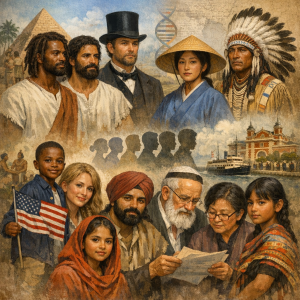
In its principal modern human sense, race is a social classification used to group people according to perceived ancestry, inherited physical traits, historical origin, and social identity. The term has never had one fixed meaning across all places, eras, disciplines, or legal systems. It may refer broadly to humanity as a whole (“the human race”); historically, to a people, lineage, nation, stock, or family; and in modern public usage, to socially recognized population categories.
Race should be distinguished from, though it may overlap with, ethnicity, nationality, citizenship, tribe, religion, and genetic ancestry. Ethnicity commonly concerns shared culture, language, history, customs, or heritage. Nationality ordinarily concerns membership in a nation or state. Citizenship is a legal political status. Ancestry describes familial or population descent. None of these terms is simply interchangeable with race.
Modern genetics does not support the proposition that humanity is naturally divided into a small number of separate, internally uniform biological races. Human beings share a common species and possess extensive genetic overlap. Genetic variation is real, and some inherited traits or disease risks may correlate with geographic ancestry or particular populations, but broad racial labels are socially variable and are imperfect substitutes for measured ancestry, family history, environment, or individual medical information. The National Human Genome Research Institute accordingly describes race and ethnicity as social constructs rather than clear, consistent biological divisions based on innate traits. ([genome.gov](https://www.genome.gov/about-genomics/policy-issues/population-descriptors-in-genomics?utm_source=openai))
For purposes of careful language, race is best understood as a historically developed social category that has had profound legal, political, economic, cultural, and personal consequences. Calling race socially constructed does not mean that its effects are imaginary. A category created and maintained through social practice can influence law, opportunity, self-identification, discrimination, community life, public policy, and historical experience.
Etymology and Origin
The English noun race, in the sense of lineage or a group of people, came through French from Italian razza, a word associated with generation, breed, lineage, or stock. Merriam-Webster records the English word in this sense from the sixteenth century. The deeper origin of the Italian term is uncertain and has been debated by etymologists; proposed connections include terms relating to generation or reproduction. Therefore, claims that the word has a certain, singular ancient Roman, Greek, religious, or governmental origin should be treated cautiously unless supported by a recognized etymological source. ([merriam-webster.com](https://www.merriam-webster.com/dictionary/race?utm_source=openai))
This word is distinct from the other English word race meaning a contest of speed, as in a horse race or footrace. That second word has a separate Germanic and Norse-related history. The two meanings became identical in spelling and pronunciation in English, but they should not be confused in etymology or legal interpretation. ([merriam-webster.com](https://www.merriam-webster.com/dictionary/race?utm_source=openai))
Earlier English uses of race could refer to a family line, a people, a nation, a breed of animal, or humankind generally. Such uses did not always carry the later modern meaning of a supposed biological division of humanity based upon physical appearance. Over time, especially in European colonial and imperial settings, the word increasingly became connected with efforts to classify human populations by ancestry, appearance, place of origin, and alleged inherited capacities.
Cultural and Historical Context
The meaning of race changed substantially between the early modern period and the nineteenth and twentieth centuries. In earlier usage, writers often employed the term loosely for descent, peoplehood, kinship, or nation. In the colonial era, however, systems of conquest, enslavement, land seizure, and labor control increasingly attached legal and political importance to inherited status and perceived origin. Categories of people were then treated not merely as descriptions, but as grounds for unequal civil standing, exclusion, forced labor, restricted marriage, unequal property rights, and denial of political participation.
In the United States, racial classification was embedded in early governmental recordkeeping and law. The first federal census in 1790 used categories tied to the constitutional order of the period, including distinctions between free persons and enslaved persons. Census categories changed repeatedly over the following centuries, reflecting changes in law, immigration, political power, social science, and self-identification. The historical changeability of these categories is important evidence that official racial classifications are not timeless biological facts. ([census.gov](https://www.census.gov/data-tools/demo/race/MREAD_1790_2010.html?os=av&utm_source=openai))
Nineteenth- and early twentieth-century “scientific racism” attempted to portray social hierarchies as products of immutable biological differences. Such theories frequently relied on selective observation, unsupported assumptions, biased measurements, and improper claims about heredity. They were used to rationalize slavery, segregation, colonial domination, exclusionary immigration policies, eugenics, and other forms of unequal treatment. Modern genomics rejects simplistic claims that broad racial categories reliably determine intelligence, moral worth, capacity, or social value. ([genome.gov](https://www.genome.gov/about-genomics/policy-issues/population-descriptors-in-genomics?utm_source=openai))
The historical misuse of race does not require denial of ancestry, heritage, culture, or population history. It does require discipline in language. A person’s inherited lineage may be meaningful to that person, family, or community. Yet ancestry is not a sound basis for assigning unequal dignity, legal rights, moral capacity, or presumptions of character. The equal worth of persons is a moral proposition and, in the American constitutional tradition, a central legal aspiration.
Biblical / Torah Context
The modern English concept of race should not be projected uncritically onto the Bible or Torah. Biblical Hebrew and Koine Greek contain words concerning peoples, nations, tribes, families, kindreds, languages, and descendants, but these do not map neatly onto contemporary racial classifications. The Hebrew Scriptures commonly speak of goyim or nations and of tribes and houses descended from particular patriarchs. The New Testament frequently uses terms such as ethnos (nation or people), laos (people), phylē (tribe), and genos (kind, family, offspring, or lineage), depending on context.
Genesis presents humanity as sharing a common human origin through Adam and Eve, and later describes the nations in relation to Noah’s descendants. These passages have historically been interpreted in many ways. They are not a reliable foundation for modern racial hierarchies. In particular, attempts to use the so-called “curse of Ham” or “curse of Canaan” to justify racial slavery are historically influential but textually unsound: Genesis 9 identifies Canaan, not Ham generally, as the object of Noah’s pronouncement, and the passage does not identify any modern racial group or authorize chattel slavery.
The Torah repeatedly commands justice toward the stranger or sojourner. Leviticus 19:33–34 directs Israel not to oppress the stranger but to love the stranger as oneself. Deuteronomy likewise emphasizes impartial judgment and protection for vulnerable persons. In the New Testament, the claim that God shows no partiality appears in contexts addressing relations among peoples, and Galatians 3:28 emphasizes unity in Christ across major social divisions. These passages do not erase historical identities, families, tribes, or nations; rather, they reject using such distinctions as a basis for denying justice, neighbor-love, or spiritual standing before God.
The English word race appears in some Bible translations in the athletic sense, such as “run the race” in Hebrews 12:1. That usage concerns endurance and contest, not racial classification. Biblical interpretation should therefore begin with the original-language context and the particular passage, rather than with assumptions drawn from a modern English word alone.
Legal Implications
Common Law and Historical Legal Usage
“Race” is not a single technical term inherited intact from English common law. Traditional common-law systems more often addressed status through such categories as subject, alien, citizen, free person, slave, villein, national origin, religion, family, legitimacy, or local allegiance. The legal significance attached to race in America developed through a mixture of colonial enactments, slavery codes, judicial decisions, constitutional provisions, post-Civil War amendments, statutes, administrative rules, and later civil-rights jurisprudence. It is therefore inaccurate to treat every present-day use of race as though it arose solely from ancient common law.
Roman law also had its own classifications concerning citizenship, status, family, freedom, and foreignness, but modern American racial law is not simply Roman law under another name. Equity, likewise, is a body of principles and remedies historically distinct from common law; it does not furnish a universal definition of race. Legal analysis should identify the governing source: constitution, statute, regulation, case precedent, contract, or administrative policy.
United States Constitutional Law
Under United States constitutional doctrine, governmental classifications based on race are ordinarily subject to strict scrutiny, the most demanding standard of judicial review. The government generally must demonstrate a compelling interest and show that the racial classification is narrowly tailored to achieve that interest. The Fourteenth Amendment’s Equal Protection Clause directly restrains state action, while equal-protection principles have been applied to the federal government through the Fifth Amendment’s Due Process Clause. ([law.cornell.edu](https://www.law.cornell.edu/wex/Equal_protection?utm_source=openai))
The Supreme Court’s race-classification cases developed over time and include decisions that rejected segregation and anti-miscegenation laws, decisions concerning remedial government programs, and decisions concerning education, voting, criminal justice, and public contracting. The Court has held that all governmental racial classifications, whether described as burdensome, remedial, or benign, receive strict scrutiny. This rule does not mean every policy mentioning race is automatically invalid; it means the government bears a heavy constitutional burden when it treats persons differently by race. ([law.cornell.edu](https://www.law.cornell.edu/constitution-conan/amendment-14/overview-of-race-based-classifications?utm_source=openai))
In Students for Fair Admissions, Inc. v. President and Fellows of Harvard College (2023), the Supreme Court held that the college-admissions programs before it violated the Equal Protection Clause. The decision materially altered the legal framework governing the consideration of race in admissions at institutions subject to constitutional equal-protection requirements. The decision did not forbid universities from considering an applicant’s individual experiences with discrimination, culture, family, or adversity where those experiences are relevant to personal character or achievement; however, an institution may not use those accounts as a proxy for assigning racial preferences. ([supremecourt.gov](https://www.supremecourt.gov/opinions/22pdf/20-1199_hgdj.pdf?itid=lk_inline_enhanced-template&utm_source=openai))
Statutes, Civil Rights, and Private Conduct
Race is also a protected category under major federal civil-rights statutes. Title VII of the Civil Rights Act of 1964 prohibits covered employment discrimination because of race, color, religion, sex, or national origin. Other laws prohibit race discrimination in specified areas such as contracts, housing, education, voting, and federally funded programs. State and local laws may provide additional protections or procedures. Whether a particular act is unlawful depends on the applicable statute, the facts, available evidence, and judicial interpretation.
Legal terminology matters. Race and color are often listed separately in statutes, as are national origin and religion. A claim based on ancestry, ethnic characteristics, skin tone, citizenship, religion, or language may involve different legal theories even when the facts overlap. In employment law, for example, regulations and guidelines may use race, sex, and ethnic group as categories for monitoring selection practices and adverse impact; this administrative usage does not establish that the categories are biologically fixed. ([law.cornell.edu](https://www.law.cornell.edu/cfr/text/41/60-3.16?utm_source=openai))
Government Data Categories
Federal agencies sometimes use standardized race and ethnicity categories for civil-rights enforcement, statistical reporting, public-health research, and census administration. Those categories serve administrative and demographic purposes. The Census Bureau has expressly stated that its race categories reflect social definitions recognized in the United States and are not an attempt to define race biologically, anthropologically, or genetically. An individual should not assume that a category on a form determines his or her complete ancestry, nationality, tribal citizenship, culture, or legal identity. ([merriam-webster.com](https://www.merriam-webster.com/dictionary/race?utm_source=openai))
Spiritual Meaning
In spiritual reflection, race raises questions of human unity, justice, prejudice, truthfulness, repentance, reconciliation, and the proper limits of worldly classifications. A biblical view of human dignity begins with the conviction that human beings bear the image of God. On that view, a person’s worth does not arise from skin color, ancestry, social rank, wealth, citizenship, or usefulness to others.
At the same time, spiritual unity should not be used to deny lived history. Calls to “see no race” may express a sincere desire for impartiality, but they can also obscure real experiences of exclusion or unequal treatment. Conversely, an exclusive fixation on racial identity may reduce persons to group membership and neglect their individual conscience, conduct, family, beliefs, and unique calling. A balanced spiritual approach recognizes human particularity without making ancestry an idol, a stigma, or a measure of righteousness.
Modern Usage
In current English, race appears in several distinct settings:
- Personal identity: individuals may describe their race as part of their family history, community membership, or social experience.
- Law and civil rights: the term identifies a protected classification in anti-discrimination law and constitutional analysis.
- Government statistics: agencies use racial categories to measure demographic patterns and possible disparities.
- Medicine and research: race may be reported as a social variable, but clinicians and researchers increasingly distinguish it from genetic ancestry and emphasize individual data.
- Ordinary speech: “human race” means humankind, while older phrases such as “the English race” often mean a people or national stock and may sound dated or imprecise today.
Precision is especially important in medicine, law, history, and public policy. If the point concerns a person’s genetic ancestry, say ancestry. If it concerns culture, say ethnicity, language, tribe, nation, or community where appropriate. If the point concerns legal discrimination, identify the precise protected category and governing law. Careful terms reduce confusion and prevent claims from being made broader than the evidence supports.
Controversies / Criticisms
The central controversy surrounding race is not whether human beings differ in appearance, ancestry, and population history; they plainly do. The controversy concerns how those differences should be categorized, what explanatory weight race should bear, and whether broad racial labels clarify or distort reality.
One position emphasizes that race is socially constructed and warns that racial categories conceal more genetic diversity within any broad group than many people assume. This position criticizes biological essentialism: the belief that race determines intelligence, virtue, criminality, spirituality, or fixed human potential. Contemporary genomic institutions strongly caution against using race as a proxy for unmeasured biological, environmental, or social causes. ([genome.gov](https://www.genome.gov/about-genomics/policy-issues/population-descriptors-in-genomics?utm_source=openai))
Another position emphasizes that racial categories remain socially and legally significant because people experience discrimination, unequal treatment, and community affiliation through those categories. From this perspective, refusing to name race can make it harder to document discrimination or remedy its effects. The practical challenge is to acknowledge the reality of racialized social experience without converting flexible social labels into rigid biological destinies.
Some writers also contest the use of race-conscious governmental remedies, admissions policies, contracting programs, or demographic targets. Supporters may argue that such measures address documented effects of past or present discrimination. Critics may argue that they unfairly classify individuals by ancestry and conflict with equal treatment. In American constitutional law, such governmental classifications are judged under strict scrutiny, not by slogans or assumptions alone. ([law.cornell.edu](https://www.law.cornell.edu/constitution-conan/amendment-14/overview-of-race-based-classifications?utm_source=openai))
Conclusion
Race is a historically powerful but imprecise term. It has referred at different times to lineage, peoplehood, nation, humanity, perceived physical difference, and legally recognized social categories. Its modern significance cannot be understood apart from the histories of slavery, colonialism, segregation, immigration, civil rights, scientific error, and ongoing debates concerning equality and identity.
A sound use of the term avoids two opposite errors: treating race as a fixed biological hierarchy, and pretending that racial classifications have had no real social or legal consequences. In law, every claim should be tied to its actual constitutional, statutory, regulatory, or case-law source. In science, ancestry and individual evidence should not be confused with broad social labels. In moral and spiritual life, every person should be regarded as possessing equal human dignity, without favoritism or contempt based on descent or appearance.
Sources / Further Reading
- Merriam-Webster Dictionary, “Race”
- National Human Genome Research Institute, “Use of Population Descriptors in Genomics”
- National Human Genome Research Institute, “Eugenics and Scientific Racism”
- United States Census Bureau, “Measuring Race and Ethnicity Across the Decades: 1790–2010”
- Legal Information Institute, “Overview of Race-Based Classifications”
- Legal Information Institute, “Equal Protection”
- Adarand Constructors, Inc. v. Peña, 515 U.S. 200 (1995)
- Students for Fair Admissions, Inc. v. President and Fellows of Harvard College, 600 U.S. (2023)
- 29 CFR § 30.2, Definition of “Race”
- Bible Gateway, selected passages: Leviticus 19:33–34; Deuteronomy 10:17–19; Galatians 3:28; Hebrews 12:1