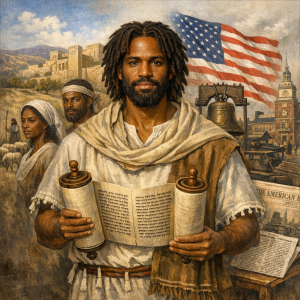
Primary Definition
In its oldest and foundational sense, an American Israelite is an American who identifies with Israel—the people named in the Hebrew Scriptures—by ancestry, covenant, religious confession, cultural inheritance, or some combination of these. The compound joins a modern civic or geographic designation, American, to the ancient ethnocovenantal designation Israelite.
The expression has several distinct applications and should be interpreted according to context:
- Ancient-heritage sense: an American who understands himself or herself as descended from, joined to, or spiritually identified with the ancient people of Israel.
- Historical American sense: a term formerly used by many American Jews, especially during the eighteenth and nineteenth centuries, to express both American citizenship and continuity with Israel.
- Proper-name sense: The American Israelite, a Cincinnati newspaper founded as The Israelite in 1854 and renamed in 1874.1
- Modern movement sense: a self-designation used by some Hebrew Israelite, Black Hebrew Israelite, Sacred Name, Torah-observant, Messianic, Anglo-Israelite, or other restorationist communities. These movements are not one organization and do not hold a single body of doctrine.
The term does not, by itself, establish biological descent, tribal enrollment, rabbinic status, citizenship in the modern State of Israel, or any special standing under United States law. It is also not synonymous with Israeli. An Israeli is ordinarily a citizen or national of the modern State of Israel, whereas an Israelite is historically a member of the ancient people of Israel or a person claiming continuity with that people.
Etymology and Origin
Israelite entered English through Latin and Greek forms derived from Hebrew Yisra’el. English forms such as Israelish, Israelitish, and Israelitic also appeared historically.2 The suffix -ite indicates a person belonging to, descended from, or associated with a named people or place.
In the Torah narrative, Jacob receives the name Israel after wrestling through the night. Genesis 32:29 explains the name through a Hebrew wordplay: Jacob has striven with Elohim and with men and has prevailed.3 Accordingly, the traditional explanation is commonly rendered “one who strives with El” or “one who strives with God.” Linguists have also proposed “El strives,” “El rules,” or “El prevails.” The biblical explanation is documented in the text; the precise pre-biblical linguistic formation remains a matter of scholarly discussion.
Within this dictionary’s Ancient Israelite heritage usage, Yah or Yahuah may be used for the Creator. Academic publications generally represent the four Hebrew consonants as YHWH, while many reconstruct the pronunciation as Yahweh; the exact ancient vocalization is not preserved beyond dispute. Likewise, Hebrew adon means a master, ruler, or owner. The traditional English title Lord carries the basic sense of “master” or “ruler,” and should not automatically be mistaken for the personal name YHWH.4
The oldest widely accepted extrabiblical reference to a people called Israel appears on the Egyptian Merneptah Stele, usually dated to about 1207 BCE. Its determinative identifies Israel as a people rather than a fortified city-state, demonstrating that a population known by that name was present in Canaan by the late thirteenth century BCE. The inscription does not, by itself, prove every detail of the Torah narrative, settle Israel’s complete origin, or identify the later descendants of every Israelite community.5
Cultural and Historical Context
Ancient Israelite Development
In the Hebrew Scriptures, Israel first names Jacob, then his descendants, the children or sons of Israel. It subsequently designates a covenant people organized through tribes, households, elders, judges, priests, and assemblies. After the united monarchy divided, Israel often referred more narrowly to the northern kingdom, while Judah referred to the southern kingdom. Prophetic texts can therefore distinguish the “house of Israel” from the “house of Judah.” In other passages, especially those expressing restoration or covenantal unity, Israel again signifies the people as a whole.
Israelite and Jew are consequently related but not identical historical terms. Yehudi originally denoted a person associated with Judah. It later acquired broader ethnic and religious meanings, particularly after the Babylonian exile and during the Second Temple period. Scholarly debate continues over when and in which texts Jew, Judean, and Israelite became functionally interchangeable. It is historically inaccurate to impose later rabbinic categories upon the earliest patriarchal and tribal setting without explanation.6
Development in America
Americans drew upon Israelite language long before the modern State of Israel was founded. Puritan and other Protestant writers compared their communities to biblical Israel, while enslaved Africans and their descendants found in Exodus a language of deliverance from bondage. These appropriations were analogical or theological; they did not necessarily amount to claims of literal Israelite genealogy.
American Jews also used Israelite as a public self-designation. The expression could affirm ancestral and religious continuity with Israel while emphasizing that the person’s civil nationality was American. A writer in 1778, for example, signed himself both a “real American” and a “true hearted Israelite,” illustrating how the two identities could be presented as compatible rather than competing.7
This synthesis became especially visible in nineteenth-century institutions. The Board of Delegates of American Israelites was organized in 1859 as an early national Jewish representative body.8 In this setting, Israelite often functioned as a dignified religious and historical designation, while American affirmed citizenship and civic loyalty.
The Newspaper
Isaac Mayer Wise founded The Israelite in Cincinnati on July 15, 1854. It was intended as a national periodical devoted to the religion, history, literature, and communal affairs of Israelites. The publication became The American Israelite on July 3, 1874. It promoted Wise’s program of American Reform Judaism and helped geographically scattered congregations communicate with one another. The Library of Congress describes it as the oldest English-language Jewish weekly in the United States.1
The title expressed a particular nineteenth-century position: one could be fully American in nationality while belonging to Israel in religion and historical inheritance. That editorial position was not universally accepted. Later Zionist, ethnic, Orthodox, Conservative, secular, and other understandings of Jewish peoplehood differed from the classical Reform tendency to describe Jewish identity principally as religion.
Biblical / Torah Context
The Torah presents Israelite identity through several overlapping elements: descent from the patriarchs, incorporation into a covenant community, allegiance to Yah, remembrance of deliverance from Egypt, and obedience to commandments governing worship, justice, family, property, food, labor, and community life.
Exodus 19 describes Israel as a covenant people called to be a priestly kingdom and a set-apart nation. Deuteronomy 6 commands Israel to hear, love, remember, and diligently teach the words of Yah. Leviticus 19 joins holiness to practical duties such as honest judgment, care for the poor, fair treatment of laborers, and love of one’s neighbor. Israelite identity in the Torah is therefore not merely a label of privilege; it entails obligations.
The Torah also contains mechanisms by which outsiders could dwell among Israel and, under stated conditions, participate in covenantal observances. Exodus 12:48–49 and Numbers 15:15–16 speak of one rule for the native and the sojourner in the matters addressed by those passages. These provisions do not erase every distinction involving genealogy, tribal land, priesthood, or household inheritance, but they show that the Torah’s community was not reducible to a modern theory of racial purity.
Governmental and military dimensions were likewise present. Numbers 1–2 describes a census and tribal encampment connected with military service. Deuteronomy provides for judges, officers, priests, witnesses, warfare, and limitations upon a future king. Ancient Israel was therefore a people, worshiping community, legal order, and at various times a political society. A modern American’s use of Israelite, however, does not automatically transfer the jurisdiction, offices, land allotments, or penalties of that ancient polity into present-day America.
Legal Implications
Historical common law: “American Israelite” was not a separate estate, nationality, or privileged class at English or American common law. Historical usage was primarily religious, ethnic, cultural, or institutional.
Current United States law: a sincere Israelite or Hebrew Israelite religious identity may receive the same general constitutional and statutory protections afforded to other religious beliefs. Under Title VII, religion is broadly defined and may include beliefs held by a small number of people or practices not approved by a large religious institution. Employers generally must reasonably accommodate sincerely held religious observances unless the accommodation would impose a substantial burden in the overall context of the business.9
Courts ordinarily distinguish the sincerity of a religious belief from its historical or theological truth. The First Amendment does not authorize a civil court to decide whether a religious doctrine is ultimately true. It may, where legally necessary, examine whether a claimed belief is religious and sincerely held.10
Religious exercise protections can also apply in prisons and other institutions. A Department of Justice agreement with the Michigan Department of Corrections specifically addressed restrictions affecting Hebrew Israelite practitioners, illustrating that a minority faith does not lose legal protection merely because officials consider it unfamiliar.11
Such protections do not create immunity from neutral criminal laws, taxes, court jurisdiction, licensing requirements, contracts, or valid judgments. A declaration of Israelite ancestry does not establish sovereign immunity or remove a person from United States citizenship and law. Genealogical or theological claims and legal status are separate questions.
Spiritual Meaning
Spiritually, the expression may signify an effort to unite American civic life with the covenantal memory of Israel. It can communicate perseverance, remembrance, repentance, liberation, obedience, and responsibility before Yah. Jacob’s struggle at Peniel gives the name Israel an enduring association with wrestling through fear, human conflict, and divine encounter.
For descendants of enslaved or displaced peoples, Israelite identity may also function as a restoration of dignity and sacred history. The Exodus provides a vocabulary for condemning bondage and trusting in deliverance. This is the dictionary’s interpretive analysis of the term’s spiritual force; it is not historical proof that every community drawing upon Exodus descends biologically from ancient Israel.
A responsible spiritual use should preserve the Torah’s ethical demands. Claiming Israel while rejecting justice, mercy, honest judgment, and care for the stranger empties the name of much of its scriptural substance. Election in the Torah is joined to service and accountability, not simply superiority.
Modern Usage
Today the phrase is less common as a general synonym for an American Jew, partly because Jewish American is more familiar and because Israelite can be confused with Israeli. It remains important in historical writing and as the title of the Cincinnati newspaper.
It is also used by varied restorationist communities. Some emphasize Torah observance and the Hebrew names of the Creator. Some accept later Christian writings or identify the Messiah with Jesus or a Hebrew form of his name; others reject Christianity. Some practice forms close to rabbinic Judaism, while others oppose rabbinic authority. No single doctrine should be attributed to all people using the label.
Black Hebrew Israelite traditions developed in the United States around claims that Black Americans or other peoples of African descent possess Israelite ancestry. Scholars emphasize that this broad label covers communities with substantially different histories, beliefs, worship practices, and attitudes toward Jews and other groups.12 Black Jews recognized by established Jewish communities, converts to Judaism, Ethiopian Jews, and Hebrew Israelite adherents are overlapping in some circumstances but are not interchangeable categories.
Other ancestry theories have claimed Israelite descent for Anglo-Saxon, Celtic, Indigenous American, Hispanic, or other populations. British Israelism influenced American groups during the nineteenth and twentieth centuries, and some later forms developed into the racist Christian Identity movement. These genealogical systems are modern interpretations, not conclusions established by the Torah or a scholarly consensus.13
Controversies / Criticisms
The principal controversy concerns who may properly claim Israelite identity. Competing answers appeal to genealogy, conversion, Torah obedience, rabbinic law, spiritual adoption, historical continuity, revelation, or national citizenship. These standards answer different questions and should not be carelessly combined.
Claims of exclusive descent are disputed when they lack documentary, archaeological, linguistic, or genetic support. Absence of proof does not necessarily disprove every family tradition, but religious conviction alone is not the same as publicly verifiable genealogy. Conversely, genetics cannot by itself determine covenant faithfulness, religious practice, or personal worth.
Some extremist factions—both white Christian Identity groups and certain Black Hebrew Israelite sects—have used Israelite ancestry theories to promote racial supremacy, antisemitism, collective condemnation, or the claim that existing Jewish communities are fraudulent. Such teachings should not be attributed to every Israelite-identifying person. Researchers and civil-rights organizations expressly caution that Hebrew Israelite communities are diverse and that many adherents do not advocate hatred or violence.12
Criticism also arises when biblical identity becomes a substitute for ethical conduct or a basis for pseudo-legal arguments. The name does not excuse threats, harassment, fraud, violence, breach of contract, or contempt of lawful process. Nor should disagreement over ancestry be used to deny anyone equal protection or freedom of conscience.
Conclusion
American Israelite is a layered designation joining a modern American setting to the ancient name Israel. Its meanings range from biblical heritage and nineteenth-century Jewish civic identity to a historic newspaper title and contemporary restorationist movements. Sound interpretation begins with the Ancient Israelite and Biblical Hebrew setting, then follows the term through Judahite, Second Temple, Jewish, Christian, and American developments in chronological order.
The phrase can express covenantal memory, cultural continuity, spiritual struggle, or claimed ancestry, but it is not self-proving. Its responsible use requires distinctions between ancient history and modern interpretation, documented descent and religious confession, protected belief and legal status, and spiritual calling and racial supremacy. At its strongest, the designation points not merely to a claim of origin, but to the obligations of remembrance, justice, faithfulness, and service associated with the name Israel.
Sources / Further Reading
- Library of Congress, “The American Israelite (Cincinnati, Ohio) 1874–Current”: https://www.loc.gov/item/sn85025894/; The American Israelite, “History”: https://americanisraelite.com/history/
- Online Etymology Dictionary, “Israelite”: https://www.etymonline.com/word/Israelite
- Mechon-Mamre, Genesis 32, Hebrew Bible in English: https://www.mechon-mamre.org/e/et/et0132.htm
- Society of Biblical Literature, “Names of God in the Hebrew Bible”: https://www.sbl-site.org/assets/pdfs/TB3_NamesofGod_RF.pdf
- Michael G. Hasel, “Israel in the Merneptah Stela,” Bulletin of the American Schools of Oriental Research: https://www.journals.uchicago.edu/doi/10.2307/1357179
- Jason A. Staples, “Israelites or Jews?” TheTorah.com: https://www.thetorah.com/article/israelites-or-jews
- The American Israelite, “For 250 Years, American Jews Have Answered Prejudice with Defiance”: https://americanisraelite.com/for-250-years-american-jews-have-answered-prejudice-with-defiance/
- Jacob Rader Marcus Center of the American Jewish Archives, “Timeline”: https://www.americanjewisharchives.org/educational-resources/timeline/
- U.S. Equal Employment Opportunity Commission, “Religious Discrimination”: https://www.eeoc.gov/religious-discrimination
- Legal Information Institute, “Laws Regulating Religious Belief”: https://www.law.cornell.edu/constitution-conan/amendment-1/laws-regulating-religious-belief
- U.S. Department of Justice, Michigan Department of Corrections religious-practice agreement: https://www.justice.gov/archives/opa/pr/justice-department-reaches-agreement-resolving-investigation-religious-practice-policies-and
- University of California, Davis, “What Are the Myths, Facts, About Hebrew Israelites?”: https://www.ucdavis.edu/blog/curiosity/what-are-myths-facts-about-hebrew-israelites
- Michael Barkun, Religion and the Racist Right: The Origins of the Christian Identity Movement: https://www.jstor.org/stable/10.5149/9781469611112_barkun