Ye
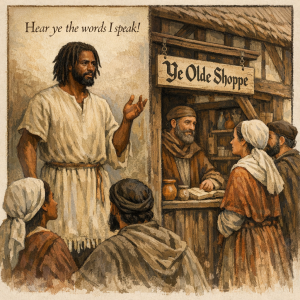
Primary Definition
As an English word, ye has two historically distinct principal uses that are often confused.
- Pronoun: In older English, it is the nominative, or subject, form of the second-person plural pronoun. In ordinary modern English, its nearest equivalent is you. Thus, “Ye are called” means “You are called.”
- Apparent article: In expressions such as “Ye Olde Shoppe,” the apparent word is usually a typographical descendant of þe, an older spelling of the using the letter thorn (þ). In that use it was historically read as the, not as the pronoun “yee.”
The two forms are therefore not merely different senses of one word; they arise from different historical sources. The pronoun is genuinely pronounced approximately “yee.” The quaint article in “Ye Olde” is ordinarily an altered visual spelling of the. A careful reader must determine which function is intended from the sentence and its historical setting.
Dictionary analysis: The central distinction is grammatical. The pronoun ye normally acts as the subject of a clause: “Ye shall know,” “Hear ye,” or “Blessed are ye.” Older English generally used you as an object: “I tell you,” “unto you,” or “with you.” This subject-object distinction gradually collapsed as you came to serve in both positions.
Etymology and Origin
The pronoun
The pronoun descends from Old English gē, the second-person plural nominative pronoun. Old English had a clearer distinction than present-day standard English between singular and plural forms and, within the second person, between subject and object forms. In simplified terms, the older paradigm included thou for singular subject, thee for singular object, ye for plural subject, and you for plural object.
The word belongs to the Germanic branch of the Indo-European language family. Related forms appear in other Germanic languages, including forms historically represented by Dutch gij and German ihr. The initial Old English sound and spelling changed over time, producing the Middle English form ye.
By the late Middle English and Early Modern English periods, speakers increasingly used you in subject position as well as object position. The resulting merger made you the general standard form, while ye became archaic in most English varieties. Dictionaries still recognize it as a formerly plural subject pronoun that survives chiefly in literary, religious, ceremonial, and dialectal use.
The apparent article in “Ye Olde”
The article has a separate history. Old English used the letter thorn, written þ, to represent a th sound. Thus, an older form of the could be written þe. In late medieval handwriting, thorn could resemble the letter y, especially when the following e was written in abbreviated or superscript form.
Early printing practices reinforced the visual substitution. Continental typefaces used by English printers did not always include thorn. Printers consequently used a y-shaped character or y as a practical substitute in certain common abbreviated forms. The printed result could look like ye, though it represented the. The historical pronunciation did not thereby become “yee.”
It is important not to oversimplify this development. The association between thorn and a y-like shape did not begin only with printing; it also reflects manuscript practices and changing letterforms. Printing helped preserve and circulate the spelling convention, but it was part of a broader transition in English writing. Eventually, th became the standard spelling for the sounds formerly written with thorn or the related letter eth (ð).
Cultural and Historical Context
The pronoun belongs to the older grammatical system of English, not to a deliberately theatrical “old-time” vocabulary. In medieval and early modern writing, pronoun selection could signal number, social distance, formality, intimacy, authority, and rhetorical tone. The precise social use varied by period, region, and speaker. It should not be reduced to a fixed rule that one form was always respectful and another always insulting.
In broad outline, thou and thee were singular forms, while ye and you were plural forms. Over time, plural you developed uses for respectful or formal address to one person. That development contributed to the retreat of thou. Once you also displaced ye as the normal plural subject form, standard English lost a distinct second-person plural pronoun.
The loss remains noticeable in modern speech. English speakers frequently create or preserve plural alternatives such as y’all, you all, you guys, youse, and you lot. These forms address an ambiguity created when modern you came to cover both singular and plural reference. They are not direct restorations of the historical pronoun, but they perform part of the communicative work that it once performed.
In literature, the word can create an elevated, archaic, biblical, communal, or theatrical voice. “Hear ye” is associated with public cries, announcements, and dramatic representations of town criers or court officers. Its force is ordinarily plural: it calls upon a group to listen. Modern writers sometimes employ it humorously or ceremonially rather than as a living grammatical form.
The commercial phrase “Ye Olde” developed a different cultural life. By the nineteenth century, businesses used such spellings to suggest antiquity, tradition, craftsmanship, Englishness, or rustic charm. The construction often combines several signals of artificial antiquity: Ye, Olde, ornate type, and sometimes deliberately nonhistorical spellings. It is therefore better understood as a modern or revived antiquarian style than as a reliable reproduction of Old English or medieval speech.
Biblical / Torah Context
The word has substantial importance for readers of older English Bible translations, particularly the King James Version of 1611 and later editions in its linguistic tradition. In those translations, ye generally translates a second-person plural subject. It commonly addresses a group rather than one individual.
For example, “Ye are the light of the world” addresses more than one hearer. Likewise, “Blessed are ye” ordinarily speaks to a group. By contrast, “I say unto you” uses you after a preposition and reflects the older object form. This grammatical distinction can sometimes help a reader see whether an English translation is presenting an address as plural or singular.
That usefulness has limits. The English word itself is not a Hebrew, Aramaic, or Greek word, and it does not possess an independent biblical doctrine. It is an English translator’s grammatical choice. Hebrew, Aramaic, and Koine Greek each have their own systems for distinguishing person, number, gender, case, and verbal agreement. A responsible study of a biblical passage should consult the original-language grammar, sound translation practice, and the literary context rather than build doctrine upon one archaic English pronoun alone.
In the Torah and the Hebrew Bible, modern English translations generally use you, though the underlying Hebrew may distinguish singular from plural address. Older English biblical phrasing may use ye where the Hebrew text addresses Israel, a congregation, a people, or another plural audience. For instance, traditional English renderings of covenantal instructions may say “ye shall,” emphasizing that the command is directed corporately. The grammatical plurality can be meaningful, but the meaning belongs to the source text and its context, not to a supposed mystical power in the English spelling.
Interpretive caution: Some readers claim that every occurrence of ye proves a collective command and every occurrence of thou proves an exclusively individual command. The underlying grammar often does distinguish singular and plural, but translation traditions are not identical in every passage, and English editions may vary. The claim should therefore be checked against the original language and a reliable interlinear or scholarly translation.
Legal Implications
The word is not a technical term of art in modern common law, equity, Roman law, statutory law, or contemporary American legal procedure. It does not create special jurisdiction, alter a person’s legal status, or transform an ordinary statement into a binding legal instrument merely because it appears in archaic language.
Historically, English legal documents were produced in several languages and registers, including Latin, Law French, and English. Older English records, proclamations, charters, pleadings, and public notices may contain archaic pronouns. In such a document, the word’s ordinary historical grammatical function matters: it may identify the persons addressed as a group, especially where it operates as the subject of a command, notice, oath, proclamation, or declaration.
That is an interpretive matter, not an independent legal doctrine. When courts construe legal texts, they examine the language in context. Depending on the instrument and jurisdiction, relevant considerations may include the text as a whole, the ordinary or historical meaning at the time of enactment, defined terms, surrounding provisions, prior judicial decisions, and applicable statutes. An archaic word in a historical instrument should be read according to reliable linguistic and legal evidence, not according to modern assumptions about its spelling.
For example, if an old ordinance states that “ye shall appear,” the phrase may plainly direct a group to appear. But its actual legal effect depends on the instrument’s authority, date, jurisdiction, enactment, subject matter, subsequent amendments or repeal, and relevant case law. No universal legal conclusion follows from the pronoun by itself.
Nor should ye be confused with “blackletter law.” The latter phrase refers to settled legal rules and derives its name from an old style of typeface used in legal books; it does not mean that every word printed in an old-looking font has a specialized common-law meaning. Similarly, the visual history of thorn and early print does not establish a Roman-law, governmental, military, ecclesiastical, or sovereign-citizen meaning for the term.
Spiritual Meaning
The word has no inherent spiritual force apart from the faith, text, prayer, or community in which it is used. Its spiritual association comes largely from the continued use of archaic English in Bible reading, hymns, liturgy, prayer books, and religious instruction. To many readers, the sound of older pronouns conveys reverence, solemnity, continuity, or a sense of sacred tradition.
That association is culturally real, but it should be distinguished from linguistic fact. Archaic English was once ordinary English. A phrase does not become spiritually authoritative merely because it uses older grammar, and modern English does not become spiritually inferior because it uses current grammar. The spiritual weight of a passage rests in its faithful meaning, context, and reception—not in whether a translation says ye rather than you.
At the same time, the plural form can support a worthwhile interpretive observation: many biblical commands, promises, and warnings are addressed to a people rather than only to isolated individuals. Where the source language confirms a plural address, readers may properly consider communal responsibility, worship, justice, covenant, fellowship, and mutual accountability. That conclusion arises from the grammar of the passage in context, not from an esoteric definition of the English term.
Modern Usage
Modern standard English generally treats the pronoun as archaic. It appears most often in the following settings:
- Biblical and liturgical language: readings, prayers, hymns, and quotations from traditional English translations.
- Literature and historical fiction: to evoke an earlier period or a formal voice.
- Public performance: phrases such as “Hear ye, hear ye,” often used ceremonially or humorously.
- Dialect: some English-speaking communities retain or revive forms resembling it in particular local usages.
- Commercial branding: “Ye Olde” appears on pubs, shops, restaurants, fairs, and novelty products to suggest age or tradition.
In ordinary contemporary writing, writers should normally use you unless quoting a historical text, preserving a liturgical form, adopting a consciously archaic style, or accurately representing a dialect. When quoting older material, editors should avoid silently changing pronouns if the grammatical distinction is relevant. A modern explanatory note may be preferable.
Controversies / Criticisms
The “Ye Olde” pronunciation error
The best-known controversy is not a serious scholarly dispute but a persistent misunderstanding. Many people pronounce “Ye Olde” as “yee old.” Historically, where the spelling represents þe, it should be understood as “the old.” This does not mean that the genuine pronoun is unreal; it means that the pronoun and the typographical article have been conflated.
False claims of hidden legal significance
Some modern claims assign secret legal, governmental, or jurisdictional significance to archaic English terms. There is no sound basis for treating this pronoun as a device that changes citizenship, court authority, contractual capacity, governmental status, or common-law rights. Such claims confuse historical language with operative law. A word may be relevant evidence of what an old document meant, but it is not a legal incantation.
Overreading biblical grammar
It is also possible to overstate the interpretive importance of the word in English Bible translations. The singular-plural distinction can be helpful, especially in older translations, but it does not eliminate the need for textual, historical, linguistic, and theological context. A single pronoun cannot responsibly bear a doctrine that the broader passage does not support.
Conclusion
The term preserves two different strands of English history. As a pronoun, it is an older plural subject form meaning “you.” As the apparent article in “Ye Olde,” it usually reflects the historical letter thorn and means “the.” Recognizing the difference prevents common errors in reading older literature, biblical translations, signs, and historical documents.
Its chief value in common-law, biblical, and historical study is grammatical and contextual. It may clarify who is being addressed in an older text, but it has no independent magical, sovereign, or technical legal power. Sound interpretation begins by distinguishing the documented history of the word from later stylistic uses and unsupported claims.
Sources / Further Reading
- Merriam-Webster, “Ye” — https://www.merriam-webster.com/dictionary/ye
- Online Etymology Dictionary, “Ye” — https://www.etymonline.com/word/ye
- Online Etymology Dictionary, “Yea” — https://www.etymonline.com/word/yea
- Cornell Legal Information Institute, “Construe” — https://www.law.cornell.edu/wex/construe
- Cornell Legal Information Institute, “Law French” — https://www.law.cornell.edu/wex/law_french
- Cornell Legal Information Institute, Bostock v. Clayton County — https://www.law.cornell.edu/supremecourt/text/17-1618
- King James Bible Online, 1611 Edition, Isaiah 43:10 — https://www.kingjamesbibleonline.org/1611_Isaiah-43-10/
- Bible Gateway, Leviticus 20:25–26 — https://www.biblegateway.com/passage/?search=Leviticus%2020%3A25-26&version=MEV%3BKJ21