Sunday – (Sun) or Dies Solis (Latin for “day of the Sun”)
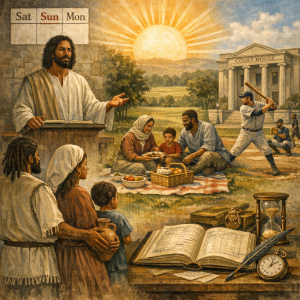
Primary Definition
Sunday is the conventional English name for the day commonly placed between Saturday and Monday. In much North American civil and religious usage, it is treated as the first day of the weekly cycle; under the international ISO 8601 week-date convention, however, Monday is day one and Sunday is day seven. The difference is a matter of calendrical convention, not a disagreement about the sequence of days. ([iso.org](https://www.iso.org/standard/70907.html?utm_source=openai))
The word has several related but distinct uses. It may refer simply to a civil calendar day; to the weekly day on which many Christians assemble for worship; to a customary day of rest, family life, sport, or reduced commerce; or, in historical legal writing, to a day subject to special rules about labor, court business, and the calculation of deadlines. A careful definition should not collapse those meanings into one. The calendar name itself, religious observance, and legal consequences have developed through overlapping but separate historical processes.
In ordinary speech, the term is usually secular and practical: “on Sunday” identifies a time. In Christian contexts, it is often called the Lord’s Day and associated with the resurrection of Jesus Christ. In Jewish law and Torah practice, it is the first day after the Sabbath rather than the Sabbath itself. Thus, the word may carry religious associations for some speakers while functioning as a neutral civil-calendar label for others.
Etymology and Origin
The English name descends from Old English Sunnandæg, literally “Sun’s day.” It belongs to a wider Germanic pattern that rendered the Latin planetary-day designation dies Solis, “day of the Sun,” into local speech. English therefore preserves a solar name where several Romance languages adopted forms derived from Latin dies dominica, “the Lord’s day”: compare French dimanche, Italian domenica, and Spanish domingo.
The Roman seven-day week used names connected with the visible heavenly bodies and the deities associated with them in Roman religion. That naming system should be distinguished from the later Christian practice of gathering on the first day of the week. The survival of a pre-Christian calendar name in English does not, by itself, establish a continuing act of solar worship, a legal duty, or a theological meaning for every person who uses the word. It is principally evidence of linguistic inheritance.
English speakers eventually received both vocabularies: the vernacular solar name and the ecclesiastical phrase “Lord’s Day.” Their coexistence is historically important. One names the day through a traditional civil-language form; the other identifies it through a Christian liturgical claim. Neither phrase automatically defines the beliefs of all persons, churches, or legal systems using it.
Cultural and Historical Context
The seven-day week emerged in the ancient Near East and became widely established in the Roman world. Jewish Sabbath observance gave the seventh day a distinctive covenantal and religious significance long before Christianity. Early Christians, many of whom were Jewish, inherited that weekly framework while also giving special attention to the first day of the week because the New Testament places the resurrection on that day.
By late antiquity, the first day had become increasingly significant in Christian worship and imperial administration. Emperor Constantine’s civil enactment of March 7, 321, directed judges, city residents, and craftsmen to rest on the “venerable day of the Sun,” while allowing agricultural work when seasonal necessity required it. The text demonstrates that the law used the existing Roman solar designation and imposed a limited civil rest rule; it did not itself use the word “Sabbath,” define all Christian doctrine, or create the seven-day week from nothing. Later imperial and church legislation expanded different forms of Sunday observance. ([sabbathsentinel.org](https://sabbathsentinel.org/2016/10/13/constantine-march-321-ad/?utm_source=openai))
In medieval and early modern Europe, the day acquired strong social and legal associations with church attendance, abstention from particular work, market restrictions, and limitations on judicial activity. English and colonial American rules commonly reflected Protestant and Christian-majority assumptions. These rules varied by locality, period, and subject matter. It is therefore inaccurate to speak of one timeless “common-law rule” governing every aspect of conduct on the day.
In the United States, changing patterns of labor, transportation, recreation, retail trade, and religious diversity transformed the practical meaning of the day. For many people it remains a principal worship day; for others it is a workday, a weekend day, or simply one coordinate in a seven-day schedule. Essential services, hospitals, public safety, transportation, hospitality, and global commerce often operate continuously.
Biblical / Torah Context
The Torah Sabbath and the First Day
The Torah identifies the Sabbath, Shabbat, as the seventh day. Exodus 20:8–11 connects it with God’s rest after creation, and Deuteronomy 5:12–15 also connects its observance with Israel’s liberation from bondage. In traditional Jewish reckoning, Sabbath begins before sunset on the sixth day and concludes after nightfall following the seventh day. The day now called Sunday is therefore not the Torah Sabbath; it begins after the Sabbath has ended.
Scripture’s original Hebrew terminology does not use the English calendar name. Biblical references instead speak of the seventh day, Sabbath, or the first day of the week. The English name arose much later through Germanic and Roman linguistic history. For that reason, arguments that the mere English word determines the biblical status of the day confuse a later translation and naming convention with the wording of the Torah.
New Testament References
The New Testament repeatedly refers to “the first day of the week.” The resurrection narratives place the discovery of the empty tomb on that day. Acts 20:7 describes disciples gathering to break bread on the first day of the week, and 1 Corinthians 16:2 directs believers to set aside collections on that day. Revelation 1:10 refers to “the Lord’s Day,” though the verse itself does not expressly define that phrase as Sunday.
These texts are interpreted differently. Many Catholic, Orthodox, and Protestant traditions understand the first-day gathering and resurrection theology as the foundation for weekly Sunday worship. The Catholic Catechism expressly distinguishes Sunday from the Sabbath while teaching that, for Christians, Sunday fulfills the Sabbath’s spiritual truth through Christ’s resurrection. ([vatican.va](https://www.vatican.va/content/catechism/en/part_three/section_two/chapter_one/article_3/ii_the_lords_day.index.html?utm_source=openai)) Other Christian communities, including various seventh-day Sabbath-keeping bodies, maintain that the biblical Sabbath remains the seventh day and contend that no biblical text expressly transfers the fourth-commandment Sabbath to the first day. That disagreement is theological and ecclesial; it should not be represented as a settled conclusion of the calendar name alone.
Legal Implications
Historical Common Law and Statute
Historically, English legal materials sometimes described the day as dies non juridicus, meaning a day on which ordinary judicial business was not conducted. The phrase should be handled with precision. It did not mean that every human act, contract, remedy, or governmental power ceased to exist for the entire day. Nor was it a universal rule of natural law. It was a procedural and institutional principle shaped by particular courts, statutes, ecclesiastical influence, and local custom.
English Sunday restrictions were often statutory rather than purely judge-made common law. The Sunday Observance Act 1677, for example, regulated worldly labor, ordinary callings, and certain commercial activities. Such enactments reflect the historical establishment of Christianity in English public life. They should not be confused with Roman civil law, biblical command alone, or a rule automatically binding in every modern common-law jurisdiction.
American colonies and states adopted varied versions of Sunday laws, frequently called “blue laws.” Some regulated retail activity, labor, entertainment, alcohol sales, or public amusements. Their scope and enforceability have changed substantially over time through repeal, amendment, judicial review, and changing social practice.
Constitutional Law in the United States
In McGowan v. Maryland (1961), the United States Supreme Court considered Maryland Sunday closing laws. The Court recognized their religious history but upheld the challenged provisions against the Establishment Clause challenge, reasoning that the laws could serve secular objectives such as a uniform day of rest and recreation. The decision did not declare that all Sunday laws are constitutional in every form, nor did it make Sunday a federally established holy day. A particular law remains subject to its text, purpose, operation, equal-protection principles, free-exercise protections, and applicable federal and state constitutional law. ([law.cornell.edu](https://www.law.cornell.edu/supremecourt/text/366/420?utm_source=openai))
Modern federal law generally does not designate the day as a nationwide federal public holiday. The federal holiday statute lists specified holidays and does not list Sunday as one of them. Federal employment law nevertheless provides premium pay in defined circumstances for covered employees who perform regularly scheduled non-overtime work that includes Sunday. The statute also permits an alternative recognized day of rest and worship for certain employees serving outside the United States where Sunday is routinely a workday. ([uscode.house.gov](https://uscode.house.gov/view.xhtml?edition=prelim&num=0&req=granuleid%3AUSC-prelim-title5-section5546&utm_source=openai))
In procedural law, the day may affect filing deadlines. Under current federal rules, if the final day of a filing period falls on a Saturday, Sunday, or legal holiday, the deadline ordinarily rolls to the next day that is not one of those days. This is a rule of time computation, not a declaration that the day is itself a federal legal holiday. State rules and individual court rules may differ and should be checked in the relevant jurisdiction. ([govinfo.gov](https://www.govinfo.gov/content/pkg/USCODE-2024-title28/pdf/USCODE-2024-title28-app-federalru-dup1.pdf?utm_source=openai))
No special military definition is inherent in the word. Military organizations may use it in duty rosters, leave schedules, religious-accommodation policies, or operational calendars, but the legal significance in those settings arises from applicable statutes, regulations, orders, and contracts—not from the name of the day itself.
Spiritual Meaning
For Christians who observe the day as the Lord’s Day, it may signify resurrection, new creation, communal worship, Eucharist or Communion, rest, mercy, and hope. Some traditions call it the “eighth day,” expressing a theological idea that the resurrection inaugurates a reality beyond the completed seven-day creation cycle. The day may therefore be treated not merely as time off, but as an occasion for worship and reorientation toward God.
For Jewish communities, the day follows the completion of Sabbath. Its spiritual importance is not normally that of Sabbath itself, though it may be a regular workday, family day, or the beginning of a new weekly rhythm depending on local custom. For nonreligious persons, it may convey rest, leisure, community, recovery from work, or no spiritual significance at all.
The dictionary’s interpretive analysis is that a day-name can acquire spiritual associations without making those associations compulsory or universal. Meaning depends on the speaker, tradition, and setting. Respectful use requires avoiding the assumption that civil-calendar terminology proves religious allegiance.
Modern Usage
In contemporary English, Sunday appears in calendars, contracts, business hours, transportation schedules, sports, news reporting, worship announcements, and software systems. It is commonly understood as part of the “weekend” in the United States and many other places, although that pattern is cultural rather than universal. Businesses may advertise “Sunday hours,” governments may set special voting, parking, alcohol, or retail rules, and employers may schedule weekend premiums or rotating shifts.
Digital systems require particular care because they may number the days differently. A U.S.-style calendar often displays the day first, while ISO 8601 places it seventh. When contracts, databases, payroll systems, or international schedules depend on week numbering, the governing standard should be stated rather than assumed.
Controversies / Criticisms
Several claims about the day are contested or overstated. First, it is historically supportable that English preserves a name derived from a solar designation; it is not supportable to infer from that etymology that every modern observance is sun worship. Words can outlive the religious systems in which they arose.
Second, Constantine’s 321 enactment is often described either as the creation of Christian Sunday worship or as proof that all Sunday observance is pagan. Both summaries are too simple. The civil law used solar language and granted a limited rest rule, while Christian first-day observance had roots predating Constantine. The historical relationship among Roman calendrical language, imperial policy, Jewish Sabbath practice, and Christian worship is real but cannot responsibly be reduced to one cause.
Third, Christians disagree over whether Sunday is the biblical Sabbath, a distinct Lord’s Day, a legitimate church tradition, or simply the customary day for assembly. The disagreement should be addressed by engaging the relevant biblical texts and the teachings of the particular tradition, rather than by asserting that a dictionary definition settles theology.
Finally, modern Sunday-closing laws have been criticized as burdensome to religious minorities, workers, small businesses, and persons whose weekly rest day is not Sunday. Supporters have defended carefully drawn rest-day laws as serving secular welfare, family time, and labor protections. The constitutional validity of any current rule depends on its jurisdiction and details, not on historical labels alone.
Conclusion
Sunday is a calendar term with Germanic linguistic roots, Roman-era naming background, Christian liturgical importance, and a long but varied legal history. It is not identical with the Torah Sabbath, even though many Christian traditions associate it with Sabbath themes of worship and rest. Historical common law and statutes sometimes gave it distinctive procedural or commercial consequences, but modern legal effect is determined by current enacted law, court rules, contracts, and constitutional limits.
The most accurate use of the term recognizes these layers without confusing them: a traditional name for a civil day; a central worship day for many Christians; the day after the Jewish Sabbath; and, in certain legal contexts, a day that may affect work, commerce, or deadlines. Claims extending beyond those documented meanings should be identified as theological interpretation, historical argument, or disputed proposition rather than stated as universal fact.
Sources / Further Reading
- United States Supreme Court, McGowan v. Maryland, 366 U.S. 420 (1961): https://www.law.cornell.edu/supremecourt/text/366/420
- Constitution Annotated, “Sunday Closing Laws,” Legal Information Institute: https://www.law.cornell.edu/constitution-conan/amendment-1/sunday-closing-laws
- United States Code, 5 U.S.C. § 5546, “Pay for Sunday and holiday work”: https://uscode.house.gov/view.xhtml?edition=prelim&num=0&req=granuleid%3AUSC-prelim-title5-section5546
- United States Code, 5 U.S.C. § 6103, federal holidays: https://uscode.house.gov/view.xhtml?edition=prelim&req=granuleid%3AUSC-prelim-title5-section6103
- U.S. Government Publishing Office, Federal Rules of Civil Procedure, Rule 6: https://www.govinfo.gov/content/pkg/USCODE-2024-title28/pdf/USCODE-2024-title28-app-federalru-dup1.pdf
- The Holy See, Catechism of the Catholic Church, “The Lord’s Day”: https://www.vatican.va/content/catechism/en/part_three/section_two/chapter_one/article_3/ii_the_lords_day.index.html
- International Organization for Standardization, ISO 8601-1:2019: https://www.iso.org/standard/70907.html