Friday – (Frigg) or Dies Veneris (Latin for “day of Venus”)
Primary Definition
Friday is the English name for the weekday that falls between Thursday and Saturday. In the common Sunday-first arrangement of the week, it is the sixth day; under the international ISO convention, which numbers Monday as the first day, it is the fifth. The word is an inherited English calendar name, not a legal maxim, religious command, or independent source of obligation.
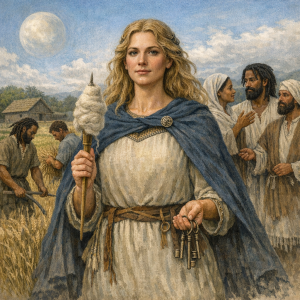
The name preserves an early Germanic rendering of a Roman weekday name associated with the planet Venus and the Roman goddess Venus. In English, that Roman association was translated through the name of a Germanic goddess generally identified in Old English as Frīg, cognate with the better-known Old Norse name Frigg. Thus, the ordinary meaning of the English word is historically “Frigg’s day” or “day of Frig.”
In contemporary speech, Friday ordinarily functions as a neutral designation of time: a date for work, travel, worship, commercial activity, court deadlines, or social plans. Its ancient etymology is real and historically important, but the modern use of the word does not ordinarily communicate devotion to a deity, acceptance of ancient astrology, or participation in a religious rite.
Etymology and Origin
The modern English form developed from Old English frīgedæg, formed from Frīg and dæg, meaning “day.” Dictionaries connect this Old English word with related West Germanic forms, including Old High German frīatag, and identify it as a Germanic translation or substitution for the Latin weekday associated with Venus. The word entered Middle English in forms such as Friday, fridai, and similar spellings before settling into its present form.
This history reflects a broader pattern in the English weekday names. Several English names preserve Germanic divine names where Latin used Roman divine names: Tuesday corresponds broadly to Mars’s day, Wednesday to Mercury’s day, Thursday to Jupiter’s day, and Friday to Venus’s day. The process was not a simple declaration that Roman and Germanic gods were identical. It was a conventional cultural translation, often called interpretatio romana, by which writers and speakers matched deities according to perceived functions, attributes, or status.
The underlying seven-day planetary week circulated widely in the Roman world and became deeply established in Europe. Roman naming convention associated each day with one of the visible heavenly bodies: Sun, Moon, Mars, Mercury, Jupiter, Venus, and Saturn. The English language retained some Roman material directly, especially in Saturday, but otherwise often used Germanic equivalents. Romance languages more visibly preserve the Latin Venus connection in names such as French vendredi, Spanish viernes, and Italian venerdì.
It is important not to overstate the linguistic evidence. The word Friday is not derived from the English adjective free, even though both may be discussed in relation to older Indo-European roots involving ideas of love, affection, or belonging. Nor does the English weekday name prove that all ancient Germanic peoples held one uniform theology. Languages preserve names across changing religions, governments, and cultures.
Cultural and Historical Context
Frigg, Freyja, and a Genuine Scholarly Question
Frigg is known in Norse literary sources as the wife of Odin and is associated with marriage, household life, motherhood, foreknowledge, and royal or domestic authority. However, Friday is sometimes popularly described as “Freyja’s day.” That statement requires qualification.
Freyja, another prominent Norse goddess, is more readily associated in surviving Norse sources with love, beauty, desire, wealth, magic, and fertility. Because Venus was a goddess of love and because Frigg and Freyja have overlapping attributes in later Scandinavian tradition, scholars and popular writers have sometimes connected Friday with Freyja, or proposed that Frigg and Freyja may preserve divergent developments from an earlier shared Germanic figure.
The direct Old English linguistic evidence, however, favors Frīg/Frigg, not the Old Norse title Freyja. Therefore, “Frigg’s day” is the more precise etymological explanation for the English word. “Freyja’s day” may reflect a comparative mythological interpretation or the broader historical confusion and blending of the two figures, but it should not be treated as the settled literal derivation of the English name.
Changing Meaning Through Use
As Christianity became dominant in England, inherited weekday names did not disappear. This illustrates an important principle of historical language: words may retain old forms after their original religious setting has ceased to govern the speakers’ beliefs. English speakers who used the name in medieval, Reformation, colonial, and modern settings were not thereby worshipping Frigg. The name became part of the ordinary civil calendar.
Friday later acquired additional cultural associations. In many English-speaking societies, it became associated with the close of the standard workweek, paydays, travel, recreation, entertainment, and the beginning of the weekend. Expressions such as “Friday night,” “casual Friday,” “Black Friday,” and “TGIF” are modern cultural developments, not meanings inherent in the old Germanic word.
Biblical / Torah Context
The word Friday does not appear as a Torah designation for a day of the week. The Torah’s primary weekly pattern is the sequence of six days of labor followed by the seventh-day Sabbath. Genesis repeatedly describes a day in the pattern of evening and morning, and the Sabbath commandment directs Israel to remember and keep the seventh day holy. The biblical and Jewish framework therefore centers on Shabbat, rather than on the later English names of weekdays.
In Jewish practice, Shabbat begins before sundown on what English speakers call Friday and continues until nightfall on Saturday. Friday consequently has major practical significance as the day of preparation for Sabbath: homes are prepared, meals are arranged, work is completed before the beginning of sacred rest, and the Sabbath may be welcomed with prayer, candles, Kiddush, and communal gathering. This significance arises from the biblical Sabbath and Jewish tradition, not from the English etymology of the weekday name.
In the New Testament, the day before the Sabbath is commonly described as “the day of Preparation.” Christian tradition identifies the crucifixion of Jesus with the day now called Good Friday, immediately before the Sabbath. Good Friday is therefore a specifically Christian liturgical observance connected with the Passion of Christ. It is not a biblical command to honor the ancient Germanic or Roman figures preserved in the English calendar name.
Friday also has a central place in Islam as the day of Jumuʿah, the congregational prayer. The Qur’an calls believers to prayer on the day of assembly and instructs them to leave trade when the call to prayer is made. This is another example of a major religious tradition giving the day spiritual and communal importance while using a different linguistic and theological framework from the English name.
Legal Implications
Common Law and Calendar Terminology
In common-law settings, a weekday name is primarily a means of identifying time. Contracts, court orders, notices, statutes, business records, and pleadings may refer to Friday in order to fix a meeting, performance date, deadline, hearing, payment date, or event. The legal consequence comes from the governing instrument, applicable statute, rule, custom, or court order—not from the etymology of the word.
There is no historical common-law rule making Friday inherently sacred, profane, unlawful, legally privileged, or legally void because its English name has pre-Christian Germanic roots. Likewise, there is no sound legal basis for claiming that a contract, court proceeding, oath, statute, or governmental act becomes invalid merely because it occurred on Friday or uses the ordinary civil calendar term.
Roman law and Roman religion contributed to the historical environment in which the Latin planetary weekday system spread, but that does not mean modern Anglo-American law derives its authority from Roman religious observance. English common law developed through English courts, royal administration, customary rules, legislation, and later constitutional arrangements. Equity developed through distinct historical institutions and doctrines. Modern United States law is governed by constitutions, statutes, regulations, judicial decisions, and applicable rules of procedure. A weekday name is not a source of jurisdiction or sovereignty.
Current Legal Use
Friday can matter legally when a statute, rule, contract, or administrative practice identifies it. For example, federal law provides that when a listed federal public holiday falls on Saturday, the preceding Friday is generally observed as the holiday for certain federal employees whose normal workweek is Monday through Friday. That rule is a statutory employment and holiday rule; it does not transform every Friday into a general legal holiday.
Federal procedural rules generally count intermediate Fridays as ordinary calendar days. Under Federal Rule of Civil Procedure 6, deadlines are ordinarily extended when the final day falls on a Saturday, Sunday, or defined legal holiday—not merely because it falls on Friday. Particular jurisdictions, courts, agencies, and contracts may use different filing hours, local holidays, or business-day definitions. Anyone calculating an actual deadline should consult the controlling rule, statute, court order, and local practice.
Governmental and Military Relevance
Friday has no demonstrated military origin in English. Military organizations, like governments and private institutions, may schedule training, leave, payroll, religious accommodation, transportation, or administrative closures around Fridays. Those practices are operational choices, not the source of the word’s meaning. Likewise, the civil calendar’s use by government does not make the ancient religious associations of a word legally operative.
Spiritual Meaning
Spiritually, Friday has no single universal meaning. Its meaning depends upon the religious, cultural, and personal framework of the speaker. For practitioners of modern heathen or Norse-inspired religions, the historical association with Frigg may be meaningful as part of devotion, ritual remembrance, or cultural reconstruction. Such usage should be described as contemporary religious practice, not assumed to represent the beliefs of all people who use the English calendar.
For Jews, Friday evening marks the entrance into Shabbat, a sanctified time of rest, worship, remembrance, family life, and separation from ordinary labor. For many Christians, Friday may signify fasting, penitence, the remembrance of Christ’s death, and especially the annual observance of Good Friday. For Muslims, Friday is a congregational day centered on the Jumuʿah prayer. For secular users, it may signify work’s end, community events, or simply a point in the calendar.
The dictionary’s interpretive conclusion is that a word’s historical origin and a speaker’s present intention must be distinguished. A person may conscientiously choose not to use a particular weekday name because of its ancient associations. Another person may use the customary name without religious intent. Neither conclusion should be forced by etymology alone. Language can preserve historical traces without requiring spiritual allegiance.
Modern Usage
Modern English uses Friday as a proper noun, customarily capitalized. It may identify a specific date (“Friday, May 8”), a recurring event (“every Friday”), a work pattern (“Friday hours”), or an informal cultural idea (“Friday feeling”). In commercial usage, the term appears in named events such as Black Friday, Good Friday sales restrictions in some localities, and “Friday night” entertainment programming.
Internationally, the practical place of Friday differs. In the United States and many other countries, Friday is commonly the final weekday before a Saturday–Sunday weekend. In countries where Friday prayers shape public schedules, the weekend may include Friday or may be structured differently. These differences concern work schedules, religious accommodation, and local law; they do not change the English word’s historical derivation.
Controversies / Criticisms
The principal controversy concerns whether the name should be connected with Frigg or Freyja. The most careful answer is that the English form points to Old English Frīg, cognate with Frigg, while Freyja is relevant to wider comparative discussions about Venus, love goddesses, and possible overlap in Germanic religious development. Presenting the matter as though there were no uncertainty oversimplifies the evidence.
A second controversy arises when ancient pagan associations are treated as if they control the present legal or spiritual meaning of ordinary English. Some religious critics object to using inherited pagan calendar names. That objection may be sincere and may guide personal speech or religious discipline. Yet the broader claim that ordinary use of the word necessarily constitutes pagan worship, creates a binding spiritual covenant, or invalidates legal acts is not supported by mainstream historical linguistics or by modern law.
A third issue is anachronism. Frigg is often called “the Norse goddess” in popular accounts, but the English word developed through Old English and wider Germanic linguistic history. Norse literary sources are valuable for understanding related traditions, but they should not be treated as a complete or direct record of every Anglo-Saxon belief. The surviving evidence is limited, regional, and filtered through later written sources.
Conclusion
Friday is a modern English calendar term with a documented Old English origin in the name of Frīg or Frigg. Its historical formation reflects the meeting of Roman planetary weekday naming and Germanic cultural translation. The word has since become an ordinary part of civil life, retaining its ancient linguistic form while acquiring many later Jewish, Christian, Islamic, secular, commercial, governmental, and social associations.
For legal purposes, Friday is ordinarily a designation of time whose effect depends on the relevant law, rule, contract, or order. For spiritual purposes, its significance depends on the beliefs and intentions of the person or community using it. Historical awareness supports careful speech, but historical origin alone does not determine present worship, legal validity, or personal conscience.
Sources / Further Reading
- Merriam-Webster, “Friday” — https://www.merriam-webster.com/dictionary/Friday
- Merriam-Webster, “Etymologies for Every Day of the Week” — https://www.merriam-webster.com/wordplay/etymologies-for-every-day-of-the-week/friday
- Online Etymology Dictionary, “Friday” — https://www.etymonline.com/word/Friday
- My Jewish Learning, “What Does Shabbat Shalom Mean?” — https://www.myjewishlearning.com/article/what-does-shabbat-shalom-mean/
- Quran.com, Surah Al-Jumuʿah 62:9 — https://quran.com/62:9
- United States House of Representatives, 5 U.S.C. § 6103, “Holidays” — https://uscode.house.gov/view.xhtml?req=(title:5%20section:6103%20edition:prelim)
- Legal Information Institute, Federal Rule of Civil Procedure 6 — https://www.law.cornell.edu/rules/frcp/rule_6