Primary Definition
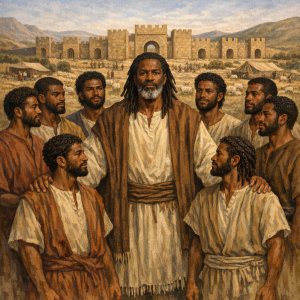
The Twelve Tribes of Israel are the tribal divisions descended, in the Torah’s ancestral account, from the twelve sons of Jacob/Yaakov, whose name was changed to Israel/Yisra’el. The expression refers to Israel as a people ordered through ancestral houses, tribes, families, inheritance, covenant responsibilities, assemblies, and—after entry into the land—territorial divisions. In this primary Biblical sense, “Israel” first names one man, Jacob/Yaakov; it later names his descendants collectively: the Israelites.
The twelve sons of Jacob/Yaakov are: Reuben, Simeon, Levi, Judah, Dan, Naphtali, Gad, Asher, Issachar, Zebulun, Joseph, and Benjamin. Genesis identifies them as sons born through four women in Jacob’s household: Leah, Rachel, Bilhah, and Zilpah. Their names became the names of the principal tribes of Israel.
Biblical lists of the tribes do not always display the same twelve names in the same form. This is not necessarily a contradiction. Levi was set apart for Levitical service and did not receive a conventional territorial inheritance comparable to the other tribes. Joseph, meanwhile, was frequently represented in land and census arrangements through his two sons, Ephraim and Manasseh, whom Jacob/Yaakov treated as his own sons for inheritance purposes. Thus, one list may name Joseph and Levi, while another may name Ephraim and Manasseh and treat Levi separately. The governing pattern remains twelve tribal portions or tribal identities.
The phrase should not be retroactively reduced to the later term Jew or Jewish. Historically, Judah/Yahudah was one tribe within the larger house of Israel. Later usage connected “Jew” especially with Judah and the Kingdom of Judah, but the Twelve Tribes of Israel in the Torah concern the whole ancestral people of Israel.
Etymology and Meaning of Israel
Israel is the English form of the Hebrew Yisra’el (יִשְׂרָאֵל). In Genesis 32, Jacob/Yaakov receives the name after struggling through the night: the narrative explains the name through his striving with the divine and with men. Genesis 35 contains a second naming account in which the Creator confirms that Jacob’s name is Israel. These passages provide the Torah’s own narrative explanation of the name.
Scholars also observe that the name contains El, a Hebrew Northwest Semitic designation for God. Exact linguistic explanations have been debated. The common popular rendering, “he who strives with God,” follows the wordplay in Genesis 32; other linguistic analyses understand the name in relation to El’s rule or authority. A careful dictionary entry should distinguish the Torah’s interpretive wordplay from claims of certain modern etymology. The text itself emphasizes Jacob’s encounter, struggle, blessing, and changed name.
In this dictionary’s Ancient Israelite heritage usage, the Creator may be referred to as Yah or Yahuah. English Bible translations often render the divine name represented by the Tetragrammaton as “LORD” in small capitals. In ordinary English, lord means master, ruler, or one possessing authority; it should not be mistaken for a personal name. The ancestral narratives also use El and related Hebrew forms in ways that reflect the vocabulary of the Biblical Hebrew text.
The transition from Jacob/Yaakov the man to Israel the people is essential. “Israel” can therefore mean: (1) Jacob/Yaakov personally; (2) his house and descendants; (3) the confederated tribes; (4) the northern kingdom in the divided-monarchy period; or (5) in later religious, political, and modern contexts, different communities or institutions. Meaning must be determined by context.
Jacob/Yaakov and the Formation of the Twelve Tribes
Genesis presents the Twelve Tribes through a family structure. Jacob/Yaakov, son of Isaac and grandson of Abraham, formed a household with Leah and Rachel, who were sisters, and with Bilhah and Zilpah, women attached to Rachel’s and Leah’s households. Genesis 29–30 narrates the births of eleven sons and one daughter, Dinah; Benjamin is born later in Genesis 35. Genesis 35:22–26 then gathers the sons into a formal genealogical list.
The account is not a modern bureaucratic classification. It is a kinship narrative in which father, mother, son, house, family, blessing, inheritance, service, and covenant belong together. The sons are portrayed as ancestral fathers of tribes, and their household relationships become the framework through which Israel later understands its internal divisions.
Genesis 46 lists the members of Jacob’s house who went down into Egypt. Genesis 48 records Jacob’s adoption-like elevation of Joseph’s sons Ephraim and Manasseh. Genesis 49 preserves Jacob/Israel’s final words concerning his sons and expressly calls them “the tribes of Israel, twelve.” These chapters establish the literary and covenantal framework later reflected in the census, camp, inheritance, and blessing passages of Numbers and Deuteronomy.
The Twelve Sons and Their Mothers
The Torah’s genealogy identifies the sons as follows:
- Leah: Reuben, Simeon, Levi, Judah, Issachar, and Zebulun.
- Rachel: Joseph and Benjamin.
- Bilhah: Dan and Naphtali. Bilhah is associated with Rachel’s household.
- Zilpah: Gad and Asher. Zilpah is associated with Leah’s household.
Genesis treats all twelve as Jacob’s sons and as progenitors of Israelite tribes, even though the mothers’ positions within the household are narrated differently. Later readers have sometimes attempted to rank tribes according to the status of their mothers. That approach should be handled carefully. The final form of Genesis 49 addresses all twelve as Israel’s tribal sons, and the Torah’s later tribal organization includes the descendants of Bilhah and Zilpah among Israel.
The Tribes Individually Explained
Reuben
Reuben was the firstborn son of Jacob/Yaakov through Leah. Firstborn status gave him an initial position of prominence within the house, yet Genesis 49 associates the loss of preeminence with his conduct involving his father’s concubine Bilhah. Reuben later appears as a tribe east of the Jordan in the territorial traditions of Numbers and Joshua.
Simeon
Simeon was the second son of Jacob/Yaakov and Leah. Genesis 49 joins Simeon with Levi in a severe remembrance of violence at Shechem. In later territorial material, Simeon’s inheritance is located within or surrounded by Judah’s territory in the south, demonstrating that tribal identity and territorial administration could overlap.
Levi
Levi was the third son of Jacob/Yaakov and Leah. Levi’s descendants became the tribe assigned to distinctive sanctuary, teaching, transport, and service responsibilities. Levi therefore remained a tribe of Israel, but was treated differently in territorial and census arrangements. The tribe’s special role must not be confused with a claim that every Levite was a priest.
Judah
Judah/Yahudah was Leah’s fourth son. Genesis 49 gives Judah language of leadership and rule, and later Biblical history associates the Davidic royal house with Judah. The southern Kingdom of Judah took its name from this tribe. “Jew” is historically related to Judah, but Judah is not a replacement name for all twelve tribes in the Torah.
Dan and Naphtali
Dan and Naphtali were sons of Jacob through Bilhah. Dan is associated in Genesis with judgment or vindication through a Hebrew wordplay, while Naphtali is associated with struggle. Both appear in wilderness censuses and camp arrangements. Dan’s later migration in the book of Judges shows that tribal location was not always fixed in practice.
Gad and Asher
Gad and Asher were sons of Jacob through Zilpah. Gad became associated with territory east of the Jordan, while Asher is associated with territory in the northwestern coastal and inland region. Genesis 49 and Deuteronomy 33 preserve poetic sayings about them, but such blessings should not be turned into invented predictions or rigid modern ethnic maps.
Issachar and Zebulun
Issachar and Zebulun were sons of Leah. Their tribal territories are described in later land-allotment traditions in the north. Biblical poems connect Issachar with labor and Zebulun with trade, travel, or seaward orientation, though the poetic language is interpretive and should not be treated as a complete historical census of each tribe’s occupation.
Joseph and Benjamin
Joseph and Benjamin were Rachel’s sons. Joseph occupies a central place in Genesis because of his descent into Egypt, rise in Pharaoh’s administration, and role in preserving Jacob’s household during famine. Benjamin, Rachel’s younger son, was born after the return toward Canaan. Joseph’s tribal inheritance was enlarged through Ephraim and Manasseh; Benjamin remained a distinct tribe.
Levi, the Levites, and the Kohanim/Priesthood
Levi is the name of one of Jacob’s sons and therefore one of Israel’s tribes. A Levite is a descendant of Levi. The Torah assigns Levites responsibilities connected with the tabernacle, its furnishings, its transport, guarding sacred space, and assisting in the ordered worship of the assembly.
A Kohen is a priest, specifically a descendant of Aaron within the tribe of Levi. Aaron and his sons received priestly duties; other Levites had sacred service roles but were not thereby Kohanim. Thus, the terms are related but not interchangeable: every Kohen is a Levite, but not every Levite is a Kohen. Numbers distinguishes Aaron’s priestly house from the broader Levitical body.
This distinction also explains why Levi is sometimes omitted from military censuses or land-portion lists. Numbers 1 counts men available for military service by tribe while excluding Levi from that count because of Levitical responsibilities. This is an administrative distinction within Israel, not an erasure of Levi from Israel.
Joseph, Ephraim, and Manasseh
Joseph was one of Jacob’s twelve sons, but Genesis 48 gives special standing to Joseph’s two sons, Ephraim and Manasseh. Jacob/Yaakov says that Ephraim and Manasseh will be regarded as his own, “as Reuben and Simeon are.” In the inheritance structure, this gives Joseph a double tribal portion through his two sons.
For that reason, territorial and census lists often count Ephraim and Manasseh separately instead of listing Joseph as one territorial tribe. Levi may then be counted separately for sacred service rather than territorial land. This arrangement preserves the recurring number twelve without pretending that every list serves the same purpose.
The order of Jacob’s blessing in Genesis 48, in which Ephraim receives the greater blessing despite being younger than Manasseh, became important in later Biblical memory. It should nevertheless be remembered that Ephraim and Manasseh are sons of Joseph and grandsons of Jacob; they are not additional direct sons inserted into Genesis 35’s genealogy.
Tribal Inheritance and Territory
Tribal identity was not merely symbolic. Numbers 26 prepares for division of the land after a new census. The land traditions in Numbers, Joshua, and related texts connect tribes with inheritance, boundaries, cities, pasturelands, and responsibility within the assembly. Reuben, Gad, and half of Manasseh received land east of the Jordan, while other tribes received portions west of it. Levi received designated cities and associated lands rather than one continuous tribal territory.
These arrangements should not be described as modern private-property law or as a modern nation-state cadastral system. The Biblical material presents inheritance as ancestral, covenantal, and communal. Land is tied to family continuity and tribal order, while ultimate possession is understood as belonging to Yah/Yahuah rather than as an unlimited commodity.
Torah and Covenant Structure
The tribal system was part of Israel’s covenant order. Numbers 1 records a census by tribe and ancestral house; Numbers 2 arranges the tribes around the tabernacle in an ordered camp; Numbers 26 provides a later census for inheritance purposes. Deuteronomy 33 gives Moses’ blessings upon the tribes, just as Genesis 49 gives Jacob/Israel’s words concerning his sons.
The tribal arrangement therefore had family, governmental, military, worship, and land-related dimensions. In the wilderness accounts, tribes supplied leaders, standards, camps, military men, and representatives. Yet the Torah does not depict twelve independent sovereign states. They are tribes within one covenant people, gathered before Yah/Yahuah and ordered around the sanctuary.
In common-law language, this is closer to an ancestral people organized through houses and inherited responsibilities than to a corporation created by filing or statute. That comparison is interpretive, not a claim that ancient Israel was governed by English common law. English common law developed much later in a different land and legal tradition. The Torah’s tribal order should be read first on its own Ancient Israelite terms.
Historical Context
The Biblical presentation of twelve tribes has been influential for more than two millennia, but historians debate how directly the final genealogical scheme reflects early social history. Some scholars understand the twelve-tribe framework as preserving memories of a loose Israelite confederation; others emphasize that tribal lists developed, changed, and were shaped by later writers and political realities. The Biblical texts themselves contain signs of variation: some tribes are prominent in some periods and nearly absent in others; territorial relationships changed; and the northern kingdom of Israel and southern kingdom of Judah later followed separate political paths.
This scholarly debate does not eliminate the importance of the Torah’s own account. It does mean that one should distinguish: (1) the Biblical narrative of shared descent from Jacob/Israel; (2) later Biblical history of tribes and kingdoms; and (3) modern historical reconstruction based on texts, archaeology, and comparative study.
Biblical/Torah Context
The principal Torah passages include:
- Genesis 29–30: births of the sons through Leah, Rachel, Bilhah, and Zilpah.
- Genesis 32: Jacob’s renaming as Israel in the wrestling narrative.
- Genesis 35:22–26: consolidated list of Jacob’s twelve sons.
- Genesis 46: the house of Jacob/Israel entering Egypt.
- Genesis 48: Ephraim and Manasseh receive standing among Jacob’s sons for inheritance.
- Genesis 49: Jacob’s final words to his sons, called the twelve tribes of Israel.
- Numbers 1 and 2: tribal census and camp order.
- Numbers 26: inheritance-related census.
- Deuteronomy 33: Moses’ blessings concerning the tribes.
Different Biblical Enumerations of the Twelve Tribes
Different lists answer different questions. A list of Jacob’s direct sons names Joseph and Levi. A territorial list may name Ephraim and Manasseh in Joseph’s place, while excluding Levi from a land portion. A military census may omit Levi because Levitical service is separately assigned. A priestly list may distinguish Aaron’s line within Levi. Some later Biblical writings arrange tribal names for theological or literary purposes.
Accordingly, it is inaccurate to argue that every Biblical list must contain the identical twelve labels in the identical sequence. The number twelve functions as a durable pattern of Israel’s ordered wholeness, while the names used can shift according to genealogy, land, sanctuary service, military organization, or theological emphasis.
The phrase “12 Gates” usually refers not to a Torah tribal list, but to the later vision in Revelation 21, where the New Jerusalem’s gates bear the names of the twelve tribes of the sons of Israel. That apocalyptic Christian text draws upon Israelite tribal imagery. It should not be used to overwrite the Torah’s earlier family, covenant, and inheritance setting.
Modern Usage and Common Misunderstandings
Modern religious communities use the Twelve Tribes in Jewish, Christian, Israelite-heritage, messianic, and other theological settings. These uses may be meaningful within their own traditions, but they should be identified as later interpretations rather than assumed to be the sole meaning of the Torah.
One common error is to say that all Israelites were simply “Jews.” In historical usage, Judah is one tribe, and “Jew” developed from Judah/Yehudah in later historical circumstances. Another error is to identify every Levite as a Kohen. A third is to insist that Ephraim and Manasseh prove there were thirteen tribes; the Torah’s different lists instead reflect Joseph’s double inheritance and Levi’s distinct service.
Claims that modern nations, ethnic populations, or particular families can be conclusively assigned to a specific “lost tribe” generally go beyond what Biblical genealogies and available historical evidence can establish. Such claims are often theological, communal, or speculative. They should not be presented as settled history without reliable documentary and genetic evidence interpreted with appropriate caution.
Conclusion
The Twelve Tribes of Israel are the ancestral houses of the Israelites, traced in the Torah through the twelve sons of Jacob/Yaakov, Israel. They express a people ordered by fatherhood, motherhood, family, tribe, inheritance, covenant, service, and land. Levi’s sacred responsibilities and Joseph’s double inheritance through Ephraim and Manasseh explain why Biblical lists can vary without abandoning the twelve-tribe structure.
In its proper Ancient Israelite setting, the term does not mean a vague religious symbol, a modern racial label, or a replacement name for only Judah. It identifies the whole house of Israel as the Torah presents it: a covenant people whose tribal memory begins with Jacob/Yaakov, Israel, and his sons.
Sources / Further Reading
- Hebrew Bible / Torah, Genesis 29–30, 32, 35, 46, 48–49; Numbers 1–2 and 26; Deuteronomy 33. https://www.sefaria.org/Genesis.29?lang=bi
- Hebrew Bible / Torah, Numbers 1–2, tribal census and camp arrangement. https://www.sefaria.org/Numbers.1?lang=bi
- Hebrew Bible / Torah, Numbers 26, second wilderness census and inheritance framework. https://www.sefaria.org/Numbers.26?lang=bi
- TheTorah.com, “A Tale of Twelve Brothers.” https://www.thetorah.com/article/a-tale-of-twelve-brothers
- TheTorah.com, “Did Israel Always Have Twelve Tribes?” https://www.thetorah.com/article/did-israel-always-have-twelve-tribes
- TheTorah.com, “Jacob Is Renamed Israel (Twice): Why Does His Name Remain Jacob?” https://www.thetorah.com/article/jacob-is-renamed-israel-twice-why-does-the-name-jacob-remain
- TheTorah.com, “Bilhah and Zilpah Mothered Four Tribes—So Are They Matriarchs?” https://www.thetorah.com/article/bilhah-and-zilpah-mothered-four-tribes-so-are-they-matriarchs