Ward
Primary Definition
In its central legal sense, ward means a person placed under the protection, care, or legal authority of another person or institution. Most commonly, a ward is a minor child or an adult whom a court has found unable, in whole or in part, to manage personal, medical, or financial affairs without legally authorized assistance. The person or body entrusted with responsibility is ordinarily called a guardian, although modern statutes may distinguish between a guardian of the person, a conservator of property, a fiduciary, a representative payee, or another protective decision-maker.
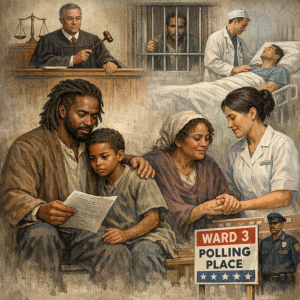
The word has several related but distinct meanings, all connected by the underlying ideas of watching, guarding, keeping, or a place under protection:
- Legal person: an individual subject to guardianship or the protective jurisdiction of a court.
- Protected custody: the condition of being kept, held, or protected; older legal and biblical usage may refer to detention or imprisonment.
- Institutional division: a separate section of a hospital, prison, workhouse, or similar institution, such as a maternity ward or prison ward.
- Political subdivision: a district within a municipality, especially one used for local representation, elections, or administration.
- Guard or watch: an older sense referring to a guard, a place of watch, or the act of guarding.
In law, therefore, “ward” does not mean that a human being has become property, a commercial asset, or a fictional entity. It identifies a legal relationship in which another person or court has defined protective duties and, often, decision-making authority. The exact scope of that authority depends on the governing statute, court order, jurisdiction, and facts of the individual case. ([law.cornell.edu](https://www.law.cornell.edu/wex/ward?utm_source=openai))
Etymology and Origin
The English word developed from Old English weard, meaning a watchman, keeper, guard, or protector, and from related forms concerning guarding or keeping watch. It belongs to a Germanic family of words associated with watching, guarding, and protecting. During the Middle English period, English usage was reinforced by Anglo-French and Old Northern French forms such as warde and warder. This history helps explain the close relationship among such English words as ward, warden, warder, guard, and guardian.
The older meaning was not originally limited to children or court supervision. A ward could be a watch, protection, custody, a guarded place, or a person who guarded. From the general idea of being “kept” or “under guard,” English developed both the custodial sense of a prisoner kept in ward and the protective sense of a child or incapacitated person kept under a guardian’s care.
The legal sense became especially important in English law because of the historical institution of wardship: the custody and control of an underage heir and, in some circumstances, the heir’s inherited land. Thus, the word carries a history containing both protection and power. A ward could receive maintenance, education, and legal protection; yet the ward’s person, labor, marriage prospects, and property could also be subject to the interests of the guardian, lord, or Crown.
Modern English retains the older family resemblance. A hospital ward is a place where patients are kept under organized care. A prison ward is a controlled portion of a detention facility. A municipal ward is a defined area placed within a city’s administrative structure. In each use, the word suggests boundaries, oversight, and responsibility. Oxford identifies the Old English sense as protection, lookout, or a body of guards, while modern dictionaries retain both the legal-person and institutional-division meanings. ([oxfordlearnersdictionaries.com](https://www.oxfordlearnersdictionaries.com/us/definition/english/ward_1?utm_source=openai))
Cultural and Historical Context
Medieval Wardship and Feudal Power
In medieval England, wardship was not simply a charitable arrangement for an orphaned child. It was also a feudal incident: a legal advantage attached to landholding. When a tenant who held land from a lord died leaving an underage heir, the lord could obtain custody of the heir’s land and, in certain forms of tenure, custody of the heir. The Crown asserted this right particularly where the deceased had held directly from the king.
This arrangement had practical and economic consequences. The guardian or lord might administer the estate and receive its income until the heir reached legal age. The right of wardship could be granted, sold, or used to reward political supporters. Historically, the right could also include substantial influence over the ward’s marriage. Such practices show why the term cannot be understood as purely benevolent: guardianship was often a source of revenue and political control as well as a claimed duty of care.
Magna Carta addressed abuses connected with wardship by requiring guardians not to commit waste upon a minor heir’s land and by imposing accountability for improper administration. Later, Henry VIII’s government established the Court of Wards and Liveries in 1540 to administer royal wardship rights. The court’s existence illustrates how deeply wardship was tied to English land law, inheritance, royal prerogative, and social rank. ([nationalarchives.gov.uk](https://www.nationalarchives.gov.uk/education/resources/magna-carta/magna-carta-1225-westminster/?utm_source=openai))
From Feudal Wardship to Protective Guardianship
Over time, the legal emphasis shifted. The modern guardianship concept is more strongly associated with the protection of a person’s welfare, rights, and property than with a lord’s profitable claim upon an heir’s estate. Courts of equity, particularly the English Court of Chancery, developed a protective jurisdiction over infants and other persons unable to safeguard their own interests. In that setting, the court was described as having a special duty toward its wards.
This historical development is important in common-law study. The word ward did not arise from Roman law as a technical English legal term, nor did it originate in modern statutory family law. Its English legal history is tied to Germanic vocabulary, medieval feudal wardship, royal prerogative, chancery practice, and later statutory guardianship systems. Roman law had its own doctrines of guardianship, but those should not be casually treated as the source of every modern common-law use of “ward.”
Municipal and Institutional Uses
The use of ward for a city district developed from the broader notion of a protected or supervised division. In many cities, wards became local units for elections, representation, policing, public works, census administration, or political organization. The word remains common in local-government terminology, though the powers of a ward vary widely. A ward is not itself a sovereign government; it is ordinarily a subdivision created and regulated by the relevant city, county, state, provincial, or national law.
Likewise, hospital and prison wards are divisions within an institution. This sense refers to the space or administrative unit, not necessarily to the legal status of every person housed there. A patient admitted to a hospital ward is not, merely by that admission, a ward of a court or ward of the state.
Biblical / Torah Context
The English word appears in older English Bible translations, especially the King James Version, but readers should not assume that the English legal term carries the same technical meaning in every biblical passage. In Scripture, “ward” commonly translates words relating to custody, guarding, imprisonment, watch, or an assigned duty. The context, rather than the English word alone, determines the meaning.
In the Torah, Joseph’s fellow prisoners are placed “in ward” in the house of the captain of the guard (Genesis 40:3–4, King James Version). The meaning is custody or confinement: they were held in a prison setting. The passage does not establish a doctrine of modern guardianship, corporate status, or civil incapacity. It describes detention under authority.
In the New Testament, Acts 12:10 states that Peter and the angel passed the “first and second ward” on leaving prison. Modern translations generally render the expression as guards or guard posts. The underlying Greek term is associated with guarding, watch, a guard, or a place of confinement. The old English translation “ward” therefore reflects the historical sense of a watch or guarded station. ([blueletterbible.org](https://www.blueletterbible.org/search/dictionary/viewtopic.cfm?topic=VT0003277&utm_source=openai))
Related biblical concepts include keeping, watching, guarding, stewardship, and protection. These may have spiritual and ethical relevance, but they should not be conflated with an automatic legal rule. Scripture does not teach that every person is legally a ward of the state, nor does it use “ward” as a hidden formula that changes a person’s civil standing. Biblical language must be read in its literary, linguistic, and historical context.
Legal Implications
Common-Law and Equity Background
Historically, English common law recognized forms of guardianship connected with minority, inheritance, tenure, and family relations. Equity added an important protective dimension. The Court of Chancery regarded infants as objects of special concern and could supervise matters affecting their persons and estates. American courts inherited aspects of this tradition, although the details were transformed by state constitutions, statutes, probate systems, family courts, and due-process requirements.
The related phrase parens patriae, Latin for “parent of the country,” describes a sovereign’s protective role toward persons legally unable to protect themselves. It developed from the English royal prerogative and later became part of American legal doctrine. The doctrine does not mean that government is literally every citizen’s parent or owner. It identifies limited governmental interests and powers recognized by law, subject to constitutional limits and judicial review. ([law.cornell.edu](https://www.law.cornell.edu/supremecourt/text/458/592?utm_source=openai))
Modern Guardianship
In contemporary United States law, a ward is generally a person for whom a court has appointed a guardian or entered another protective arrangement. A minor may be a ward where parents are unavailable, parental rights have been limited or terminated, a guardian has been appointed, or the court has otherwise assumed protective jurisdiction. An adult may become a ward when a court finds that the person lacks sufficient capacity to make certain decisions and that a guardianship or narrower protective arrangement is necessary.
Terminology varies substantially. One state may call the protected adult a “ward”; another may use “protected person.” One jurisdiction may reserve “guardian” for personal and medical decisions and use “conservator” for finances; another may use the terms differently. A valid definition must therefore avoid claiming that one label has identical legal consequences everywhere.
A guardian ordinarily owes fiduciary and statutory duties. Those duties may include acting in the ward’s best interests, avoiding conflicts of interest, preserving property, seeking appropriate care, filing accountings, and obeying the court’s orders. Guardianship is not supposed to grant unlimited personal dominion. Courts may limit a guardianship to particular decisions, require reports and accountings, appoint counsel or a guardian ad litem, review the arrangement periodically, and terminate or modify it when circumstances change.
Because guardianship can restrict liberty, privacy, property control, family autonomy, and voting or contractual rights in some jurisdictions, procedural protections are important. The United States Supreme Court’s juvenile due-process cases rejected the idea that the state’s claimed protective role automatically excuses deprivation of fundamental procedural rights. In In re Gault (1967), the Court emphasized that a child does not lose constitutional protections merely because proceedings are described as benevolent or civil. ([law.cornell.edu](https://www.law.cornell.edu/supremecourt/text/387/1?utm_source=openai))
“Ward of the State”
The phrase “ward of the state” commonly refers to a child placed under the legal custody or protective responsibility of a state agency or court. It is often used in child-welfare, foster-care, juvenile, and guardianship contexts. The phrase should not be used loosely. Whether a particular child or adult is legally a ward of a state depends upon an actual statute, agency action, or court order—not merely upon birth registration, possession of an identification number, attendance at public school, receipt of public benefits, or participation in commerce.
Claims sometimes circulate that ordinary citizens are secretly “wards of the state” because of capitalization of names, birth certificates, Social Security numbers, licenses, or alleged trusts. Those claims are not supported by ordinary American guardianship law. A legal wardship is a recognizable legal status requiring lawful authority and, typically, notice, adjudication, appointment, and continuing court or agency supervision. Anyone confronting an actual guardianship proceeding should review the controlling state law and obtain qualified legal advice.
Federal Indian Law and the “Ward” Metaphor
In Cherokee Nation v. Georgia (1831), Chief Justice John Marshall described the relationship of Indian tribes to the United States as resembling that of “a ward to his guardian.” The language was part of the Court’s discussion of the Cherokee Nation’s constitutional status as a “domestic dependent nation.” It did not make individual Native people the private property of the federal government, nor did it erase tribal nationhood.
That metaphor is historically significant and deeply controversial. It has been associated with paternalistic federal policy, federal control over Native lands and affairs, and doctrines that have sometimes limited tribal self-determination. Modern federal law recognizes tribes as governments with inherent sovereignty in important areas, while Congress, federal courts, treaties, and statutes define a complex field of federal-tribal relations. The Indian Child Welfare Act, for example, recognizes tribal-court jurisdiction in specified child-custody matters, including where an Indian child is a ward of a tribal court. ([supreme.justia.com](https://supreme.justia.com/cases/federal/us/30/1/?utm_source=openai))
Spiritual Meaning
Spiritually, the idea suggested by ward can be understood as responsible protection, watchfulness, and accountability. A guardian’s proper role is not domination but faithful care for someone who is vulnerable. In that limited interpretive sense, the word may call attention to moral duties: protecting children, honoring the dignity of persons with disabilities, safeguarding those who are ill or elderly, and refusing to exploit dependence for financial or personal advantage.
This is interpretive analysis rather than a separate theological definition. The word itself does not confer spiritual authority, establish a religious hierarchy, or prove that a civil court action is divinely sanctioned. Nor should spiritual language be used to minimize a ward’s own voice, conscience, family ties, or rights. Ethical care requires protection joined with respect for the personhood of the one receiving care.
Modern Usage
Modern usage is diverse. In ordinary speech, a person may say, “She became his ward after her parents died,” meaning that a guardian assumed legal responsibility. In health care, “cardiac ward,” “pediatric ward,” and “psychiatric ward” designate units within a hospital. In corrections, a prison ward may mean a section containing cells or detainees. In local politics, a city council member may represent a ward.
Legal writers increasingly prefer more person-centered terms, such as “protected person,” “person subject to guardianship,” or simply “the individual,” especially in adult guardianship matters. This change reflects concern that the traditional label may sound passive or may obscure the individual’s remaining legal capacities. Nevertheless, “ward” remains a valid and common term in statutes, cases, court forms, historical records, and general dictionaries.
Controversies / Criticisms
The principal criticism of wardship concerns the imbalance of power it can create. A guardian may make decisions about housing, medical treatment, money, relationships, and daily life. When supervision is weak, the legal system may expose vulnerable people to isolation, neglect, unnecessary loss of independence, or financial exploitation. These risks support the modern preference for narrowly tailored orders, supported decision-making where feasible, regular review, meaningful notice, access to counsel, and transparent financial accountings.
A second criticism concerns historical language. Feudal wardship and the guardian-ward metaphor in federal Indian law demonstrate that “protection” has sometimes been joined to control, profit, dispossession, or political subordination. It is therefore inaccurate to assume that every historical use of the word was benevolent. A careful common-law study recognizes both the protective purpose asserted by the doctrine and the ways it could be abused.
Finally, the word may create confusion because its institutional, biblical, political, and legal senses are not interchangeable. A hospital ward is not necessarily a court ward; a biblical “ward” may mean a guard station; and a municipal ward is a district, not a guardianship relationship. Sound interpretation begins with the governing context.
Conclusion
Ward is an old English word rooted in guarding, watching, and keeping. Its legal meaning developed through medieval wardship, common-law guardianship, equitable protection of infants, and modern statutory systems for minors and adults needing assistance. In present legal usage, a ward is generally a person under a guardian’s or court’s lawful protective authority, not a person stripped of humanity, reduced to property, or secretly placed under state ownership.
The word’s history cautions against two opposite errors: treating guardianship as inherently oppressive in every case, or treating it as harmless merely because it is called protective. The proper legal question is always concrete: what authority exists, who exercises it, what duties and limits apply, what rights does the individual retain, and what court or law provides review?
Sources / Further Reading
- Oxford Learner’s Dictionaries, “ward”: https://www.oxfordlearnersdictionaries.com/us/definition/english/ward_1
- Merriam-Webster, “ward”: https://www.merriam-webster.com/dictionary/ward
- Cornell Legal Information Institute, “Ward”: https://www.law.cornell.edu/wex/ward
- Cornell Legal Information Institute, “Guardian”: https://www.law.cornell.edu/wex/guardian
- Cornell Legal Information Institute, “Parens Patriae”: https://www.law.cornell.edu/wex/parens_patriae
- The National Archives (United Kingdom), “Court of Wards and Liveries 1540–1645”: https://www.nationalarchives.gov.uk/help-with-your-research/research-guides/land-inheritance-court-of-wards-liveries-1540-1645/
- The National Archives (United Kingdom), Magna Carta, 1225: https://www.nationalarchives.gov.uk/education/resources/magna-carta/magna-carta-1225-westminster/
- Cherokee Nation v. Georgia, 30 U.S. 1 (1831): https://supreme.justia.com/cases/federal/us/30/1/
- United States Code, 25 U.S.C. chapter 21, Indian Child Welfare Act: https://uscode.house.gov/view.xhtml?edition=prelim&path=%2Fprelim%40title25%2Fchapter21
- Vine’s Expository Dictionary, “Ward”: https://www.blueletterbible.org/search/dictionary/viewtopic.cfm?topic=VT0003277