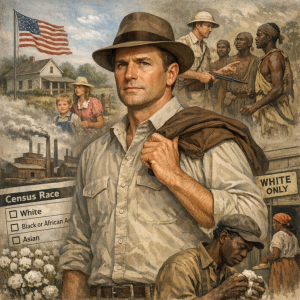
Primary Definition
White man ordinarily means an adult male who is identified, identifies himself, or is perceived as White. In common modern American usage, “White” is a racial and social classification rather than a precise statement of ancestry, nationality, religion, citizenship, or genetic composition. Depending on the setting, the expression may refer broadly to a man of European descent, to a man classified as White on a government or institutional form, or simply to a man socially regarded as White because of appearance and local custom.
The term must be read in context. It can be descriptive and neutral, as in a historical record that contrasts legally imposed racial categories. It can also be politically charged, especially where it invokes colonialism, segregation, racial privilege, exclusion, or stereotypes. “White man” is not a surname, nationality, tribal identity, political status, or independent legal capacity. Nor does it establish any special common-law rank, immunity, jurisdiction, citizenship, property right, or exemption from statute.
In present federal statistical practice, racial categories are administrative classifications, not biological findings. The U.S. Census Bureau has expressly stated that its race categories generally reflect social definitions recognized in the United States and are not attempts to define race biologically, anthropologically, or genetically. ([census.gov](https://www.census.gov/topics/population/race/about.html?utm_source=openai))
Etymology and Origin
The phrase joins the ordinary English adjective white with man. The word white descends from Old English hwīt, meaning bright, shining, or white. It is related to other Germanic terms, including modern German weiß, and ultimately to older Indo-European roots associated with shining or brightness. The basic color word is ancient; its racial application is historically much later. ([merriam-webster.com](https://www.merriam-webster.com/dictionary/white?utm_source=openai))
In English, color words long carried figurative meanings. “White” could suggest brightness, cleanliness, innocence, peace, surrender, or ceremonial clothing. Those symbolic meanings should not be confused with the later development of “White” as a label for populations. Etymology explains the prior color word; it does not prove that any modern racial classification is natural, fixed, or ancient.
Etymological reference works date the racial sense of white, meaning a person distinguished by light complexion, to the later seventeenth century, with the specific phrase white man recorded in the 1690s. That chronology is important. The phrase did not originate as a universal biblical, Roman, Greek, or medieval legal category. It developed in the English-speaking Atlantic world during an era of colonization, enslavement, land expansion, and increasingly formal racial classification. ([etymonline.com](https://www.etymonline.com/word/white?utm_source=openai))
Capitalization varies. Lowercase white man is common in general prose. Capitalized White man may appear where a style guide capitalizes racial designations or where the phrase is used collectively or rhetorically. Capitalization changes neither a person’s legal rights nor the historical meaning of the words.
Cultural and Historical Context
The phrase acquired much of its present force in colonial and post-colonial history. English and later American institutions increasingly organized legal rights, political membership, landholding, labor, and social standing through classifications that separated persons described as White from persons described as enslaved, Black, Indigenous, Asian, mixed-race, alien, or otherwise excluded. Those classifications varied by colony, state, period, and legal subject. They were not applied consistently across all places or all people.
The first United States census, conducted in 1790, counted “free white” males and females in separate categories, alongside “all other free persons” and enslaved persons. This demonstrates that “white” was already being used by the new federal government as an administrative category connected to freedom and status. It does not mean that all persons deemed White had equal political, property, familial, or voting rights; sex, property, age, state law, and other restrictions also mattered. ([archives.gov](https://www.archives.gov/research/census/1790?utm_source=openai))
Historical usage also changed with migration, war, politics, and shifting ideas about nationality and ancestry. Groups now commonly counted as White were not always accepted equally within American society. Irish, Italian, Jewish, Slavic, southern European, Middle Eastern, North African, and other communities have encountered different patterns of acceptance, prejudice, and official classification at different times. Thus, “White man” has often been a broad social label that conceals substantial differences of ethnicity, religion, language, national origin, class, and historical experience.
The expression also appears in the language of conquest and empire. In narratives concerning Indigenous peoples, “the white man” was frequently used as a collective reference to European settlers, officials, soldiers, traders, missionaries, or the expanding authority of colonial and American governments. In that setting, the phrase may carry historical memories of treaty-making, dispossession, forced removal, boarding schools, warfare, and unequal political power. Its use should therefore be historically precise rather than casually romanticized.
The later phrase “the white man’s burden,” especially associated with Rudyard Kipling and imperial ideology, is not a neutral synonym for “white man.” It expressed a paternalistic colonial claim that European powers had a duty to rule or “civilize” other peoples. Modern dictionaries commonly mark that phrase as old, offensive, or historically associated with colonialism. ([merriam-webster.com](https://www.merriam-webster.com/dictionary/white%20man%27s%20burden?utm_source=openai))
Biblical / Torah Context
Neither the Torah nor the Bible supplies a modern racial definition of “White man.” The English phrase is not a Hebrew, Aramaic, or Greek biblical term. Biblical references to color commonly concern visible appearance, cloth, animals, hair, ritual conditions, snow, light, purity, or symbolic contrast. They do not create a modern legal or scientific category equivalent to “White” as used in American census forms or racial discourse.
In the Torah, humanity is described through families, peoples, languages, lands, covenant communities, and nations. Genesis 10, often called the Table of Nations, concerns descent and peoples after the flood; it does not divide humanity into the modern racial categories of White, Black, Asian, or Hispanic. Reading contemporary American racial categories back into that text is interpretive speculation, not a plain statement of the text.
Likewise, biblical passages involving “white” hair, skin, wool, garments, or light must be interpreted according to their immediate literary and ritual setting. For example, Leviticus contains rules concerning skin conditions and priestly examination; those rules are not a doctrine of racial hierarchy. Claims that Scripture establishes that a particular modern population is inherently superior, cursed, divinely privileged, or permanently disqualified because of skin color are disputed theological assertions and have often been used to justify racial oppression. They should not be represented as settled biblical teaching.
Legal Implications
Historical American Law
“White man” and related phrases such as “free white person” had serious legal consequences in portions of American history. The Naturalization Act of 1790 limited naturalization to a “free white person” of good character. Later federal enactments retained racial restrictions while making changes that included persons of African nativity or African descent. These were statutory rules enacted by legislatures, not timeless principles of common law. ([constitution.congress.gov](https://constitution.congress.gov/browse/essay/ArtI_S8_C4_1_2_3/ALDE_00013163/?utm_source=openai))
American courts then faced the difficult and often contradictory task of deciding who qualified as “white” under those statutes. In Ozawa v. United States (1922), the U.S. Supreme Court held that a Japanese applicant was not eligible under the then-existing statutory language. In United States v. Bhagat Singh Thind (1923), the Court held that an Indian applicant was not “white” for naturalization purposes, despite arguments based on ethnological classifications. The Court’s opinions reveal that legal “whiteness” was not a stable scientific fact; it was a contested statutory category interpreted through changing popular, judicial, and racial assumptions. ([law.cornell.edu](https://www.law.cornell.edu/supremecourt/text/260/178?utm_source=openai))
It is therefore inaccurate to say that every historical court treated “White” as a simple matter of skin shade, ancestry, or science. The cases show the opposite: judges struggled with an unstable category and reached outcomes that reflected the legal and social ideas of their period. Those rulings are historical records, not sound authority for modern claims of racial superiority or legal caste.
Common Law, Statutes, Equity, and Current Law
In the strict legal sense, white man is not a general term of art of English common law. Common law consists of legal principles developed through judicial decisions. The important American racial uses of “white person” were often rooted in colonial enactments, state laws, federal statutes, administrative practices, and judicial interpretations of those laws. Equity, which historically developed as a separate body of remedies and doctrines, did not create a universal racial status called “white man.” Roman law likewise does not supply a controlling definition for modern American racial classifications.
Current United States law does not grant a person a special legal standing simply because he is described as a White man. The racial bar to naturalization was removed by the Immigration and Nationality Act of 1952. The current naturalization statute provides that the right to become a naturalized citizen may not be denied or abridged because of race, sex, or marriage. ([uscode.house.gov](https://uscode.house.gov/view.xhtml?edition=prelim&num=0&req=granuleid%3AUSC-prelim-title8-section1422&utm_source=openai))
Modern civil-rights laws generally protect individuals against discrimination because of race, including White individuals. Under Title VII of the Civil Rights Act of 1964, employment discrimination because of race or color is unlawful in covered employment settings. The Equal Employment Opportunity Commission states that Title VII protects persons of all races and that its protections apply to discrimination against White employees as well as against other employees. The statute does not require a person to be a member of a racial minority in order to possess protection from intentional race discrimination. ([eeoc.gov](https://www.eeoc.gov/laws/guidance/section-15-race-and-color-discrimination?utm_source=openai))
At the same time, a government form’s racial classification does not settle all legal questions about ancestry, ethnicity, national origin, culture, or discrimination. The Census Bureau’s historical 1997 standard defined “White” broadly to include origins in Europe, the Middle East, and North Africa, while federal standards were revised in 2024 and agencies are implementing those revised standards over time. Administrative classification can therefore differ by program, date, and purpose. ([census.gov](https://www.census.gov/topics/population/race/about.html?utm_source=openai))
Spiritual Meaning
There is no single spiritual meaning of “White man.” Spiritual traditions may use white as a symbol of light, cleansing, peace, mourning, joy, holiness, surrender, or rebirth, but symbolic color language does not define the moral worth of a racial group. A person’s character, conduct, responsibilities, and spiritual commitments cannot be reliably inferred from racial classification.
Some religious or esoteric systems attach symbolic significance to colors, directions, peoples, or ancestral narratives. Such teachings should be identified as the beliefs of particular communities rather than presented as universally binding fact. In particular, religious language must not be used to convert historical racial labels into claims of divine entitlement, collective guilt, or inherited spiritual superiority.
Modern Usage
Today, “white man” is used in several ways:
- Ordinary description: identifying an adult male understood to be White.
- Historical writing: describing persons classified as White under a particular past law, census, custom, or political system.
- Demographic or institutional discussion: referring to a population category in employment, education, health, voting, or public-policy data.
- Political or rhetorical speech: referring broadly to perceived White male power in an institution, profession, or historical narrative.
- Criticism or satire: challenging dominance, exclusion, or an allegedly narrow cultural viewpoint.
Because the phrase can sound generalizing, writers should prefer specificity when it is available. “A White male applicant,” “men classified as White in the 1920 census,” “British colonial officials,” “European-American settlers,” or “a particular named individual” may communicate more accurately than treating all White men as a single social, political, or moral bloc.
“White man” should also not be used as a substitute for “American,” “European,” “Christian,” “citizen,” “Caucasian,” or “colonizer.” Those words describe different things. A White man may be of many nationalities, religious traditions, ethnic backgrounds, immigration histories, and political viewpoints. Conversely, an American citizen, a Christian, or a European national need not be a White man.
Controversies / Criticisms
The term is controversial because it can reduce an individual to race and sex, erase differences within broad populations, or imply that all White men share the same social advantages, beliefs, or historical responsibility. Critics argue that collective use may become stereotyping when it assigns blame or character to persons solely because of ancestry or appearance.
Others maintain that the phrase remains necessary in historical and institutional analysis because racial and sex-based classifications have materially affected access to citizenship, voting, property, education, employment, political office, and cultural authority. On that view, careful reference to White men can help identify who held legal power in a particular time and place. The soundness of such usage depends on evidence, scope, and precision—not on treating race as an essence.
Scientific criticism also concerns the mistaken treatment of racial labels as discrete biological divisions. Human genetic variation is real, but it does not map neatly onto a few fixed racial boxes. Smithsonian educational materials summarize research describing much human genetic variation as gradual across geography and noting that most variation occurs among individuals rather than between broad continental groupings. ([humanorigins.si.edu](https://humanorigins.si.edu/evidence/genetics/human-skin-color-variation?utm_source=openai))
Finally, the phrase sometimes appears in unsupported arguments alleging that “White man” is a secret legal designation, a corporate status, a term that eliminates constitutional rights, or a label that creates special common-law powers. No general rule of American law supports such claims. Legal rights and obligations arise from constitutions, statutes, regulations, valid contracts, judicial decisions, and facts—not from asserting or denying a racial description.
Conclusion
“White man” is a modern English racial-and-sex designation whose meaning has changed with historical conditions. Its color-word roots are ancient, but its use as a social and legal population label developed comparatively late and became especially consequential in the Atlantic colonial world and the United States. Historical law sometimes made “white” status central to freedom, citizenship, and social power; current American law rejects race as a basis for denying naturalization and generally prohibits race discrimination against persons of every race.
The term should therefore be used with care. It may be appropriate when historical sources, demographic categories, or a specific social analysis make race and sex relevant. It should not be treated as a scientific essence, a biblical caste, a universal cultural identity, or a source of separate common-law authority. Precision, individual dignity, and attention to the particular legal and historical context are the most reliable guides.
Sources / Further Reading
- Merriam-Webster Dictionary, “White”
- Online Etymology Dictionary, “White”
- National Archives, “1790 Census Records”
- Constitution Annotated, “Early U.S. Naturalization Laws”
- Takao Ozawa v. United States, 260 U.S. 178 (1922)
- United States v. Bhagat Singh Thind, 261 U.S. 204 (1923)
- United States Code, 8 U.S.C. § 1422
- U.S. Census Bureau, “About the Topic of Race”
- U.S. Census Bureau, “Updates to Race/Ethnicity Standards for Our Nation”
- U.S. Equal Employment Opportunity Commission, “Race and Color Discrimination”
- Smithsonian Human Origins Program, “Human Skin Color Variation”