Negus
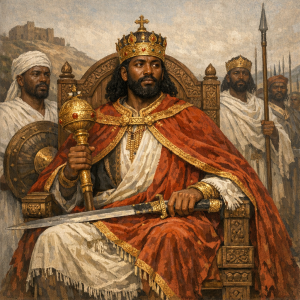
Primary Definition
Negus is an English rendering of an Ethiopian Semitic royal title meaning “king.” In historical Ethiopian usage, it could describe a ruler of a major kingdom, province, or region. It did not invariably mean the sole sovereign of all Ethiopia. The higher imperial style was nəgusa nägäst, commonly translated “King of Kings” and conventionally rendered in English as Emperor of Ethiopia. ([merriam-webster.com](https://www.merriam-webster.com/dictionary/negus?utm_source=openai))
The distinction is important. A negus could be a powerful ruler, including a ruler of Shewa, Gojjam, Wollo, or another important Ethiopian region, while the nəgusa nägäst stood above subordinate kings or regional rulers in the imperial order. Thus, translating every occurrence simply as “emperor” can obscure the constitutional and political hierarchy that existed within historic Ethiopia. ([en.wikipedia.org](https://en.wikipedia.org/wiki/Ethiopian_aristocratic_and_court_titles?utm_source=openai))
In ordinary English-language historical writing, however, “the Negus” was often used loosely for the Ethiopian monarch himself. This older Western usage is understandable but imprecise. A careful dictionary definition should therefore distinguish between: (1) negus, a king or royal ruler; and (2) nəgusa nägäst, the “King of Kings,” the imperial sovereign of Ethiopia.
The word also has an unrelated English homonym: negus, a hot drink made from wine, water, sugar, lemon, and spices. That beverage was named after Colonel Francis Negus and has no linguistic or historical connection to the Ethiopian title. ([merriam-webster.com](https://www.merriam-webster.com/dictionary/negus?utm_source=openai))
Etymology and Origin
The title comes through Amharic from the classical Ethiopian language Geʽez. English dictionaries commonly give the source as Amharic nəgus, derived from Geʽez nəgūś or related forms meaning “king.” The fuller expression nəgusa nägäst is structurally comparable to “king of kings”: the first element identifies the ruling king and the second denotes kings collectively. ([merriam-webster.com](https://www.merriam-webster.com/dictionary/negus?utm_source=openai))
Geʽez belongs to the Ethio-Semitic branch of the Afroasiatic language family. It is historically associated with the ancient kingdom of Aksum and remains a liturgical language of the Ethiopian Orthodox Tewahedo Church and Eritrean Orthodox Tewahedo Church. Amharic and Tigrinya, among other languages of the region, preserve related royal vocabulary.
Scholars commonly connect negus with a Semitic verbal root concerning ruling or reigning. Because ancient Semitic languages developed over long periods and because titles passed through spoken, written, translated, and ceremonial forms, transliteration varies. English readers may encounter negus, nagus, nəgus, nigūś, or forms such as negusa nagast. These variations usually reflect different systems for representing Geʽez or Amharic sounds in Latin letters, not different offices.
The English word has been recorded since the late sixteenth century. Its long presence in English does not mean that it was always used precisely. Older European writers frequently applied “Negus” to the emperor of Ethiopia as a general label, even where Ethiopian court practice would have required a more exact title. ([merriam-webster.com](https://www.merriam-webster.com/dictionary/negus?utm_source=openai))
Cultural and Historical Context
Aksum and the Development of Royal Titles
The title belongs to a deep Ethiopian and Eritrean political tradition reaching back to the Aksumite world of late antiquity. Aksumite rulers used several styles, in Geʽez, Greek, and South Arabian scripts, as their political authority expanded and their relationships with neighboring peoples changed. In this setting, royal language was more than ornament: it expressed territorial claims, religious standing, military authority, lineage, and relations among rulers.
The style “King of Kings” was used in Aksumite and later Ethiopian royal ideology to identify a sovereign with authority over other rulers. Similar expressions appear in more than one ancient political culture, so the phrase should not be treated as uniquely Ethiopian or automatically as evidence of direct borrowing from any one empire. In Ethiopia, however, nəgusa nägäst became a distinctive imperial title with its own local history and religious significance. ([treccani.it](https://www.treccani.it/enciclopedia/negus/?utm_source=openai))
Regional Kings and the Imperial Order
For much of Ethiopian history, political authority was not administered in the modern centralized form familiar to contemporary nation-states. Power was often distributed among emperors, regional kings, nobles, governors, church institutions, local communities, and military leaders. A ruler called a negus could govern an important territory while recognizing, contesting, or negotiating the superior authority of the nəgusa nägäst.
During periods of fragmentation, especially the Zemene Mesafint or “Era of the Princes,” powerful provincial rulers exercised extensive practical power. Hereditary influence, marriage alliances, military strength, local legitimacy, and religious patronage could matter as much as formal rank. The title negus must therefore be understood in its particular historical setting rather than treated as a fixed equivalent of a modern governmental office. ([en.wikipedia.org](https://en.wikipedia.org/wiki/Ethiopian_aristocratic_and_court_titles?utm_source=openai))
In the nineteenth and early twentieth centuries, the title was borne by significant regional rulers, including the Negus of Shewa. Menelik II, before becoming emperor in 1889, had been Negus of Shewa. Tafari Makonnen, later Emperor Haile Selassie I, was granted the title Negus in 1928 before his accession as emperor in 1930. Such examples demonstrate that the title could mark high royal status without itself being identical to the supreme imperial office. ([en.wikipedia.org](https://en.wikipedia.org/wiki/Ethiopian_aristocratic_and_court_titles?utm_source=openai))
Military and Governmental Meaning
A negus was not merely a ceremonial figure. In premodern and imperial Ethiopian political life, major rulers were commonly connected with the raising of forces, defense of territory, adjudication, tribute, diplomacy, and administration. Nevertheless, negus was not a military rank equivalent to general, colonel, or commander. Military authority followed from kingship, territory, and political power; it was not the lexical meaning of the word itself.
Likewise, the title should not be confused with a modern civil-service position, an elected office, or a governmental department. It identified a royal ruler within the historical political structures of Ethiopia. The Ethiopian monarchy was overthrown in 1974, and “Negus” is not a present constitutional office under the Federal Democratic Republic of Ethiopia. Modern Ethiopia is a federal republic governed under its contemporary constitutional order, not a monarchy. ([tile.loc.gov](https://tile.loc.gov/storage-services/master/frd/frdcstdy/et/ethiopiacountrys00ofca_0/ethiopiacountrys00ofca_0.pdf?utm_source=openai))
Biblical / Torah Context
Negus is not a Hebrew Torah term and does not appear as the title of a ruler in the books of the Torah. It is a Geʽez and Ethiopian Semitic royal term. Accordingly, attempts to derive the word directly from Hebrew biblical vocabulary, to treat it as a hidden Torah legal term, or to give it an automatic biblical definition are not supported by the ordinary linguistic evidence.
The Bible is nevertheless important to the cultural history of Ethiopian kingship. Biblical translations often use “Ethiopia” for places or peoples associated with Cush or Kush. In many biblical passages, however, that geographical language refers principally to regions south of Egypt, especially Nubia and areas now associated largely with Sudan, rather than serving as a direct map of the modern Ethiopian state. Biblical “Ethiopia” and modern Ethiopia overlap imperfectly and should not be treated as identical without attention to language, period, and context. ([biblegateway.com](https://www.biblegateway.com/resources/encyclopedia-of-the-bible/Ethiopia?utm_source=openai))
The Queen of Sheba is central to Ethiopian religious and national tradition. The biblical account of her visit to Solomon appears in 1 Kings 10 and 2 Chronicles 9, but those passages do not call her a negus, do not identify her as an Ethiopian ruler by that title, and do not describe the later Ethiopian Solomonic royal genealogy. Those later claims are associated principally with the Kəbrä Nägäśt, or Glory of the Kings, a medieval Geʽez work blending biblical material, interpretation, tradition, and political theology. ([africabib.org](https://www.africabib.org/rec.php?RID=11952757X&utm_source=openai))
The Kəbrä Nägäśt has immense importance in Ethiopian literary, ecclesiastical, and dynastic history. It presents a tradition in which Ethiopian royal authority is connected to Solomon, the Queen of Sheba, Menelik I, the Ark of the Covenant, and the tribe of Judah. As a matter of faith and national tradition, these themes have shaped the spiritual imagination of many believers. As a matter of historical method, they should be distinguished from independently verifiable documentary evidence concerning ancient Israel, Solomon, Sheba, or the Ark.
Legal Implications
Not a Common-Law Status
In English and American common law, negus is not a legal term of art that creates legal capacity, sovereign immunity, hereditary jurisdiction, diplomatic status, property rights, or exemption from statutes. Calling oneself a “Negus,” using it as a personal name, or asserting descent from a historical royal line does not by itself establish any legal authority in a modern court.
Historic Ethiopian kingship should not be confused with English common law. Ethiopia developed legal traditions through customary law, royal practice, ecclesiastical law, local institutions, later codification, and foreign legal influences. These traditions were not simply an Ethiopian version of Anglo-American common law. Legal analysis should therefore avoid transferring rules from one legal system into another merely because both systems used courts, rulers, judges, customs, or ideas of justice.
The Fətḥa Nägäśt: “Law of the Kings”
The related expression Fətḥa Nägäśt, commonly translated “Law of the Kings,” is significant in Ethiopian legal history. It is not the same word as negus, though both derive from the royal vocabulary of nägäst, “kings.” The text was compiled in Arabic in thirteenth-century Coptic Christian circles and later translated into Geʽez. It combined church-law materials with secular legal materials that reflected, through a long transmission history, Roman and Byzantine legal influences. ([link.springer.com](https://link.springer.com/chapter/10.1007/978-3-032-26065-9_5?utm_source=openai))
It would be inaccurate to describe the Fətḥa Nägäśt as either pure Roman law, pure biblical law, pure Ethiopian custom, or common law. It was a composite legal and ecclesiastical text received into Ethiopian Christian legal culture. Its role in actual legal practice changed by period, locality, religious community, and subject matter. Scholarly sources caution that the text was not necessarily promulgated as a single comprehensive state code in the modern sense and that customary law and equitable judgment continued to play substantial roles. ([cambridge.org](https://www.cambridge.org/core/journals/journal-of-african-law/article/abs/private-law-in-ethiopia/427E1E87A008D51BAB5537C6181C6D19?utm_source=openai))
Modern Ethiopian codes and constitutions gradually displaced earlier legal arrangements. The criminal provisions of older systems were superseded through twentieth-century penal legislation, while major civil and commercial codification occurred in 1960. The historical importance of the Fətḥa Nägäśt remains substantial, but its historic prestige should not be mistaken for present binding law in every matter. ([link.springer.com](https://link.springer.com/chapter/10.1007/978-3-032-26065-9_5?utm_source=openai))
Spiritual Meaning
Within Ethiopian Christian political thought, kingship could be understood as a responsibility under God rather than an assertion that a ruler was divine. Imperial styles and court language sometimes emphasized election, anointing, divine favor, justice, and the ruler’s duty to defend the faith and preserve order. The title “King of Kings” also carried biblical resonance because Scripture uses supreme royal language for God and, in Christian interpretation, for Christ.
That resonance requires care. In Ethiopian imperial tradition, titles connecting rulers to biblical Israel or the tribe of Judah functioned as claims of sacred dynastic legitimacy. They should not be read as placing any human negus on the same level as God or Christ. Theological affirmations of Christ as “King of Kings” are Christian doctrinal claims; the political use of royal titles is a historical matter that must be evaluated within its own culture and period.
Interpretively, negus may symbolize leadership, responsibility, judgment, protection, and ordered authority. That is a spiritual or literary interpretation, not the literal dictionary meaning. Literally, the word means “king” or identifies a historical royal title.
Modern Usage
Today, negus appears chiefly in historical writing, Ethiopian and Eritrean cultural discussion, religious literature, genealogy, museums, academic study, and references to the former Ethiopian monarchy. It may also be used as a personal name, surname, artistic name, or honorific expression. In those uses, meaning depends on the speaker’s community and purpose.
Writers should use the term with precision. “Negus of Shewa” identifies a regional royal title; “Negusa Nagast of Ethiopia” identifies the imperial title traditionally translated “Emperor of Ethiopia.” Referring simply to “the Negus” may be understandable in older English usage, but it can conceal the distinction between a regional king and the emperor.
Controversies / Criticisms
One controversy concerns translation. European writers often called Ethiopia’s emperor “the Negus,” even though the more exact imperial style was nəgusa nägäst. This can diminish the complexity of Ethiopian political institutions by making different ranks appear interchangeable. Conversely, translating every occurrence of negus as “king” without context may understate the power held by particular rulers.
A second issue concerns sacred history and historical proof. The Solomonic tradition has profound religious, literary, and cultural authority in Ethiopia. Yet historians distinguish the medieval composition and political use of the Kəbrä Nägäśt from direct evidence about biblical-era events. Respect for a living tradition does not require treating every traditional claim as a settled finding of modern historical scholarship. ([africabib.org](https://www.africabib.org/rec.php?RID=11952757X&utm_source=openai))
A third issue concerns modern legal claims. Historical royal terminology is sometimes used rhetorically to assert personal sovereignty or immunity from governmental authority. Such assertions do not follow from the historical meaning of negus. A title from a former monarchy does not override current constitutional law, statutes, court jurisdiction, immigration law, tax law, criminal law, or private contractual obligations.
Conclusion
Negus is a historic Ethiopian Semitic title meaning “king.” Its fullest understanding requires attention to the difference between a regional king and the nəgusa nägäst, the “King of Kings” or emperor. The word belongs to the political, linguistic, religious, and legal history of Ethiopia and Eritrea; it is not a term of Anglo-American common law and does not create modern legal sovereignty.
The title remains culturally meaningful because it preserves a record of Ethiopian statecraft, royal hierarchy, Christian political theology, and Geʽez literary tradition. Accurate usage respects both its historical dignity and its limits: it is a title of kingship, not proof of a present legal office, a biblical Hebrew word, a military grade, or an automatic claim of personal exemption from modern law.
Sources / Further Reading
- Merriam-Webster Dictionary, “Negus”
- Treccani Encyclopedia, “Negus”
- Library of Congress, Ethiopia: A Country Study
- Oxford Academic, “The Reception of the Books of Kings in Ethiopia”
- Old Testament Essays, “The Biblical Portrayal of Ethiopia”
- Springer Nature, “The Fǝtḥa Nägäśt and First Attempts at Codifying Law”
- Journal of African Law, “Private Law in Ethiopia”
- Comparative Legal History, “Roman Law in Ethiopia: Traces of a Seventeenth Century Transplant”