Hamashiach
Primary Definition
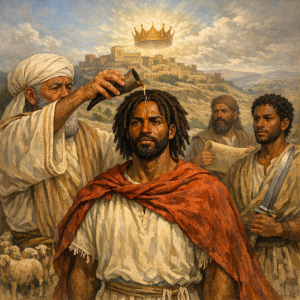
HaMashiach (Hebrew: הַמָּשִׁיחַ) literally means “the anointed one.” The initial ha- is the Hebrew definite article, equivalent to English “the”; Mashiach is commonly rendered in English as “Messiah.” In its most specific traditional Jewish sense, HaMashiach is the future anointed king expected to arise from the line of David, restore Jewish national and religious life in accordance with Torah, gather the dispersed of Israel, and help inaugurate an age characterized by peace, justice, and knowledge of God.
The literal meaning must be kept distinct from the later specialized meaning. In the Hebrew Bible, mashiach does not always identify a single future redeemer. It can describe a person set apart, consecrated, commissioned, or installed for sacred public service—particularly a king or high priest. Thus, “anointed one” is first a designation of office and divine appointment; “the Messiah” is the later, more particular expectation of a future Davidic ruler and redemptive age.
Dictionary usage should also distinguish HaMashiach from related English terms. Messiah is the ordinary English form. Messianic may mean “relating to the Messiah,” but in modern religious usage it can also identify specific movements, including Messianic Judaism. Messianism refers more broadly to beliefs, hopes, movements, or political programs organized around anticipated redemption. These terms overlap but are not interchangeable.
Etymology and Origin
Mashiach derives from the Hebrew root משח (m-sh-ch), “to anoint,” especially with oil. The noun מָשִׁיחַ (mashiach) is therefore a passive or status-bearing form: one who has been anointed. Ancient Israelite anointing was not merely decorative. It was a public rite signifying consecration, authorization, and responsibility before God and the people.
The Hebrew expression ha-mashiach means “the anointed one.” Hebrew pronunciation varies by community and transliteration system: ha-Mashiach, HaMashiach, ha-Moshiach, and HaMoshiach may all appear in English-language writing. “Moshiach” reflects Ashkenazic-style pronunciation; “Mashiach” more closely reflects modern Israeli and academic Hebrew conventions.
The English word Messiah came through Greek and Latin forms of the Hebrew or Aramaic term. That linguistic path matters because it helps explain why a word rooted in Israelite rites of anointing acquired distinct meanings in Jewish and Christian traditions. The underlying Hebrew word did not originally mean “God incarnate,” “miracle worker,” or “savior of all humanity.” Those are theological claims associated with particular later interpretations, not the basic lexical meaning of mashiach.
In biblical usage, anointing was associated with legitimate authority. Kings could be anointed, as were priests, including the “anointed priest” (ha-kohen ha-mashiach) in Levitical law. The designation could even be applied to Cyrus, the Persian king, in Isaiah 45:1. Cyrus was not an Israelite king or a participant in Israelite priestly rites; he is called God’s anointed in the sense that he was providentially appointed to serve a stated purpose, including the return from exile and rebuilding of Jerusalem. This usage decisively shows that the bare word mashiach is broader than the later expectation of the final Davidic Messiah. ([sefaria.org](https://www.sefaria.org/Isaiah.45.1-7?lang=bi&with=Midrash&utm_source=openai))
Cultural and Historical Context
The original background of the term is the public culture of ancient Israel: kingship, priesthood, covenant, land, Temple, exile, and restoration. Anointing communicated that authority was not simply self-created. The king or priest occupied an office understood as accountable to God’s law. In this setting, “the LORD’s anointed” could refer to the reigning king, not necessarily to a future end-times figure.
The destruction of the Kingdom of Judah by Babylon in 586 BCE profoundly altered the political setting in which the term was heard. The Davidic monarchy ceased to rule independently, the Temple was destroyed, and much of the population experienced exile. The hope that God would restore Israel, renew just rule, and vindicate covenantal promises became increasingly important. Prophetic passages concerning a restored Davidic line, peace among nations, return from dispersion, and the renewal of Zion supplied major materials later joined to messianic expectation.
Historical development was neither simple nor uniform. Scholars generally distinguish the ordinary biblical uses of “anointed” from later Jewish messianism, in which a future deliverer becomes a central expectation. Some Second Temple Jewish writings anticipated a Davidic royal figure; other sources envisioned a priestly leader, a prophetic forerunner, heavenly agents, or more than one anointed figure. The Dead Sea Scrolls, for example, are commonly understood to reflect expectations involving priestly as well as royal leadership. This diversity cautions against treating every Jewish community before the Common Era as holding one settled doctrine of HaMashiach. ([academic.oup.com](https://academic.oup.com/edited-volume/61673/chapter-abstract/550525912?login=false&utm_source=openai))
The Roman destruction of the Second Temple in 70 CE, followed by the Bar Kokhba revolt of 132–135 CE, made questions of messianic identification especially consequential. Rabbi Akiva’s support for Bar Kokhba—also called Bar Koziba in rabbinic sources—became an important example in later Jewish discussion: a candidate may be regarded as promising, yet failure to accomplish the expected redemptive work prevents final recognition as HaMashiach. Maimonides later made this point expressly, arguing that signs and wonders are not the controlling test. ([sefaria.org](https://www.sefaria.org/Mishneh_Torah%2C_Kings_and_Wars.11.1?lang=en&with=About&utm_source=openai))
Biblical / Torah Context
Anointing in Torah and the Hebrew Bible
The Torah presents anointing as part of consecration for sacred service. Priestly anointing is especially clear in the legal materials of Exodus and Leviticus. Leviticus refers to the high priest as ha-kohen ha-mashiach, “the anointed priest.” This is a concrete biblical use of the term that should not be reduced to later messianic expectation.
Kings also are described as anointed. The narratives concerning Saul and David establish the enduring association between anointing and Israelite kingship. David refuses to harm Saul because Saul remains “the LORD’s anointed,” demonstrating that the term could identify a current officeholder even when that ruler had acted wrongly. In the Davidic covenant of 2 Samuel 7, God’s promise concerning David’s house and kingdom later became central to Jewish expectations that a future redeemer would be descended from David.
The Prophets contribute images commonly connected with the messianic age: righteous governance, security, return from exile, the gathering of Israel, justice for the poor, the end of war, and worldwide recognition of the God of Israel. Isaiah 11, Jeremiah 23, Ezekiel 37, Micah 4, Zechariah 9, and related passages are frequently read in this light. Yet care is required: not every passage describes the future figure using the noun mashiach. The later doctrine is built from a body of scriptural texts and rabbinic interpretation rather than from one simple biblical definition.
Rabbinic and Medieval Jewish Teaching
Rabbinic literature develops the hope of redemption in many forms. It discusses the coming of the Messiah, the restoration of Israel, Elijah’s preparatory role, resurrection, judgment, and the world to come. There are substantial differences among rabbinic passages concerning timing, signs, political events, and the relationship between human repentance and divine appointment. Such variation is a feature of the tradition, not a defect to be concealed.
Maimonides (Rabbi Moses ben Maimon, 1138–1204) gave one of the most influential systematic formulations in Mishneh Torah, Laws of Kings and Their Wars, chapters 11–12. He describes the Messianic king as a Davidic ruler who strengthens Torah observance, fights the wars of God, builds the Temple, and gathers the dispersed of Israel. In his formulation, a person who begins this work may be presumed to be Mashiach; one who completes it successfully is established as such. Maimonides also rejects the proposition that the Messiah must prove his identity by performing miracles or changing the natural order. ([sefaria.org](https://www.sefaria.org/Mishneh_Torah%2C_Kings_and_Wars.11.1?lang=en&with=About&utm_source=openai))
That formulation is highly authoritative in many Orthodox Jewish communities, but it is not the only Jewish presentation. Other traditional thinkers place greater emphasis on miraculous transformation, resurrection, mystical dimensions of redemption, or the eschatological significance of the messianic age. Therefore, a responsible definition should identify Maimonides as a major rabbinic authority, not treat every detail of his approach as the sole view within Judaism.
Legal Implications
HaMashiach is not a technical term of English or American common law. English common law developed through judicial decisions and customs of the English legal system; the Hebrew religious title does not create a common-law office, jurisdiction, sovereign status, exemption from law, or private legal authority. Claims that simply using the word “HaMashiach,” “Messiah,” or “anointed” establishes a legal standing or releases a person from civil law are unsupported by ordinary common-law doctrine.
Historically, the term has governmental significance within the biblical world because anointing marked kings and priests as holders of public or sacred responsibility. That historical fact should not be confused with current governmental power. The biblical king was not a modern constitutional executive, and ancient Israelite covenantal law is not identical to Roman law, English common law, equity, American statutory law, or contemporary Israeli law.
In the United States, religious belief and expression concerning HaMashiach generally fall within constitutional protections for speech and the free exercise of religion. At the same time, the First Amendment does not authorize courts or governments to decide theological truth—such as whether a particular person is, or is not, the Messiah—on religious grounds. Civil courts may address neutral legal questions involving contracts, property, fraud, employment, public safety, or other civil matters when such questions arise, but a religious title alone does not determine the legal result. ([law.cornell.edu](https://www.law.cornell.edu/constitution/first_amendment?utm_source=openai))
The term can also arise in Israeli legal and governmental debates involving Jewish identity, conversion, immigration, and the Law of Return. Those questions are statutory and constitutional questions within Israel’s distinct legal system, not examples of English common law. In particular, disputes involving persons who identify as Messianic Jews may involve legal definitions of Jewish status for specified statutory purposes. Such rulings do not settle the theological question of HaMashiach for Judaism, Christianity, or any other faith community.
Military language is relevant only in a limited historical and religious sense. Biblical kings led or authorized armies, and Maimonides includes “the wars of God” in his description of a prospective Messianic king. This does not make “HaMashiach” a contemporary military rank, commission, command authority, or lawful justification for violence. Any present-day military authority arises from the law of the relevant nation and chain of command, not from private messianic claims.
Spiritual Meaning
Within Jewish spirituality, HaMashiach is inseparable from geulah, redemption. Redemption is not merely escape from hardship or a prediction about the future. It points toward the repair of communal life under God’s sovereignty: justice, peace, return from exile, faithful observance, and a world in which divine knowledge is more fully recognized.
For many traditional Jews, awaiting HaMashiach is an active discipline rather than passive speculation. It encourages repentance, prayer, study, acts of charity, observance of commandments, and moral responsibility. The anticipated age is understood not as permission to abandon present obligations but as a reason to fulfill them faithfully now.
Some Jewish mystical and Hasidic teachings give the term additional inward meanings. They may speak of redemption as the disclosure of divine unity, the refinement of the material world, or the healing of fragmentation in the human soul and community. These are theological interpretations, not alternative dictionary meanings that erase the historical sense of an anointed king. They should be received as particular teachings within Jewish spiritual traditions.
Christian theology uses “the Messiah” in a distinct and foundational way, identifying Jesus of Nazareth as the Christ—the Greek equivalent of “anointed one.” Most Christian traditions further confess doctrines concerning Jesus’ divinity, atoning death, resurrection, and future return. Mainstream Jewish theology does not accept that identification and generally maintains that the messianic promises of universal peace, restoration, and redemption have not yet been fulfilled in the manner expected by Jewish tradition. The disagreement is real and significant; accuracy requires neither concealing it nor using it as a basis for hostility.
Modern Usage
In contemporary Jewish life, HaMashiach remains a living religious term, especially in Orthodox, Hasidic, and many traditional communities. It appears in prayer, Torah teaching, religious songs, Passover discussion, and expressions of hope for redemption. “May he come speedily in our days” is a familiar form of religious aspiration in many communities.
Modern Judaism does not speak with one voice on the nature of the Messiah. Orthodox Judaism generally preserves belief in a personal Davidic Messiah. Some Conservative Jewish thinkers treat the question of a personal Messiah as open or emphasize the ethical meaning of a messianic age. Reform Judaism has often emphasized human partnership with God in bringing about peace and justice rather than expectation of a single future king, though beliefs among individual Reform Jews vary. ([myjewishlearning.com](https://www.myjewishlearning.com/article/modern-jewish-messianism/?utm_source=openai))
The word is also used figuratively in public discourse. A political candidate, celebrity, inventor, or movement may be called “messianic” when followers appear to expect extraordinary deliverance. This figurative usage is often critical, suggesting excessive hope, charismatic authority, or unrealistic expectations. It should not be confused with Jewish doctrine concerning HaMashiach.
“Messianic Judaism” is a modern religious movement that identifies Jesus (often called Yeshua) as the Messiah while incorporating selected Jewish practices and symbols. Major Jewish denominations generally do not recognize Messianic Judaism as a form of Judaism because of its Christological commitments and its acceptance of the New Testament. Conversely, many adherents understand themselves as followers of Jesus who retain or reclaim Jewish identity and practice. The terminology is therefore contested and should be used precisely and respectfully. ([myjewishlearning.com](https://www.myjewishlearning.com/article/messianic-judaism/?utm_source=openai))
Controversies / Criticisms
The foremost controversy concerns identity: whether any historical person has fulfilled the role of HaMashiach. Judaism and Christianity answer this question differently, and Jewish sources themselves contain differing descriptions of the expected redeemer and age of redemption. A dictionary entry should state the competing claims fairly without pretending that a lexical definition can resolve a theological dispute.
A second controversy concerns failed or disputed messianic claimants. Jewish history includes movements centered on figures believed by followers to be the Messiah, most notably Shimon Bar Kokhba in the second century and Sabbatai Zevi in the seventeenth century. Such episodes have made many Jewish authorities cautious about date-setting, political absolutism, and claims that a living or deceased leader must be universally recognized as HaMashiach.
A third concern is political misuse. The language of redemption can inspire service, hope, and resistance to injustice; it can also be used to sanctify coercion, territorial absolutism, or violence. No claim of messianic purpose removes the duty to distinguish religious conviction from lawful authority, moral accountability, and the dignity of other persons.
Finally, popular etymologies sometimes overstate the term. HaMashiach does not mean “the saved one,” “the only begotten,” “a legal sovereign,” “a military commander,” or “one exempt from human law.” Its documented lexical foundation is anointing and appointment. Broader claims require support from particular religious texts and traditions, and those claims remain matters of interpretation and faith.
Conclusion
HaMashiach means “the anointed one,” but its significance reaches far beyond a literal translation. The term began as a biblical designation for persons consecrated to sacred or royal responsibility. Over time, Jewish scriptural interpretation, rabbinic teaching, historical exile, and hope for restoration gave it the more specific meaning of the future Davidic redeemer and the anticipated age of peace, justice, Torah, and knowledge of God.
For legal purposes, HaMashiach is a religious and historical term rather than a source of independent common-law authority. For spiritual purposes, it expresses enduring hope for redemption and calls many believers toward present faithfulness, justice, and repentance. Its meaning should be discussed with precision: distinguish ancient biblical usage from later doctrine, Jewish belief from Christian belief, spiritual expectation from governmental authority, and documented history from disputed theological claims.
Sources / Further Reading
- Sefaria, Mishneh Torah, Kings and Wars 11: https://www.sefaria.org/Mishneh_Torah%2C_Kings_and_Wars.11.1?lang=en&with=About
- Sefaria, Isaiah 45:1–7: https://www.sefaria.org/Isaiah.45.1-7?lang=bi&with=Midrash
- Sefaria, Brown-Driver-Briggs Hebrew Lexicon, māshîaḥ: https://www.sefaria.org/BDB%2C_%D7%9E%D6%B8%D7%A9%D6%B4%D7%99%D7%97%D6%B7.1
- Oxford Academic, John J. Collins, “Messianism”: https://academic.oup.com/edited-volume/61673/chapter-abstract/550525912?login=false
- My Jewish Learning, “Jewish Messianism”: https://www.myjewishlearning.com/article/jewish-messianism/
- My Jewish Learning, “Who Are Messianic ‘Jews’?”: https://www.myjewishlearning.com/article/messianic-judaism/
- Chabad.org, “What Is the Jewish Belief About Moshiach (Messiah)?”: https://www.chabad.org/library/article_cdo/aid/108400/jewish/The-End-of-Days.htm
- Cornell Legal Information Institute, First Amendment: https://www.law.cornell.edu/constitution/first_amendment