Discharged
Primary Definition
Discharged is the past-tense and past-participle form of discharge. In its central and oldest practical sense, it means released from a burden, obligation, custody, duty, claim, office, or service, or that the burden itself has been satisfied, removed, cancelled, carried out, or otherwise brought to an end.
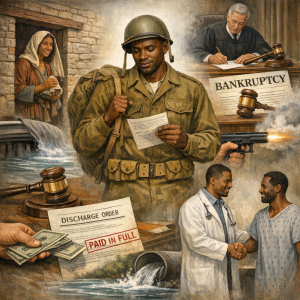
The exact meaning depends upon the thing from which a person, property, institution, or obligation has been discharged. A person may be discharged from military service, hospital care, employment, custody, a jury, or an assigned duty. A debt may be discharged by payment, agreement, operation of law, or a bankruptcy order. A firearm may be discharged, meaning fired. A river, pipe, battery, or wound may discharge material, fluid, or energy. Thus, the word does not carry one universal legal consequence; it identifies a release or outgoing act whose effect must be determined from its context.
In legal usage, the most important general meaning is the ending or release of a legally enforceable duty. Cornell Law School’s Legal Information Institute summarizes the term as the extinguishment or release of a legal obligation or duty. This may occur because the duty was performed, because the parties agreed to a release, because a court entered an order, or because a statute provides for discharge under stated conditions.
Dictionary interpretive analysis: The common thread among the word’s many uses is removal of a “charge.” A charge may be a load, a responsibility, a debt, a command, a legal claim, a stored electrical force, or a person placed in another’s care. To be discharged is therefore to have that charge taken off, sent out, completed, or released.
Etymology and Origin
Discharge entered English in the Middle English period, with recorded use from the fourteenth century. It came through Anglo-French forms such as descharger and deschargen, meaning to unload, free from a burden, relieve, or get rid of a debt or obligation. The word is built from a negative or reversing prefix, dis- or des-, joined with charge.
The older sense of charge was not limited to an invoice or accusation. It could mean a load placed upon a person, animal, ship, or vehicle; an entrusted responsibility; a command; or an obligation. A ship discharged its cargo by unloading it. From that concrete image developed the figurative meanings: a debtor could discharge a debt, an officer could discharge a duty, a court could discharge a jury, and a sovereign or commander could discharge a person from service.
The word’s history therefore does not begin as a specialized technical expression of modern American law. It is an ordinary English and Anglo-French word that acquired technical applications in courts, commerce, government, medicine, military administration, engineering, and religion. Its legal meanings remain connected to the older idea of taking off a burden or completing an obligation.
English legal writing used discharge broadly because law frequently concerns duties: duties to pay, perform, appear, serve, obey, account, or refrain from acting. In legal instruments, a “discharge” may refer either to the act that releases the obligation or to the written evidence of that release, such as a satisfaction, receipt, release, certificate, or court order.
Cultural and Historical Context
Historically, the language of discharge was especially useful in societies organized around personal service, military duty, commerce, debt, and officeholding. A servant completing a term, a soldier leaving service, a prisoner released from custody, a merchant unloading goods, and a debtor satisfying an account could all be described with variants of the same word. The term conveyed a transition from being bound, burdened, or retained to being free, finished, or separated.
In commercial life, a discharge commonly represented the completion of an account. A creditor who had been paid might give a receipt or release showing that the obligation had been satisfied. This practical function remains important. A person asserting that an obligation has been discharged should ordinarily be able to identify the source of discharge: payment records, a signed release, a settlement agreement, a filed satisfaction of judgment, a recorded lien release, a statute, or an order of a court or administrative body.
Military discharge has a long documentary history in the United States. National Archives records include discharge certificates for Regular Army soldiers dating from 1792 through 1815. In modern administration, a DD Form 214 is generally the principal report of separation or release from active duty. It commonly records service dates, rank, awards, separation authority, reason for separation, reenlistment information, and character of service. A military discharge is therefore both an event ending or changing a service relationship and an official record that may affect veterans’ benefits, employment verification, retirement matters, and other rights.
The word also developed nonlegal meanings without losing its underlying imagery. A weapon “discharges” when it releases a projectile; a battery discharges when it releases stored electrical energy; a pipe discharges water; and a hospital discharges a patient when care in that setting ends. These meanings are related by release or outward movement, but they should not be confused with legal discharge.
Biblical / Torah Context
The English word discharged is not derived from Hebrew or biblical Greek. It is a later English word of Anglo-French origin. Nevertheless, the concepts of release, remission, freedom from debt, and release from service are materially relevant to biblical and Torah study.
Deuteronomy 15 describes the shemitah, often translated as a release, remission, or cancellation associated with the seventh year. The chapter directs creditors not to exact certain loans from fellow Israelites at the appointed time and directs the release of Hebrew servants after a term of service. The text connects release with generosity, remembrance of Israel’s prior bondage, and concern for the poor. These passages are religious and covenantal instructions within the Torah’s historical legal setting; they are not themselves a source of modern United States contract, bankruptcy, tax, or collection law.
In a broader biblical sense, release may describe liberation from bondage, forgiveness of obligations, restoration of fellowship, or relief from oppression. Christian readings often connect release from debt with forgiveness, mercy, redemption, and freedom from sin. Jewish interpretation has developed extensive legal and ethical discussion concerning the sabbatical year, debts, lending, and the prozbul, a later rabbinic legal mechanism associated with the collection of debts. Those traditions should be understood within their own religious and legal frameworks rather than treated as interchangeable with English common law.
Interpretive analysis: Spiritual uses of “discharged” can express the idea that a burden has been lifted. That may be a meaningful devotional metaphor, but it does not by itself prove that a civil debt, criminal obligation, tax liability, lien, contract, or judgment has been legally discharged.
Legal Implications
General Legal Meaning
In law, a discharge may end a duty, release a person from a duty, or bar enforcement of an obligation. The legal effect depends upon the applicable body of law and the facts. A discharge may arise from:
- full performance, such as payment of a debt or completion of promised work;
- a voluntary release, waiver, settlement, accord and satisfaction, or novation;
- a court judgment or order;
- expiration, cancellation, rescission, or another operation of law;
- a statutory process, including bankruptcy; or
- an administrative act authorized by law.
At common law, the discharge of a contractual duty could result from performance, mutual agreement, a material breach by the other party, impossibility in limited circumstances, or other recognized doctrines. The precise rule has always depended on the kind of obligation and the jurisdiction. Modern contract law in the United States is not exclusively “common law”: it also includes statutes, the Uniform Commercial Code for many sales-of-goods transactions, court decisions, administrative regulations, and, in some fields, federal law.
Equity historically supplied remedies and doctrines distinct from the older common-law courts, including rescission, reformation, injunctions, and equitable relief from certain forfeitures or mistakes. The procedural separation between law and equity has largely merged in American courts, but the substantive distinction can remain important. A statement that an obligation is “discharged at common law” is incomplete unless the asserted ground, governing law, parties, documents, and judicial or administrative action are identified.
Debt, Payment, and Bankruptcy
A debt is not automatically discharged merely because it is disputed, overdue, transferred to a collector, reported as delinquent, charged off for accounting purposes, or difficult to collect. A creditor’s internal “charge-off” generally concerns accounting treatment; it is not necessarily a legal release of the debtor. Likewise, a collection agency’s failure to contact a debtor is not, without more, proof of discharge.
Payment may discharge a debt if it satisfies the obligation under the contract and applicable law. A negotiated settlement may discharge all or part of a claim if the agreement is valid and its conditions are met. A satisfaction of judgment generally indicates that a judgment has been paid or otherwise satisfied, but the relevant court record and state procedure control.
Bankruptcy discharge is a specialized statutory discharge under federal law. It releases an eligible debtor from personal liability for specified debts and generally prohibits collection efforts on those discharged debts. Under 11 U.S.C. § 524, a bankruptcy discharge can void judgments to the extent they determine personal liability on discharged debts and operates as an injunction against efforts to collect those debts as personal liabilities.
Bankruptcy discharge is not identical to dismissal of a bankruptcy case. A dismissal ends the case but does not necessarily provide the debtor the release that a discharge would provide. Nor does a bankruptcy discharge eliminate every debt. The Bankruptcy Code contains exceptions, including categories of debts addressed in 11 U.S.C. § 523. Further, valid liens that survive the case may remain enforceable against collateral even when the debtor’s personal liability has been discharged. These distinctions are legally significant and require review of the actual bankruptcy docket, discharge order, schedules, claims, liens, and relevant statutory provisions.
Employment, Jury, Custody, and Public Duty
In employment law, to be discharged ordinarily means to be involuntarily terminated or fired. The word is often more formal than “fired,” but the effect may be the same. Whether a discharge is lawful can depend on an employment contract, collective-bargaining agreement, civil-service rules, anti-discrimination laws, whistleblower protections, public-policy doctrines, and state at-will employment rules.
A constructive discharge is different. It refers to a situation in which an employee resigns because working conditions were allegedly so intolerable that a reasonable person would feel compelled to leave. It is not established merely because work was unpleasant or a person preferred to resign; legal standards and facts matter.
A court may discharge a jury after its service is complete, after a verdict, or after the court declares a mistrial. This releases jurors from their duty in that proceeding. The discharge of a jury does not necessarily decide the merits of the case or prevent every later proceeding; the consequences depend upon the procedural posture, constitutional protections, and applicable rules.
A person may also be discharged from custody, probation, parole, guardianship, hospital care, office, or a public duty. Each use has its own governing law. Discharge from a hospital, for example, ends inpatient care at that facility but is not a declaration that the person has no medical condition. Discharge from custody may mean release under conditions rather than complete freedom from all legal supervision.
Spiritual Meaning
Spiritually, discharged may signify relief from a burden of guilt, fear, resentment, oppressive duty, or unresolved obligation. In faith-based speech, a person may say that they feel discharged from a calling, released from a season of service, or freed from a burden after prayer, repentance, reconciliation, or wise counsel.
This language can be constructive when it encourages responsibility, truthfulness, forgiveness, and restoration. It becomes problematic when spiritual conviction is used to deny an obligation that remains legally or morally unresolved. A person may sincerely believe they have been released inwardly from shame or fear while still needing to address restitution, contractual duties, family responsibilities, taxes, court orders, or other enforceable commitments.
Modern Usage
Modern usage retains the word’s wide range of meanings:
- Legal: “The obligation was discharged by payment.”
- Bankruptcy: “The debtor received a discharge, subject to statutory exceptions.”
- Employment: “The employee was discharged from the company.”
- Military: “The service member was discharged from active duty.”
- Medical: “The patient was discharged from the hospital.”
- Judicial: “The court discharged the jury.”
- Physical: “The battery discharged,” or “the firearm discharged.”
- Environmental or engineering: “The facility discharged water into the treatment system.”
Governmental usage also includes a “discharge petition” in the United States House of Representatives, a procedural device by which members may seek to bring a measure out of committee for House consideration. That specialized parliamentary use concerns release of a measure from committee control, not release from debt or liability.
Controversies / Criticisms
The principal controversy surrounding the word is misuse through overgeneralization. Because “discharged” sounds final and authoritative, it is sometimes asserted without identifying the legal act that created the discharge. In law, labels alone do not ordinarily extinguish obligations. A handwritten declaration, a private affidavit, a notice using the word “discharged,” or a personal belief that an account has been settled does not itself compel a creditor, court, agency, employer, or public office to recognize a discharge.
Claims that particular phrases, stamps, endorsements, or self-created documents automatically discharge public or private debts are contested and generally unsupported unless they correspond to an actual payment, valid agreement, statute, court order, or authorized administrative action. The relevant question is not whether the word discharged was used, but whether the law recognizes the asserted act as legally sufficient to release the obligation.
Another recurring confusion is between discharge of personal liability and elimination of every interest connected to a debt. In bankruptcy, for example, a debtor’s personal duty to pay may be discharged while a surviving lien remains attached to collateral. Similarly, a discharged employee may be free from the employment relationship but still be bound by valid post-employment duties, such as confidentiality obligations, return of property, or enforceable contractual restrictions.
Finally, language surrounding military discharge can be emotionally and legally sensitive because separation classifications and characterizations may affect benefits, reputation, reenlistment eligibility, and later administrative remedies. The official separation record, applicable statutes, and the relevant service department—not casual terminology alone—determine those effects.
Conclusion
Discharged means released, relieved, completed, sent out, or freed from a charge, burden, obligation, duty, custody, service, or stored force. Its enduring meaning comes from the practical image of unloading a burden. In law, however, the word is never self-defining. One must ask: What was discharged, by whom, under what authority, on what date, and with what legal effect?
A reliable use of the term identifies the source of release—payment, contract, court order, statute, administrative action, military separation record, or other recognized authority. In spiritual language, discharge may properly describe release from an inward burden; in legal language, it should be supported by the governing facts and law.
Sources / Further Reading
- Merriam-Webster, “Discharge” — https://www.merriam-webster.com/dictionary/discharge
- Cornell Law School, Legal Information Institute, “Discharge” — https://www.law.cornell.edu/wex/discharge
- United States Courts, “Discharge in Bankruptcy” — https://www.uscourts.gov/court-programs/bankruptcy/bankruptcy-basics/discharge-bankruptcy-bankruptcy-basics
- United States Code, 11 U.S.C. § 524, “Effect of Discharge” — https://www.law.cornell.edu/uscode/text/11/524
- United States Code, 11 U.S.C. § 523, “Exceptions to Discharge” — https://www.law.cornell.edu/uscode/text/11/523
- National Archives, “About Military Service Records and Official Military Personnel Files (OMPFs, DD Form 214)” — https://www.archives.gov/veterans/military-service-records/about-service-records
- Sefaria, “Deuteronomy 15” — https://www.sefaria.org/Deuteronomy.15?with=Halakhah
- Cornell Law School, Legal Information Institute, “Constructive Discharge” — https://www.law.cornell.edu/wex/constructive_discharge