Primary Definition
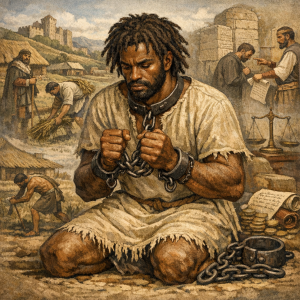
Bondman is an archaic noun for a male person held in bondage or compelled to serve another. Depending on period and context, it may denote:
- a male slave whose person and labor are controlled by another;
- a serf or villein owing compulsory labor and customary obligations to a lord;
- a debtor or dependent whose service is enforced until an obligation is discharged; or
- figuratively, a person dominated by an appetite, ideology, institution, fear, debt, or other controlling power.
Modern dictionaries commonly summarize the word as “slave” or “serf,” while historical legal dictionaries also associate it with villeinage and involuntary personal servitude. These terms overlap, but they are not always interchangeable. A chattel slave could be treated as transferable property; a medieval serf usually occupied land and owed service under manorial custom; a debt servant might be bound only until a debt or stated term was satisfied. The particular legal and social arrangement must therefore be determined from context. ([merriam-webster.com](https://www.merriam-webster.com/dictionary/bondman))
The ordinary plural is bondmen. Historical feminine forms include bondwoman, bondmaid, and bondswoman. The form bondservant is also encountered, especially in biblical translation and religious writing. In contemporary historical scholarship, writers often prefer enslaved person, unfree tenant, or the precise institutional term because each identifies the condition without making bondage the person’s defining identity.
Etymology and Origin
The word is recorded in Middle English from the thirteenth century. It combines bond, in the historical sense of a tenant farmer or person of servile condition, with man. Its earlier history is more complicated than the modern appearance of the word suggests. The first element is generally traced through Middle English bonde to an Old Norse term related to a dweller, householder, husbandman, or cultivator of the soil. In English social conditions, the sense deteriorated from farmer or tenant to unfree agricultural laborer and eventually to a man in bondage. The word then became naturally associated with the separate English family of bind, bound, and bondage. ([etymonline.com](https://www.etymonline.com/word/bondman))
This distinction matters. The word should not be explained simply as “a man who signed a bond,” nor should every bond in contract law be treated as a device for creating a bondman. The historical word developed within the vocabulary of agricultural status and personal servitude. Its present spelling encouraged an understandable association with being legally or physically bound, but that association does not establish that all contractual bonds, debts, oaths, or civil obligations create bondage.
The term is Germanic and Scandinavian in linguistic ancestry, not Roman or Greek in origin. Roman law had its own classifications, including the slave, or servus, and various dependent cultivators. Later jurists compared those institutions with English villeinage, but such comparisons do not make the English word a Roman legal term. Nor is there evidence that it originated as a doctrine of equity, canon law, military law, or ecclesiastical government.
Cultural and Historical Context
In medieval England, the word belonged to a broad vocabulary of unfreedom that included serf, villein, neif, thrall, and slave. Usage varied by century, region, record keeper, and language. Latin documents might use servus; legal French and English sources might speak of villeins or bondmen. Modern historians consequently disagree over when the word should be translated as “slave” and when “serf” or “unfree tenant” better represents the person’s actual condition. ([ehs.org.uk](https://ehs.org.uk/slavery-in-medieval-england-broad-continuation-between-the-12th-and-17th-centuries/?utm_source=openai))
English villeinage developed within the manorial economy. An unfree tenant commonly occupied land for the support of a household while owing labor, produce, money, and incidents of personal dependence to the lord. Obligations could include agricultural work on the lord’s demesne, ditching, carrying, harvesting, payments connected with marriage or inheritance, and restrictions upon departure from the manor. Such persons were not necessarily destitute. Some controlled substantial holdings, traded goods, managed households, and participated in village life. Their economic activity did not, however, erase the legal disabilities attached to unfree status.
William Blackstone’s eighteenth-century account divided villeins into those regardant, attached to a manor, and those in gross, attached to the person of a lord. He described restrictions on movement, uncertain labor services, hereditary status, and the lord’s power to seize property acquired by the villein. Blackstone was summarizing an older institution from the perspective of a later age, so his account should not be treated as a complete description of every medieval manor. It nevertheless shows how severe the formal common-law incidents of villeinage could be. ([avalon.law.yale.edu](https://avalon.law.yale.edu/18th_century/blackstone_bk2ch6.asp))
Villeinage declined through no single cause. Manumission, local custom, the commutation of labor services into money rents, migration, economic development, demographic disruption, and the growth of customary landholding all contributed. The labor scarcity following the Black Death strengthened the bargaining position of many workers, although the process was uneven and lords sometimes attempted to reinforce old obligations. By Blackstone’s period, pure personal villeinage had long ceased to be a living English institution, while some tenurial customs survived in copyhold and manorial forms. ([support.bl.uk](https://support.bl.uk/Files/edd1284e-aaa3-4382-8ee2-acd700e7644d/British-Library_Philanthropy_compressed.pdf?utm_source=openai))
In literature and political rhetoric, the bondman became the opposite of the freeman. The image conveyed a lowered voice, compelled obedience, loss of independent judgment, and subjection to another’s will. Shakespeare’s reference to a “bond-man’s key” in The Merchant of Venice uses the word to evoke submissive speech rather than to classify a litigant’s formal status. Later abolitionist and revolutionary writing used bondman more broadly for an enslaved or politically oppressed man.
Biblical / Torah Context
English Bible translations, particularly the King James Version, helped preserve the word after it had become uncommon in ordinary speech. In the Hebrew Scriptures, bondman is one possible translation of ʿeḇeḏ or eved. That Hebrew noun has a broad range: slave, servant, subordinate, royal officer, worshiper, or a person speaking humbly before a superior. The King James Version therefore translates the same Hebrew word variously as servant, manservant, bondman, and bondservant. Translation must be controlled by the surrounding social and literary context rather than by one fixed English equivalent. ([blueletterbible.org](https://www.blueletterbible.org/lexicon/h5650/lut/wlc/6-1/?utm_source=openai))
The Torah distinguishes among several forms of service. Exodus 21:2–6 and Deuteronomy 15:12–18 address a Hebrew man or woman entering service and ordinarily receiving release after six years. Deuteronomy commands provision for the released servant and recalls Israel’s own deliverance from bondage in Egypt. Exodus also describes a servant who elects to remain in the household, symbolized by the piercing of the ear. That passage has sometimes supplied the devotional image of a willing bondservant, although its ancient economic and patriarchal setting should not be converted too quickly into a modern employment analogy.
Leviticus 25:39–43 directs that an impoverished Israelite is not to be worked as a bondservant but treated as a hired worker or resident laborer until the Jubilee. Verses 44–46 separately permit the acquisition of male and female slaves from surrounding nations and describe such persons as inheritable holdings. The text therefore contains both restraints upon the treatment of Israelite kin and permissions that modern readers recognize as slavery. A responsible dictionary study should neither conceal the distinction nor claim that every biblical servant occupied the same status. ([sefaria.org](https://www.sefaria.org/Leviticus.25.39-46?lang=bi))
In the Greek New Testament, doulos ordinarily denotes a slave or bondman, though English translations frequently use servant or bondservant. The word can describe an actual enslaved person, but it is also used metaphorically for allegiance: a servant of God, a slave of Christ, a slave to sin, or a servant of righteousness. Classical Greek lexicography identifies the basic social sense as a slave or bondman in contrast with a master or free person. The metaphor gains its force from that underlying relationship of authority and belonging. ([atlas.perseus.tufts.edu](https://atlas.perseus.tufts.edu/dictionaries/entry/urn%3Acite2%3Ascaife-viewer%3Adictionaries.v1%3Alsj-n28188/?utm_source=openai))
Legal Implications
Historical Common Law
Under historical English common law, bondman was generally descriptive of servile status, while villein was the more technical classification. A villein could possess a degree of legal personality and could have enforceable relations with persons other than the lord, yet remain vulnerable to the lord’s claims. This relative position distinguishes villeinage from a simple modern contract of employment and, in some respects, from absolute chattel slavery. It was nevertheless a condition of inherited and coercive inequality rather than a freely terminable labor agreement.
The disappearance of villeinage did not result from a declaration that every service obligation was void. Customary rights gradually hardened, personal claims fell into disuse, manumission liberated individuals, and many labor obligations became rent. Equity did not create the status, and it should not be portrayed as having abolished it by itself. Statutes concerning land tenure, later judicial developments, and broad social change belong to different stages of the legal history.
Current United States Law
The word is not a present civil status under United States law. The Thirteenth Amendment, adopted in 1865, prohibits slavery and involuntary servitude throughout the United States, except as punishment for crime after conviction, and empowers Congress to enforce that prohibition. Federal statutes also criminalize peonage, forced labor, trafficking into servitude, and related conduct. ([constitution.congress.gov](https://constitution.congress.gov/constitution/amendment-13/?utm_source=openai))
The Supreme Court has distinguished a voluntary agreement to work toward payment of a debt from peonage enforced through law, force, or threats. A worker may incur ordinary contractual liability for breach, but a creditor cannot convert the debt into a power to compel continued personal service. Later legislation broadened federal protection against forced labor beyond the narrow forms of physical or legal coercion discussed in some earlier cases. ([law.cornell.edu](https://www.law.cornell.edu/constitution-conan/amendment-13/section-1%E2%80%932/peonage?utm_source=openai))
Not every mandatory public obligation makes a person a bondman. Courts have historically treated jury service, certain civic duties, lawful military conscription, and some forms of court-authorized penal labor differently from private involuntary servitude. International labor standards likewise contain defined exceptions for military service of a purely military character, normal civic obligations, emergencies, and specified penal or communal work. These exceptions are legal categories with limits; they do not establish a general governmental ownership of citizens. ([law.cornell.edu](https://www.law.cornell.edu/supremecourt/text/487/931?utm_source=openai))
Distinction from a Bondsman
A bondsman in contemporary law is ordinarily a surety—someone who guarantees another person’s obligation—or, more specifically, a commercial bail bond agent. A surety bond involves a principal, an obligee, and a surety guaranteeing performance. That financial meaning must not be confused with the archaic spelling bondsman for a bondman or slave. Context determines which meaning is intended. ([law.cornell.edu](https://www.law.cornell.edu/wex/bail_bond?utm_source=openai))
International Law
Modern international law does not normally employ bondman as a technical category. It instead distinguishes slavery, servitude, debt bondage, serfdom, forced labor, and human trafficking. The 1926 Slavery Convention defines slavery by the exercise of powers attaching to ownership over a person. The 1956 Supplementary Convention separately addresses practices similar to slavery, including debt bondage and serfdom. The Universal Declaration of Human Rights declares that no one shall be held in slavery or servitude. ([legal.un.org](https://legal.un.org/avl/ha/sc/sc.html))
Spiritual Meaning
Spiritually, the bondman symbolizes a person whose will has come under another power. In biblical teaching, the image may be negative, as in bondage to sin, fear, corruption, or worldly appetite. It may also be used devotionally for complete allegiance to God. The contrast is not merely between work and leisure but between rival masters: that which degrades and consumes the person, and that which calls the person into faithful service.
Some religious traditions describe the believer as a voluntary bondservant whose liberty is found in obedience to divine truth. This is theological interpretation, not the lexical definition of every historical bondman. It should not be used to romanticize slavery, excuse coercive religious leadership, or suggest that submission to a human authority is automatically sacred. The spiritual metaphor is legitimate within its scriptural setting precisely because bondage is understood as a profound transfer or loss of self-direction.
At an ethical level, the term asks whether a person governs desires through conscience and truth or is governed by fear, debt, addiction, propaganda, or appetite. Such uses are figurative. They may illuminate moral dependence, but they do not by themselves prove the existence of legal slavery.
Modern Usage
Today the word appears chiefly in older Bible translations, historical writing, literature, sermons, poetry, and discussion of medieval social status. It is rarely appropriate as a neutral description of a modern employee, debtor, prisoner, taxpayer, soldier, or citizen. Where actual coercive labor is alleged, current legal terms such as forced labor, involuntary servitude, peonage, trafficking, or debt bondage are more precise.
The International Labour Organization defines forced labor by work exacted under threat of penalty where the person has not offered himself or herself voluntarily. Modern analysis focuses not only on formal ownership but also on freedom to leave, confiscation of documents, threats, fraud, violence, abuse of legal process, and exploitation of vulnerability. Thus a person may suffer a slavery-like condition even where no law formally recognizes ownership of human beings. ([ilo.org](https://www.ilo.org/topics/forced-labour-modern-slavery-and-trafficking-persons/what-forced-labour?utm_source=openai))
Controversies / Criticisms
One controversy concerns translation. Rendering eved or doulos as “servant” may sound less coercive than the ancient institution actually was; rendering every occurrence as “slave” may obscure diplomatic, administrative, devotional, or household senses. “Bondservant” is sometimes chosen as a compromise, but it can create the false impression that the relationship always arose from a voluntary contract. No single English term resolves every passage.
A second controversy concerns historical classification. Some historians emphasize the legal differences between a serf and a chattel slave; others stress that medieval villeinage could permit hereditary status, compulsory labor, restrictions on movement, and powers resembling ownership. The sound approach is to identify the documented incidents of a particular institution rather than declaring all unfree labor identical or, at the opposite extreme, minimizing severe coercion merely because the person held land.
Finally, some modern political or “common-law” theories claim that birth registration, taxation, public debt, government-issued identification, use of a legal name, or ordinary citizenship secretly converts every person into a bondman. Such claims may function as metaphors criticizing dependency or government power, but they are not recognized legal doctrines. A certificate, tax obligation, loan, license, or social contract does not establish ownership of the person. Actual claims of servitude require evidence of legally relevant coercion, compelled labor, or powers comparable to ownership—not wordplay based on bond, birth certificate, or corporate person.
Conclusion
A bondman is, at its core, a man deprived of ordinary freedom and placed under another’s compulsory service. The word moved from the language of householders and cultivators into the vocabulary of serfdom, slavery, biblical translation, and moral metaphor. Its history joins language, land tenure, labor, status, and power, but it does not make every obligation a form of enslavement.
In historical common law, the closest technical setting is villeinage. In Scripture, the underlying Hebrew and Greek words range from literal slavery to service and spiritual allegiance. In modern law, the archaic label has yielded to more exact prohibitions against slavery, involuntary servitude, peonage, debt bondage, trafficking, and forced labor. Careful use therefore requires attention to period, jurisdiction, source language, and the actual degree of coercion involved.
Sources / Further Reading
- Merriam-Webster, “Bondman”
- American Heritage Dictionary, “Bondman”
- Online Etymology Dictionary, “Bondman”
- William Blackstone, Commentaries on the Laws of England, Book II, Chapter 6
- Economic History Society, “Slavery in Medieval England”
- Sefaria, Leviticus 25:39–46
- Perseus/LSJ Greek Lexicon, doulos
- Congress.gov, Thirteenth Amendment
- Cornell Legal Information Institute, “Peonage”
- United Nations Audiovisual Library of International Law, Slavery Convention
- International Labour Organization, “What Is Forced Labour?”
- United Nations, Universal Declaration of Human Rights