Certify (v)
Primary Definition
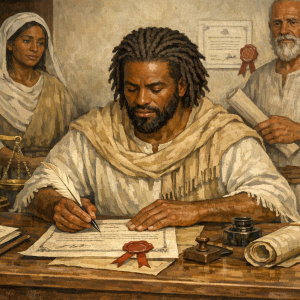
To certify is to declare, confirm, or attest that a fact, record, condition, qualification, process, or result is true, accurate, authentic, complete, or compliant with an identified standard. The declaration ordinarily carries greater weight than an informal assertion because it is made by a person or body possessing relevant knowledge, custody, authority, or recognized competence.
The verb may describe several related acts:
- Attesting to truth or accuracy: stating that information is correct to the certifier’s knowledge.
- Authenticating a record: confirming that a copy corresponds to an official record, or that a signature, seal, or office is genuine.
- Confirming compliance: declaring that a person, product, organization, or system satisfies specified requirements.
- Recognizing qualifications: formally acknowledging that a person has completed required education, testing, training, or professional review.
- Communicating officially: formally making a matter known to another court, official, agency, or governing body.
- Authorizing a legal consequence: making a determination that activates a procedure, payment, status, representation, or right under governing law.
Certification does not necessarily establish absolute truth. Its effect depends on the certifier’s authority, the wording of the certificate, the governing rule, and the evidence supporting the declaration. A certificate may be conclusive for a limited administrative purpose, create a rebuttable presumption, satisfy an evidentiary foundation, or amount only to the certifier’s representation after reasonable inquiry.
Distinction from Related Terms
Certify, verify, attest, authenticate, notarize, license, and accredit overlap but are not interchangeable. Verification concerns checking truth or accuracy. Attestation is the act of bearing witness or affirming. Authentication establishes that an item is what it purports to be. Notarization records a particular notarial act, such as taking an acknowledgment or oath. Licensing grants legal permission to engage in a regulated activity. Accreditation commonly evaluates the competence of an organization that performs testing, inspection, or certification. In standards practice, certification is frequently a form of third-party attestation concerning conformity with stated requirements. ([merriam-webster.com](https://www.merriam-webster.com/dictionary/certify?utm_source=openai))
Etymology and Origin
The English verb entered Middle English in the fourteenth century through Anglo-French and Old French forms such as certefier or certefiier. These came from Late Latin certificare, meaning to make certain, assure, or convince. The Latin formation joins certus, meaning settled, sure, or certain, with a form related to facere, “to make” or “to do.” The underlying image is therefore that of making a matter certain. ([merriam-webster.com](https://www.merriam-webster.com/dictionary/certify?utm_source=openai))
Early English usage was broader than present technical usage. It could mean to inform, notify, instruct, assure, confirm, or declare the truth of something. Over time, the word became increasingly associated with formal writings, official seals, institutional authority, professional qualifications, and compliance with prescribed standards.
The Latin ancestry of the word is a linguistic fact, but it should not be mistaken for proof that every legal form of certification originated in Roman law. Roman, canon, common-law, commercial, and administrative systems all developed methods of authoritative attestation. Modern certification is a family of practices rather than one undivided doctrine inherited from a single legal system.
Cultural and Historical Context
Certification became especially important in societies where decisions had to be made at a distance. A ruler, court, merchant, or landholder could not personally inspect every event, record, shipment, or qualification. Trusted officers therefore transmitted certified information. A clerk might certify a copy of a judgment; a customs officer might certify cargo information; a church or civil registrar might certify a birth, marriage, or death; and a guild might confirm that a worker had acquired recognized skill.
Seals, signatures, witnesses, official custody, and chains of authentication developed as means of answering two questions: Who made this statement? and Why should it be trusted? Certification did not eliminate the possibility of error or fraud, but it assigned responsibility and made reliance possible without requiring every recipient to repeat the original investigation.
The expansion of centralized government, international commerce, printing, public registries, industrial production, and professional education greatly enlarged the word’s field of use. In the modern period, governments and private institutions certify teachers, physicians, aircraft, elections, laboratory results, financial statements, organic products, computer systems, and compliance programs. The constant idea is an authoritative bridge between underlying evidence and the person expected to rely upon it.
Biblical / Torah Context
In older English Bible translations, certify often carries its historical meaning of making known rather than the narrower modern meaning of issuing a formal certificate. In the King James Version, forms of the word appear in passages including 2 Samuel 15:28, Ezra 4:14–16, Ezra 5:10, Ezra 7:24, Esther 2:22, and Galatians 1:11.
The underlying biblical languages do not establish one special theological term equivalent to modern institutional certification. In the Hebrew and Aramaic passages, the translated words generally concern telling, announcing, showing, or making something known. In Galatians 1:11, “I certify you, brethren” translates the Greek gnōrizō, meaning to make known, declare, or cause to understand. Many later English translations accordingly use “make known,” “have you know,” or similar language. ([bibletools.org](https://www.bibletools.org/index.cfm/fuseaction/Def.show/RTD/ISBE/ID/1928/Certify.htm?utm_source=openai))
The scriptural usage nevertheless reflects an important principle: knowledge is communicated with an assertion of reliability. In Ezra, officials report matters to royal authority. In Galatians, Paul solemnly declares the claimed source and character of the gospel he preached. The force arises from the speaker, subject, and context, not from a paper credential or technical formula.
Torah principles concerning truthful testimony, honest measures, impartial judgment, and the prohibition against bearing false witness provide an ethical background relevant to certification. A person who certifies assumes a duty not to convert uncertainty, favoritism, or convenience into a false appearance of certainty. This is a moral application rather than a claim that modern certification procedures are directly prescribed by Torah law.
Legal Implications
Historical Common Law
At common law, certificates were widely used to authenticate public records and transmit official information. Clerks and custodians certified that copies corresponded with records held in their offices. Courts also certified records or questions to other courts. This practice reduced the need to remove original public records or summon their custodians in every proceeding.
Modern evidence rules continue this tradition. Federal Rule of Evidence 902 recognizes various self-authenticating public documents and certified copies of public records. The rule’s notes expressly acknowledge that common law and numerous statutes recognized authentication of public records by certificate. Certification can dispense with separate testimony establishing authenticity, but an opposing party remains free to dispute accuracy, admissibility, legal effect, or other defects. ([law.cornell.edu](https://www.law.cornell.edu/rules/fre/rule_902?utm_source=openai))
A certified copy ordinarily represents that the copy accurately reproduces the record in official custody. It does not necessarily certify that every statement within the original record is substantively true. Authenticity and truth are related but distinct evidentiary questions.
Roman Law, Equity, and Statutory Law
Although the vocabulary is Latin-derived, certify does not identify a uniquely Roman-law remedy. Nor did equity give the verb one universal technical meaning separate from common law. Courts of law, courts of equity, ecclesiastical tribunals, and later unified courts all employed certificates according to their procedures. Present legal consequences usually arise from constitutions, statutes, court rules, contracts, administrative regulations, or the law governing a particular profession or instrument.
Judicial Certification
In litigation, certification may refer to different judicial acts. Under Federal Rule of Civil Procedure 23, a court determines whether an action satisfies the requirements for treatment as a class action. Class certification does not decide that the plaintiffs will prevail; it decides that defined claims may proceed through the representative procedure established by the rule. ([law.cornell.edu](https://www.law.cornell.edu/uscode/text/28a/courtrules-Civil/title-IV/courtrule-23?utm_source=openai))
A court may also certify a question of law to another court whose authoritative guidance is needed. Federal law permits a United States court of appeals to certify a question of law to the Supreme Court, although this procedure is uncommon. Federal courts may also certify unsettled questions of state law to state supreme courts when state rules permit it. ([law.cornell.edu](https://www.law.cornell.edu/uscode/text/28/1254?utm_source=openai))
Certifications by Lawyers and Parties
Some certifications arise automatically from signing and filing a document. Under Federal Rule of Civil Procedure 11, a signer represents, after an inquiry reasonable under the circumstances, that a filing is not presented for an improper purpose, that its legal contentions have an adequate basis, and that its factual assertions or denials have appropriate evidentiary support. A false or inadequately investigated certification can lead to sanctions. ([law.cornell.edu](https://www.law.cornell.edu/rules/frcp/rule_11?utm_source=openai))
The word certify does not by itself mean “swear under oath.” A statute or prescribed formula may, however, give it that effect. Under 28 U.S.C. § 1746, an unsworn written declaration, certificate, verification, or statement may substitute for certain sworn statements when it is dated, signed, and expressly made under penalty of perjury. The exact wording and governing law therefore matter. ([law.cornell.edu](https://www.law.cornell.edu/uscode/text/28/1746?utm_source=openai))
Governmental and Military Administration
Government officers may certify election results, eligibility, expenditures, records, appointments, or compliance with statutory conditions. Election certification formalizes the official result for subsequent legal steps, but the responsible officer’s duties, discretion, and available challenges depend on the applicable constitution and statutes. Federal presidential-election law, for example, employs certificates of ascertainment and certificates of vote within a detailed statutory process. ([archives.gov](https://www.archives.gov/electoral-college/provisions?utm_source=openai))
Certification can carry personal responsibility in public finance. Under 31 U.S.C. § 3528, a federal certifying official is responsible for information and computations supporting a voucher, the legality of the proposed payment, and certain improper payments resulting from an inaccurate or misleading certificate. These rules have practical application to both civilian and military financial administration. Merely placing the word “certify” in a document does not necessarily create this statutory office or liability; the person’s legal designation and actual function are decisive. ([law.cornell.edu](https://www.law.cornell.edu/uscode/text/31/3528?utm_source=openai))
Commercial and Administrative Uses
Under Uniform Commercial Code § 3-409, a certified check is a check accepted by the bank on which it is drawn. The certification constitutes the bank’s signed agreement to honor the check as presented; a bank generally has no obligation to certify merely because certification is requested. ([law.cornell.edu](https://www.law.cornell.edu/ucc/3/3-409?utm_source=openai))
In labor law, the National Labor Relations Board may certify a labor organization as the exclusive bargaining representative after the applicable representation process. Certification then carries legal consequences, including an employer’s duty to recognize and bargain with the certified representative, subject to governing labor law. ([nlrb.gov](https://www.nlrb.gov/about-nlrb/rights-we-protect/the-law/employees/your-right-to-form-a-union?utm_source=openai))
Spiritual Meaning
Spiritually understood, to certify is to place one’s name, honor, and accountability behind a statement. It joins knowledge with responsibility. The ethical certifier does not merely repeat what is convenient; the certifier examines the matter, speaks within the limits of actual knowledge, discloses material qualifications, and refuses to lend authority to deception.
Certification also illustrates the difference between outward approval and inward truth. A seal may persuade people, but it cannot transform falsehood into truth. Conversely, a true matter does not become false merely because an institution refuses to certify it. The dictionary’s interpretive conclusion is that legitimate certification should serve truth by making evidence responsibly communicable; it should never be treated as a substitute for truth itself.
Modern Usage
Modern usage ranges from formal legal acts to ordinary assurances:
- A records custodian certifies a copy as accurate.
- A physician certifies a medical condition for a defined purpose.
- A professional board certifies that an applicant meets specialty requirements.
- A laboratory certifies test results or conformity with a method.
- A court certifies a class or a legal question.
- A government officer certifies an election return or payment voucher.
- A company certifies compliance with contractual or regulatory requirements.
- A technology professional certifies electronic records, system results, or copied digital data.
Digital systems have not displaced certification; they have changed its mechanisms. Electronic signatures, cryptographic certificates, audit logs, identity controls, and documented testing may now perform functions once associated mainly with ink, seals, and paper custody. Federal evidence rules expressly address certified records generated by electronic systems and certified data copied from devices or files. ([law.cornell.edu](https://www.law.cornell.edu/rules/fre/rule_902?utm_source=openai))
Controversies / Criticisms
The principal criticism of certification is that it can create an appearance of certainty greater than the evidence warrants. The public may assume that “certified” means independently tested, government-approved, safe in every respect, or permanently guaranteed. In reality, a certification may be based on limited criteria, a sample taken on one date, information supplied by the applicant, or self-attestation rather than independent review.
Conflicts of interest arise when certifiers are paid by the persons or businesses seeking approval. Other concerns include weak standards, inconsistent audits, inaccessible appeals, institutional favoritism, credential inflation, counterfeit certificates, and “certificate mills” that issue impressive documents without meaningful examination.
Certification marks may also become misleading advertising. The Federal Trade Commission has warned that broad or unexplained environmental seals can imply benefits beyond those actually substantiated. A legitimate certification should identify its certifier, scope, standard, testing method, limitations, duration, and whether the review was independent. ([ftc.gov](https://www.ftc.gov/news-events/news/press-releases/2015/09/ftc-sends-warning-letters-about-green-certification-seals?utm_source=openai))
A further legal misconception is that certification automatically makes a statement incontestable. Usually it does not. Certification may establish authenticity or procedural regularity, but jurisdiction, hearsay, fraud, mistake, due process, and substantive accuracy may remain open to challenge. The authority to certify is limited to the authority granted; no officer, expert, or institution can conclusively certify matters beyond its lawful office or demonstrated competence.
Conclusion
To certify is to make a formal and accountable declaration that a matter is true, accurate, authentic, qualified, or compliant for a stated purpose. The word developed from the idea of “making certain,” but legal and practical certainty is rarely unlimited. A valid certification depends on competent authority, adequate inquiry, clear standards, faithful records, proper form, and honest disclosure of scope.
At common law and in modern law, certification facilitates reliance: it allows courts, governments, businesses, and individuals to act without personally repeating every investigation. Its value rests not in the label alone but in the integrity of the evidence and the accountability of the certifier. A certificate should therefore be read precisely—who certified, what was certified, according to which standard, on what evidence, for what purpose, and with what legal effect.
Sources / Further Reading
- Merriam-Webster, “Certify”: https://www.merriam-webster.com/dictionary/certify
- Online Etymology Dictionary, “Certify”: https://www.etymonline.com/word/certify
- Cornell Legal Information Institute, Federal Rule of Evidence 902: https://www.law.cornell.edu/rules/fre/rule_902
- Cornell Legal Information Institute, Federal Rule of Civil Procedure 11: https://www.law.cornell.edu/rules/frcp/rule_11
- Cornell Legal Information Institute, Federal Rule of Civil Procedure 23: https://www.law.cornell.edu/rules/frcp/rule_23
- Cornell Legal Information Institute, 28 U.S.C. § 1746: https://www.law.cornell.edu/uscode/text/28/1746
- Cornell Legal Information Institute, U.C.C. § 3-409: https://www.law.cornell.edu/ucc/3/3-409
- National Institute of Standards and Technology, “Conformity Assessment”: https://www.nist.gov/glossary-term/20976
- National Archives, Electoral College Legal Provisions: https://www.archives.gov/electoral-college/provisions
- National Labor Relations Board, “Conduct Elections”: https://www.nlrb.gov/about-nlrb/what-we-do/conduct-elections
- United States Code, 31 U.S.C. § 3528: https://www.law.cornell.edu/uscode/text/31/3528
- International Standard Bible Encyclopedia, “Certify”: https://www.bibletools.org/index.cfm/fuseaction/Def.show/RTD/ISBE/ID/1928/Certify.htm