Zephaniah
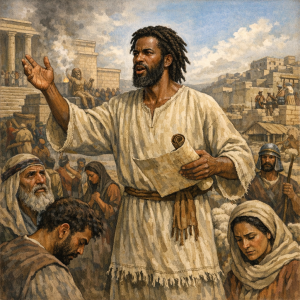
Primary Definition
Zephaniah is a Hebrew personal name and the customary English name of (1) a prophet of Judah associated with the biblical Book of Zephaniah and (2) the three-chapter prophetic book bearing his name. In Jewish tradition, the book belongs to the Nevi’im (Prophets), within the collection known as the Twelve Prophets; in most Christian Old Testaments, it is one of the “Minor Prophets.” “Minor” refers to the book’s relative brevity, not to a lesser authority or importance.
The prophet is introduced in Zephaniah 1:1 as “Zephaniah son of Cushi, son of Gedaliah, son of Amariah, son of Hezekiah,” active “in the days of Josiah son of Amon, king of Judah.” The book therefore presents its message as prophecy delivered in the kingdom of Judah during Josiah’s reign, conventionally dated 640–609 BCE. Its central themes are divine judgment, public and private corruption, idolatry, the “day of the LORD,” repentance, the humbling of pride, and the eventual restoration of a faithful remnant.
As a dictionary term, Zephaniah should not be treated merely as a personal name. The name has become inseparable from the prophetic message associated with it: the warning that moral disorder, false worship, political pride, and unjust conduct are subject to divine scrutiny, alongside the promise that judgment is not necessarily the final word for those who seek righteousness and humility.
Etymology and Origin
Zephaniah represents the Hebrew name צְפַנְיָה (Tsephanyah or Ṣəphanyāh), with a longer form sometimes represented as צְפַנְיָהוּ (Tsephanyahu). It is a theophoric name: that is, a name containing an element referring to the God of Israel. The final element Yah is a shortened form of the divine name YHWH.
The first element is commonly linked with the Hebrew root צפן (tsaphan), which can carry senses such as to hide, conceal, store up, reserve, or treasure. Consequently, translations of the name vary: “YHWH has hidden,” “YHWH protects by hiding,” “YHWH has stored up,” or, in a more interpretive rendering, “YHWH treasures.” The basic and most widely recognized gloss is “the LORD has hidden” or “YHWH has concealed.”
The differences among English glosses should not be overstated. They arise from the semantic range of the Hebrew root, rather than from evidence that the name had several unrelated origins. In ancient Hebrew naming practice, a theophoric name could express parental faith, a hoped-for divine protection, a remembered event, or a theological confession. It does not, by itself, establish a detailed biography of the person who bore it.
The English form Zephaniah reached English through Greek and Latin biblical transmission. The Hebrew consonants and vowels were adapted in the ancient Greek Septuagint as Sophonias, then in Latin as Sophonias, while English translations ultimately standardized the familiar form “Zephaniah.” Jewish usage often retains forms closer to Hebrew, including Tzefaniah or Tzfaniah.
Cultural and Historical Context
The book identifies Zephaniah’s ministry with the reign of King Josiah of Judah. This was a period of major transition in the ancient Near East. Assyrian power, which had dominated much of the region for generations, was weakening; Nineveh, the Assyrian capital, fell in 612 BCE. Judah existed amid competing imperial pressures and faced internal questions of religious loyalty, public order, wealth, leadership, and national survival.
Zephaniah’s superscription supplies an unusually long genealogy, extending four generations. Some interpreters have suggested that the named Hezekiah was King Hezekiah of Judah, which, if correct, would give the prophet royal ancestry. That identification is possible but not certain: the text does not explicitly call this Hezekiah “king,” and Hezekiah was also a personal name. A responsible reading therefore distinguishes the biblical genealogy itself from later conclusions drawn from it.
Scholars generally place at least the core of Zephaniah’s preaching in Josiah’s reign, but the exact date remains disputed. Some place it before Josiah’s religious reforms, often associated with approximately 622 BCE, because the book strongly condemns Baal worship, astral devotion, syncretism, and religious complacency. Others place it during or after the reform, viewing the prophecy as participating in or reinforcing a wider reforming movement. The book itself does not provide enough chronological detail to settle the question conclusively.
Historically, Zephaniah belongs to the prophetic world of late monarchic Judah, alongside such figures as Jeremiah, Nahum, and Habakkuk. The book speaks not only against Judah and Jerusalem but also against surrounding peoples and cities: Philistia, Moab, Ammon, Cush, and Assyria/Nineveh. This broad horizon reflects a prophetic conviction that no nation, however powerful, stands outside divine judgment.
The name Zephaniah is not limited to the prophet. Other biblical persons bear it, including a priest mentioned in 2 Kings and Jeremiah during Jerusalem’s final years before the Babylonian destruction of the city. That priest should not be casually merged with the prophet. Shared names were common, and biblical context must determine which individual is meant.
Biblical / Torah Context
Zephaniah is not part of the Torah in the narrow Jewish sense of the Five Books of Moses. It is part of the Hebrew Bible or Tanakh, specifically the Prophets. The book’s teachings nevertheless stand in continuity with Torah themes: exclusive loyalty to God, rejection of idolatry, accountability for violence and fraud, the obligation of leaders to act justly, and the covenantal connection between conduct and communal wellbeing.
The Book’s Main Movement
The Book of Zephaniah is commonly read in three broad movements:
- Zephaniah 1: A sweeping warning of judgment, concentrated particularly upon Judah and Jerusalem. The chapter denounces idolatrous practices, complacency, luxury, violence, deception, and those who assume that the LORD will neither act for good nor for evil.
- Zephaniah 2: A call to seek the LORD, righteousness, and humility, followed by pronouncements against neighboring nations and cities. The call to humility stands as one of the book’s clearest ethical appeals.
- Zephaniah 3: A rebuke of Jerusalem’s unfaithful officials, prophets, and religious authorities, followed by an international and restorative vision in which peoples call upon the LORD and Zion rejoices in divine renewal.
A key expression is the “day of the LORD.” In Zephaniah, this is not simply a twenty-four-hour period. It is prophetic language for a decisive divine intervention in history. The day is depicted as near, severe, and morally searching. It overturns the false security of wealth, status, military strength, and political power. The imagery is poetic and theological; it should not automatically be converted into a prediction of a particular modern war, government, or date.
Zephaniah’s language can be universal in scope. The opening announces judgment in sweeping terms, and the later chapters address multiple nations. Yet the book’s immediate moral focus remains Judah and Jerusalem. The prophecy confronts those closest to the covenantal claims they professed. In that respect, Zephaniah rejects the idea that religious identity immunizes a people from accountability.
Jewish and Christian Reception
In Jewish reading, Zephaniah is one of the Twelve Prophets and is interpreted within the larger scriptural witness concerning covenant, repentance, judgment, exile, and restoration. The final section, especially Zephaniah 3:14–20, is notable for its language of rejoicing, gathering, restoration, and the removal of shame.
Christian readers have also received Zephaniah as part of the Old Testament’s prophetic witness. Many Christian interpretations connect the “day of the LORD,” the humble remnant, and the restoration of the nations with later New Testament themes. Those connections are theological interpretations within Christianity; they should not be confused with a claim that the historical meaning of every verse is exhausted by later Christian application.
Legal Implications
Zephaniah has no independent technical definition in Anglo-American common law. It is not a legal office, legal status, legal maxim, jurisdiction, writ, remedy, or rule of evidence. The name and book may be cited in religious, historical, literary, or ethical discussion, but they do not create enforceable civil duties merely by being quoted.
There is likewise no sound basis for asserting that the Book of Zephaniah is itself a source of binding modern common law. Historical English common law developed through custom and judicial decisions, later supplemented and altered by statutes. Modern United States law is governed through federal and state constitutions, statutes, administrative rules, and judicial decisions. Biblical texts may have influenced the moral vocabulary of some lawmakers, judges, and communities, but influence is not identical with legal authority.
The book does contain themes that have legal and governmental relevance at the level of moral reflection. It condemns violence, fraud, abuse by officials, corrupt leadership, and exploitation. It also portrays rulers, judges, priests, and prophets as answerable for misconduct. Such passages can inform discussions of public ethics, fiduciary responsibility, impartial justice, and the limits of power. They do not, however, supply a modern statutory definition of fraud, a common-law cause of action, or a constitutional rule.
It is important to distinguish several legal categories. Zephaniah is not Roman law, not English common law, not equity in its technical chancery sense, and not a modern statute or reported judicial opinion. It belongs to ancient Israelite religious literature. Any attempt to invoke it in a legal argument must identify the actual present-day authority—constitution, statute, regulation, contract, or precedent—on which the legal claim rests.
The book’s governmental imagery is genuine but limited to its ancient setting. It references kings, princes, judges, officials, priests, and prophets in the kingdom of Judah. It does not establish a modern theory of national sovereignty, military command, citizenship, taxation, or court jurisdiction. Assertions that a person may avoid current civil obligations simply by appealing to biblical names or prophetic texts are unsupported by established law.
Spiritual Meaning
The spiritual force commonly associated with Zephaniah lies in the tension between concealment, exposure, judgment, and restoration. If the name is understood as “YHWH has hidden,” it may suggest divine protection or preservation; yet the book itself emphasizes that hidden wrongdoing is not permanently hidden from God. Zephaniah 1 presents divine judgment as searching even those who have become spiritually indifferent.
The book does not present humility as weakness. “Seek the LORD,” “seek righteousness,” and “seek humility” express a spiritual posture of turning away from self-sufficiency and toward truthful, obedient conduct. The emphasis is not on using religious language to escape consequences, but on a genuine reordering of life.
Zephaniah also provides a spiritual pattern in which judgment and mercy are not opposites. Judgment exposes corruption and arrogance; restoration gathers the afflicted, renews worship, and creates cause for rejoicing. The concluding vision has therefore been important to readers who understand repentance not merely as fear of punishment but as the possibility of communal renewal.
This spiritual reading is interpretive. The biblical text plainly contains themes of divine judgment and restoration, but particular applications—whether personal, national, eschatological, Jewish, Christian, or otherwise—should be acknowledged as applications rather than presented as the only possible meaning.
Modern Usage
In modern English, Zephaniah is used primarily in four ways: as the name of the biblical prophet; as the title of the biblical book; as a male given name; and as a reference in sermons, scholarship, music, religious education, and literature. The standard abbreviation for the biblical book is often Zeph.
The name remains more common in religious communities than in general secular naming practice, though it is used across different cultures and languages. Spellings such as Tzefaniah, Tsefania, Sofonias, and related forms reflect differences in transliteration and translation traditions.
Modern readers frequently quote Zephaniah in connection with humility, the danger of complacency, judgment upon pride, and the closing promise of restoration. The best-known passages are often drawn from the final chapter. Sound interpretation requires attention to the book’s whole movement, however, rather than isolating consoling verses from the warnings that precede them.
Controversies / Criticisms
The principal scholarly controversies concern dating, authorship, and composition. While the book attributes its prophecy to Zephaniah in Josiah’s reign, scholars differ over whether every section of the present book originated with the historical prophet. Many scholars regard substantial portions as authentically connected to Zephaniah while proposing that some passages may have been edited, expanded, arranged, or supplemented in later periods. Other interpreters defend the essential unity of the book. The evidence does not produce universal agreement.
Another issue concerns the precise historical referents of the nations condemned in the book. Some references may fit late seventh-century BCE political realities closely; others may function as traditional prophetic portrayals of hostile nations. Caution is appropriate when assigning every oracle to a single event or military campaign.
The book’s severe judgment language has also drawn ethical criticism. Modern readers may find its depictions of disaster, destruction, and divine wrath difficult. Religious interpreters answer in different ways: some stress that the oracles oppose oppression and arrogance; others emphasize the book’s restorative ending; still others regard parts of its ancient prophetic rhetoric as historically conditioned. These are interpretive debates, not questions settled merely by the name’s etymology.
Finally, Zephaniah is sometimes used in speculative end-times claims. The text has long been read eschatologically in Jewish and Christian traditions, but using it to identify a particular present-day nation, leader, war, or calendar date goes beyond what the book explicitly states. Such claims should be identified as speculative and should not be represented as established historical, legal, or linguistic fact.
Conclusion
Zephaniah is a Hebrew name most closely associated with a prophet of Judah and the short but forceful biblical book attributed to him. Its name likely means “YHWH has hidden” or conveys a closely related idea of divine concealment, preservation, or storing up. Historically, the prophet is situated in the reign of Josiah amid the instability of the late seventh-century BCE Near East.
The Book of Zephaniah joins uncompromising criticism of idolatry, injustice, pride, and complacency with a final vision of humility, purification, gathering, and restoration. It has enduring religious and ethical importance, but it is not a technical source of present-day common law. Careful use of the term requires separating the ancient biblical text, later theological interpretation, historical reconstruction, and modern legal claims.
Sources / Further Reading
- Sefaria, Zephaniah (Hebrew and English text): https://www.sefaria.org/Zephaniah
- Chabad.org, Tzefaniah (Zephaniah): https://www.chabad.org/library/bible_cdo/aid/16200/jewish/Chapter-1.htm
- Merriam-Webster Dictionary, “Zephaniah”: https://www.merriam-webster.com/dictionary/Zephaniah
- Online Etymology Dictionary, “Zephaniah”: https://www.etymonline.com/word/Zephaniah
- Bible Hub, Hebrew Lexicon, צְפַנְיָה: https://biblehub.com/hebrew/6846.htm
- Waldemar Chrostowski, “The Historical, Social and Religious Context of the Teaching of Prophet Zephaniah,” Collectanea Theologica: https://czasopisma.uksw.edu.pl/ct/article/view/2549