T
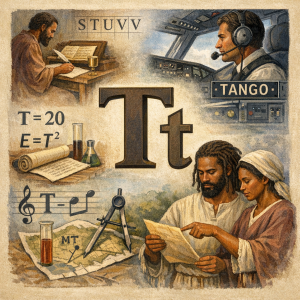
Primary Definition
T is the twentieth letter of the modern English alphabet and the twentieth letter of the basic Latin alphabet. Its ordinary lowercase form is t. In English, it normally represents a voiceless alveolar stop: the consonant sound heard at the beginning of time, take, and truth. The exact sound varies with position and dialect. For example, English speakers may pronounce the sound with an audible release in top, with aspiration in tea, with a softer or glottalized realization in some dialects, or as part of a combination such as th, which is not simply a pronounced t.
As a dictionary term, the letter has several distinct functions:
- Alphabetic: a written character representing a speech sound or sounds.
- Ordinal: the twentieth position in the English alphabet.
- Symbolic: a mark used in mathematics, science, music, mapping, typography, and technical notation where a document or discipline defines it.
- Abbreviatory: an initial standing for a word, name, title, variable, exhibit, classification, or other context-specific designation.
- Phonetic: “Tango” in the International Radiotelephony Spelling Alphabet, used to prevent misunderstanding in aviation, military-adjacent, maritime, emergency, and other voice communications.
The central rule for interpretation is context. A single letter does not carry one fixed legal, governmental, spiritual, military, or commercial meaning merely because of its shape or position in the alphabet. It acquires a specialized meaning only when a governing text, accepted convention, contract, statute, regulation, court record, technical standard, or speaker supplies one.
Etymology and Origin
The English letter descends from a very old family of alphabetic signs. Its immediate classical ancestor is the Latin T, which came through the Greek letter tau (Τ, τ). Greek tau is generally understood to derive from the Northwest Semitic/Phoenician letter commonly called taw or tav. Related forms appear in Hebrew ת (tav) and other Semitic writing traditions.
The historical relationship should be stated carefully. The Latin character is not identical to the Hebrew character, and the English letter should not be treated as though it were a Hebrew word. They belong to related alphabetic traditions, but each script developed its own forms, names, pronunciations, scribal practices, and cultural associations. The English letter’s modern shape and place in the alphabet are products of the Greek, Etruscan, Roman, medieval, and later European transmission of writing.
The name tau entered English in the Middle Ages as the name of the Greek letter corresponding to Latin T. Etymological sources connect it ultimately with taw, a Semitic letter name associated with a “sign” or “mark.” That older semantic association belongs principally to the Semitic letter name; it is not proof that every later use of the Roman letter T means “mark,” “truth,” “cross,” or any other symbolic concept.
The letter has been notably stable as a consonant sign. While forms of English pronunciation and spelling have changed considerably, t has long served as a principal representation of the /t/ sound. In particular word histories, however, written t may correspond to sounds that developed differently. In words such as nature, for example, the combination tu has often developed a “sh” or “ch”-like value in ordinary speech. Conversely, the digraph th represents sounds historically and phonetically distinct from a plain t.
Cultural and Historical Context
Because the capital form consists of a vertical stroke crossed near the top by a horizontal stroke, it has been repeatedly adapted into visual designs. This visual economy has made it useful in printing, surveying, drafting, signage, and diagrams. A T-shape may describe an intersection, a tool, a support, a garment, or a structural configuration without necessarily referring to the alphabet as such. Terms such as T-junction, T-square, T-bar, and T-shirt are ordinarily descriptive: they refer to a shape resembling the capital letter.
The familiar idiom to a T means exactly, precisely, or perfectly. It is often associated in popular explanation with the care required to cross one’s t’s, but the phrase’s precise origin is uncertain. The related expression cross one’s t’s and dot one’s i’s plainly emphasizes completeness and attention to detail in writing. Such idioms show how a letter can become a cultural shorthand for exactness without becoming a rule of law.
Historically, the tau-shaped cross was also called a tau cross or, in some traditions, a Saint Anthony’s cross. This is a matter of visual association between the Greek letter tau and a cross-shaped emblem. It does not establish that the original purpose of the alphabetic letter was Christian, nor does it make every printed T a religious sign.
In digital text systems, the ordinary capital character is encoded as Unicode U+0054, LATIN CAPITAL LETTER T, and its lowercase counterpart is U+0074, LATIN SMALL LETTER T. Unicode identification is useful in legal and technical settings because visually similar characters from different scripts are not necessarily the same character. A Latin T, Greek tau, and Hebrew tav may look comparable in particular fonts while remaining distinct code points, letters, and linguistic units.
Biblical / Torah Context
The most relevant biblical context is not the Roman letter itself, but the Hebrew letter tav (ת), the final letter of the Hebrew alphabet. In Jewish tradition, tav has a numerical value of 400. It is a letter used throughout the Hebrew text of the Torah and the rest of the Tanakh; like other alphabetic characters, its primary function is to form words.
A particularly important passage is Ezekiel 9:4. In the vision, a figure is instructed to place a mark upon the foreheads of persons who grieve over Jerusalem’s abominations. The Hebrew wording uses a form connected with tav, and Jewish commentary has long connected that “mark” with the letter tav. Rashi explains the passage as marking the righteous for identification. Rabbinic discussion adds interpretive detail concerning judgment, protection, responsibility, and the failure to protest wrongdoing.
This passage supports a documented association of tav with a mark or sign in biblical and rabbinic interpretation. It does not mean that the English letter T, wherever printed, automatically creates protection, covenant, jurisdiction, authority, or spiritual status. The Hebrew text, the ancient script, later rabbinic interpretation, and later Christian visual symbolism must be kept distinct.
The Torah itself does not set out a doctrine that the Latin alphabetic character T possesses independent legal or mystical force. Jewish interpretive traditions sometimes explore the forms, names, positions, and numerical values of Hebrew letters. Those teachings may be important within their theological and devotional settings, but they are interpretive traditions rather than a substitute for the plain linguistic meaning of a text. They should not be converted into universal claims about English spelling, civil government, or common-law rights.
Legal Implications
Common-Law Meaning
There is no general historical common-law doctrine under which the character T, standing alone, has a fixed legal definition or operates as a grant, reservation, signature, seal, status, jurisdictional objection, or immunity. Common law developed through judicial decisions, custom, reasoned analogy, and later interaction with statutes and equity. It recognizes the importance of written instruments and symbols when parties or the law give them meaning, but it does not treat isolated letters as self-executing legal commands.
Accordingly, the legal meaning of T depends on the instrument in which it appears. A letter can identify a party in a reported case, label an exhibit, distinguish a schedule, designate a map point, name a variable in a statute, identify a witness in a privacy-protected opinion, or form part of an abbreviation. The meaning comes from the surrounding record and applicable law.
Statutes, Regulations, Contracts, and Court Records
In modern legal drafting, capital letters frequently organize documents: “Exhibit T,” “Schedule T,” “Part T,” or “Person T.” These are labels, not words with inherent legal effects. If a contract defines “T” as a taxpayer, trustee, territory, transaction, or technical term, that definition governs the agreement subject to ordinary principles of interpretation. If a statute or regulation defines an abbreviation, the statutory or regulatory definition governs within that enactment.
Likewise, a letter in a signature block, filing caption, docket number, or evidence tag must be read in context. A court may consider surrounding language, incorporated documents, established trade usage, and the purpose of the instrument when genuine ambiguity exists. But a party generally cannot defeat an otherwise valid instrument by assigning a private, undisclosed meaning to a common letter after the fact.
Equity and Roman Law
Equity historically developed alongside common law in England and supplied remedies where the common-law forms and damages were inadequate. Neither equity nor Roman law gives the English character T a universal operative meaning. Roman law influenced legal vocabulary and later civilian systems, while English common law and equity formed distinct historical traditions. Invoking “Roman law,” “common law,” or “equity” does not transform a typographic character into legal authority.
Historical Punishment and the Letter as a Mark
Some historical sources note that T was used as a brand for a convicted thief in certain periods and jurisdictions. This was a punitive marking practice, not a general common-law definition of the letter and not a current rule authorizing private persons to brand, classify, or stigmatize others. Historical uses of letters as marks illustrate that symbols can be legally assigned a limited function by a particular government or institution; they do not show that the symbol has an eternal legal meaning independent of enacted authority.
Claims Requiring Caution
Claims sometimes circulate that capitalization, a particular letter, punctuation, or a name written in a certain style changes one’s citizenship, creates a separate legal person, voids a court’s jurisdiction, or converts an ordinary document into a trust or commercial instrument. Such propositions are contested and are not established rules of American common law. Legal rights and obligations are determined by applicable constitutions, statutes, regulations, valid contracts, court rules, and judicial decisions—not by unsupported symbolic interpretations of individual letters.
Spiritual Meaning
Spiritually, the letter may be used as a symbol of completion, marking, truth, humility, suffering, service, or the cross, depending on the religious community and interpretive tradition. The association with completion is understandable because Hebrew tav is the last letter of the Hebrew alphabet. Jewish teachings may associate tav with emet, “truth,” because tav is the final letter of that Hebrew word. Other teachings emphasize the “mark” in Ezekiel or tav’s place at the end of the alphabet.
Christian traditions have sometimes associated the tau form with the cross, especially in devotional art and in traditions linked to Saint Francis and Saint Anthony. This is a legitimate historical devotional association, but it is not a universally binding biblical rule. A tau cross is not the same object as every Roman capital T, and a theological symbol should not be confused with a civil legal device.
The dictionary’s interpretive analysis is therefore that T can serve as a reminder of precision, witness, marking, or completion when a community intentionally uses it that way. Such meaning is symbolic and voluntary unless a religious body’s own rules provide otherwise. It is not an inherent power embedded in the printed glyph.
Modern Usage
In contemporary English, T appears in ordinary words and in a broad range of abbreviations. It can mean time in a scientific formula, temperature in a defined equation, a route designation, a shirt size, a transit line, a classification, or an initial. These meanings are discipline-specific. In mathematics and science especially, authors routinely choose letters as variables; the same character can represent entirely different quantities in different books or formulas.
In radio communication, T is represented by Tango in the International Radiotelephony Spelling Alphabet. The purpose is practical clarity: the code word reduces the chance that a listener will confuse T with a similarly sounding letter in noisy or multilingual communication. This standardized usage is relevant to aviation and was adopted broadly by military and international communications systems, but “Tango” is not the ordinary legal definition of the letter.
In informal modern speech, “T” may also be shorthand for particular words or names within a social group. Slang is highly context-dependent and changes rapidly. A responsible reader should not infer a slang meaning in a legal, biblical, historical, or technical document unless the context clearly supports it.
Controversies / Criticisms
The principal controversy surrounding this entry is overextension of symbolic meaning. Because the letter’s ancestors are associated with ancient alphabets and because T visually resembles a cross, writers may make sweeping claims about ancient religion, Roman authority, biblical prophecy, secret legal codes, or governmental power. Some such claims begin with a genuine historical fact—such as the relationship of tau, tav, and a mark—but then move beyond the evidence.
A careful study distinguishes among: (1) documented paleographic history; (2) the literary meaning of a particular biblical passage; (3) later Jewish or Christian interpretation; (4) ceremonial or artistic symbolism; and (5) claims of present legal effect. These are not interchangeable categories. A spiritual interpretation can be sincere and meaningful without becoming a statement of statutory law. A historical resemblance between symbols can be noteworthy without proving direct identity or legal consequence.
Another criticism concerns anachronism: reading modern English-letter assumptions back into ancient Hebrew, Phoenician, Greek, or Roman texts. The original scripts should be considered in their own linguistic and historical settings. The Latin alphabet has inherited and transformed older letter traditions; it has not preserved every ancient association unchanged.
Conclusion
T is primarily an alphabetic character: the twentieth letter of the English alphabet and a standard sign for the consonant sound commonly heard in time. Its history reaches through Latin and Greek tau to older Semitic letter traditions connected with tav or taw. Its simple cross-stroke form has encouraged many later practical and symbolic uses.
In Torah and biblical discussion, the relevant letter is Hebrew tav, especially in connection with the mark described in Ezekiel 9:4 and later Jewish interpretation. In Christian devotion, the tau-shaped cross has acquired additional symbolic significance. In law, however, T has no universal common-law power. Its legal meaning arises only from competent authority and context: the text of a statute, contract, rule, court record, technical standard, or defined usage. Careful interpretation requires preserving that distinction between documented history, religious symbolism, and actual legal effect.
Sources / Further Reading
- Online Etymology Dictionary, “T”
- Online Etymology Dictionary, “tau”
- Unicode Consortium, Unicode Character Code Charts
- Sefaria, Ezekiel 9:4
- Sefaria, Rashi on Ezekiel 9:4
- Chabad.org, “Tav: The Twenty-Second Letter of the Hebrew Alphabet”
- International Civil Aviation Organization, International Radiotelephony Spelling Alphabet
- Cornell Law School Legal Information Institute, Wex Legal Dictionary