Tuesday – (Tyr) or Dies Martis (Latin for “day of Mars”)
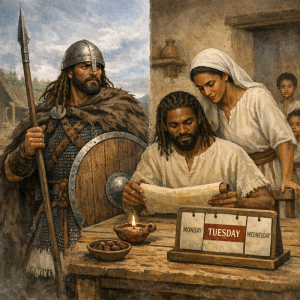
Primary Definition
Tuesday is the weekday that follows Monday and precedes Wednesday. In the ordinary Sunday-first arrangement long used in English-speaking calendars, it is the third day of the week; under ISO 8601, which treats Monday as the first day of the week, it is the second. The difference concerns calendar convention, not the identity of the day itself.
As an English word, Tuesday preserves an early Germanic religious and linguistic inheritance. Its name is associated with Tiw or Týr, while the corresponding Latin weekday expression refers to Mars. The connection is historical and etymological: the modern use of the word ordinarily identifies a civil calendar date and does not, by itself, constitute devotion to either deity.
In legal, commercial, governmental, and everyday usage, Tuesday is principally a date-designation. Its significance depends upon the instrument in which it appears. A contract may require performance “on Tuesday”; a court rule may make Tuesday the next available filing day after a holiday; a legislature may schedule an election, hearing, or meeting on a Tuesday. The word has no independent legal force apart from the governing text, jurisdiction, and applicable rules for computing time.
Etymology and Origin
The immediate English ancestor of Tuesday is Old English tīwesdæg, conventionally understood as “Tiw’s day.” Middle English forms such as tiwesday led to the modern spelling and pronunciation. The first element refers to Tiw, an Old English Germanic divine name corresponding broadly with Old Norse Týr. The second element, dæg, is the ordinary Old English word for “day.” Major English dictionaries identify this Old English formation and trace the recorded English word to before the twelfth century.
The English name belongs to a wider Germanic pattern. Related forms include Old Norse týsdagr, Swedish tisdag, Danish and Norwegian tirsdag, and older German forms associated with Ziu or Tiw. Modern German Dienstag and Dutch dinsdag have more complicated histories and have generated scholarly discussion concerning their first element; they should not be treated as simple proof that every Germanic language preserved precisely the same divine name in the same manner.
The connection between Tiw/Týr and Mars reflects a historical practice often called interpretatio romana: Roman writers and later translators explained non-Roman gods by comparison with Roman gods whose perceived functions seemed similar. Mars was the Roman god especially associated with war, martial power, and the Roman people. Tiw/Týr was considered a suitable Germanic counterpart, particularly because of his association with battle. Thus the Germanic weekday name functioned as a translation or cultural equivalent of the Roman “day of Mars,” rather than as proof that Týr and Mars were the same being within either religious system.
The deeper history remains partly reconstructed rather than directly documented. Linguists generally connect the Germanic divine name with Proto-Germanic *Tīwaz, and ultimately with an Indo-European word-family associated with deity, brightness, sky, or heaven. This larger word-family is also often compared with names such as Zeus and Jupiter. Such comparison identifies linguistic relationship; it does not establish that all later gods, myths, offices, or forms of worship were identical.
Latin Form and Romance-Language Relatives
The classical Latin expression is commonly written diēs Mārtis, literally “day of Mars.” From Latin-derived naming traditions come French mardi, Italian martedì, Spanish martes, and related forms. These languages preserve the Roman planetary-deity designation more visibly than English does. English instead preserves the Germanic substitution of Tiw for Mars.
The weekday sequence itself developed within the ancient seven-day week, in which days became associated with the Sun, Moon, and five visible planets. In the classical planetary order, Tuesday was linked with Mars. English weekday names therefore combine several layers of history: the seven-day week, Roman planetary associations, Germanic translations, Old English transmission, and modern civil-calendar use.
Cultural and Historical Context
The survival of Tuesday’s name demonstrates that words can preserve older cultural material long after the original religious setting has changed. England’s conversion to Christianity did not require every inherited weekday name to be discarded. Instead, familiar vernacular names continued in ordinary speech, legal records, commerce, and later printed calendars. A person may therefore use the word Tuesday in a wholly secular or Christian setting while the word’s historical form still points to pre-Christian Germanic tradition.
Týr is not among the most extensively documented Norse gods. The principal literary evidence for Norse mythology is found in the Poetic Edda and the Prose Edda, texts written down in medieval Iceland after the conversion of Scandinavia to Christianity, though they preserve older poetic and traditional material. Consequently, modern accounts must distinguish surviving textual evidence from attempts to reconstruct earlier Germanic religion.
In the best-known myth, the gods seek to bind the wolf Fenrir, whose growing strength threatens them. Fenrir agrees only if one of the gods places a hand in his mouth as a pledge of good faith. Týr does so, knowing the gods do not intend to release the wolf if the binding holds. When Fenrir discovers the deception and cannot escape, he bites off Týr’s hand. The story strongly associates Týr with courage, pledges, risk, battle, and the costly maintenance of order. It is reasonable to read the narrative as an illustration of sacrifice for collective security; it is less certain to assign it a single, fixed theological meaning.
Some modern descriptions call Týr a god of law, oaths, justice, or the public assembly as well as war. Those descriptions have a basis in scholarly interpretation of his name, associations, and mythic role, but the surviving evidence is limited. It is more careful to say that Týr is often interpreted as connected with law and oath-bound order than to claim that he was the sole or universally recognized “god of law” throughout all Germanic societies and periods.
Military and Governmental Relevance
Tuesday’s ancient association with a war deity does not give the day a special military status in modern armed forces. Military organizations use weekdays for schedules, deployment orders, training calendars, reporting periods, and operations, but those uses are administrative. A military order dated for Tuesday takes its force from lawful command authority and the content of the order, not from the historical name of the day.
Likewise, governments may set elections, legislative sessions, public meetings, court dates, or administrative deadlines on Tuesdays. In the United States, for example, many elections are held on Tuesday because federal and state election laws prescribe dates in statutory terms. The governmental consequence arises from the statute or regulation, not from common-law symbolism attached to Týr or Mars.
Biblical / Torah Context
The Torah does not call the weekday “Tuesday.” Biblical Hebrew generally identifies the days in relation to the Sabbath rather than naming them after pagan gods or planets. In modern Hebrew, Tuesday is Yom Shlishi (יוֹם שְׁלִישִׁי), meaning “third day.” This numerical pattern is consistent with the creation narrative’s sequence of first day, second day, third day, and so forth, culminating in the seventh-day Sabbath.
Genesis 1:9–13 describes the third day as the time when the waters were gathered, dry land appeared, and vegetation was brought forth. Jewish tradition identifies the weekly third day with Tuesday. In the Jewish reckoning of days, however, a day begins at sunset rather than at midnight. Thus the period called Yom Shlishi begins on what a modern civil calendar normally labels Monday evening and continues until Tuesday evening.
There is a notable contrast between the Hebrew and English names. Yom Shlishi is ordinal and Sabbath-centered; Tuesday is etymologically theonymic and rooted in the Germanic rendering of the Roman planetary week. Neither naming system, by itself, determines the religious faith of the person using it. They record different cultural histories of timekeeping.
Some Jewish teachings note that the creation account says “it was good” twice in connection with the third day: once after the gathering of the waters and again after the growth of vegetation. This has supported a favorable traditional association with Tuesday in some Jewish communities. That association is a matter of religious interpretation and custom, not a universal legal rule of Torah, nor a command that all persons must treat Tuesday as specially blessed.
Legal Implications
Common Law and Historical Usage
At common law, the names of weekdays served the practical function of identifying dates for courts, writs, notices, market arrangements, meetings, contracts, and performance obligations. Common law did not create a separate substantive doctrine of “Tuesday,” and the word’s Germanic religious etymology did not make Tuesday a source of jurisdiction, sovereignty, duty, or immunity. Historical common law concerned such questions as whether a stated date was sufficiently certain, whether a condition was timely performed, and how legal time was calculated under the applicable rule.
It is therefore inaccurate to argue that the use of the word Tuesday in an English-language legal document automatically invokes pagan law, Roman law, ecclesiastical law, or a separate body of “common law.” A date word is ordinarily construed according to its ordinary calendar meaning in context. The historical origin of its syllables may be relevant to a dictionary study, but it does not displace enacted law, controlling precedent, contractual language, or procedural rules.
Modern Time Computation
Under modern law, whether an act is due on Tuesday depends on the particular statute, court rule, agency rule, contract, or order. In federal civil procedure, Federal Rule of Civil Procedure 6 generally excludes the triggering day, counts intervening calendar days, and moves a deadline that ends on a Saturday, Sunday, or legal holiday to the next day that is not one of those days. Tuesday may therefore become a filing deadline when a period would otherwise end on a Monday holiday, but Tuesday is not inherently a legal holiday or universal business day.
Federal rules, state rules, and private agreements can differ. Some legal provisions specify “calendar days,” “business days,” “court days,” or “days excluding weekends and holidays.” Some define when electronic filing closes, when a clerk’s office is inaccessible, or which state holidays count. A reader should never assume that “next Tuesday” or “within ten days” has one fixed legal consequence without consulting the controlling text and jurisdiction.
The United States Supreme Court has also recognized, in interpreting a federal statutory deadline, the familiar background principle that a deadline landing on a weekend or legal holiday ordinarily carries forward to the next business day unless the relevant law indicates otherwise. This is a rule of statutory and procedural interpretation, not an application of the ancient associations of Mars or Týr.
Roman Law, Equity, and Statutory Law
The Latin weekday name should not be confused with Roman law. Diēs Mārtis is a Roman linguistic expression; it does not mean that every Tuesday in an English-speaking jurisdiction is governed by Roman legal principles. Similarly, equity historically developed alongside common-law courts in England, but equity did not derive authority from weekday names. In current American law, statutes, constitutions, regulations, binding judicial decisions, and duly adopted procedural rules govern time computation and public scheduling.
Spiritual Meaning
For persons who approach the day spiritually, Tuesday can provide an occasion for reflection on courage, responsibility, disciplined action, and the consequences of promises. The Týr-and-Fenrir narrative is frequently interpreted as a story of personal cost undertaken to restrain destructive power. That is an interpretive lesson drawn from myth, not a legal command and not a doctrine shared by all religious traditions.
Within Jewish reflection, the third day may call attention to land, growth, fruitfulness, and the ordered goodness of creation. Within Christian practice, Tuesday has no universally binding sacramental status comparable to the Lord’s Day in many traditions, though particular churches may assign readings, devotions, or saints’ commemorations to particular Tuesdays. In secular practice, it may simply be a normal working day.
Contemporary Heathen and other reconstructionist practitioners may honor Týr on Tuesday, sometimes connecting the day with oaths, justice, courage, or the T-rune. Such observances represent modern religious practice and should not be projected automatically onto every historical Germanic community. Nor should they be confused with the ordinary civil use of the weekday’s English name.
Modern Usage
Modern English uses Tuesday as both a noun and an adverbial time expression: “The meeting is Tuesday,” “We meet on Tuesdays,” and “Tuesday morning.” In formal writing, the name is capitalized. The plural Tuesdays commonly means recurring Tuesdays, while “Tuesday’s” may be possessive, as in “Tuesday’s hearing,” or may appear in a contraction only where grammar permits.
Calendar systems may number the days differently. In the United States, many wall calendars begin with Sunday, making Tuesday the third displayed day. International technical standards commonly begin the week with Monday, making Tuesday day two. To avoid ambiguity in legal, governmental, medical, travel, or business matters, a weekday should be accompanied by a complete date, time, time zone where relevant, and the applicable year.
Controversies / Criticisms
A recurrent overstatement is that because Tuesday’s name derives from Tiw/Týr, every use of the word is an act of pagan worship or submission to pagan authority. That proposition is not supported by ordinary principles of language, law, or religious practice. Words frequently outlive the beliefs that contributed to their formation. Modern speakers generally use Tuesday as a conventional calendar label.
Another overstatement is that Týr’s connection with Tuesday proves he was originally the supreme god of all Germanic peoples, the exclusive god of courts, or the source of modern common law. Linguistic evidence may suggest that the name is old and important, but the surviving historical evidence is insufficient to establish such sweeping conclusions. The development of English common law occurred through English royal courts, custom, legislation, legal profession, and judicial precedent—not through the etymology of a weekday.
Care is also needed with claims that “Tuesday” is directly named after Mars. In English, the immediate name is Germanic: Tiw’s day. It is accurate to explain that the Germanic name corresponds to, and likely translates, the Latin Mars-day pattern. It is less precise to erase the Germanic layer and say English simply retained the Latin name.
Conclusion
Tuesday is a common calendar word with an unusually visible historical depth. Its English form comes through Old English tīwesdæg, preserving the name of Tiw/Týr, while its Latin counterpart identifies the day with Mars. The name illustrates the meeting of Roman and Germanic calendar traditions, not the merger of their religions or laws.
For biblical and Torah-oriented study, the relevant Hebrew designation is Yom Shlishi, the third day, linked in Jewish tradition with the third day of creation. For legal study, Tuesday is a conventional date term whose effect comes from the controlling constitution, statute, rule, case, order, or agreement. Its ancient name may enrich historical understanding, but it does not independently create legal rights, obligations, jurisdiction, or spiritual obligation.
Sources / Further Reading
- Merriam-Webster Dictionary, “Tuesday”
- Online Etymology Dictionary, “Tuesday”
- timeanddate.com, “Tuesday: Tiw’s and Mars’ Day”
- World History Encyclopedia, “Tyr”
- Orthodox Union, “Tuesday / Yom Shelishi”
- Sefaria, Genesis 1:9–13
- Legal Information Institute, Federal Rule of Civil Procedure 6
- Supreme Court of the United States, 2024 Term Opinions, including Monsalvo Velazquez v. Bondi