Original Man
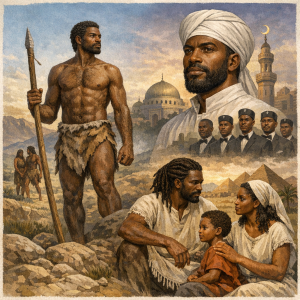
Primary Definition
Original Man is an English descriptive phrase whose meaning depends heavily on context. In its ordinary sense, it may mean the first human being, the earliest human ancestor, or humanity in its primal condition. In that broad and nontechnical sense, it is comparable to phrases such as “first man,” “original human,” or “earliest mankind.” It is not, by itself, a defined term of English common law, United States constitutional law, military law, Roman law, or statutory law.
When capitalized as Original Man, however, the phrase has a more specific cultural and religious meaning in teachings associated principally with the Nation of Islam (NOI) and, in altered forms, with some related Black religious-nationalist movements. Within classical Nation of Islam teaching, the “Original Man” is identified with the Black man, often called the “Original Asiatic Blackman.” The expression conveys a doctrine of primordial identity, divine dignity, recovered history, and independence from racial subordination. In that setting, it is not merely a statement about the earliest human population; it is part of a larger sacred history and moral interpretation of oppression.
This dictionary distinguishes three uses that are often incorrectly blended together:
- Ordinary descriptive use: the first or earliest human being.
- Religious-cultural use: a capitalized expression in Nation of Islam and related teachings concerning Black origin, identity, and divinity.
- Political or pseudo-legal use: an asserted ancestral, national, or “sovereign” identity. Such an assertion may have personal or religious meaning, but it does not itself establish a separate legal citizenship, immunity, jurisdictional exemption, property right, or exemption from law.
The latter distinction is important. A person may use “Original Man” as an affirmation of heritage, spirituality, or human worth without making any legal claim at all. Conversely, where the phrase is used in court papers or governmental dealings to imply that an individual is outside the jurisdiction of the United States or a state, the claim must be assessed under actual constitutional, statutory, treaty, and case law—not by the spiritual or rhetorical force of the words.
Etymology and Origin
The phrase is composed of two ordinary English words. Original entered English through medieval French and Latin forms connected with origo, meaning beginning, source, or origin. In modern English it ordinarily means first, initial, primary, or not derived from a copy. Man comes from Old English mann, which historically could mean a human being or person generally, although modern usage frequently gives it a male-specific sense. Thus, in its literal English construction, original man means “first human,” “primal person,” or “humanity at its beginning.” ([merriam-webster.com](https://www.merriam-webster.com/dictionary/man?utm_source=openai))
The words themselves do not derive from a hidden legal formula, an ancient Roman status, a military designation, a governmental classification, or a secret ecclesiastical title. No reliable etymological authority supports claims that the English phrase Original Man inherently creates a legal distinction between a “natural man” and an ordinary citizen, resident, defendant, taxpayer, or person under law.
The capitalized doctrinal expression developed in twentieth-century African American religious and political life. It is particularly associated with the teachings that emerged around Wallace D. Fard in Detroit during the early 1930s and that were systematized and widely taught under Elijah Muhammad. The historical record concerning Fard is incomplete, and the exact first use of every formula cannot always be fixed with certainty. It is therefore more accurate to say that “Original Man” became a recognized term within early Nation of Islam theology than to claim a provable single inventor or date of coinage.
Cultural and Historical Context
The rise of the Nation of Islam must be understood against the history of slavery, segregation, racial violence, exclusion from political power, and the Great Migration of African Americans from the rural South to northern and midwestern cities. Detroit, where the movement began, was a major industrial destination for Black migrants seeking work and safety while encountering new forms of housing discrimination, labor inequality, and social segregation. The National Archives describes the Nation of Islam as an Islamic and Black nationalist movement founded in Detroit and notes its subsequent growth under Elijah Muhammad during the 1950s and 1960s. ([archives.gov](https://www.archives.gov/research/african-americans/black-power/nation-of-islam?utm_source=openai))
In this historical setting, “Original Man” functioned as a reversal of dehumanizing racial narratives. For centuries, slavery, colonialism, and pseudoscientific racism had represented African people as inferior, derivative, uncivilized, or outside the full dignity of humanity. The phrase answered that degradation with an assertion of primacy, antiquity, intelligence, agency, and sacred worth. Its cultural force cannot be understood merely by treating it as a biological proposition. It also served as a language of moral repair and collective self-respect.
Elijah Muhammad’s teaching placed the Original Man within a distinctive sacred history in which Black people were the first human beings and possessed an original religious and civilizational identity that had been obscured through enslavement and domination. Scholarly accounts identify the doctrine as a central element of Nation of Islam anthropology and note that Elijah Muhammad linked it to Africa, Mecca, Islam, and a larger account of human origins. ([doi.org](https://doi.org/10.1163/9789004435544_035?utm_source=openai))
The phrase later circulated beyond formal Nation of Islam settings. It has appeared in Black nationalist writing, speeches, prison religious communities, Five Percent Nation vocabulary, music, and popular cultural references. Its meaning may therefore range from formal theology to a generalized expression of Black consciousness. Context matters: not every person who says “Original Man” accepts every historical or theological claim made in classic Nation of Islam teaching.
Biblical / Torah Context
The exact capitalized phrase Original Man is not a standard technical expression in the Torah or the Hebrew Bible. The closest scriptural subject is adam. In Genesis, humanity is created in the image of God, male and female, and Genesis also portrays the human being as formed from the ground. The Hebrew word adam can refer to humanity or humankind, while adamah means ground or soil; the literary relationship expresses human dependence on the earth and on God. ([sefaria.org](https://www.sefaria.org/Genesis.1-27?utm_source=openai))
Accordingly, a Torah-based discussion of the first human concerns Adam and humanity’s common origin, moral responsibility, stewardship, and relationship to the Creator. The Torah does not establish a racial doctrine that one present-day racial category is the only true human race or that another race was manufactured as a separate, inherently evil species. Such propositions belong to later interpretive systems, not to the plain wording of Genesis.
In Christian reading, Adam is commonly understood as the first man or representative human being. In Jewish interpretation, the Adam narratives have also been read as teachings about the unity of humankind, human mortality, moral choice, and the image of God. These traditions contain many internal interpretations, but “Original Man” is not a conventional biblical title comparable to Adam, Son of Man, Messiah, prophet, priest, or covenant people.
The Nation of Islam’s use of biblical names and themes should not be confused with mainstream Jewish or Christian doctrine. Its account of Yacub or Yakub, its racial origin narrative, and its teaching concerning the Original Man are distinctive Nation of Islam teachings. They are neither statements of Torah law nor universally accepted interpretations of the Bible.
Legal Implications
Common law. “Original Man” has no established technical definition in the historical English common law. Common law developed rules concerning persons, property, contracts, crimes, remedies, jurisdiction, and legal capacity; it did not recognize “Original Man” as a separate legal estate, political class, or immunity-bearing status. A natural person is a human being recognized by law as capable of bearing rights and duties. That ordinary legal concept should not be confused with a religious description of primordial humanity.
Roman law and equity. Roman-law classifications such as persona, status, and citizenship, and equitable concepts such as conscience, trust, fiduciary duty, and injunction, do not supply a legal definition of “Original Man.” Equity is a body of remedies and principles developed to supplement the common law; it does not transform ancestry, self-description, capitalization, punctuation, signatures, or religious titles into an exemption from valid law.
United States law. Citizenship, nationality, legal residence, taxation, criminal jurisdiction, court jurisdiction, and property rights arise under applicable constitutional provisions, statutes, treaties, administrative rules, and judicial decisions. For example, the Fourteenth Amendment provides for citizenship of persons born or naturalized in the United States and subject to its jurisdiction, while federal nationality statutes identify categories of nationals and citizens at birth. ([law.cornell.edu](https://www.law.cornell.edu/wex/natural_born_citizen?utm_source=openai))
A religious or ancestral declaration may be relevant to a person’s free exercise of religion, speech, association, and cultural identity. It does not, standing alone, revoke citizenship, nullify a driver’s-license requirement, eliminate tax duties, defeat a criminal charge, create diplomatic immunity, establish ownership of land, or deprive a court of jurisdiction.
“Sovereign Citizen” and Moorish-Identity Claims
The term sometimes appears near claims made by persons identifying as Moorish American, Moorish national, Indigenous, aboriginal, or sovereign. Those movements are not uniform, and they should not be casually conflated with the Nation of Islam, the Moorish Science Temple of America, Islam, African American culture, or every individual who uses Moorish language. Nevertheless, courts have repeatedly rejected arguments that self-declared sovereign, Moorish, or noncitizen status places a person beyond the reach of United States law. Federal court opinions describe such jurisdictional theories as frivolous, and the Department of Justice has prosecuted fraud schemes premised on supposed Moorish exemptions or land claims. ([ecf.flmd.uscourts.gov](https://ecf.flmd.uscourts.gov/cgi-bin/show_public_doc?2020-02526-3-8-cv=&utm_source=openai))
Therefore, the sound legal rule is narrow and clear: spiritual identity is protected as expression and belief within lawful limits; it is not a substitute for legal proof. A person asserting treaty rights, tribal citizenship, land title, nationality, religious accommodation, or governmental immunity must identify the controlling legal authority and satisfy its actual requirements.
Spiritual Meaning
In Nation of Islam thought, “Original Man” is a spiritual affirmation as much as an origin statement. It can express the belief that Black people possess an inherent relationship to God, a lost but recoverable knowledge of self, and a duty to rise above imposed inferiority. In this interpretive sense, the phrase challenges the psychological effects of racism by affirming dignity, discipline, self-government, family responsibility, health, economic development, and communal solidarity.
The dictionary’s interpretive analysis is that the phrase has often served a restorative function. It gives language to the claim that a people subjected to historical degradation are not defined by slavery, legal exclusion, caricature, or the judgments of those who oppressed them. Used in that manner, “Original Man” may be read as an assertion that human worth precedes political domination.
That spiritual reading should still be distinguished from literal historical or biological claims. A belief may be meaningful to adherents without becoming verified archaeology, genetics, history, or law. Respectful discussion requires both recognition of the doctrine’s existential importance and candor about the difference between faith, symbolism, historical evidence, and legal fact.
Modern Usage
Modern usage is varied. In some communities, “Original Man” remains a formal religious expression connected to classic Nation of Islam teachings. In others, it is used more loosely in conversation, social media, music, or identity-centered writing to mean an awakened Black man, a person of African descent conscious of ancestral heritage, or a person who rejects degrading racial labels.
Writers should use the phrase carefully. Capitalization usually signals the specific Nation of Islam-related doctrinal usage; lowercase wording may simply describe the earliest human being. Because man can sound male-specific in contemporary English, a writer referring to all humanity may prefer “original human,” “earliest humans,” “first people,” or “human origins,” unless preserving the historically significant phrase itself.
In scientific discussion, “Original Man” is not a recognized category in paleoanthropology or population genetics. Current evidence places the emergence of Homo sapiens in Africa roughly 300,000 years ago, while also showing that human origins involved populations and long-term evolutionary processes rather than a single modern racial category. ([humanorigins.si.edu](https://humanorigins.si.edu/evidence/human-fossils/species/homo-sapiens?utm_source=openai))
Controversies / Criticisms
The principal controversy concerns whether the Nation of Islam doctrine should be read literally, symbolically, historically, or politically. Critics reject claims that any contemporary race is biologically original, inherently divine, inherently superior, or inherently evil. They object especially to racialized teachings associated with the Yacub narrative, including claims about the origin and nature of white people. Those claims are not accepted by mainstream Judaism, Christianity, or Islam, and they are not supported by modern genetics or anthropology.
Modern genomic institutions caution against treating race as a clear biological taxonomy. The National Human Genome Research Institute states that race and ethnicity are social constructs and that broad racial labels do not reliably define biological or genetic divisions. Human genetic variation is real, but it does not support a hierarchy of separate human kinds. ([genome.gov](https://www.genome.gov/about-genomics/policy-issues/population-descriptors-in-genomics?utm_source=openai))
There is also controversy over gender. Traditional formulations such as “the Black man is the Original Man” may be criticized for centering male identity or leaving Black women insufficiently named. Some adherents and interpreters understand “man” in its older sense of humanity; others prefer language that expressly includes women and all people.
Finally, the phrase can be misused in pseudo-legal commerce. Claims that an “Original Man,” “aboriginal man,” “Moor,” or “living man” is categorically exempt from courts, licensing laws, taxes, contracts, or criminal law are not validated by common law merely because they are framed in historical, spiritual, or etymological language.
Conclusion
“Original Man” is best understood as a phrase with both ordinary and highly specific meanings. In ordinary English, it refers to the first human or humanity at its beginning. In Nation of Islam-related usage, it is a religious and cultural term asserting Black primacy, sacred identity, and recovery from racial oppression. Its historical importance lies partly in its response to systems that denied Black humanity and dignity.
The term has no independent force as a doctrine of common law or governmental jurisdiction. Its spiritual, cultural, and rhetorical power should be acknowledged without confusing belief with enforceable legal status, or symbolic origin narratives with established scientific history. Careful use requires attention to capitalization, community context, and the distinction between religious conviction, historical interpretation, science, and law.
Sources / Further Reading
- Merriam-Webster Dictionary, “Original”
- Merriam-Webster Dictionary, “Man”
- U.S. National Archives, “The Nation of Islam”
- Brill, “The Nation of Islam,” in Handbook of ইসলamic Sects and Movements
- PBS American Experience, “Elijah Muhammad and the Nation of Islam”
- Sefaria, Genesis 1:26–27
- Cornell Legal Information Institute, “Natural Born Citizen”
- Office of the Law Revision Counsel, 8 U.S.C. § 1401
- Smithsonian Human Origins Program, “Homo sapiens”
- National Human Genome Research Institute, “Use of Population Descriptors in Genomics”
- U.S. Department of Justice, Moorish Temple tax-fraud prosecution