Hue Man (Human)
Primary Definition
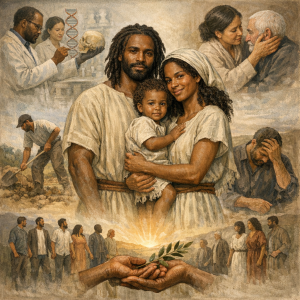
Human ordinarily means a member of humankind: a living individual of the species Homo sapiens, or, as an adjective, something belonging to, characteristic of, or made by such a being. In ordinary English, the word may emphasize biological life (“a human body”), moral feeling (“human compassion”), fallibility (“human error”), or the shared condition of humankind (“human dignity”). Major dictionaries trace the English word through Middle English and Anglo-French to Latin humanus, meaning “of or belonging to man” or humankind. Merriam-Webster, “human”
Hue Man is not the documented historical spelling or etymological source of human. It is a modern, stylized separation of the sound of the English word into “hue” and “man.” It may be used poetically, spiritually, or rhetorically to direct attention to color, visible appearance, individuality, or a supposed distinction between a living man or woman and a legal label. That interpretive use can carry personal meaning for its speaker; it should not, however, be confused with the established linguistic history of the word.
In a precise dictionary sense, a human is a living human being. In legal language, the closest conventional expression is often natural person: an individual human being as distinguished from an artificial entity, such as a corporation, partnership, government body, or other organization recognized by law. The expression does not mean that a human being exists outside all law; rather, it identifies the kind of legal subject involved. Cornell Legal Information Institute, “natural person”
Etymology and Origin
The accepted etymology of human does not divide the word into English hue plus man. English received it in the fifteenth century as forms such as humain and humaigne, through Anglo-French and Old French, from Latin humanus. Latin humanus was related to homo, “human being” or “man.” In Latin usage, humanus could mean not only “human” but also humane, kind, cultivated, civilized, or learned. Online Etymology Dictionary, “human”
There is a longstanding scholarly association between Latin homo and words for earth or ground. This association makes conceptual sense in the ancient contrast between mortal earth-dwellers and gods. Still, etymology should be stated cautiously. The earlier linguistic relationships are reconstructed from patterns among languages rather than preserved in a single original written record. What is secure for English usage is the Latin and French route: human derives from humanus, not from the separate English noun hue.
Hue, by contrast, has its own Germanic history. It comes through Middle English hewe from Old English hīw, which carried senses including color, form, appearance, and kind. Thus, “hue” can legitimately evoke color or outward appearance in modern English, but its historical origin is independent of human. The phrase “Hue Man” is therefore best classified as a modern wordplay, folk etymology, or interpretive respelling rather than an original meaning concealed in the word human. Merriam-Webster, “hue”
The word man also requires care. In older English, man could mean a person or humankind generally, while other words could be used to distinguish an adult male. Over time, modern English increasingly favored human being, person, individual, people, or humankind where sex is not relevant. This development helps explain why human is now often preferred as a more inclusive general term.
Cultural and Historical Context
Across cultures, the idea of the human being has often been considered in relation to mortality, reason, speech, moral responsibility, community, and the natural world. Classical philosophical traditions frequently distinguished humans from other animals by rational capacities, political life, or the ability to deliberate about justice. Religious traditions often describe human beings in terms of creaturehood: bodily, dependent, accountable, and capable of worship, moral choice, and relationship.
In English-speaking legal and political history, “person” became an important organizing term because law needs a way to identify who may hold rights, bear duties, own property, make agreements, bring claims, or answer for wrongs. This technical legal use did not erase the ordinary meaning of human being, but it did create a distinction between a physical human individual and an entity that law treats as a person for limited legal purposes.
William Blackstone’s eighteenth-century Commentaries on the Laws of England, a major historical source for the common-law tradition, divided persons into natural and artificial persons. In Blackstone’s formulation, natural persons were human beings formed by nature, while artificial persons were corporations or bodies politic created by human law for social and governmental purposes. This historical classification demonstrates that common-law writers recognized a difference between living individuals and legal entities; it does not support the proposition that a living individual is thereby exempt from the law of the jurisdiction in which he or she acts or resides. Blackstone, Commentaries, Book I, Chapter 1
The corporate form itself is not a recent invention. Religious houses, municipalities, universities, guilds, charitable bodies, and commercial enterprises have long used collective legal forms. A corporation was described in common-law language as a body capable of continuing despite changes in its members. Blackstone called such a body “one person in law,” an expression concerning legal capacity and continuity, not a claim that the organization is biologically alive. Blackstone, Commentaries, Book I, Chapter 18
Biblical / Torah Context
The English word human does not appear in the original Hebrew of the Torah, and it should not be treated as if it were a Hebrew sacred name. Biblical discussion instead turns on Hebrew terms translated into English as “man,” “human being,” “mankind,” or “humankind.” The principal term is אָדָם (’adam), which can refer, depending on context, to a human being, humanity collectively, or the personal name Adam.
Genesis 1:26–27 presents humanity as created in the image of God, male and female. English translations vary: some use “man,” while others use “humankind,” “humanity,” or “human beings.” The variation reflects the breadth of ’adam in context and the changing conventions of English translation. The theological emphasis of the passage is not a hidden English word division; it is the relationship of human beings to the Creator, to one another, and to the created world. Genesis 1:27, multiple English translations
Genesis 2:7 makes a notable wordplay between ’adam and adamah, “ground” or “soil.” The man is formed from the ground, underscoring creaturely dependence and the mortal connection between human life and earth. Many Jewish and Christian readers understand this imagery spiritually: the human being possesses dignity because life comes from God, yet humility because the body is formed from dust. The passage is not evidence that the English word human means “hue man,” but it does support a profound scriptural theme of embodied life, breath, responsibility, and return to the earth. Genesis 2:7 and Genesis 1:26–27
Other biblical terms add nuance. Ish commonly refers to a man in a male-specific sense; ishah refers to woman; and enosh can emphasize mortal humanity. These distinctions caution against reading one English term as if it contains the entire biblical anthropology. Torah and later biblical writings address human beings as embodied creatures, members of families and communities, moral agents, and bearers of duties toward God and neighbor.
Legal Implications
Human Being, Natural Person, and Legal Person
In contemporary American legal usage, a natural person is a living human being. A legal person is a being or entity that the law recognizes as capable, within defined limits, of holding rights and duties. A human being is ordinarily a legal person; an organization may also be a legal person. The terms overlap but are not identical. Legal personhood is a legal classification, not a biological description. Cornell Legal Information Institute, “legal person”
The distinction matters in ordinary matters of contracts, property, lawsuits, estates, taxation, bankruptcy, licensing, and criminal responsibility. A corporation may own property, enter contracts, sue, and be sued in its own name, but it acts through human agents and does not thereby become a living man or woman. The United States Supreme Court described a corporation in Trustees of Dartmouth College v. Woodward (1819) as an “artificial person” existing in contemplation of law. That is historical legal terminology concerning corporate capacity. Trustees of Dartmouth College v. Woodward, 17 U.S. 518 (1819)
Statutory definitions vary by context. Under the federal Dictionary Act, the words “person” and “whoever,” when used in federal statutes, generally include corporations, companies, associations, firms, partnerships, societies, joint-stock companies, and individuals unless the context indicates otherwise. Congress may also define related words differently in particular statutes. For example, federal law provides that the terms “person,” “human being,” “child,” and “individual” include every infant member of the species Homo sapiens born alive at any stage of development. The controlling definition in an actual legal question is the specific constitution, statute, regulation, or case law at issue—not a preferred spelling or private declaration. 1 U.S.C. § 1; 1 U.S.C. § 8
Common Law, Equity, Statutes, and Current Law
Historically, common law developed through judicial decisions and customary legal principles in England and later influenced American law. Equity developed alongside common law to provide remedies and procedures where common-law forms were inadequate. Modern American law is not composed of common law alone. It includes the United States Constitution, state constitutions, statutes enacted by legislatures, administrative regulations, treaties where applicable, and judicial decisions interpreting those authorities.
Accordingly, an appeal to “common law” cannot by itself displace a valid statute, court rule, constitutional provision, or binding judicial decision. Nor does historical common-law vocabulary override a court’s jurisdiction. The legal meaning of “person,” “individual,” “resident,” “citizen,” “driver,” “employee,” “consumer,” or “taxpayer” may differ from one legal setting to another because each term is governed by the relevant law and facts.
There is no general legal rule that capital letters in a name identify a separate artificial entity, that a birth certificate creates a separate “strawman,” or that calling oneself a “living man,” “Hue Man,” “flesh-and-blood human being,” or “natural person” removes one from statutory duties or court jurisdiction. Federal and state courts have repeatedly rejected such arguments when raised in sovereign-citizen-style litigation. One court summarized the governing point: a person is not beyond a court’s jurisdiction merely because of a claimed status as a sovereign citizen, secured-party creditor, or flesh-and-blood human being. Dixon v. Warden (D.N.J. 2020)
Governmental and Military Context
Government and military institutions commonly use “human” in descriptive rather than mystical or jurisdictional senses: human resources, human intelligence, human remains, human rights, human factors, and humanitarian law. In military contexts, “human” may distinguish personnel from equipment, automated systems, or nonhuman intelligence sources. These are functional classifications. They do not establish a separate legal identity called “Hue Man.”
Spiritual Meaning
As spiritual language, “Hue Man” can serve as a voluntary symbol. A speaker may use hue to contemplate color, visible diversity, complexion, individuality, or the many expressions of one human family. The phrase may also be used to resist reducing persons to records, numbers, commercial categories, or institutional labels. In that limited interpretive sense, it can remind readers that a person is more than an administrative file.
This dictionary’s interpretive analysis is that the most constructive spiritual use of the expression is ethical rather than evasive: to affirm the inherent worth of embodied persons while accepting responsibility for one’s conduct toward neighbors, family, community, and lawful authority. Spiritual dignity and legal accountability are not opposites. The fact that a human being possesses conscience, faith, and moral agency does not eliminate duties to avoid harm, honor just obligations, or participate honestly in civil life.
Jewish and Christian readings of creation commonly hold together two truths: human beings bear a special dignity, and human beings are finite creatures accountable to God. Any spiritual interpretation of “Hue Man” should be measured against those themes rather than used to create unsupported claims of immunity, superiority, or separation from other people.
Modern Usage
Today, human is used broadly in science, medicine, law, technology, journalism, religion, and everyday speech. It may identify the species, contrast persons with machines or animals, describe empathy, or refer to the vulnerabilities common to all people. Terms such as “human-centered,” “human rights,” “humanitarian,” “human resources,” and “human intelligence” show the word’s range.
“Hue Man” appears primarily in creative, spiritual, identity-centered, and internet-based contexts. Some use it as affirming wordplay concerning color and humanity. Others attach it to claims about personal sovereignty, commercial law, names printed in capital letters, governmental authority, or a purported distinction between a living person and a legal fiction. These uses should be separated. Poetic or spiritual wordplay is a matter of personal expression; legal claims require support in controlling law.
Controversies / Criticisms
The principal controversy surrounding “Hue Man” is not over the ordinary definition of human, but over claims derived from the respelling. Linguists and standard dictionaries do not treat “hue man” as the word’s origin. The spelling creates a modern English pun by separating sounds that entered English as part of a Latin-derived word. Calling the phrase an etymology without qualification is therefore inaccurate.
A second controversy arises when the expression is used to support sovereign-citizen or “strawman” theories. Advocates may claim that government can regulate only a corporate persona associated with a name, not the living individual. This proposition is contested in public discourse but is not an unsettled rule of American law: courts have consistently rejected it. A person may raise genuine jurisdictional, constitutional, contractual, statutory, or procedural defenses when the facts and law support them; merely relabeling oneself as a “Hue Man” or living human does not create such a defense.
A further criticism concerns exclusion. If “hue” is interpreted as color or complexion, the term can be used positively to celebrate diversity. Yet any suggestion that legal worth, spiritual worth, or basic human dignity depends on a particular hue is inconsistent with the ordinary meaning of human equality and with the inclusive biblical presentation of humankind. The term is most responsibly used as a personal reflection on human diversity, not as a basis for hierarchy.
Conclusion
Human is an established English word for a member of humankind and for what pertains to human life, nature, and society. Its documented linguistic path runs from Latin humanus, through French, into English. “Hue Man” is a modern interpretive respelling, not the historical source of the word.
In law, a living human being is generally a natural person, while corporations and other entities may be legal persons for defined purposes. The distinction is real and historically rooted in common-law vocabulary, but it does not create a private exemption from statutes, courts, obligations, or lawful governmental authority. In spiritual reflection, “Hue Man” may be used constructively to emphasize embodied dignity, diversity, conscience, and the shared human condition. Its soundest meaning is found not in unsupported legal claims, but in the recognition that every human being is both worthy of respect and responsible for conduct.
Sources / Further Reading
- Merriam-Webster — “Human”
- Online Etymology Dictionary — “Human”
- Merriam-Webster — “Hue”
- Online Etymology Dictionary — “Hue”
- The Avalon Project, Yale Law School — Blackstone’s Commentaries, Book I, Chapter 1
- The Avalon Project, Yale Law School — Blackstone’s Commentaries, Book I, Chapter 18
- Cornell Legal Information Institute — “Natural Person”
- Cornell Legal Information Institute — “Legal Person”
- 1 U.S.C. § 1 — Federal Dictionary Act
- 1 U.S.C. § 8 — Definition of Person, Human Being, Child, and Individual
- Trustees of Dartmouth College v. Woodward, 17 U.S. 518 (1819)
- Bible Gateway — Genesis 1:27
- Bible Gateway — Genesis 1:26–27 and 2:7