G
Primary Definition
G is the seventh letter of the modern English alphabet and of the basic Latin alphabet. In ordinary English writing it is a consonant letter, represented in uppercase as G and in lowercase as g. Its usual name in English is gee.
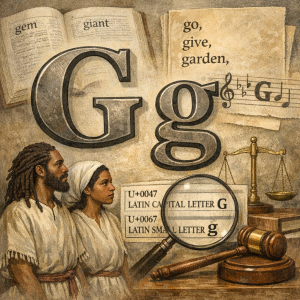
The letter has more than one sound value. Most commonly, it represents the “hard g” sound /g/, a voiced velar stop, as in go, give, garden, and great. Before certain vowels, particularly e, i, and y, it often represents the “soft g” sound /dʒ/, as in gem, giant, and gym. English spelling, however, is historical rather than perfectly phonetic. Therefore, these tendencies are not absolute: get, give, girl, and gift retain hard g before letters that often signal soft g.
In a dictionary sense, the primary meaning of G is thus the letter itself. Its secondary meanings arise from convention, abbreviation, symbolism, technical notation, grading systems, music, science, government, military usage, law, and popular culture. Those secondary meanings are not interchangeable. The meaning of an isolated “G” depends heavily upon the document, discipline, jurisdiction, and surrounding words.
In digital character encoding, uppercase G is U+0047 LATIN CAPITAL LETTER G, while lowercase g is U+0067 LATIN SMALL LETTER G. The Unicode designation identifies the abstract written character; it does not determine every font style, handwriting form, pronunciation, or symbolic use attached to the letter.
Etymology and Origin
The English letter G came through the Latin alphabet. Its more remote ancestry is connected with the family of ancient Semitic alphabetic signs from which Greek and then Latin scripts developed. The Greek counterpart is gamma (Γ, γ), traditionally the third letter of the Greek alphabet. The related Hebrew letter is gimel (ג), also third in the Hebrew alphabet.
The direct history of Latin G is particularly important because it explains why G is the seventh Latin letter rather than the third. Early Latin used the letter C for sounds that later Latin spelling distinguished as /k/ and /g/. In time, Roman writers created or standardized G by modifying C with an added stroke, producing a separate sign for the voiced /g/ sound. Etymological references commonly date this Roman development to approximately the third century BCE. The resulting G was placed in the alphabetic position formerly occupied by Z, which had fallen out of ordinary early Latin use. This is why G occupies the seventh position in the modern Latin alphabet, while Greek gamma remains third.
The name gamma is traditionally connected with Phoenician gimel. A longstanding explanation associates gimel with a word for “camel.” That explanation concerns the name and early pictorial background of an ancestral letter-sign; it does not mean that modern Latin G literally means “camel,” nor does it establish a spiritual or legal meaning for the modern character.
English inherited G through the Roman alphabet but developed unusual spelling patterns over many centuries. In Old English, letter values varied with their position and neighboring vowels. Later contact with Scandinavian languages, Norman French, Latin, and Greek loanwords influenced English spelling and pronunciation. The modern contrast between hard and soft G is partly a result of that layered history. English therefore preserves spellings that may look inconsistent to a modern reader but record older linguistic developments.
Cultural and Historical Context
As a letter, G belongs to a writing system that became globally influential through Roman expansion, medieval manuscript culture, European printing, colonization, trade, education, science, and modern electronic communication. The letter’s basic identity is linguistic and graphical, not governmental or religious. Its cultural meanings have accumulated because a simple character can be reused in many fields.
In English-language culture, G appears in initials, monograms, names, serial designations, maps, schoolwork, technical diagrams, and product labels. A capital G may stand for a person’s given or family name, a location, a model, a section, or a classification. None of those meanings follows automatically from the alphabet. An initial identifies only what the relevant speaker, organization, form, or record says it identifies.
Music
In Western musical notation, G names a pitch class. It is one of the letter-names used for notes: A, B, C, D, E, F, and G. The note G has a defined relationship to other notes within a musical tuning system, but its exact sounding frequency varies by octave and tuning reference. The treble clef is also historically called the G clef because its curl marks the line assigned to G. This is a technical musical use, not an assertion that the letter itself has an inherent mystical frequency.
Science and Measurement
Lowercase g frequently denotes standard gravitational acceleration, especially in expressions such as “2 g” or “5 g.” In this context it describes acceleration relative to the conventional value of gravity at Earth’s surface; it does not mean “gravity” in every possible scientific equation. Capital G commonly denotes the gravitational constant in physics. The distinction between uppercase and lowercase is therefore material in scientific writing.
In metric prefixes, lowercase g is the symbol for gram, while the prefix G means giga-, or one billion times a stated unit. Thus g, G, and GHz must be read precisely. Case sensitivity is not mere typography; it can change the quantity being expressed.
Ratings, Grades, and General Classifications
In the United States film-rating system, G means “General Audiences,” indicating that all ages are admitted. The rating is a classification created by the motion-picture rating system, not a legal finding that a film is harmless in every household or suitable for every individual child. Parents and guardians may still make their own judgments based on a film’s subject matter and their family’s standards.
In other settings, G can identify a grade, category, group, generation, or geographic designation. For example, institutional forms sometimes use letters as internal codes. Such codes must be interpreted from the governing document. A letter code in one school, agency, employer, court system, or database does not automatically carry the same meaning elsewhere.
Biblical / Torah Context
The Latin letter G does not appear as such in the original consonantal text of the Torah, which is written in Hebrew script. It is therefore inaccurate to treat English G as an original Torah letter or to assign it a direct biblical definition merely because English translations use words beginning with G.
The relevant Hebrew letter is gimel (ג). Gimel is the third letter of the Hebrew alphabet and has a numerical value of three in traditional Hebrew letter-number practice. In Hebrew transliteration, gimel is generally associated with a g sound. Although gimel and Latin G belong to historically related alphabetic traditions, they are not identical characters, and their respective religious, linguistic, and scribal contexts should not be collapsed into one another.
Jewish interpretive traditions sometimes draw moral or symbolic lessons from the forms, names, sequences, and numerical values of Hebrew letters, including gimel. Such interpretations may be meaningful within particular rabbinic, mystical, educational, or devotional traditions. They should be identified as interpretations rather than treated as universally binding lexical definitions. The Torah does not provide a dictionary entry declaring that the later English letter G independently possesses a fixed sacred meaning.
Likewise, biblical translations may contain many English terms beginning with G—such as God, grace, garden, or gospel—but those English initial letters do not prove that G itself carries the theological content of those words. Meaning belongs first to the relevant Hebrew, Aramaic, Greek, or translated word in context, not to an isolated initial.
Legal Implications
Standing alone, G has no single universal meaning in common law. Common law develops through judicial decisions and legal principles recognized in particular jurisdictions; it does not generally assign independent legal rights, duties, status, or jurisdiction to the seventh letter of the alphabet.
In legal documents, a capital or lowercase G may be an initial, exhibit label, paragraph marker, schedule designation, case-related identifier, statutory subsection, or abbreviation. Its legal effect, if any, comes from the document’s definitions, the applicable rules of interpretation, and the surrounding context. For example, “Section G” means the portion labeled G within that instrument; it does not invoke a separate body of common-law authority because of the letter used.
Common Law, Statutes, and Court Practice
Historically, common-law courts relied on pleadings, writs, records, precedents, and established legal terminology. Alphabetic labels were practical tools of organization. They could identify parties, counts, exhibits, or subdivisions, but the label itself did not create the substance of a claim. A court determines rights and obligations from governing law and facts, not from unsupported symbolic interpretations of letters.
Modern statutes, administrative rules, court rules, and forms commonly use letters for subsections and classifications. For example, a statute may contain subsection “(g),” or a court may mark an attachment as “Exhibit G.” The legal meaning is determined by that specific enactment, rule, order, pleading, contract, or evidentiary record. It is important to distinguish this ordinary drafting convention from the historical common law itself.
Roman law, equity, common law, and modern statutory law are distinct legal traditions or sources of law. The Roman creation of the letter G is a history of alphabetic development; it does not make modern legal use of G a rule of Roman law. Similarly, a court’s use of “G” as an exhibit or subsection label is clerical and organizational unless the document expressly assigns it another function.
Abbreviations and Precision
Legal abbreviations can be consequential, but G alone is inherently ambiguous. In a particular jurisdiction or practice area it may refer to a form, a grade of offense, a governmental entity, a regulatory category, or an internal notation. Lawyers, litigants, and researchers should not infer an abbreviation’s meaning from internet lists or from another jurisdiction’s practice. They should consult the controlling statute, court rule, agency regulation, local form, legal dictionary, or defined terms section.
This caution has special importance where an argument claims that a letter, capitalization style, punctuation mark, or name format changes legal status without statutory or judicial authority. Courts ordinarily require relevant law, admissible facts, and coherent legal reasoning. Claims founded only on alleged secret meanings of letters are not established common-law doctrine.
Military and Governmental Context
G has appeared in military and governmental systems as part of abbreviations, staff labels, grades, maps, forms, classifications, and operational codes. One familiar example is the staff designation “G-1,” “G-2,” and similar forms used in certain army headquarters structures, where the initial identifies a general-staff function. The particular meaning depends on the nation, service branch, historical period, and organizational doctrine.
Government agencies also use alphabetic letters in administrative forms, classification systems, and regulations. These uses are conventional and institution-specific. No general principle of constitutional law, common law, or military law provides that G, merely by appearing in a government record, establishes governmental power, military jurisdiction, citizenship, consent, or contractual obligation.
Spiritual Meaning
There is no single documented spiritual meaning inherent in the Latin letter G. Spiritual associations commonly arise from communities, symbols, teachings, artistic traditions, or personal reflection. A person may regard G as meaningful because it begins a sacred name or valued concept, because of its relationship to Hebrew gimel, because of a fraternal emblem, or because of a private devotional practice. Such meaning may be sincere and important to that person or tradition, but it should not be represented as a universal linguistic fact.
Some esoteric, religious, and fraternal systems use the letter G symbolically. The interpretation varies. It may be connected with God, geometry, generation, gnosis, goodness, or another concept depending on the group and source. These differing interpretations demonstrate that the symbol is not self-defining. A responsible dictionary treatment distinguishes documented use within a named tradition from broad claims that “G always means” one spiritual idea.
Modern Usage
Modern English uses G and g extensively as letters, initials, symbols, and abbreviations. Common examples include:
- G as the seventh alphabetic letter or as an initial in a name;
- g for gram in measurement;
- G for giga- in scientific and technical prefixes;
- g for acceleration expressed in multiples of standard gravity;
- G as a musical note;
- G as the U.S. “General Audiences” film rating;
- G or g in mathematical, scientific, software, and engineering notation;
- G as an informal slang expression, sometimes meaning a friend, associate, or a person regarded as notably confident or capable.
Informal usage changes rapidly. In slang, capitalization, tone, audience, and regional culture may affect meaning. In formal writing—especially legal, medical, scientific, contractual, or governmental writing—an undefined G should be avoided when ambiguity may cause error.
Controversies / Criticisms
The principal controversy surrounding a single letter is usually not its ordinary alphabetic identity but the claims made about it. Symbolic theories can become problematic when they are presented as proven etymology, binding law, or universal theology without reliable supporting evidence.
One recurring error is to confuse resemblance with derivation. Ancient letter shapes may resemble objects, animals, body parts, religious symbols, or later characters. Resemblance alone does not establish historical descent or intended meaning. Historical linguistics and paleography evaluate dated inscriptions, writing systems, sound values, manuscript transmission, and scholarly evidence; they do not treat visual similarity by itself as proof.
Another error is to project a modern English word backward onto an ancient sign. For example, the fact that God, government, gold, or good begins with G in English does not demonstrate that ancient gimel, Greek gamma, or Latin G originally signified those concepts. Those are separate words with their own histories.
Finally, claims that capitalization or an isolated letter automatically changes a person’s legal identity, jurisdiction, rights, or obligations are contested and generally unsupported by mainstream legal authority. Legal interpretation depends on applicable constitutions, statutes, regulations, contracts, common-law precedents, procedural rules, and evidence. Symbolic speculation is not a substitute for those sources.
Conclusion
G is primarily the seventh letter of the Latin alphabet, with a history that reaches through Roman script to earlier Greek and Semitic alphabetic traditions. Its modern uses are numerous because letters function efficiently as symbols, labels, initials, and technical signs. In English it commonly represents either hard g or soft g, while in music, science, film ratings, government records, and legal documents it may acquire specialized meanings.
Its meaning must always be read in context. G is not, by itself, a legal doctrine, a biblical word, a governmental grant of power, or a universally fixed spiritual symbol. Where a particular religious, legal, military, scientific, or cultural community assigns it a special use, that use should be documented, carefully limited to its proper setting, and distinguished from the letter’s ordinary alphabetic definition.
Sources / Further Reading
- Online Etymology Dictionary, “G”: https://www.etymonline.com/word/G
- Online Etymology Dictionary, “Gamma”: https://www.etymonline.com/word/gamma
- Unicode Consortium, Basic Latin Code Chart: https://www.unicode.org/charts/nameslist/n_0000.html
- Unicode Consortium, The Unicode Standard: https://www.unicode.org/versions/latest/
- Cornell Law School Legal Information Institute: https://www.law.cornell.edu/
- Motion Picture Association, Film Ratings: https://www.filmratings.com/