Dowry
Primary Definition
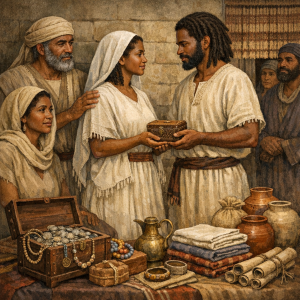
A dowry is money, land, goods, rights, or other valuable property transferred in connection with a marriage, traditionally from the bride, her parents, or her wider family to the husband, the husband’s household, or sometimes to the bride herself for use within the new household. The exact form, recipient, legal ownership, and purpose of a dowry have differed greatly among societies and historical periods. It may have been a contribution toward establishing a household, an anticipated portion of inheritance, a means of securing a woman’s material support, an alliance between families, or, in abusive forms, a coerced demand imposed as a condition of marriage.
The word must be used carefully. In ordinary modern English, “dowry” usually means property brought by or for a bride at marriage. It does not ordinarily mean a payment made by a groom or his family to the bride’s family. That latter institution is more accurately called bridewealth, bride-price, or, in particular religious and legal settings, mahr. Nor is dowry the same as dower, a historical common-law estate or provision for a widow from her deceased husband’s property.
Thus, although the terms share linguistic ancestry and were sometimes used loosely in older writings, their legal meanings became distinct. A dowry generally concerns property entering a marriage from the wife’s side; dower historically concerned a surviving wife’s claim against property held by her husband during marriage. Cornell’s Legal Information Institute accordingly describes dowry as a financial or material gift exchanged in connection with marriage, with its form and purpose varying by culture. Cornell Law School, Legal Information Institute: “Dowry”
Etymology and Origin
Dowry entered English around the beginning of the fifteenth century through Anglo-French and Old French forms such as dowarie and doaire. Those forms derive from medieval Latin dotarium, related to classical Latin dos (genitive dotis), meaning a marriage portion or endowment. The deeper linguistic idea is one of giving or endowing, rather than an inherently commercial “price” for a spouse. Online Etymology Dictionary: “Dowry”
The closely related word dower developed a more specialized legal sense in English common law. In ordinary modern legal usage, dower means a widow’s historical interest in her late husband’s real property; dowry means the property conveyed in connection with a bride’s marriage. Confusion arises because older French and English sources did not always preserve the later distinction consistently. A careful reader of historical documents should therefore determine meaning from the instrument, jurisdiction, and date rather than from the word alone.
The Latin background also helps explain why Roman-law discussions frequently use the term dos. In Roman legal tradition, the dos broadly denoted property given or promised in connection with marriage to assist with the burdens of the marital household. Roman law developed rules concerning its administration and, in various circumstances, its restoration after the marriage ended. That civil-law history influenced continental European legal thought, but it should not be casually treated as identical to English common-law dower or to every customary dowry system.
Cultural and Historical Context
Dowry systems have appeared in many regions of Europe, the Mediterranean, the Middle East, South Asia, and elsewhere, but no single explanation accounts for all of them. In some societies, a dowry functioned as a daughter’s advance share of family wealth when inheritance practices favored sons or concentrated land in a male line. In others, it helped establish a new household by providing clothing, furnishings, livestock, money, land, or tools. In elite families, it could accompany marriage arrangements designed to join estates, secure political alliances, or define future inheritance for children.
Such arrangements were not necessarily simple gifts to the husband. A marriage settlement could distinguish between property delivered for household use, property held in trust, property managed by a husband during marriage, and property reserved for the wife should she become widowed or separated. Medieval and early modern family property arrangements were therefore often more complicated than the simplified statement that “the bride’s family paid the groom.” Historical research on English customary law shows that women’s property rights, inheritance expectations, and pre-marital transfers could materially affect the organization and transmission of family land. Cambridge University Press, “Women’s Property Rights Under Customary Law”
In medieval Europe, dowries were particularly important among families possessing land or significant movable wealth. They could enable a daughter to enter a household with recognized resources while also limiting later claims on her natal family’s estate. The consequences varied: a substantial dowry might provide security and status, but a dowry system could also turn marriage into an economic negotiation in which women had limited direct control over property nominally associated with them.
In many modern societies, formal dowry arrangements have declined as women gained independent property, contract, wage, and inheritance rights, and as marriage increasingly became a personal rather than a family-economic institution. Yet customary practices can persist even where they have no formal legal recognition. Moreover, “dowry” is still used figuratively to mean a valuable endowment, natural advantage, body of learning, talent, or resource brought into a relationship or undertaking.
Biblical / Torah Context
The Torah does not establish a universal rule requiring a bride’s family to pay a dowry to a groom. Biblical marriage narratives contain several different kinds of marriage-related transfers, and modern labels must not be forced onto ancient texts without qualification.
A central Hebrew term is mohar, often translated “bride-price” or “bridewealth.” In Exodus 22:16–17, a man who seduces an unbetrothed virgin is directed to pay the bride-price and take her as wife unless her father refuses the marriage. Genesis 34:12 likewise refers to a requested bride-price and gift. These passages concern an obligation borne by the prospective husband, not a dowry paid by the bride’s father to the groom. They therefore should not be cited as proof that the Torah instituted the modern sense of dowry.
Other biblical accounts describe gifts accompanying betrothal or marriage. Abraham’s servant gives costly items in connection with Rebekah’s betrothal to Isaac (Genesis 24), and Jacob labors for Laban in connection with marrying Leah and Rachel (Genesis 29). These narratives demonstrate that marriage involved family, labor, gifts, and property, but they do not reduce to a single standardized system. The Hebrew Bible reflects a social world in which kinship, inheritance, household labor, and marital alliances were deeply connected.
Later Jewish law developed more detailed marital-property arrangements. The ketubah, or Jewish marriage contract, includes financial obligations owed by the husband to the wife, especially in the event of divorce or widowhood. Traditional legal discussion also distinguishes property a wife brings into marriage from the husband’s marital obligation toward her. The Jewish Encyclopedia notes that property brought by a woman, including real estate or movable goods, could be recorded in the marriage contract; this is closer to a dowry concept, though its rules belong to later Jewish legal development rather than a simple Torah command. Jewish Encyclopedia: “Dowry”
It is also important not to confuse a dowry with mahr in Islamic law. Mahr is an obligatory marital gift from the husband to the wife. It belongs to the wife, not to her father or her husband’s family. India’s Dowry Prohibition Act itself expressly distinguishes prohibited dowry from dower or mahr for persons to whom Muslim Personal Law applies. India Code, Dowry Prohibition Act 1961, § 2
Legal Implications
Historical Common Law
Under historical English common law, a dowry was not the same legal institution as dower. The distinction is essential. Dower was the widow’s common-law right, generally a life estate in a portion of the land of which her husband had been seised during the marriage. The precise rules were technical and could depend upon the character of the land title, joint ownership, conveyances, statutes, and local law. The United States Supreme Court described dower as a legal right and recognized its common-law limitations in cases involving jointly held land. Mayburry v. Brien, 40 U.S. 21 (1841)
By contrast, a dowry involved property connected to the bride’s side of the marriage. Under coverture, the common-law doctrine that substantially merged a married woman’s legal identity with that of her husband, a woman’s practical control over property brought into marriage could be severely limited. The exact result depended on whether property was realty or personalty, whether it had been settled in trust, and whether equity recognized a separate estate. Equity could protect property through a trust or marriage settlement, but access to such arrangements was uneven and often favored families with resources and legal assistance.
Equity, Statute, and Legal Reform
Equity did not simply duplicate common law. Courts of chancery could recognize a married woman’s separate estate where property had been conveyed or settled for her separate use. This was an important protection, but it depended upon the terms of the settlement and did not eliminate the broader disabilities imposed by coverture.
Nineteenth-century Married Women’s Property Acts substantially altered this legal landscape. The English Married Women’s Property Act 1882 declared that a married woman could acquire, hold, and dispose of real and personal property as her separate property and could contract, sue, and be sued much as a feme sole. Married Women’s Property Act 1882 Comparable statutory reforms occurred across the United States, though dates and details varied by state. These reforms reduced the former legal importance of dowries and marriage settlements as devices for protecting a wife’s assets from automatic marital control.
Modern United States law does not generally treat “dowry” as a standard category of domestic-relations law. Questions about property transferred at marriage are instead resolved under contract law, gift law, trusts and estates law, marital-property statutes, divorce law, probate law, and sometimes conflict-of-laws principles. Whether an engagement or wedding-related transfer is a completed gift, a conditional gift, marital property, separate property, or a loan depends on jurisdiction and evidence of intent. No general common-law rule permits a spouse or in-law to demand a dowry.
Some jurisdictions still retain statutory remnants of dower, curtesy, elective-share, homestead, or spousal-inheritance rights. These are rights concerning surviving spouses and estates, not a modern rule requiring dowry. Cornell’s Legal Information Institute notes that dower and curtesy are outdated terms whose surviving legal effects vary by state. Cornell Law School, Legal Information Institute: “Dower and Curtesy”
Contemporary Statutory Prohibitions
In some countries, especially where coercive dowry demands have become associated with extortion, domestic abuse, or violence, legislatures have enacted specific prohibitions. India’s Dowry Prohibition Act, 1961 defines dowry broadly as property or valuable security given or agreed to be given in connection with marriage, prohibits giving, taking, and demanding dowry, and declares agreements for giving or taking it void. India Code: Dowry Prohibition Act, 1961
Such statutes should not be read as proof that every voluntary wedding gift is unlawful. Legal definitions, exceptions, evidentiary rules, and enforcement mechanisms depend upon the jurisdiction. A person facing an actual family-law, criminal-law, immigration, inheritance, or property dispute should consult a qualified lawyer in the applicable jurisdiction.
Spiritual Meaning
In spiritual and literary language, dowry may be used figuratively for a person’s gifts, virtues, wisdom, dignity, or inherited blessings. This figurative use draws on the older sense of an endowment brought into a new state of life. It does not establish a legal entitlement and should not be used to romanticize coercive material demands imposed on a prospective spouse or family.
Within Jewish, Christian, Muslim, Hindu, and other religious communities, teachings about marriage often stress mutual responsibility, fidelity, provision, generosity, family duty, and protection of the vulnerable. Those moral teachings may be discussed alongside historical dowry customs, but they are not identical to a universal religious command for dowry. Claims that dowry was invented by one particular religion, church, empire, or legal system are historically oversimplified. Marriage-related transfers long predate many present religious and national institutions and have taken different forms across cultures.
Modern Usage
In current English, “dowry” may refer to:
- property traditionally supplied by the bride’s family in connection with marriage;
- a customary marriage payment described by local law or custom as dowry;
- the assets or household goods a bride brings into a marriage;
- figuratively, an endowment of abilities, resources, beauty, knowledge, or blessing.
The term should not be used interchangeably with:
- bridewealth / bride-price: property or payment from the groom’s side to the bride’s family;
- mahr: a marital gift or obligation owed by a Muslim husband to his wife;
- dower: a historical widow’s interest in her late husband’s property;
- trousseau: clothing, linens, and personal items prepared for marriage, which may be part of a dowry but are not necessarily the whole of one;
- prenuptial agreement: a modern contract governing property and financial rights before marriage.
Controversies / Criticisms
Dowry is controversial because its effects have ranged from legitimate family provisioning to serious exploitation. Defenders of voluntary, non-coercive customary gifts may describe them as an expression of affection, inheritance planning, household formation, or support for a daughter. Critics respond that a system can appear voluntary while operating under powerful social pressure, especially where a marriage is delayed, threatened, or made contingent upon escalating demands.
The strongest criticism concerns coercion. Dowry demands can create financial hardship for a bride’s family, reinforce the treatment of women as economic burdens, and expose wives to harassment or violence when promised property is not delivered. United Nations guidance on legislation addressing violence against women identifies dowry-related harassment and violence as matters requiring clear legal condemnation and effective remedies. UN Women, Supplement to the Handbook for Legislation on Violence Against Women
It is equally important to avoid cultural caricature. Dowry is not unique to a single ethnicity, religion, or nation; nor does every family that gives wedding gifts participate in an oppressive dowry system. Sound analysis asks who owns the transferred property, whether consent is genuine, whether the transfer was demanded, whether refusal brings penalty or abuse, and what legal and social remedies are available to the wife.
Conclusion
A dowry is best understood as a historically variable marriage-related transfer of property, usually associated with the bride’s side of the marriage. Its meaning cannot be separated from the law of property, inheritance, marital status, and family power in the society where it appears. The term must be distinguished from bridewealth, mahr, and common-law dower.
Historically, dowries could supply a new household, operate as an advance inheritance, reinforce family alliances, or provide limited economic security for women. They could also consolidate male control of family property or become coercive demands that cause profound harm. Modern legal systems generally address marriage-related property through statutes governing gifts, contracts, marital property, divorce, inheritance, and domestic violence rather than through a general common-law doctrine of dowry. The lawful and moral character of any particular arrangement therefore depends not merely on its label, but on ownership, consent, purpose, fairness, and the governing law.
Sources / Further Reading
- Cornell Law School, Legal Information Institute — “Dowry”
- Cornell Law School, Legal Information Institute — “Dower and Curtesy”
- Online Etymology Dictionary — “Dowry”
- United Kingdom Legislation — Married Women’s Property Act 1882
- United States Supreme Court — Mayburry v. Brien, 40 U.S. 21 (1841)
- India Code — Dowry Prohibition Act, 1961
- Jewish Encyclopedia — “Dowry”
- UN Women — Supplement to the Handbook for Legislation on Violence Against Women