Command (n)
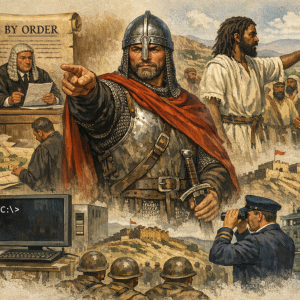
Primary Definition
Command is an authoritative direction requiring or forbidding an act, an exercise of authority by which one person or institution directs another, or the authority itself by which such directions may be issued. The word may denote both the directive given and the lawful power, office, or responsibility from which the directive proceeds.
The principal senses include:
- An authoritative order: a direction presented as binding rather than merely advisory or persuasive.
- The authority to direct: lawful, institutional, delegated, or practical control over persons, property, operations, or resources.
- A position of leadership: an office in which a commander is responsible for a military unit, vessel, organization, district, or operation.
- The persons or territory governed: a body of personnel, geographical area, or organizational division placed under one authority.
- Mastery or effective control: as in having command of a language, subject, instrument, or situation.
- A controlling instruction: in computing, machinery, communications, and automated systems, an input directing a device or program to perform an operation.
- A strategically dominant position: a height, fortification, or viewpoint that overlooks or controls surrounding ground.
A request seeks voluntary cooperation; advice recommends a course; a command purports to impose an obligation. Nevertheless, forceful wording alone does not create authority. A valid command ordinarily depends upon the speaker’s office or relationship to the recipient, the scope of that authority, the lawfulness and intelligibility of the direction, and the recipient’s corresponding duty to obey.
Etymology and Origin
The English word entered Middle English through Anglo-French and Old French forms such as comander. These developed from a post-classical or Vulgar Latin form, commandare, influenced by Latin commendare, meaning to entrust, commit, or place in another’s charge, and by mandare, meaning to commission, enjoin, or entrust. English records show both the verb and noun in use during the later Middle Ages. ([merriam-webster.com](https://www.merriam-webster.com/dictionary/command?utm_source=openai))
The older idea of entrusting is significant. Command originally carried more than the image of a superior shouting an order. It could involve committing a person, task, or responsibility into another’s hands. The related English words commend and mandate preserve different branches of this history: one emphasizes entrusting or recommending, while the other emphasizes an authoritative commission. These words are related but are not interchangeable in modern law.
The term is Latin rather than pagan, Greek, military, or ecclesiastical in exclusive origin. Military, royal, governmental, and religious institutions greatly developed its later applications, but none of them alone created the word.
Cultural and Historical Context
In medieval and early modern societies, command was closely associated with household government, royal authority, military service, navigation, and the administration of estates. Kings commanded officers; officers commanded soldiers; shipmasters commanded crews; and heads of households directed servants and dependents. Because political and social structures were openly hierarchical, command was often treated as a normal incident of rank.
As government became more bureaucratic, command was increasingly attached to an office rather than merely to the personal status of an individual. A direction issued “by command” could represent the authority of the Crown, a council, a court, or a commissioned officer. This transition helped distinguish institutional authority from personal domination: an officer might issue binding directions while in office but possess no comparable power outside the office or beyond its jurisdiction.
The military sense broadened from the act of ordering troops to the entire organization under a commander. Thus, a person may “take command,” serve in “high command,” or be assigned to a regional or operational command. The idea of a chain of command expresses a structured line through which authority, information, and responsibility pass. Properly understood, such a chain does not merely transmit power downward; it also identifies responsibility upward for supervision, discipline, reporting, and the conduct of subordinates.
Several figurative meanings developed from these institutional uses. A hill may command a road because its position permits observation or control. A person may command resources because those resources are available for use. One may command respect because respect is strongly elicited, though not literally ordered. Command of a language or craft denotes developed mastery rather than authority over another human being.
Biblical / Torah Context
English Bible translations frequently use command and commandment</em for several related Hebrew expressions. The Hebrew verb tsavah conveys commanding, charging, appointing, commissioning, or giving orders. The noun mitzvah, commonly rendered “commandment,” is derived from this field of meaning. The semantic range can include both a direct prohibition and a positive commission entrusted to a person or community. ([bibletools.org](https://www.bibletools.org/index.cfm/fuseaction/Lexicon.show/ID/H6680/tsavah.htm?utm_source=openai))
Torah should not be reduced to a collection of arbitrary commands. Its usual meaning includes instruction, teaching, and direction. Deuteronomy, for example, places commandments together with statutes and judgments and requires that they be taught, remembered, and practiced within the covenant community. Biblical command therefore operates within a larger relationship involving deliverance, covenant, worship, justice, communal identity, and responsibility between generations. ([biblegateway.com](https://www.biblegateway.com/verse/en/Deuteronomy%206%3A1?utm_source=openai))
The traditional English expression “Ten Commandments” is useful but not a literal reproduction of the Hebrew title. Exodus and Deuteronomy refer to the covenantal text as the “ten words” or “ten sayings,” commonly transliterated as Aseret HaDibrot. This matters because the passage includes both direct imperatives and foundational declarations, including the identification of the God who delivered Israel from bondage. ([biblegateway.com](https://www.biblegateway.com/passage/?search=Exodus+34%3A27-28&version=NRSVUE&utm_source=openai))
In Jewish interpretation, a divine command is not ordinarily understood as valid merely because it is backed by superior force. It is connected with the identity, faithfulness, holiness, and justice of the One giving it. Human rulers remain subject to divine standards; the narratives of Pharaoh, Saul, Ahab, and other rulers repeatedly distinguish political power from moral legitimacy. Prophets may confront kings, and obedience to office does not erase personal accountability before God.
In the New Testament writings, the Greek term entolē is commonly translated as command or commandment. When asked about the greatest commandment in the Law, Jesus identifies love of God and love of one’s neighbor as the central obligations. The resulting spiritual interpretation does not abolish authority but judges its exercise by faithfulness, love, justice, mercy, and service. ([biblegateway.com](https://www.biblegateway.com/verse/en/Matthew%2022%3A36?utm_source=openai))
Interpretive analysis: Biblical command combines authority with covenantal responsibility. Obedience is not portrayed solely as fear of punishment; it may also arise from trust, gratitude, reverence, wisdom, and love. At the same time, claims of private revelation or divine command require discernment. A person’s assertion that “God commanded me” is not, by itself, proof that the claim is true or that civil or religious communities must submit to it.
Legal Implications
Historical Common Law
In classical common-law writing, command was often used to describe an essential feature of positive or municipal law. William Blackstone described municipal law as a rule of civil conduct prescribed by the supreme power in a state, commanding what was right and prohibiting what was wrong. He also contrasted a compact, which proceeds from a person’s own promise, with law understood as a rule directed to the subject. ([avalon.law.yale.edu](https://avalon.law.yale.edu/18th_century/blackstone_intro.asp?utm_source=openai))
Blackstone’s formulation should not be taken to mean that every common-law rule began as an individualized royal order. Historical common law developed through customs, judicial decisions, writs, institutional practices, legislation, and principles applied across successive cases. A judicially recognized custom is different in origin and form from a battlefield order, even though both may ultimately create enforceable duties.
In older royal administration, writs and other instruments were commonly issued in the sovereign’s name and directed an officer, court, sheriff, or subject to perform or refrain from a specified act. Over time, the authority represented by such commands became increasingly regulated by jurisdiction, procedure, precedent, statute, and constitutional limitation. The rule of law therefore replaces the notion of unrestricted personal will with authority exercised through legally established offices and forms.
Roman Law and Jurisprudence
Roman public law employed concepts such as imperium for governmental and military authority, while mandatum could refer to a commission, authorization, or mandate. These concepts influenced later European legal language, but they should not be collapsed into a single universal doctrine of command. English common law developed through its own institutions, even while borrowing Latin terminology and interacting with canon, civil, and natural-law traditions.
In nineteenth-century jurisprudence, John Austin presented a prominent “command theory” under which laws properly so called were general commands of a sovereign, supported by sanctions and directed to political subjects. Austin attempted to account for custom and judicial lawmaking as commands adopted or tacitly accepted by the sovereign. His theory strongly influenced analytical jurisprudence but has been extensively criticized. ([plato.stanford.edu](https://plato.stanford.edu/archives/spr2013/entries/austin-john/?utm_source=openai))
Courts, Equity, and Injunctions
A court order is a legally enforceable command issued within judicial authority. An injunction, historically associated with equity, directs a person either to perform an act or to cease specified conduct. Temporary restraining orders, preliminary injunctions, and permanent injunctions differ in duration, procedure, and the showing required for issuance. Disobedience may lead to civil or criminal contempt, but enforceability depends upon such matters as jurisdiction, notice, specificity, and applicable procedural protections. ([law.cornell.edu](https://www.law.cornell.edu/wex/Injunction?utm_source=openai))
This judicial use illustrates the difference between a naked assertion of power and a lawful command. A court does not acquire authority merely by using imperative words. Its order must arise from a case or proceeding within its lawful competence and must bind a person or entity properly subject to it. An order may be challenged, stayed, modified, or reversed through established legal procedures; simply ignoring it, however, can expose the recipient to contempt sanctions.
Criminal Responsibility for Commanding an Offense
A person who directs another to commit a crime may bear responsibility even without personally performing the final act. This principle has roots in the treatment of principals and accessories and is now expressed in many statutes. Under current federal law, for example, one who aids, abets, counsels, commands, induces, or procures the commission of a federal offense may be punished as a principal. The exact mental state and required connection to the offense depend upon the governing statute and case law. ([uscode.house.gov](https://uscode.house.gov/view.xhtml?edition=prelim&f=treesort&jumpTo=true&num=0&req=%28title%3A18+section%3A2+edition%3Aprelim%29+OR+%28granuleid%3AUSC-prelim-title18-section2%29&utm_source=openai))
An unlawful act does not become lawful because a superior commanded it. Nor does command automatically establish guilt: criminal liability generally requires proof of the legally required intent, participation, causation, knowledge, or duty. The word is therefore evidentiary and relational; courts examine who spoke, what was said, what authority existed, what the recipient understood, and how the instruction contributed to the prohibited act.
Military and Governmental Command
Military command combines legal authority with responsibility for personnel, discipline, planning, operations, and compliance with the law of armed conflict. The Uniform Code of Military Justice penalizes specified forms of disobedience to lawful orders. The qualifying word lawful is essential. Military personnel are not granted a universal defense merely because they acted under orders, particularly where an order is manifestly or obviously unlawful. ([uscode.house.gov](https://uscode.house.gov/view.xhtml?edition=prelim&req=granuleid%3AUSC-prelim-title10-section892&utm_source=openai))
Command responsibility is a distinct doctrine of military and international criminal law. It may impose responsibility upon a military commander or other superior who possesses effective command, authority, and control and culpably fails to prevent, repress, or report crimes committed by subordinates. The doctrine is not simply strict liability for everything a subordinate does; its requirements vary by legal system and may include effective control, actual or constructive knowledge, and a failure to take necessary and reasonable measures. Article 28 of the Rome Statute is an important international formulation. ([asp.icc-cpi.int](https://asp.icc-cpi.int/sites/asp/files/asp_docs/Publications/Compendium/compendium.3rd.01.eng.pdf?utm_source=openai))
In United States constitutional law, the President is Commander in Chief of the armed forces and of state militia when called into federal service. That title confers substantial operational authority but does not make every presidential direction supreme law. Congress retains important constitutional powers concerning war, appropriations, military regulation, and the armed forces. In Youngstown Sheet & Tube Co. v. Sawyer, the Supreme Court rejected the claim that executive and Commander in Chief authority permitted the President to seize domestic steel mills without statutory authorization. ([constitution.congress.gov](https://constitution.congress.gov/browse/essay/artII-S2-C1-1-11/ALDE_00013473/?utm_source=openai))
Spiritual Meaning
Spiritually, command signifies the relationship between authority and obedience, but also between entrustment and stewardship. A genuine command assigns responsibility: the recipient must understand what is required, while the one giving the command remains accountable for the justice, wisdom, and consequences of the direction.
Religious traditions often distinguish obedience to God from servility toward human power. Human authority is limited, fallible, and capable of corruption. A ruler, employer, parent, minister, or commander cannot make evil good merely by ordering it. From a natural-law or conscience-centered perspective, authority deserves obedience only within the boundaries of truth, justice, and the proper jurisdiction of the office.
Command may also describe self-government. To command one’s appetites, speech, fear, or anger is to exercise disciplined rule over oneself. This inward sense counters the assumption that command concerns domination of others. The person ungoverned within may be poorly prepared to exercise authority without.
Modern Usage
In contemporary organizations, command generally refers to formal decision-making authority. Military forces, police agencies, emergency services, corporations, and government departments use command structures to assign responsibility and coordinate action. “Command and control” describes systems for collecting information, making decisions, communicating directions, and monitoring execution.
In computing, a command is an instruction entered through a command-line interface, menu, application, script, or machine protocol. The computer sense is metaphorical: the user or program issues a defined instruction, and the system performs the associated operation if the instruction is recognized and permitted. Permissions, authentication, and system architecture determine whether the apparent issuer actually possesses authority to execute it.
Ordinary figurative uses remain common. A skilled advocate may possess command of the facts; a musician may display command of an instrument; an experienced leader may have command presence; and a scarce product may command a high price. In these examples, the word conveys mastery, influence, or the power to obtain a response rather than a literal order.
Controversies / Criticisms
The principal controversy concerns whether law is fundamentally command. Austin’s command theory explains coercive orders and many criminal prohibitions, but critics argue that it does not adequately describe constitutions, powers, permissions, contracts, wills, customs, or rules enabling citizens to create legal relationships. H. L. A. Hart and other later positivists emphasized that a legal system contains several kinds of rules and cannot be reduced to threats issued by a habitually obeyed sovereign. ([cambridge.org](https://www.cambridge.org/core/books/cambridge-companion-to-legal-positivism/john-austin/BEEBB544875C513221E3E30304406BE0?utm_source=openai))
The command model may also blur the difference between authority and coercion. A robber’s threat can produce obedience, but fear-induced compliance does not ordinarily establish legitimate jurisdiction. Constitutional and common-law traditions therefore ask not only whether a direction can be enforced, but who issued it, by what lawful authority, through what procedure, and subject to what rights and remedies.
Another dispute concerns conscience and unlawful orders. Absolute obedience can enable abuse, while indiscriminate personal refusal can destroy lawful coordination. The difficult question is not whether every command must be obeyed or rejected, but how lawful authority, objective illegality, moral responsibility, institutional review, and emergency necessity should be reconciled.
Religious command language is likewise vulnerable to misuse. Leaders may portray personal preferences as divine orders, suppress questions, or demand loyalty beyond the proper scope of their role. A responsible dictionary treatment must therefore distinguish documented scriptural commands from later interpretation and from an individual’s unverified assertion of supernatural authority.
Modern technological language introduces an additional concern. Describing automated systems as obeying commands can conceal the human choices built into software, targeting systems, workplace algorithms, and surveillance tools. Machines execute programmed instructions, but moral and legal responsibility ordinarily remains with the people and institutions that design, authorize, deploy, and supervise them.
Conclusion
Command denotes more than a strongly worded instruction. At its core are authority, direction, responsibility, and an asserted duty of obedience. Its history joins the ideas of ordering and entrusting, which explains why genuine command carries both power and stewardship.
In common law, constitutional government, equity, military justice, and criminal law, the decisive question is not merely whether a command was spoken, but whether it was lawful, intelligible, properly issued, and within the authority of the issuer. Biblical and spiritual usage adds a further question: whether the command is consistent with justice, covenantal faithfulness, love, and moral accountability. Authority may direct conduct, but authority itself remains subject to judgment.
Sources / Further Reading
- Merriam-Webster, “Command”
https://www.merriam-webster.com/dictionary/command - Online Etymology Dictionary, “Command”
https://www.etymonline.com/word/command - William Blackstone, Commentaries on the Laws of England, Introduction
https://avalon.law.yale.edu/18th_century/blackstone_intro.asp - Stanford Encyclopedia of Philosophy, “John Austin”
https://plato.stanford.edu/archives/spr2021/entries/austin-john/ - Constitution Annotated, Historical Background on the Commander in Chief Clause
https://constitution.congress.gov/browse/essay/artII-S2-C1-1-1/ALDE_00013463/ - United States Code, Title 10, Section 892, Article 92 of the UCMJ
https://uscode.house.gov/view.xhtml?edition=prelim&req=granuleid%3AUSC-prelim-title10-section892 - United States Code, Title 18, Section 2, Principals
https://uscode.house.gov/view.xhtml?edition=prelim&f=treesort&jumpTo=true&num=0&req=%28title%3A18+section%3A2+edition%3Aprelim%29 - International Criminal Court, Rome Statute, Article 28
https://asp.icc-cpi.int/sites/asp/files/asp_docs/Publications/Compendium/compendium.3rd.01.eng.pdf - Sefaria, “The Ten Utterances”
https://www.sefaria.org/Sheet.36369