Primary Definition
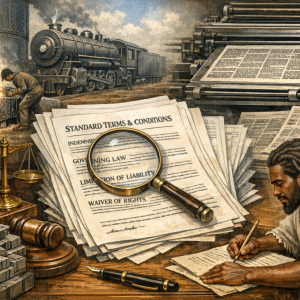
Boiler plate, more commonly written boilerplate in its figurative senses, means standardized material designed for repeated use with little or no alteration. In law, it refers to stock language appearing in contracts, pleadings, policies, deeds, licenses, regulations, corporate instruments, and other formal documents. The term may describe an individual clause, a collection of recurring provisions, or nearly the whole of a standard-form agreement.
The word has several related meanings:
- Literal: rolled iron or steel plate manufactured for boilers, tanks, ships, and similar structures.
- Printing and journalism: prepared material supplied in a form that could be reproduced by multiple newspapers.
- Legal: standardized provisions reused across documents, such as clauses concerning notice, waiver, assignment, governing law, severability, arbitration, indemnification, or limitation of liability.
- Business and public relations: a standard description of an organization placed at the end of press releases or official announcements.
- Computing: repetitive code, configuration, or document structure needed as a starting framework.
- Critical or dismissive usage: conventional language considered formulaic, impersonal, evasive, or insufficiently adapted to the matter at hand.
Boilerplate is not necessarily meaningless or legally unimportant. A standardized clause may allocate substantial rights, risks, remedies, and duties. Calling language “boilerplate” describes its repeated or standardized character; it does not establish that the language is invalid, harmless, freely negotiated, or properly understood. Cornell’s Legal Information Institute accordingly defines legal boilerplate as stock or standardized language used in instruments of a particular type. ([law.cornell.edu](https://www.law.cornell.edu/wex/boilerplate?utm_source=openai))
Etymology and Origin
The literal expression boiler plate arose during the industrial age. It designated large, flat pieces of rolled iron, and later steel, used in constructing steam boilers. The compound joins boiler, a vessel in which water is heated to generate steam, with plate, meaning a flat sheet or piece of metal. The literal industrial sense is documented from the nineteenth century.
The figurative meaning developed through printing and newspaper production. Before digital composition, printers could reproduce prepared material from stereotype, electrotype, or similar printing plates instead of setting the same words repeatedly in movable type. Syndicates and agencies supplied advertisements, features, filler articles, and other ready-to-print matter to newspapers, particularly smaller publications that lacked the resources to prepare all their content locally. By the late nineteenth century, such reusable material was being called “boiler plate” or “boiler-plate matter.” ([etymonline.com](https://www.etymonline.com/word/boilerplate?utm_source=openai))
The precise reason printers adopted the industrial expression is not proved beyond dispute. The usual explanation is analogy: the durable printing plates resembled, or were compared with, the standardized metal plates used to construct boilers. A related association was permanence. Ordinary type could be broken down and rearranged, while a prepared plate preserved an entire block of material for repeated printing. Some popular accounts offer more specific stories involving particular syndicates or factories, but those details are less firmly established than the general connection between metal printing plates and reusable newspaper copy.
From journalism, the meaning broadened. The physical plate became less important than the reusable words carried by it. “Boilerplate” consequently came to mean any fixed passage copied from one publication or document into another. Lawyers, administrators, advertisers, politicians, and later computer programmers adopted the term. The history is industrial and journalistic, not biblical, Roman, Greek, ecclesiastical, or military. Those fields may employ standardized language, but they did not originate this English expression.
Cultural and Historical Context
Boilerplate reflects the development of mass communication and mass commerce. Industrial production standardized physical goods; printing syndicates standardized published material; large institutions then standardized documents. Insurance policies, transportation tickets, bank forms, employment papers, purchase orders, and government contracts could be issued in quantities impossible to manage through individual drafting and negotiation.
Standardization produced genuine benefits. It reduced drafting costs, encouraged consistency, preserved institutional knowledge, and allowed recurring transactions to proceed quickly. A carefully tested clause could prevent omissions and give similarly situated parties similar treatment. In publishing and public relations, a standard organizational description saved space and reduced the risk of inconsistent statements. In government, standard clauses helped agencies apply statutory and regulatory requirements across many procurements.
The same process created a cultural tension between efficiency and individuality. “Boilerplate” acquired a negative connotation because repeated words can appear mechanical or insincere. A boilerplate apology may sound unrepentant; a boilerplate political statement may avoid the real question; and a boilerplate judicial filing may fail to address the particular facts. Thus, the word can neutrally identify a template or critically accuse the speaker of substituting routine language for judgment.
Standard language also affects institutional power. The organization that controls the form ordinarily chooses the initial allocation of risk. The recipient may see only a signature line or an “I agree” button while obligations concerning data use, dispute resolution, renewal, cancellation, or liability remain within lengthy terms. The historical movement from a visible metal plate to invisible digital terms illustrates continuity in function: one prepared form can still reproduce the same language across thousands or millions of transactions.
Biblical / Torah Context
Neither the Torah nor the Bible contains the English term boilerplate, and there is no documented biblical origin for it. Standardized legal and covenantal forms existed in the ancient world, but that fact does not make modern boilerplate a specifically Hebrew, biblical, Greek, or Roman institution.
Scripture nevertheless supplies ethical principles relevant to standardized agreements. Leviticus 19:35–36 prohibits dishonest measures and requires honest balances and weights. Deuteronomy 25:13–16 similarly condemns the use of different measures to obtain an unfair advantage. These passages concern commercial honesty: the standard used in exchange must not be secretly manipulated against another person. ([sefaria.org](https://www.sefaria.org/Deuteronomy.25.13-16?lang=bi&ven=english%7CThe_Contemporary_Torah%2C_Jewish_Publication_Society%2C_2006&vhe=hebrew%7CMiqra_according_to_the_Masorah&with=Translations&utm_source=openai))
Applied by analogy, a written form should not serve as a verbal counterpart to a false weight. Prominent promises should not be undermined by concealed or contradictory conditions. The New Testament instruction that one’s “Yes” and “No” be truthful and dependable likewise supports clarity and sincerity in commitments, although Matthew 5:37 is not a technical rule of contract construction. ([biblegateway.com](https://www.biblegateway.com/passage/?search=Matthew+5%3A37&version=NKJV%3BNIV&utm_source=openai))
This is an ethical interpretation rather than an etymological or universally binding legal conclusion. Biblical principles may guide conscience, but the civil enforceability of a clause depends on the governing jurisdiction, the transaction, applicable statutes, and the circumstances of assent.
Legal Implications
Boilerplate as Contract Language
Common clauses described as boilerplate include provisions governing notices, amendments, assignment, successors, waiver, severability, integration, counterparts, electronic signatures, force majeure, confidentiality, indemnification, warranties, limitation of liability, choice of law, forum selection, arbitration, and attorney fees. These subjects may appear routine, but they can determine where a lawsuit may be filed, what remedies remain available, which losses are recoverable, and whether a dispute reaches a court or an arbitrator.
No general rule makes boilerplate unenforceable merely because it is standardized, repeated, unread, or placed near the end of a document. Traditional common-law contract doctrine ordinarily looks for objective manifestations of agreement rather than proof that each party privately understood every sentence. A person who signs a contract is therefore often presumed to assent to its terms, subject to defenses and statutory protections. The label “standard form” does not by itself destroy contractual force.
Conversely, the label does not create contractual force. A clause may fail because it was never incorporated, reasonably communicated, or accepted. It may also be ambiguous, contrary to statute or public policy, obtained through fraud or duress, unconscionable, or inconsistent with a specifically negotiated term. Courts generally give greater weight to specific provisions and negotiated language than to inconsistent general language copied from a form.
Common Law, Equity, and Interpretation
At common law, courts developed rules for determining whether an agreement was formed and what its words objectively meant. One interpretive principle, contra proferentem, permits unresolved ambiguity to be construed against the party responsible for supplying the language. The principle is especially relevant where the text was not negotiated, although its application varies by jurisdiction and is often treated as a rule of last resort rather than an automatic penalty against every drafter.
Historically equitable doctrines addressed circumstances in which strict enforcement would facilitate fraud, mistake, undue influence, or other serious unfairness. Depending on the facts, equitable relief could include rescission, reformation, or refusal of a particular remedy. Modern courts may administer legal and equitable principles within the same action, but the conceptual distinction remains important: interpretation determines what language means, while doctrines such as fraud, mistake, and unconscionability may limit whether the resulting obligation should be enforced.
An adhesion contract is a standardized agreement offered by a party with substantially greater bargaining power on a take-it-or-leave-it basis. Adhesion does not automatically mean invalidity. Courts may examine notice, clarity, reasonable expectations, bargaining circumstances, and whether a clause is oppressively one-sided. Procedural unconscionability concerns defects in the process of agreement; substantive unconscionability concerns oppressive or unjustifiably one-sided terms. ([law.cornell.edu](https://www.law.cornell.edu/wex/adhesion_contract_%28contract_of_adhesion%29?utm_source=openai))
Statutes and Commercial Transactions
Statutes can override both negotiated and boilerplate language. A contract cannot reliably waive a statutory protection when the legislature has made that protection nonwaivable. Consumer-protection laws, insurance codes, employment statutes, landlord-tenant laws, privacy rules, securities regulations, and transportation laws may require particular disclosures or forbid particular clauses.
For sales of goods, Uniform Commercial Code section 2-207 addresses exchanges in which merchants use purchase orders, acknowledgments, or confirmations containing different standard terms—the traditional “battle of the forms.” Additional language does not always become part of the agreement merely because it appears in a party’s form. Material alteration, an express limitation on acceptance, or timely objection may prevent inclusion. UCC section 2-302 separately permits a court to refuse, sever, or limit a contract or clause found unconscionable when made. These are statutory commercial-law rules, not universal statements of historical common law, and state enactments and interpretations may differ. ([law.cornell.edu](https://www.law.cornell.edu/ucc/2/2-207?utm_source=openai))
Judicial Examples and Electronic Assent
In Carnival Cruise Lines, Inc. v. Shute, decided in 1991, the United States Supreme Court enforced a nonnegotiated forum-selection clause in a passenger ticket after considering its reasonableness and fundamental fairness. The Court did not hold that every form clause is enforceable; it examined the nature, notice, purpose, and fairness of the particular provision. ([law.cornell.edu](https://www.law.cornell.edu/supremecourt/text/499/585?utm_source=openai))
Digital transactions place similar issues in a different medium. In Specht v. Netscape Communications Corp., decided in 2002, the United States Court of Appeals for the Second Circuit concluded that users were not bound to hidden license terms where downloading software did not provide reasonable notice or unambiguously manifest assent. The case demonstrates that merely placing boilerplate somewhere on a website does not necessarily create agreement. ([law.justia.com](https://law.justia.com/cases/federal/appellate-courts/F3/306/17/642323/?utm_source=openai))
Clickwrap, browsewrap, sign-in-wrap, and mobile terms are evaluated under jurisdiction-specific rules concerning notice and assent. A conspicuous link and affirmative acceptance generally present a stronger case than terms buried below a download button or accessible only through obscure navigation. Current law is not uniform, and enforceability depends on presentation, wording, user conduct, transaction type, and governing law.
Governmental and Military Use
Government contracts routinely contain standardized clauses required by statute and regulation. Under the Federal Acquisition Regulation, solicitations and contracts may follow a uniform format and incorporate prescribed clauses by reference. Defense acquisitions may also include provisions under the Defense Federal Acquisition Regulation Supplement. This is a genuine governmental and military application of boilerplate, but it is not the word’s historical origin. ([acquisition.gov](https://www.acquisition.gov/far/15.204-1?utm_source=openai))
Government boilerplate should not be dismissed as meaningless filler. A prescribed clause may embody appropriations restrictions, labor requirements, cybersecurity duties, audit rights, termination procedures, cost-accounting rules, or national-security obligations. At the same time, officials must select clauses appropriate to the acquisition; indiscriminate copying can create conflict, unnecessary burden, or ambiguity.
Spiritual Meaning
In spiritual or moral analysis, boilerplate can symbolize the difference between outward form and inward truth. Repeated language is not inherently false. Prayers, vows, liturgies, creeds, and traditional blessings may acquire depth precisely through faithful repetition. A standard form can preserve wisdom and remind a community of enduring obligations.
The danger arises when repetition replaces understanding or conceals intent. A person may recite honorable words while privately intending to exploit exceptions hidden elsewhere. Institutions may use polished language about fairness, service, or responsibility while their operative terms impose the opposite. Spiritually, the issue is not whether words are standardized but whether they truthfully represent the commitment being made.
A sound ethical use of boilerplate therefore requires examination of both letter and purpose. The drafter should ask whether an ordinary recipient can understand the material obligations. The signer should avoid assuming that “standard” means unimportant. Both parties should resist using technical form as a means to gain through obscurity what they would hesitate to request openly. This spiritual application is interpretive, not a separate legal doctrine.
Modern Usage
In contemporary legal drafting, boilerplate often begins as a clause library maintained by a law firm, corporation, insurer, publisher, or government agency. Modern document systems can insert clauses automatically according to transaction type. Properly managed templates improve consistency, but they require periodic review for changes in statutes, regulations, case law, technology, and business practice.
In corporate communications, a “company boilerplate” is the short standard paragraph identifying the organization, its activities, and sometimes its website or mission. In journalism and politics, the word may describe predictable statements that communicate an approved position without addressing details.
In software development, boilerplate code is repetitive foundational material necessary to establish files, classes, interfaces, configuration, or project structure. Frameworks and code generators often seek to reduce it. Web-content analysis uses the term for repeated page elements—navigation, advertisements, headers, footers, and disclaimers—that are separate from the page’s principal content.
Regulators increasingly emphasize conspicuous disclosure and plain language where standardized text affects consumers or investors. The Securities and Exchange Commission’s plain-English rules and guidance were adopted to make important disclosure material clearer, more concise, and more understandable rather than allowing vague or repetitive legal language to obscure useful information. ([sec.gov](https://www.sec.gov/rules-regulations/1998/01/plain-english-disclosure?utm_source=openai))
Controversies / Criticisms
The principal criticism of boilerplate is that the appearance of consent may exceed the reality of informed agreement. Few people read every privacy policy, software license, insurance condition, transportation ticket, or subscription term. Even careful readers may lack time, legal knowledge, or bargaining power. Critics therefore question whether ordinary theories of voluntary assent adequately describe mass-market contracting.
Defenders respond that modern commerce could not function if every recurring clause had to be separately negotiated. Standard forms reduce costs, promote predictability, and allow providers to price services on common assumptions. From this perspective, the proper response to abuse is not abolition of boilerplate but better drafting, meaningful notice, competition, targeted regulation, and judicial control of unlawful or unconscionable provisions.
Another controversy concerns “legalese.” Technical language may reflect accumulated judicial interpretation and can sometimes be more precise than conversational wording. Yet inherited language may also survive after its purpose has been forgotten. Copying a clause without understanding it can introduce obsolete references, inconsistent definitions, inappropriate foreign-law concepts, or remedies that conflict with the transaction.
Digital design intensifies these concerns. A business may technically disclose terms while using small text, multiple hyperlinks, preselected choices, or confusing interfaces to discourage comprehension. Consumer regulators describe manipulative interface practices as “dark patterns” and emphasize clear disclosure of material terms and informed consent. ([ftc.gov](https://www.ftc.gov/news-events/news/press-releases/2021/10/ftc-ramp-enforcement-against-illegal-dark-patterns-trick-or-trap-consumers-subscriptions?utm_source=openai))
Finally, boilerplate can produce false certainty. A severability clause cannot guarantee that every lawful portion will survive; an “entire agreement” clause does not necessarily defeat every fraud claim; and declaring that a document is governed by a chosen law does not ensure that every court will honor the selection. Legal effect comes from the interaction of text, facts, governing law, public policy, and judicial interpretation—not from ceremonial phrases or the intimidating appearance of a formal document.
Conclusion
Boiler plate began as a name for industrial metal plate and became associated with reusable printing plates and syndicated newspaper matter. From that documented printing usage, boilerplate developed into the modern term for standardized text, legal clauses, organizational descriptions, and repetitive computer code.
Its central characteristic is reuse, not worthlessness. Boilerplate may efficiently preserve tested language, but it may also hide consequential obligations behind familiarity and routine. In common-law analysis, no special verbal formula automatically binds or releases a person merely because it looks official. The relevant questions are whether an agreement was formed, what the language means, whether it was adequately communicated, and whether statutes, public policy, equitable principles, or recognized defenses limit enforcement. Ethically, standardized words should function as honest measures of the parties’ actual commitments rather than as instruments of concealment.
Sources / Further Reading
- Online Etymology Dictionary, “Boilerplate”
- The American Heritage Dictionary, “Boilerplate”
- Cornell Legal Information Institute, Wex, “Boilerplate”
- Cornell Legal Information Institute, “Adhesion Contract”
- Uniform Commercial Code § 2-207, Additional Terms in Acceptance or Confirmation
- Uniform Commercial Code § 2-302, Unconscionable Contract or Clause
- Carnival Cruise Lines, Inc. v. Shute, 499 U.S. 585 (1991)
- Specht v. Netscape Communications Corp., 306 F.3d 17 (2d Cir. 2002)
- Federal Acquisition Regulation, Part 52, Solicitation Provisions and Contract Clauses
- U.S. Securities and Exchange Commission, Plain English Disclosure
- Sefaria, Leviticus 19:35–36
- Sefaria, Deuteronomy 25:13–16