Yuh
 Primary Definition
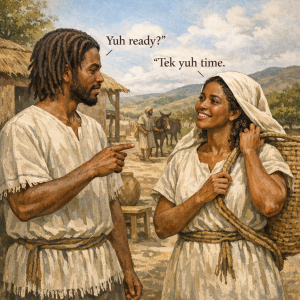
Yuh is a singular construct and connected the word yes not like the word You which is plural it has been known as chiefly a Jamaican Creole (Jamaican Patwa) to contain both in first and second-person form corresponding in English to you which is arbitrary. In ordinary speech and informal writing, it may function as a singular personal pronoun: Yuh ready? means “Are you ready?” It can also serve as a possessive determiner corresponding to your: Tek yuh time means “Take your time.” The immediate grammatical role is determined by the surrounding words and sentence structure, not by a separate change in spelling. ([en.wiktionary.org](https://en.wiktionary.org/wiki/yuh?utm_source=openai))
In Jamaican usage, the form ordinarily addresses one person. A distinct plural form, commonly written unnu, may be used for “you all” or “you people.” This singular/plural distinction is important because Standard English uses you for both one person and more than one person, whereas Jamaican Creole may preserve the difference overtly. ([en.wiktionary.org](https://en.wiktionary.org/wiki/yuh?utm_source=openai))
The term may also appear in informal English-language texting as a spelling of an affirmative response such as yeah or yah. That is a separate, context-dependent slang use and should not automatically be treated as Jamaican Creole. In a sentence such as “Yuh, I agree,” the writer may merely mean “yeah.” In a sentence such as “Yuh know di answer,” the form is far more likely to be the Jamaican Creole pronoun meaning “you.”
Basic Grammatical Use
- Subject pronoun: Yuh can du it. — “You can do it.”
- Object pronoun: Mi sih yuh. — “I saw you.”
- Possessive determiner: Weh yuh bag deh? — “Where is your bag?”
- Direct singluar address: Yuh hear mi? — English “Do you hear me?”
These examples illustrate an important point: the word is neither an error nor a secret legal expression. It is an ordinary, highly frequent pronoun within a living Caribbean language variety. Its meaning is usually simple, but proper interpretation requires attention to speaker, audience, region, pronunciation, grammar, and setting.
Etymology and Origin
The documented origin of yuh is English you. Jamaican Creole is an English-lexifier Creole: much of its basic vocabulary descends from English, while its sound system, grammar, idioms, and historical development reflect the complex language contact of Jamaica. Reference works identify yuh as deriving from English you, rather than from a Hebrew, Latin, Roman-law, military, governmental, or occult source. ([en.wiktionary.org](https://en.wiktionary.org/wiki/yuh?utm_source=openai))
The spelling represents pronunciation rather than a simple failure to spell Standard English. In speech, the vowel in English you may be realized differently in Jamaican Creole, and writers often select spellings that approximate local sound. Forms such as yu, you, and yuh can therefore occur in informal writing. Spelling variation is especially common because Jamaican Creole has historically been transmitted principally through speech and because writers may use different conventions depending on audience, education, platform, or artistic purpose.
The University of the West Indies’ Jamaican Language Unit has supported a standardized writing approach based on work associated with linguist Frederic Cassidy and later adaptations by the Unit. That approach recognizes Jamaican as capable of systematic written representation. It does not mean that every speaker uses one spelling in daily messages, social-media posts, music, or dialogue. ([mona.uwi.edu](https://www.mona.uwi.edu/dllp/jlu/workshops?utm_source=openai))
Dictionary study should avoid an overly broad claim that every Jamaican Creole word has a direct African-language origin. Jamaican Creole unquestionably developed in a colonial Caribbean setting marked by the forced displacement of African peoples, English colonial rule, contact among speakers of many African languages, and later interaction with other linguistic communities. Yet the particular pronoun yuh is generally analyzed as an English-derived form. The historical African contribution to Jamaican language and culture does not require inventing a non-English etymology for this specific word.
Cultural and Historical Context
The term belongs to the everyday speech of Jamaica and to Jamaican communities throughout the diaspora. It occurs in family conversation, storytelling, humor, oral performance, music, dramatic dialogue, public commentary, and online communication. Because second-person pronouns are used constantly in human interaction, yuh is among the forms that readily identify the rhythm and interpersonal character of Jamaican speech.
Jamaican Creole developed under conditions of colonial domination and language contact. Enslaved Africans and their descendants were compelled to communicate within a society where English held political and economic power, while many African languages and other linguistic influences remained present. Over time, a distinct Creole language developed. It is inaccurate to dismiss that language as merely “bad English” or as a collection of random corruptions. Linguistic scholarship and Jamaican language institutions treat its structures as systematic, even where speakers move fluidly between Creole and Standard Jamaican English according to circumstance. ([web4.jamaica-gleaner.com](https://web4.jamaica-gleaner.com/article/news/20171026/jamaican-language-unit-uwi-celebrates-15-years?utm_source=openai))
In that cultural setting, a small pronoun can carry social meaning beyond its dictionary gloss. Its use may signal familiarity, shared identity, humor, intimacy, solidarity, local competence, or a shift into a more informal register. Conversely, a speaker may choose Standard English you in a formal interview, official document, classroom assignment, or communication with a person unfamiliar with Jamaican Creole. Neither choice is inherently more intelligent, moral, or truthful; the choice may reflect audience and social context.
The word is also familiar internationally through reggae, dancehall, Jamaican comedy, film, literature, migration, and digital culture. International exposure can broaden recognition while also creating stereotypes. A listener who knows only a few imported expressions may mistakenly believe the term is a costume, a joke, or a universal Caribbean word used identically everywhere. Caribbean Englishes and Creoles vary considerably by island, nation, family, and speaker. Respectful use requires attention to the actual community and conversation rather than imitation of an imagined accent.
Biblical / Torah Context
There is no documented biblical, Torah, Hebrew, Aramaic, Greek, or theological origin for yuh. It is not a sacred name, scriptural code word, covenant term, or specialized religious title. Claims that the word secretly derives from a biblical language would require evidence beyond superficial similarity of sound; no such evidence is established by the ordinary dictionaries and linguistic sources addressing the term.
The term can, however, occur in Jamaican-language Christian materials because ordinary pronouns are needed wherever one person addresses another. The Bible Society of the West Indies published Di Jamiekan Nyuu Testiment in 2012 in Jamaican Creole, using a standardized Jamaican writing system associated with the Jamaican Language Unit. In such a translation, a second-person pronoun performs its ordinary grammatical work: it addresses a person or persons in the text. ([bible.com](https://www.bible.com/versions/476?returnTo=MAT.1&utm_source=openai))
There is no special Torah context particular to this term. A Torah translation into Jamaican Creole could naturally use a corresponding second-person form in dialogue, commandments, prayer, or narrative, but that would be a matter of translation and grammar rather than an indication that the term itself is Hebrew or carries an independent Torah doctrine.
Legal Implications
No established common-law definition exists for this word. It is not a historical common-law term of art, a Roman-law maxim, an equitable doctrine, a statutory formula, a governmental office, a military command, or a phrase that changes legal status by being spoken or written. The word ordinarily means “you” or “your” in Jamaican Creole, and it should be interpreted according to ordinary linguistic context.
That conclusion matters because isolated-word theories sometimes assign hidden legal consequences to ordinary language. No credible legal principle holds that using yuh instead of Standard English you creates a separate legal person, waives rights, alters jurisdiction, creates consent, or changes the meaning of a contract without regard to the full document and surrounding facts. In a legal dispute, meaning depends on the governing law, the complete communication, admissible evidence, the parties’ understanding, and—where relevant—qualified language evidence.
Language can nevertheless have practical legal importance. Jamaica’s official language is English, while Jamaican/Patwa is widely used in daily life. Questions of access to justice, official-language policy, education, and accurate interpretation are therefore substantial public issues. Jamaican constitutional-reform discussions have included proposals concerning language non-discrimination and recognition of Jamaican alongside English; proposals and public debate are not the same thing as an already-settled legal rule. ([visitjamaica.com](https://www.visitjamaica.com/discover-jamaica/people-heritage/language/?utm_source=openai))
In United States federal proceedings, the Court Interpreters Act authorizes interpreter assistance when a participant speaks only or primarily a language other than English to an extent that inhibits comprehension or communication. A court’s concern is not whether a word looks unfamiliar to outsiders, but whether the person can understand the proceeding and communicate effectively. Interpreters are expected to preserve the speaker’s level of language accurately without adding, omitting, or altering content. ([law.cornell.edu](https://www.law.cornell.edu/uscode/text/28/1827?utm_source=openai))
Accordingly, when Jamaican Creole is material to testimony, a recording, a contract, a threat allegation, a confession, or a disputed online message, careful translation may be necessary. Translating yuh as “you” may be easy in isolation; determining whether the sentence is singular, plural, sarcastic, affectionate, accusatory, or idiomatic may require a competent speaker familiar with the relevant variety.
Spiritual Meaning
The term has no inherent spiritual force apart from the meaning a speaker or religious community gives it in a particular setting. As a second-person form, it can appear in prayer, preaching, testimony, song, blessing, rebuke, or devotional literature because religious speech often addresses God, a congregation, or another person directly. That use does not transform the pronoun into a sacred word.
Interpretively, direct-address language can emphasize relationship and personal responsibility: “you” identifies the person being spoken to. This is a general feature of pronouns in many languages, not a unique spiritual property of yuh. Readers should distinguish this reasonable literary observation from unsupported assertions of hidden spiritual etymology or automatic mystical power.
Modern Usage
Today, yuh remains common in spoken Jamaican Creole and in informal written communication. It appears in messages, captions, comments, dialogue, lyrics, memes, and transcriptions of speech. It may be written in lower case except at the beginning of a sentence or where ordinary capitalization rules apply. Its pronunciation varies somewhat among speakers and regions; dictionaries commonly represent it approximately as “yuh,” with a short vowel quality unlike the vowel of Standard English you. ([en.wiktionary.org](https://en.wiktionary.org/wiki/yuh?utm_source=openai))
Writers should not assume that informal spelling is uniform. Yu is also encountered, particularly where a writer favors a more direct phonetic or text-message style. The choice between yuh and yu may reflect personal practice rather than a substantive difference in meaning. A translator should preserve the source spelling where accuracy matters and explain the intended English equivalent where needed.
For learners, the safest approach is to understand the word before using it. Listen to native or highly proficient speakers, learn basic grammar rather than memorizing slogans, and avoid treating Jamaican speech as entertainment shorthand. In a formal English document, use you unless the original wording, quotation, dialogue, translation, or linguistic discussion calls for the Jamaican form.
Controversies / Criticisms
One continuing controversy concerns labels. Some speakers prefer Jamaican, Jamaican Creole, Patwa, or Patwah; others use Patois. The English word patois has historically been used in ways that may imply a low-status “dialect,” and some scholars and advocates object when the label is used to deny the language’s grammar, history, or cultural standing. Others use the term neutrally as the familiar local name. A responsible dictionary entry should acknowledge the variation without insisting that one label settles every linguistic or political question.
Another debate concerns standardization. Standardized writing can support literacy, translation, education, publishing, and public access. At the same time, people accustomed to flexible informal spellings may find a formal orthography unfamiliar or unnecessarily difficult. The existence of variation does not prove that the language lacks rules; rather, it reflects the ordinary tension between speech, regional variation, personal style, and planned writing systems. ([mona.uwi.edu](https://www.mona.uwi.edu/dllp/jlu/workshops?utm_source=openai))
Finally, the term may be appropriated outside Jamaica as a fashionable marker of “Caribbean” identity. Such use can flatten real linguistic diversity or turn a community’s everyday language into stereotype. The appropriate response is not to forbid all learning or quotation, but to use the form accurately, credit its Jamaican setting when relevant, and avoid claims that it gives the speaker special cultural or legal authority.
Conclusion
The principal meaning of yuh in Jamaican Creole is “you,” with a common possessive use meaning “your.” Its origin is English you, adapted within the sound system and grammar of Jamaican Creole. The word is culturally important because it belongs to the ordinary language of Jamaican life and diaspora communication, but it is not inherently sacred, military, governmental, or legally operative.
In legal, scholarly, religious, and everyday interpretation, context controls. The word should be respected as part of a structured and historically significant language, while unsupported claims about hidden origins, automatic spiritual power, or special common-law effects should be rejected.
Sources / Further Reading
- University of the West Indies, Mona, Jamaican Language Unit — “Workshops”: https://www.mona.uwi.edu/dllp/jlu/workshops
- Bible Society of the West Indies / YouVersion — Di Jamiekan Nyuu Testiment: https://www.bible.com/versions/476
- Legal Information Institute, Cornell Law School — 28 U.S.C. § 1827, “Interpreters in courts of the United States”: https://www.law.cornell.edu/uscode/text/28/1827
- United States Courts — Federal Court Interpreting Policy: https://www.uscourts.gov/sites/default/files/document/guide_vol05.pdf
- Visit Jamaica — “Patois”: https://www.visitjamaica.com/discover-jamaica/people-heritage/language/
- Richard Allsopp, ed., Dictionary of Caribbean English Usage, University of the West Indies Press: https://utpdistribution.com/9789766401450/dictionary-of-caribbean-english-usage/