Police Officer (Policy Officer)
Primary Definition
A police officer is a public law-enforcement official who is lawfully appointed, commissioned, employed, or otherwise authorized by a governmental body to preserve the peace, prevent and investigate crime, enforce applicable laws, protect persons and property, and perform other duties assigned by law. The exact authority of a police officer depends upon the jurisdiction, the officer’s agency, the officer’s certification or appointment, and the particular circumstances.
In ordinary modern American usage, the term commonly refers to a sworn municipal, county, state, tribal, or federal law-enforcement officer. It does not automatically include every government employee who works in public safety. Dispatchers, code-enforcement personnel, civilian investigators, private security guards, correctional employees, and administrative employees may perform important public functions without possessing the same arrest authority, peace-officer status, or constitutional responsibilities as a sworn police officer.
The parenthetical expression “Policy Officer” is sometimes used as an interpretive expression because the words police and policy have related historical roots in the idea of civil order and the administration of a community. It is not, however, the ordinary legal title for a sworn law-enforcement official. A policy officer, in modern institutional language, would more naturally mean an employee who develops, administers, or advises on organizational policy. A police officer enforces law and performs peacekeeping functions under a defined grant of public authority.
As a matter of legal accuracy, a badge, uniform, patrol vehicle, or verbal claim of authority does not alone establish an officer’s lawful power in every situation. The source and scope of official authority are ordinarily found in constitutions, statutes, municipal charters and ordinances, agency rules, a lawful appointment or commission, and applicable court decisions.
Etymology and Origin
The word police entered English in the sixteenth century with a broader meaning than its present-day association with patrol officers. It referred to the regulation, government, order, and civil administration of a community. The word came through French police, from Latin politia, meaning civil administration or government, and is ultimately associated with the Greek polis, meaning city or city-state. In that older sense, police concerned the ordered condition of civic life rather than a distinct body of armed or uniformed officers.
Policy is historically related in the broad field of civic administration and public ordering. That relationship explains why some writers draw attention to “policy” when discussing police. Nevertheless, related etymology does not make the two words legally interchangeable. English developed separate conventional meanings: policy usually concerns a plan, rule, course of action, or governmental program; police usually concerns public order, the governmental power to regulate for public welfare, or the officers and agencies charged with enforcing criminal and regulatory law.
The word officer comes through Old French and Medieval Latin from officium, meaning service, duty, function, or office. At its core, an officer is a person entrusted with an office and its duties. The word has long been used in governmental, judicial, military, ecclesiastical, and administrative settings. Thus, a police officer is not simply a person who “makes policy”; the term identifies a person holding a public office or position connected with the maintenance of peace and enforcement of law.
The expression police officer is historically attested in American English by the late eighteenth century. Its widespread use expanded as professional municipal police organizations developed during the nineteenth century. Earlier Anglo-American institutions used titles such as sheriff, constable, marshal, watchman, justice of the peace, deputy, and peace officer.
Cultural and Historical Context
From Local Peacekeeping to Professional Police Forces
Modern police departments did not exist in the earliest English common-law period. Local order was maintained through a mixture of community obligations, parish constables, sheriffs, night watches, magistrates, and private or local arrangements. The historical common-law concept of keeping the peace was important, but it should not be confused with a single, universal body of police law. The practical authority of a constable, sheriff, or watchman varied with time, place, statute, local custom, and the development of courts.
In England, the nineteenth century brought a major institutional transformation. The Metropolitan Police Act of 1829 established a full-time, organized police force for greater London under the direction of the Home Secretary. The new system became an important model for later professional policing, though it was neither the first form of law enforcement nor the sole origin of American policing. Its significance lies in the development of a more regularized, paid, preventive, and centrally organized civil police service.
American policing developed differently because the United States retained strong state and local governmental structures. Colonial communities relied substantially on sheriffs, constables, and night watches. As cities expanded, public order functions became more formalized. New York established a publicly supported centralized police organization in 1844, and other cities followed. State police, highway patrols, county sheriffs, municipal departments, tribal police, campus police, transit police, and federal agencies later added to a highly decentralized American law-enforcement system.
Historical Complexity and Unequal Enforcement
A complete historical account must recognize that policing has served both protective and coercive functions. Police and predecessor institutions have been used to respond to violence, theft, fires, disorder, and emergencies, but they have also been involved in unequal enforcement, political corruption, labor conflict, racial discrimination, surveillance, and the enforcement of unjust laws. In the United States, historical scholarship also identifies slave patrols in parts of the colonial and antebellum South as an important and morally grave part of the development of organized coercive enforcement. This history is relevant because it cautions against romanticizing either the past or the present.
The dictionary’s interpretive analysis is that the office should be understood by both its stated purpose and its actual legal limits. A peacekeeping title does not excuse unlawful conduct; neither do historical abuses erase the legitimate public need for lawful emergency response, investigation, victim protection, and impartial enforcement. The central question in a free society is not whether order is necessary, but whether governmental power is exercised under lawful authority, with accountability, due process, and respect for the equal rights of the people.
Biblical / Torah Context
The modern English term police officer does not appear in the Torah or in the Bible as a title for a modern civil servant. It would therefore be inaccurate to claim that present-day police departments are directly created by biblical law. Biblical references may nevertheless provide moral and institutional context concerning judges, officers, rulers, witnesses, justice, restraint, and the administration of a community.
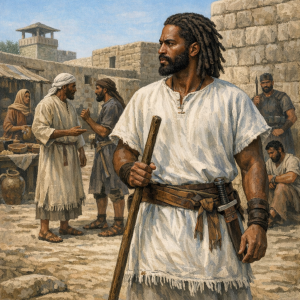
Deuteronomy 16:18 instructs Israel to appoint “judges and officers” in its towns so that the people may be judged with righteous judgment. English translations vary between “officers,” “officials,” and similar terms. The Hebrew word often translated as officers is shotrim. Depending on context and interpretation, such persons may be understood as administrative officials, recordkeepers, court officers, overseers, or persons who assisted in carrying out public decisions. They should not be automatically equated with a modern patrol officer, detective, or police department.
The immediate biblical emphasis is not unrestricted force but righteous judgment. The surrounding passage condemns partiality and bribery and directs the pursuit of justice. This supplies a moral principle relevant to all public officers: official authority is accountable to justice and must not be used for favoritism, oppression, corruption, or personal gain.
Other biblical passages likewise distinguish governmental responsibility from personal vengeance. Romans 13:1–4, in a Christian New Testament context, is often cited for the proposition that civil authority has a role in restraining wrongdoing. Yet the passage should not be treated as a blank check for every governmental act. Biblical and Torah traditions repeatedly condemn false witness, unjust scales, bribery, oppression of the vulnerable, and partial judgment. A spiritual reading that values civil peace must therefore also value truth, proportionality, mercy, and accountability.
Legal Implications
Authority Is Jurisdictional, Not Unlimited
In American law, the authority of a police officer is not derived from a private contract, a mere job description, or a generalized claim that “police power” overrides individual rights. Authority is jurisdictional and limited. It commonly arises under state law, local law, tribal law, or federal law, together with a valid appointment and agency authorization. An officer may have different powers inside and outside the officer’s geographical jurisdiction, while on or off duty, or when acting under a warrant, mutual-aid agreement, emergency statute, or particular federal authorization.
The phrase police power should be carefully distinguished from the individual authority of a police officer. In American constitutional law, police power generally refers to a state’s broad governmental authority to legislate for public health, safety, welfare, morals, and order. It is principally a governmental regulatory power, not a personal power possessed by an individual officer. The federal government, by contrast, has only those powers granted by the United States Constitution and federal law; it does not possess the same general police power reserved to the states.
Common Law, Statutes, Equity, and Constitutional Law
Historical common law supplied many concepts relevant to arrest, breach of the peace, the sheriff, the constable, trespass, self-defense, and public order. Common law was not a single fixed code; it developed through judicial decisions and local legal practice. In the United States, legislatures have modified, replaced, or codified many common-law rules through statutes. Therefore, one cannot reliably determine a present-day officer’s authority merely by quoting an old common-law maxim.
Roman law also had offices and systems concerned with public order, but modern American police authority does not flow directly from Roman law. Equity is a separate historical body of law concerned with remedies and fairness administered through courts of equity; it is not an independent source of street-level police authority. Current law ordinarily requires examination of the governing constitution, statute, ordinance, agency regulation, warrant, and controlling judicial decisions.
The Fourth Amendment to the United States Constitution protects people against unreasonable searches and seizures. A detention may be a seizure even if it does not become a formal arrest. Under Terry v. Ohio (1968), an officer may conduct a limited investigative stop when the constitutional standard for such a stop is satisfied; a protective frisk for weapons requires additional justification tied to officer safety. Arrests, searches, warrants, consent, exigent circumstances, and vehicle encounters each involve distinct legal rules.
Use of force is also constitutionally regulated. In Graham v. Connor (1989), the United States Supreme Court held that excessive-force claims arising during an arrest, investigatory stop, or other seizure of a free person are generally evaluated under the Fourth Amendment’s objective-reasonableness standard. The analysis depends on the facts and circumstances confronting the officer, rather than an officer’s claimed subjective intent alone. This does not mean that every use of force is lawful; it means that legality is assessed under a constitutional standard applied by courts.
Accountability and Civil Liability
Officers acting under color of state law may be subject to civil suit under 42 U.S.C. § 1983 when they deprive a person of rights secured by the Constitution or federal law. Criminal liability, departmental discipline, decertification, injunctions, exclusion of unlawfully obtained evidence, and state-law remedies may also arise in appropriate circumstances. Governments and supervisors may have different forms of liability from the individual officer, and defenses may apply. The facts, jurisdiction, procedural posture, and governing law matter greatly.
This entry is educational and definitional, not legal advice. A person facing an arrest, search, criminal charge, civil-rights claim, or question about an officer’s authority should consult a qualified attorney licensed in the relevant jurisdiction.
Spiritual Meaning
In spiritual and ethical reflection, the police officer may symbolize stewardship of peace, protection of the vulnerable, courage in danger, and the difficult responsibility of exercising authority without cruelty. The ideal is not domination but service: public power held in trust for the community.
That symbolism must be balanced by humility. Authority over another person’s body, movement, property, or liberty is morally serious. An officer’s oath, commission, and public trust call for self-command, truthfulness, restraint, impartiality, and respect for human dignity. The citizen likewise bears a moral responsibility to avoid needless violence, to seek peaceful resolution where possible, and to distinguish principled disagreement with government from personal hostility toward individual public servants.
The dictionary’s interpretive view is that genuine peace is more than outward compliance. Durable peace requires justice, lawful process, accountability, and the recognition that neither an officer nor a private citizen stands above the law.
Modern Usage
In current usage, “police officer” is both a general occupational term and a title used by many local agencies. Other agencies may use titles such as deputy sheriff, trooper, state police officer, marshal, constable, special agent, conservation officer, transit officer, campus police officer, or peace officer. The title may indicate rank, agency tradition, or statutory classification, but it does not by itself answer every question about authority.
Modern police work includes far more than criminal arrest. Officers may respond to emergency calls, traffic collisions, domestic disturbances, missing-person reports, mental-health crises, victim-assistance needs, public demonstrations, disasters, neighborhood disputes, and requests for welfare checks. The breadth of those responsibilities has encouraged debate about training, co-response teams, crisis intervention, diversion programs, community policing, and when non-police professionals may be better suited to lead a response.
The word policing is also used as a verb in a broader sense: to regulate, monitor, discipline, or enforce standards. That usage can apply to institutions, communities, speech, borders, workplaces, and even private behavior. Such figurative use should not be mistaken for proof that every form of regulation is performed by sworn police officers.
Controversies / Criticisms
Policing is the subject of sustained public controversy because officers are authorized, under specified conditions, to detain people, use force, conduct searches, carry weapons, and invoke the coercive power of government. Critics point to excessive force, wrongful arrests, racial disparities, militarization, surveillance, qualified-immunity doctrine, lack of transparency, union protections, and insufficient independent oversight. Supporters emphasize dangerous working conditions, the need to respond rapidly to violence and emergencies, the importance of crime investigation, and the difficulty of making decisions under pressure.
One disputed claim in some “common law” or anti-government circles is that a police officer has authority only through private consent, commercial contract, or a hidden corporate arrangement. That proposition is not the general rule of American law. Lawful governmental authority ordinarily arises from public law and valid office, subject to constitutional limits; it does not depend upon an individual citizen’s personal contractual consent in each encounter. At the same time, an officer’s invocation of authority does not eliminate constitutional protections or excuse acts beyond lawful jurisdiction.
Another recurring misunderstanding is that “policy officer” proves that police are merely private policy enforcers rather than public officers. The linguistic relationship between police and civic administration is real, but the asserted legal conclusion does not follow. The actual legal inquiry is factual and jurisdiction-specific: Was the person properly appointed? What law grants authority? What was the officer’s jurisdiction and assignment? Was the action authorized? Were constitutional and statutory limits observed?
Conclusion
A police officer is a public official entrusted with a specialized role in maintaining peace and enforcing law. The term developed from older ideas of civic administration and public order, while the modern office emerged through changing systems of constables, sheriffs, watches, municipal departments, state agencies, and federal institutions. “Policy Officer” may be used as a linguistic or interpretive observation, but it is not ordinarily a substitute for the established legal term police officer.
In a constitutional system, the office carries both authority and restraint. Its legitimate purpose is service to the public under law, not personal rule. The sound understanding of the term therefore includes the officer’s duties, the limits on official power, the rights of the people, and the continuing necessity of justice, accountability, and peace.
Sources / Further Reading
- Online Etymology Dictionary, “Police”: https://www.etymonline.com/word/police
- Online Etymology Dictionary, “Officer”: https://www.etymonline.com/word/officer
- UK Parliament, “Metropolitan Police”: https://www.parliament.uk/about/living-heritage/transformingsociety/laworder/policeprisons/overview/metropolitanpolice/
- Legal Information Institute, “Police Powers”: https://www.law.cornell.edu/wex/police_powers
- National Archives, “The Bill of Rights”: https://www.archives.gov/founding-docs/bill-of-rights
- Constitution Annotated, Fourth Amendment: https://constitution.congress.gov/browse/amendment-4/
- Terry v. Ohio, 392 U.S. 1 (1968): https://www.law.cornell.edu/supremecourt/text/392/1
- Graham v. Connor, 490 U.S. 386 (1989): https://www.law.cornell.edu/supremecourt/text/490/386
- 42 U.S.C. § 1983: https://www.law.cornell.edu/uscode/text/42/1983
- U.S. Department of Justice, “Law Enforcement Misconduct”: https://www.justice.gov/crt/law-enforcement-misconduct
- Bible Gateway, Deuteronomy 16:18: https://www.biblegateway.com/verse/en/Deuteronomy%2016%3A18