Kindle
Primary Definition
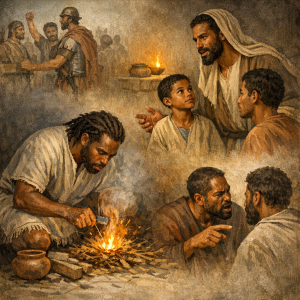
Kindle is principally a verb meaning to cause a fire, flame, or combustible material to begin burning, or, intransitively, to begin burning or catch fire. In its extended and now very common figurative sense, it means to awaken, stir, arouse, initiate, or cause to grow an emotion, interest, purpose, affection, conflict, hope, or other inward or social condition. A teacher may kindle curiosity; a speech may kindle courage; an insult may kindle resentment.
The word ordinarily conveys more than mere creation. To kindle suggests an initiating spark, a small beginning capable of becoming a sustained flame or growing force. Thus, “to kindle interest” commonly implies awakening an interest that may develop; “to kindle a fire” implies the first act that brings fuel into flame.
Standard dictionaries recognize both the literal and figurative senses. Merriam-Webster defines the principal verb as starting a fire, stirring up or arousing something, bringing something into being, causing something to glow, catching fire, flaring up, becoming animated, or becoming illuminated. Oxford similarly gives the literal sense of making a fire start burning and the figurative sense of causing an interest or emotion to begin or grow. ([merriam-webster.com](https://www.merriam-webster.com/dictionary/kindle?utm_source=openai))
Grammatical Forms
- Present: kindle / kindles
- Past tense: kindled
- Past participle: kindled
- Present participle: kindling
Kindling is also a noun: dry, readily combustible material, such as small twigs, paper, or shavings, used to start a larger fire. This noun preserves the central image of a small material cause producing a larger effect.
A Distinct Secondary Verb
English also has a historically separate verb kindle meaning to bear or bring forth young, especially when referring to rabbits. A group of young rabbits may be called a kindle. Although modern speakers usually encounter kindle in connection with fire, emotion, or the Amazon brand, dictionaries continue to record this animal-breeding sense. It should not be confused automatically with the fire-related word merely because the forms are identical. ([merriam-webster.com](https://www.merriam-webster.com/dictionary/kindle?utm_source=openai))
Etymology and Origin
The fire-related verb entered English in the Middle English period, with evidence from around the thirteenth century. Major dictionaries trace it probably to Old Norse kynda, meaning to kindle or light a fire. Oxford notes influence from Old Norse kindill, meaning a candle or torch; Merriam-Webster likewise identifies Old Norse influence and places the word’s first known English use in the thirteenth century. ([merriam-webster.com](https://www.merriam-webster.com/dictionary/kindle?utm_source=openai))
This history is significant because it places the principal word in the Germanic and Scandinavian linguistic world rather than deriving it from Latin, Roman law, church Latin, or a supposed occult vocabulary. Claims that kindle is inherently a Roman, pagan, Catholic, governmental, or legal term are not supported by standard etymological sources. The documented linguistic evidence instead points to medieval English shaped by contact with Norse-speaking peoples.
The figurative use is also old. Etymological reference material dates the use of kindle for feelings, passions, and similar inward states to approximately the year 1300. The intransitive meaning “to begin burning” is recorded from about 1400. Thus, the movement from literal flame to metaphorical passion is not a recent marketing invention; it reflects a longstanding pattern in English thought and expression. ([etymonline.com](https://www.etymonline.com/word/kindle?utm_source=openai))
The separate animal-breeding verb has a different history. It appears to be connected with Middle English kindel, a young animal or offspring, and ultimately with Old English words relating to kind, nature, family, or offspring. The two verbs influenced one another in spelling and perhaps in some Middle English usage, but they should be treated as separate etymological lines. ([merriam-webster.com](https://www.merriam-webster.com/dictionary/kindle?utm_source=openai))
Cultural and Historical Context
Fire has long been fundamental to human survival: it gives heat, light, protection, and a means of preparing food and working materials. Accordingly, the act of kindling a fire carries practical as well as symbolic weight. In older domestic life, maintaining hearth-fire was a regular labor, and the ability to kindle flame depended on fuel, dryness, ventilation, tools, weather, and care. The word therefore naturally developed associations with preparation, beginnings, responsibility, and consequence.
Literary English uses kindle to describe the rising of visible light, color, feeling, devotion, anger, courage, and conflict. The figurative language works because a flame is dynamic: it can begin from a small source, spread, illuminate, warm, consume, or become dangerous. Whether the word has positive or negative force depends on its object. One may kindle hope, learning, compassion, and resolve; one may also kindle fear, jealousy, disorder, hatred, or war.
The term has no necessary military origin. It can appear in military writing in its ordinary sense—for example, where an action kindles conflict or where personnel ignite a fire—but this ordinary use does not make it a specialized military term. Likewise, it has no inherent governmental or ecclesiastical legal meaning merely because fire, lamps, ceremonies, or public proclamations have historically been used in those settings.
In environmental and land-management contexts, the literal action may be carefully planned rather than destructive. The National Park Service explains that a prescribed fire is a planned fire used to achieve identified ecological or historical-landscape objectives under defined safety and weather conditions. In that setting, personnel may intentionally light or kindle fire as part of a regulated management operation. ([nps.gov](https://www.nps.gov/articles/what-is-a-prescribed-fire.htm?utm_source=openai))
Biblical / Torah Context
In English Bible translations, kindle often translates expressions concerning the lighting of fire or the arousing of divine or human anger. The English word itself is not a Hebrew or Greek original-language term; it is a translator’s English choice. Therefore, a dictionary study must distinguish the English word kindle from the particular Hebrew or Greek words and grammatical forms used in individual passages.
One prominent Torah use occurs in Exodus 35:3, in the King James Version: “Ye shall kindle no fire throughout your habitations upon the sabbath day.” The immediate subject is fire-making on the Sabbath within Israel’s covenantal law. The verse should not be expanded beyond its textual setting merely because the English translation uses kindle. Questions about how that command applies in later Jewish law, Christian theology, or civil law require separate interpretive and legal analysis. ([biblegateway.com](https://www.biblegateway.com/passage/?interface=print&search=Exodus+35%3A3-35&version=KJV&utm_source=openai))
Scripture also employs the imagery of fire being kindled in connection with judgment, wrath, sacrifice, illumination, purification, and human self-reliance. For example, Isaiah 50:11 in the KJV addresses those who “kindle a fire” and surround themselves with sparks, using the image in a warning concerning reliance upon one’s own light rather than trust in the Lord. The force of the passage is theological and prophetic, not an etymological claim about the English word. ([biblegateway.com](https://www.biblegateway.com/passage/?search=Leviticus+21-24%2CIsaiah+41-52&version=KJV&utm_source=openai))
In biblical interpretation, fire imagery must therefore be read by context. Fire may signify God’s presence, judgment, refining action, altar service, destruction, guidance, or human passion. It is inaccurate to declare that every occurrence of “kindle” has one fixed spiritual meaning. The same image can function differently according to the passage, speaker, covenantal setting, and literary genre.
Legal Implications
Kindle is not, by itself, a technical term that creates a separate body of “common law” rights, jurisdiction, status, or exemption. In legal usage, the word normally retains its ordinary meaning: to ignite, cause combustion, or figuratively provoke. Whether a person “kindled” a fire may be an evidentiary question in a case involving arson, negligence, insurance coverage, wildfire liability, regulatory compliance, or property damage.
Historical Common Law
At historical English common law, arson was narrowly defined as the malicious burning of the dwelling house of another. The question was not simply whether a person used the word kindle, but whether the required legal elements of the offense were established. Cornell’s Legal Information Institute summarizes this historical common-law definition and explains that modern statutes have generally broadened or altered it. ([law.cornell.edu](https://www.law.cornell.edu/wex/arson?utm_source=openai))
Thus, in a historical common-law discussion, “kindling” may describe the physical act of setting a flame, but the legal consequence depended upon elements such as malice, burning, the nature of the property, and the ownership or occupancy rules recognized by the relevant common-law authority. Common law developed through judicial decisions and inherited legal doctrine; it should not be confused with every present-day statute bearing on fire.
Modern Statutes and Current Law
Modern American arson law is primarily statutory and varies by jurisdiction. State statutes may cover dwellings, other buildings, vehicles, personal property, wildlands, attempts, reckless burning, insurance fraud, injury, and death. The legal question is usually framed in statutory language such as intentionally, knowingly, maliciously, recklessly, unlawfully, or without consent—not solely in terms of whether a person “kindled” something.
Federal law also criminalizes certain fire-related conduct. For example, 18 U.S.C. § 844(i) addresses malicious damage or destruction, or attempted damage or destruction, by fire or explosive, of property used in interstate or foreign commerce or in an activity affecting commerce. The statute’s commercial-activity requirement is material; federal jurisdiction is not established merely because a fire occurred. ([uscode.house.gov](https://uscode.house.gov/view.xhtml?edition=prelim&num=0&req=granuleid%3AUSC-prelim-title18-section844&utm_source=openai))
The United States Supreme Court’s decision in Jones v. United States, 529 U.S. 848 (2000), held that an owner-occupied private residence not used for commercial purposes was outside § 844(i)’s reach. That decision illustrates a central legal principle: the ordinary fact of a fire must be analyzed under the actual words and jurisdictional limits of the governing law. ([law.cornell.edu](https://www.law.cornell.edu/wex/arson?utm_source=openai))
Equity, Contract, and Evidence
Equity does not supply an independent special definition of kindle. In equitable proceedings, as in ordinary civil litigation, its meaning would ordinarily be determined from context, evidence, contract language, and applicable law. A contract may use terms such as “ignite,” “light,” “start,” or “kindle” when allocating fire-safety responsibilities, but the legal result depends on the agreement and the jurisdiction’s rules of interpretation.
In civil disputes, proof that a person kindled a fire may be relevant to causation, duty of care, foreseeability, insurance exclusions, trespass, nuisance, or damages. It is not automatically proof of criminal intent. Conversely, a person may face legal consequences for a fire that began through unlawful recklessness or negligence even if no deliberate act of ignition occurred. The applicable statute, common-law tort rule, contract, and facts must be kept distinct.
Spiritual Meaning
In spiritual, devotional, and moral writing, kindle commonly functions as a metaphor for awakening what is dormant. Writers may speak of kindling faith, charity, zeal, conscience, wisdom, prayer, repentance, courage, or love. The image suggests that inward transformation may begin in a small but genuine way and must be nourished if it is to continue.
This is interpretive symbolism, not a fixed dictionary rule. The word does not inherently mean “divine activation,” “spiritual authority,” or “legal sovereignty.” Such claims go beyond ordinary lexical meaning and must be supported, if at all, by the particular religious tradition, text, or teaching in which they are made.
The image also has a cautionary side. Passions can be kindled toward good or evil. Anger, pride, vengeance, fear, and destructive speech may spread like fire when fed by repeated attention or action. A balanced spiritual use of the term recognizes both possibilities: the need to nurture truth, mercy, and courage, and the need to restrain impulses that consume rather than illuminate.
Modern Usage
Modern English continues to use kindle most often in figurative expressions: “kindle interest,” “kindled imagination,” “kindle debate,” “kindle romance,” “kindle outrage,” and “kindle hope.” The word is somewhat more elevated and literary than the everyday verbs start, light, or cause, but it remains readily understood.
Capitalized Kindle is also Amazon’s brand name for its electronic reading devices, reading applications, digital-book ecosystem, and related publishing services. Amazon introduced the first Kindle e-reader on November 19, 2007. The brand name draws upon the ordinary idea of igniting thought, imagination, and reading, but a trademarked brand should not be mistaken for the historical origin of the English verb. ([aboutamazon.com](https://www.aboutamazon.com/news/devices/kindle-at-10?utm_source=openai))
In contemporary discourse, capitalization matters. Lowercase kindle normally refers to the verb or the rabbit-related noun; uppercase Kindle commonly refers to Amazon’s branded products or services. Context resolves the meaning: “Kindle the stove” concerns fire, while “download it to a Kindle” concerns digital reading.
Controversies / Criticisms
Most controversy concerning kindle arises not from the word’s ordinary meaning but from overextended claims about its origin or legal significance. Etymology can show how a word entered English and how its senses developed; it does not, by itself, establish hidden legal doctrines, religious obligations, political authority, or secret institutional intent.
Another recurring error is to confuse a metaphor with a factual legal conclusion. Saying that speech “kindled violence” may be a powerful rhetorical statement, but legal responsibility requires analysis of evidence, causation, intent, constitutional protections, statutory elements, and the controlling jurisdiction. A figurative use of kindle cannot substitute for those legal inquiries.
Finally, fire language can be morally charged. Some readers associate fire immediately with judgment or destruction; others associate it with warmth, knowledge, renewal, or inspiration. Both sets of associations have historical and literary support, but neither should be imposed mechanically on every occurrence of the word.
Conclusion
Kindle is an old English verb of probable Old Norse origin whose primary meaning is to start a fire or cause something to burn. From that literal act developed an enduring figurative sense: to awaken, arouse, stimulate, or bring into active growth. The word may describe constructive beginnings, such as kindled learning and hope, or destructive beginnings, such as kindled resentment and unlawful fire.
In biblical translation, legal writing, environmental management, literature, and modern technology, the word must be read in context. It has no automatic hidden legal, military, governmental, or spiritual force. Its strength lies in the enduring image it conveys: a beginning that, once supplied with fuel, may give light and warmth, or may spread beyond control.
Sources / Further Reading
- Merriam-Webster, “Kindle” — https://www.merriam-webster.com/dictionary/kindle
- Oxford Advanced Learner’s Dictionary, “kindle” — https://www.oxfordlearnersdictionaries.com/us/definition/english/kindle
- Online Etymology Dictionary, “kindle” — https://www.etymonline.com/word/kindle
- Bible Gateway, Exodus 35:3, King James Version — https://www.biblegateway.com/passage/?search=Exodus%2035%3A3&version=KJV
- Bible Gateway, Isaiah 50:11, King James Version — https://www.biblegateway.com/passage/?search=Isaiah%2050%3A11&version=KJV
- Cornell Legal Information Institute, “Arson” — https://www.law.cornell.edu/wex/arson
- United States Code, 18 U.S.C. § 844 — https://uscode.house.gov/view.xhtml?req=granuleid:USC-prelim-title18-section844
- National Park Service, “What is a Prescribed Fire?” — https://www.nps.gov/articles/what-is-a-prescribed-fire.htm
- Amazon, “Kindle at 10” — https://www.aboutamazon.com/news/devices/kindle-at-10