Bear
Primary Definition
The word has two principal and historically distinct identities: a noun naming an animal and a verb expressing the ideas of carrying, supporting, producing, enduring, displaying, or accepting responsibility. Context determines which meaning applies.
As a Noun
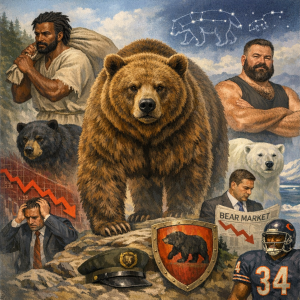
In its primary zoological sense, the word denotes a large mammal of the family Ursidae. Bears are generally heavy-bodied, short-tailed, plantigrade animals with powerful limbs, nonretractile claws, and an acute sense of smell. Living species include the American black bear, brown bear, polar bear, Asian black bear, sun bear, sloth bear, spectacled bear, and giant panda. North America has three native species: the American black bear, brown bear, and polar bear.
The noun also has several extended meanings:
- A powerful, rough, or formidable person: The comparison may emphasize strength, size, protectiveness, awkwardness, or an unsociable disposition.
- A pessimistic market participant: In finance, a bear expects the price of a security, commodity, or market to decline. A “bear market” is a sustained period of falling prices and pessimistic sentiment. The commonly used benchmark is a decline of at least 20 percent in a broad market index, although that convention is not itself a universal rule of law.
- A cultural identity: In contemporary LGBTQ usage, particularly among gay men, the term may refer to a large, heavyset, muscular, or hairy man and to communities organized around that identity.
- A proper name or emblem: The animal appears in personal names, place names, heraldry, military insignia, sports mascots, national and regional symbols, and astronomical names such as the Great Bear and Little Bear.
As a Verb
As a verb, the word may mean:
- to carry, convey, or support a person, object, weight, office, title, or responsibility;
- to sustain pressure, expense, liability, hardship, pain, or loss;
- to endure or tolerate, as in “cannot bear the delay”;
- to produce, yield, or bring forth, as when a tree bears fruit;
- to give birth to a child;
- to possess, exhibit, or display a name, mark, seal, resemblance, or inscription;
- to give testimony, as in “bear witness”;
- to carry oneself or maintain a manner, posture, or relationship;
- to move or turn in a stated direction, as in “bear left” or “bear north”; and
- to have a legally significant burden, duty, risk, cost, or responsibility.
The verb must be distinguished from bare, meaning to uncover or expose. A person bears a burden but bares an arm. The ordinary past tense is bore. The past participle is usually borne, while born is normally reserved for the fact of birth: a burden is borne, but a child is born.
Etymology and Origin
The animal noun and the carrying verb are homonyms with different historical lines. The animal name comes through Old English bera and related Germanic forms, including Old Norse bjǫrn, Dutch beer, and German Bär. A widely repeated etymological theory connects the Germanic name with a root meaning “brown” or “the brown one.” According to the traditional explanation, early Germanic speakers avoided the animal’s older inherited name because naming a dangerous animal directly was believed to attract it, offend it, or give it power.
The taboo-avoidance explanation is plausible and influential, but its strongest form should not be treated as proven fact. Historical linguists reconstruct prehistoric forms from later languages; they do not possess a written account from Proto-Germanic speakers explaining why the substitution occurred. Moreover, scholars have questioned whether the proposed “brown” root can be reconstructed as confidently as popular accounts sometimes suggest. The careful conclusion is that “the brown one” is a conventional and plausible etymology, while the claim that fear of summoning the animal caused the name change remains an inference.
Greek arktos and Latin ursus preserve forms related to the older Indo-European animal name. Greek arktos also underlies Arctic, literally the northern region associated with the Bear constellations.
The verb descends from Old English beran, meaning to carry, bring, support, endure, produce, or give birth. It belongs to a broad Indo-European family represented by Latin ferre and Greek pherein, both meaning to carry or bring. The verb’s many modern senses developed naturally from the central image of carrying: one may carry a physical load, carry legal responsibility, carry a child, carry a weapon, carry a name, or carry suffering without surrender.
Cultural and Historical Context
Bears have occupied an unusual position in human culture because they combine recognizable humanlike behaviors with immense physical power. They stand upright, manipulate objects with their forepaws, protect their young, eat both plants and animals, and withdraw seasonally into dens. These qualities have made them symbols of strength, motherhood, healing, danger, sovereignty, renewal, and the wilderness.
Indigenous traditions are diverse and should not be compressed into a single “Native American bear belief.” In numerous North American societies, bears supplied meat, fat, hides, bones, tools, medicine, and ceremonial materials. Particular nations developed their own teachings concerning kinship, hunting conduct, healing, courage, and respectful treatment of the animal. The U.S. Geological Survey notes that American black bears historically served both practical and symbolic roles among Indigenous peoples, including associations with strength, hard work, and love. Such traditions belong to specific peoples and should not be appropriated as a universal spiritual system.
In northern Eurasia and among the Ainu of Japan, documented ceremonial traditions treated the bear as a powerful spiritual being or visitor from another realm. Other societies portrayed it as an ancestor, forest ruler, warrior, or guardian. European heraldry later used bears to signify courage, ferocity, protection, and territorial identity. The animal remains prominent in civic emblems, including the flag of California, where the grizzly represents strength despite the extinction of the native California grizzly population.
The word also entered military and governmental language through the verb. A standard-bearer was literally a person entrusted to carry a military standard, banner, or ensign. Because the standard identified and rallied a body of troops, losing it could be a grave dishonor. Figuratively, a standard-bearer became the leading representative of a cause, party, movement, or set of principles.
Biblical / Torah Context
The animal does not play a developed symbolic role in the Torah, meaning the Five Books of Moses. Its significant appearances occur elsewhere in the Hebrew Bible. The Hebrew noun is dov or dob (דֹּב), which occurs twelve times in the traditional Hebrew text according to standard concordances.
Biblical writers ordinarily invoke the animal as an image of physical danger, ferocity, grief, royal oppression, or judgment. David tells Saul that, while tending sheep, he defended the flock against both lion and bear; the account presents pastoral protection as preparation for confronting Goliath. Proverbs declares that meeting a mother bear robbed of her cubs is safer than encountering a fool acting in folly. Hosea compares impending judgment to the attack of a bereaved mother bear. Proverbs 28:15 likens a wicked ruler over poor people to a charging lion and hungry bear, making the animal an image of predatory government.
Isaiah 11 reverses the usual image of danger: the cow and bear feed together, and their young lie down together. In that prophetic vision, reconciliation within creation demonstrates the peace and justice of the coming righteous order.
Daniel 7 describes a symbolic beast resembling a bear. Interpretive traditions commonly connect the animal with an empire represented in Daniel’s sequence of kingdoms, although the precise historical identification has been debated. Revelation 13 later describes a composite beast with feet like those of a bear, drawing upon Daniel’s imagery to portray violent political power. It is therefore unsound to declare that every biblical bear always represents one modern nation, government, or political movement.
The account in 2 Kings 2:23–24, in which two female bears maul forty-two members of a group mocking the prophet Elisha, is one of the Bible’s most controversial narratives. Translations vary between “children,” “boys,” “lads,” and “youths” because the relevant Hebrew terms can cover a range of ages and social positions. The passage does not state that all forty-two were killed, although it clearly describes severe violence. Traditional readings treat the event as judgment for organized contempt toward a prophetic office; critics regard the punishment as morally disproportionate. A responsible dictionary entry should identify these interpretive disputes rather than pretending that the language removes every ethical difficulty.
The English verb is also important in biblical translation. Scripture speaks of bearing witness, bearing burdens, bearing fruit, bearing sin, bearing a name, and bearing one another’s weaknesses. These expressions preserve the verb’s central idea: carrying something that has moral, evidentiary, relational, or spiritual weight.
Legal Implications
Carrying Duties, Risks, and Burdens
Legal English frequently uses the verb to assign responsibility. A party may bear costs, liability, risk of loss, a tax burden, the burden of proof, or the consequences of breach. In litigation, the party who bears the burden of persuasion risks losing on an issue if the evidence remains insufficient or evenly balanced. The burden of production concerns the duty to introduce enough evidence for an issue to be considered. These burdens may be allocated by common-law principles, constitutional rules, statutes, rules of evidence, or the elements of a particular claim or defense.
In most American civil actions, a plaintiff ordinarily bears the burden of proving the claim by a preponderance of the evidence. In a criminal prosecution, the government bears the burden of proving guilt beyond a reasonable doubt. Exceptions and shifting burdens depend on jurisdiction and subject matter; the ordinary wording does not permit the automatic conclusion that every defendant must prove innocence.
To Bear Witness
To bear witness is to give testimony, attest to a fact, or supply evidence. Historically, testimony might be borne orally, by affidavit, through a subscribed instrument, or by persons witnessing an act such as the execution of a will. Modern evidentiary law distinguishes personal knowledge, admissible testimony, authentication, hearsay, and expert opinion. The moral command to speak truth and the legal duty imposed by oath overlap, but they are not identical: legal testimony remains subject to procedural rules and penalties for perjury.
Bearer Instruments
A bearer is the person possessing an instrument or document payable or deliverable to whoever holds it. Under the Uniform Commercial Code, an instrument may be payable to bearer when it expressly says so, names no payee, is payable to cash, or otherwise indicates that the possessor is entitled to payment. Bearer paper can generally be negotiated by transfer of possession, unlike an instrument payable to an identified person that may require an indorsement. These are statutory commercial-law rules, not mystical consequences arising merely from possession of ordinary paper.
The Right to Keep and Bear Arms
In American constitutional law, “bear arms” appears in the Second Amendment. Its historical meaning has been intensely disputed. Some evidence uses the expression in military or militia settings; other evidence supports the broader sense of carrying weapons for confrontation, defense, or other lawful purposes.
In District of Columbia v. Heller (2008), the United States Supreme Court held that the Second Amendment protects an individual right to possess and carry weapons for lawful purposes, including self-defense in the home, and is not limited to active militia service. McDonald v. City of Chicago (2010) applied that right against state and local governments. New York State Rifle & Pistol Association v. Bruen (2022) recognized that the right extends beyond the home and directed courts to examine constitutional text and the nation’s historical tradition of firearm regulation. In United States v. Rahimi (2024), the Court held that a person judicially found to pose a credible threat to another’s physical safety may be temporarily disarmed consistently with the Second Amendment.
These decisions do not establish an unlimited right to possess or carry every weapon in every location or circumstance. Firearms law remains governed by constitutional decisions together with federal, state, territorial, tribal, and local statutes. Claims about what a person may legally carry must therefore be examined under the law of the relevant jurisdiction.
Spiritual Meaning
Outside formal biblical interpretation, the animal is often treated as a spiritual image of strength, protection, courage, introspection, healing, and renewal. Seasonal denning has inspired comparisons with retreat, death and rebirth, contemplation, and the restoration of strength. A mother defending her cubs may represent protective love, while an attacking bear may symbolize uncontrolled anger, oppressive power, or danger that has been underestimated.
These meanings are interpretive rather than universal facts. There is no single, historically uniform “bear spirit” shared by all religions or peoples. Personal dream interpretations, animal-guide teachings, and modern spiritual systems may be meaningful to adherents, but they should not be falsely attributed to the Torah, the Bible, or an unspecified Indigenous tradition.
The verb contributes a separate spiritual dimension. To bear a burden can signify patience and responsibility; to bear witness can signify fidelity to truth; and to bear fruit can signify that inward character has produced visible results. Healthy endurance should not, however, be confused with a religious obligation to remain under abuse, fraud, or unlawful domination.
Modern Usage
Common modern expressions include “bear in mind,” “bring pressure to bear,” “bear responsibility,” “bear the cost,” “bear fruit,” “bear witness,” “bear arms,” “bear with me,” “grin and bear it,” “take one’s bearings,” and “have a bearing on.” Although each retains some idea of carrying, direction, production, or support, the legal effect of an expression depends on the full sentence and governing document.
In markets, bearish describes an expectation of declining prices. The financial use is often traced to traders who sold bearskins before obtaining them, anticipating that they could later acquire the skins more cheaply. The popular explanation that bears symbolize falling markets because they strike downward is memorable but is probably a later visual analogy rather than the original source.
In conservation discourse, the animal may represent wilderness protection, habitat conflict, hunting regulation, public safety, and coexistence. Romantic portrayals should not obscure that bears are powerful wild animals. Conversely, fear-based portrayals should not erase their ecological role or justify careless destruction.
Controversies / Criticisms
- Etymological certainty: “The brown one” and prehistoric naming taboo are credible theories, but popular retellings often present reconstructed motives as recorded history.
- Biblical overinterpretation: Assigning one fixed prophetic meaning to every occurrence ignores literary context and differences among wisdom, narrative, prophetic, and apocalyptic texts.
- Second Amendment disputes: Arguments continue over the historical scope of “bear arms,” proper analogies to founding-era regulation, protected weapons, sensitive places, licensing, and disqualification. Current doctrine must be distinguished from a writer’s political preference.
- Spiritual appropriation: Generic claims about “Native bear medicine” may combine unrelated traditions or detach sacred teachings from the peoples to whom they belong.
- Legal wordplay: Similarity among bear, bearer, “birth certificate,” “strawman,” and negotiable-instrument terminology does not create secret ownership rights or release a person from statutes, judgments, taxes, or contractual obligations.
- Social labeling: The modern identity term may be affirming when self-chosen but intrusive or insulting when imposed on another person.
Conclusion
The word unites two ancient but distinct ideas: a formidable animal and the act of carrying. From those roots developed a remarkable range of meanings involving strength, endurance, birth, testimony, responsibility, direction, finance, warfare, law, government, and spiritual reflection. Its legal uses are especially dependent on context: bearing a burden of proof, possessing bearer paper, and bearing arms involve different bodies of doctrine and cannot be interpreted by etymology alone.
The animal’s cultural power likewise requires careful treatment. Documented traditions may properly be described, but disputed linguistic theories, prophetic systems, and modern spiritual interpretations should be identified as interpretations rather than universal truths. At its broadest, the term conveys the capacity either to carry great weight or to embody great power—and therefore also raises the question of how such weight and power are responsibly governed.
Sources / Further Reading
- Merriam-Webster, “Bear”: https://www.merriam-webster.com/dictionary/bear
- Online Etymology Dictionary, “Bear”: https://www.etymonline.com/word/bear
- U.S. National Park Service, “Cultural Connections to Bears”: https://www.nps.gov/subjects/bears/bearculture.htm
- U.S. Geological Survey, “American Black Bear”: https://www.usgs.gov/publications/american-black-bear-ursus-americanus
- Investor.gov, “Bear Market”: https://www.investor.gov/introduction-investing/investing-basics/glossary/bear-market
- Blue Letter Bible, Hebrew Lexicon H1677, dov: https://www.blueletterbible.org/lexicon/h1677/wlc/wlc/0-1/
- Bible Gateway, “Bear,” Encyclopedia of the Bible: https://www.biblegateway.com/resources/encyclopedia-of-the-bible/Bear
- Cornell Legal Information Institute, “Burden of Proof”: https://www.law.cornell.edu/wex/burden_of_proof
- Uniform Commercial Code § 1-201, General Definitions: https://www.law.cornell.edu/ucc/1/1-201
- Uniform Commercial Code § 3-109, Payable to Bearer or Order: https://www.law.cornell.edu/ucc/3/3-109
- Congressional Research Service, Constitution Annotated, Second Amendment Overview: https://constitution.congress.gov/browse/essay/amdt2-1/ALDE_00000408/
- District of Columbia v. Heller, 554 U.S. 570 (2008): https://supreme.justia.com/cases/federal/us/554/570/
- United States v. Rahimi, 602 U.S. 680 (2024): https://www.law.cornell.edu/supremecourt/text/22-915