
Primary Definition
Youthful is an adjective meaning of, relating to, characteristic of, suitable for, or marked by youth. It may describe a person who is young or not yet fully mature, but it also commonly describes qualities associated with youth: freshness, vigor, hope, energy, inexperience, playfulness, novelty, or an appearance of being young.
The word does not establish a fixed age. A “youthful person” may be a child, adolescent, young adult, or—when the word is used figuratively—an older person who retains energy, curiosity, resilience, or a young-looking appearance. Thus, the meaning depends heavily on context. “Youthful athletes” ordinarily refers to persons who are young; “a youthful nation” refers to a nation with a relatively young population or a sense of newness and possibility; “a youthful face” concerns appearance rather than legal age.
Standard dictionaries recognize both the literal and figurative senses. Merriam-Webster defines youthful as relating to or characteristic of youth; being young and not yet mature; possessing youth; or having youth’s freshness and vigor. The dictionary also recognizes a specialized physical-geography use: “youthful mountains” are mountains that have experienced comparatively little erosion. ([merriam-webster.com](https://www.merriam-webster.com/dictionary/youthful?utm_source=openai))
In ordinary use, youthful is generally favorable, suggesting vitality and promise. Yet it can be neutral or critical where it points to immaturity, lack of experience, impulsiveness, or naiveté. “Youthful enthusiasm” may be praise; “youthful indiscretion” often means a past error attributed, fairly or unfairly, to immaturity.
Distinctions
- Youthful describes a quality, appearance, condition, conduct, or association with youth.
- Young is broader and more direct; it usually concerns age, relative newness, or early development.
- Youth is ordinarily a noun referring to the period of life, young people collectively, or sometimes an individual young person.
- Juvenile is more technical and may carry legal, institutional, or unfavorable connotations depending on context.
- Immature usually emphasizes incomplete development or deficient judgment; it is not a synonym for every use of youthful.
Etymology and Origin
Youthful is formed from youth and the English adjectival suffix -ful. In this construction, -ful means “full of,” “having,” or “characterized by.” The literal structural sense is therefore “characterized by youth.”
The modern word is recorded from the sixteenth century. Etymological sources date youthful to the 1560s in the senses “not yet aged” and “pertaining or suitable to the early stage of life,” with the further sense “fresh and vigorous” appearing by about 1580. Merriam-Webster gives a first known use of 1557. ([etymonline.com](https://www.etymonline.com/word/youthful?utm_source=openai))
The underlying noun youth comes through Middle English from Old English geoguð, meaning the early stage of life, youthfulness, young people, and in some uses young warriors or the young of animals. It is related to Old English geong, meaning “young.” The word belongs to a broad Germanic family that includes modern German Jugend and Dutch jeugd. Etymologists connect the deeper linguistic ancestry to an Indo-European root associated with youthful vigor or vital force. ([etymonline.com](https://www.etymonline.com/word/youthful?utm_source=openai))
This history is important because the word began as an English and Germanic expression. It is not derived from a Roman legal category, a Greek religious title, a military rank, or an ecclesiastical office. Although Latin and Roman law had their own classifications for children and persons below full legal capacity, those classifications do not supply the English word youthful.
Cultural and Historical Context
Historically, societies have treated youth both as a period of strength and promise and as a period requiring instruction, discipline, and gradual assumption of responsibility. The word youthful reflects that double character. It can praise readiness, courage, physical power, and openness to learning, while also suggesting that judgment has not yet been fully tested by experience.
Older English usage could connect youth with service, apprenticeship, family authority, military readiness, and inheritance. In agricultural and household societies, a person’s passage from childhood into productive responsibility was often more socially visible than it is in modern industrial society. The contemporary idea of a distinct “teenage” culture is comparatively recent, but the older vocabulary of youth has long marked the transition between dependence and mature social standing.
In literature, “youthful” frequently carries imagery of spring, dawn, green growth, beginnings, beauty, and quick movement. Such imagery is interpretive rather than a legal definition. It reflects a recurring cultural tendency to associate youth with renewal and possibility. At the same time, literature often contrasts youthful confidence with the wisdom, caution, or regret associated with age.
The word may also be used of things that are not persons. A youthful organization may be newly founded; a youthful style may be lively, informal, or associated with younger consumers; a youthful landscape, in geology, may refer to an early erosional stage. In each case, the core idea is relative newness, vigor, or incomplete development rather than a particular number of years.
Biblical / Torah Context
The English adjective youthful does not occur as a governing technical category in the Torah or in biblical law. Biblical Hebrew instead uses several words that English translations may render as “child,” “young person,” “young man,” “youth,” or “youthful.” Care should therefore be taken not to treat an English word as if it were the original Hebrew legal or theological term.
For example, Psalm 119:9 uses the Hebrew na’ar, commonly translated “young man” in many English versions: “How can a young man keep his way pure?” The verse answers by directing the person to guard his way according to God’s word. In this setting, youth is not presented as an excuse for moral disorder. Rather, the early period of life is a time for learning, self-government, and obedience. ([sefaria.org](https://www.sefaria.org/Psalms.119.9?utm_source=openai))
Ecclesiastes 11:9 uses language translated as “young man,” “youth,” and “youthfulness.” It calls the young to rejoice in the days of youth but immediately joins enjoyment with accountability before God. The following verse observes that youth and physical vigor are fleeting. This passage does not condemn joy, strength, or youth itself; it places them within the reality of mortality, moral responsibility, and divine judgment. ([sefaria.org](https://www.sefaria.org/Ecclesiastes.11.9?utm_source=openai))
In Torah and biblical wisdom generally, the proper formation of the young is communal as well as personal. Parents are instructed to teach God’s commandments diligently to their children. The concern is not merely chronological age but the transmission of covenantal instruction, memory, justice, and reverence for God. A youthful person is therefore capable of learning, service, accountability appropriate to circumstances, and growth in wisdom.
The New Testament likewise treats youth as neither a disqualification nor a license for irresponsibility. In 1 Timothy 4:12, Timothy is instructed not to permit others to despise his youth, but to be an example in speech, conduct, love, faith, and purity. The principle commonly drawn from the passage is that credible character may answer contempt based on age. ([biblegateway.com](https://www.biblegateway.com/passage/?search=1+Timothy+4%3A12&version=KJV&utm_source=openai))
Legal Implications
“Youthful” is ordinarily not a legal term of art. By itself, it does not define a person’s age of majority, contractual capacity, criminal responsibility, voting eligibility, military status, or family-law rights. Legal consequences arise from more precise terms such as minor, child, juvenile, infant, adolescent, or from an age expressly stated in a constitution, statute, regulation, contract, or court order.
Under historical English common law, “infant” was the principal legal word for a person below full age; it did not mean only a baby. Blackstone described infancy as continuing until age twenty-one and explained that an infant generally lacked full ability to make a binding deed, subject to recognized exceptions and qualifications. This historical common-law usage differs from ordinary modern speech, in which “infant” normally means a very young child. ([avalon.law.yale.edu](https://avalon.law.yale.edu/18th_century/blackstone_bk1ch17.asp?utm_source=openai))
Modern American law is principally statutory and varies by jurisdiction. In most states, the age of majority is eighteen, but particular rights and duties may attach at different ages. Juvenile justice, education, child welfare, labor, consent, marriage, voting, and alcohol laws use their own definitions and qualifications. The federal Juvenile Delinquency Act, for example, defines a “juvenile” generally by reference to a person who has not attained eighteen years of age, while federal workforce law may define “out-of-school youth” using an age range from sixteen through twenty-four. ([law.cornell.edu](https://www.law.cornell.edu/wex/juvenile?utm_source=openai))
Accordingly, describing someone as “youthful” in a legal filing, affidavit, policy, or contract is usually too indefinite if legal consequences depend on age. A careful legal writer should state the person’s actual age or use the governing statutory term. For example, “a youthful employee” is rhetorically understandable but legally weaker than “an employee age seventeen,” “a minor,” or “an individual covered by the applicable child-labor statute.”
Neither Roman law nor equity supplies a special general doctrine of “youthful” persons under that exact English adjective. Roman law had age-related categories, and equity historically developed protective principles concerning infants, wards, fiduciaries, and unconscionable dealings. Those bodies of law may be relevant to disputes involving minors, but they should not be confused with a definition of youthful itself.
Spiritual Meaning
In spiritual reflection, youthful often signifies more than biological age. It may describe renewed hope, readiness to learn, humility, courage, gratitude, and the capacity to begin again. Such use is metaphorical. It should not be mistaken for a promise that physical aging is spiritually defective or that youth automatically equals virtue.
A balanced spiritual reading recognizes both gifts and dangers associated with youth. Energy may become service; curiosity may become wisdom; confidence may become courage; and teachability may become maturity. Conversely, energy without self-command may become recklessness, and independence without moral grounding may become pride. The biblical pattern is not contempt for youth but formation of youth through truth, discipline, faithful example, and responsibility.
For this reason, “youthful spirit” can be a wholesome expression when it means living with gratitude and vitality. It becomes misleading when used to deny the value of age, experience, patience, or sober judgment. Spiritual maturity does not require abandoning joy; it requires ordering joy toward what is good.
Modern Usage
Modern English uses youthful in at least four principal ways:
- Age-related: “The program serves youthful participants.”
- Appearance-related: “She has a youthful appearance.”
- Temperament-related: “His youthful optimism encouraged the group.”
- Figurative or technical: “The company has a youthful brand,” or “the region has youthful landforms.”
The term is common in advertising, fashion, cosmetics, fitness, entertainment, and political speech. In these settings, it often functions as a favorable label for freshness or desirability. Readers should recognize that commercial uses may imply that looking young is inherently preferable. That implication is cultural and promotional, not an objective definition of worth.
In government and nonprofit programs, “youth” may be a defined eligibility category, but the definition must be located in the particular program’s governing authority. In military contexts, “youthful” may describe recruits, cadets, or a demographic population in ordinary language, but it is not generally a rank or universal military classification.
Controversies / Criticisms
The principal difficulty with youthful is vagueness. Because it can mean young in age, young-looking, energetic, inexperienced, or newly developed, it may obscure rather than clarify important facts. This is especially problematic in legal, medical, employment, educational, and governmental writing, where a specific age or formal status may matter.
The word may also reinforce age-based assumptions. Calling an adult “youthful” can be complimentary, but calling a young adult “youthful” may sometimes diminish that person’s competence or authority. Conversely, calling an older person “youthful” as praise can suggest that age itself is undesirable. These are not defects built into the word’s dictionary meaning, but they are possible effects of social usage.
Some claims made in popular etymology go further than the evidence allows, asserting hidden religious, governmental, or legal meanings merely because a word concerns youth. The documented linguistic history does not support such claims. Youthful is a straightforward English formation from youth plus -ful; its meaning has developed through ordinary English usage.
Conclusion
Youthful means characterized by youth, whether literally in age or figuratively in vigor, freshness, appearance, or newness. Its English roots are Germanic, its established written use reaches back to the sixteenth century, and its ordinary meaning remains stable: it points to qualities associated with the early stages of life.
In biblical and spiritual contexts, youth is presented as a season of joy, formation, moral responsibility, and potential. In law, however, youthful should not be treated as a precise legal classification. Historical common law used “infant” for persons below full age, while current law relies on statutes and jurisdiction-specific definitions such as “minor” or “juvenile.” Sound interpretation therefore requires attention to the setting in which the word is used.
Sources / Further Reading
- Merriam-Webster, “Youthful”: https://www.merriam-webster.com/dictionary/youthful
- Online Etymology Dictionary, “Youthful”: https://www.etymonline.com/word/youthful
- Yale Law School Avalon Project, William Blackstone, Commentaries on the Laws of England, Book I, Chapter 17: https://avalon.law.yale.edu/18th_century/blackstone_bk1ch17.asp
- Cornell Legal Information Institute, “Juvenile”: https://www.law.cornell.edu/wex/juvenile
- Cornell Legal Information Institute, 29 U.S.C. § 3164 definition of in-school and out-of-school youth: https://liicornell.org/definitions/uscode.php?def_id=29-USC-11552049-696109131&iframe=true
- Sefaria, Psalm 119:9: https://www.sefaria.org/Psalms.119.9
- Sefaria, Ecclesiastes 11:9: https://www.sefaria.org/Ecclesiastes.11.9
- Bible Gateway, 1 Timothy 4:12: https://www.biblegateway.com/passage/?search=1%20Timothy%204%3A12&version=KJV
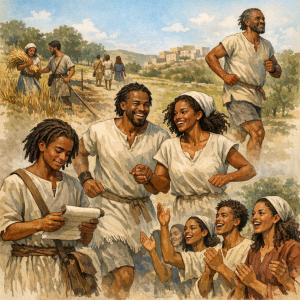
- Youthful!-- cld-ai-expansion-start -- !-- cld-ai-inline-image-start --!-- cld-ai-inline-image-end --
Primary Definition
Youthful is an adjective meaning of, relating to, characteristic of, suitable for, or having the appearance, freshness, energy, or qualities commonly associated with youth. The word may describe a person, a physical appearance, conduct, an attitude, a nation, an organization, a style, or an object.
The term has two principal senses:
- Literal or age-related: young; belonging to the earlier period of life; appropriate to young persons. Example: “a youthful student,” “youthful clothing,” or “a youthful congregation.”
- Figurative or qualitative: fresh, vigorous, lively, hopeful, energetic, or retaining an appearance associated with younger age. Example: “a youthful spirit,” “a youthful voice,” or “a youthful appearance.”
“Youthful” does not necessarily mean that a person is legally a child, a minor, immature, inexperienced, or incapable. An adult may be described as youthful because of appearance, vitality, enthusiasm, curiosity, adaptability, or conduct. Conversely, a young person may not be described as youthful where the intended meaning is energetic, fresh, or carefree.
The word is ordinarily favorable, but its force depends upon context. “Youthful energy” is generally praise. “Youthful error,” “youthful impulse,” or “youthful indiscretion” can imply inexperience, haste, lack of judgment, or conduct expected to be corrected by maturity. Thus, the word may recognize both the strength and the incompleteness historically associated with early life.
Etymology and Origin
Youthful is formed from youth plus the English adjectival suffix -ful. In this construction, -ful generally means “full of,” “marked by,” or “characterized by.” A youthful person is therefore one characterized by youth or by traits associated with youth.
The word is documented in English from the sixteenth century. Etymological references place its use in the 1560s in the...