Eos quod earum officiis voluptatem.
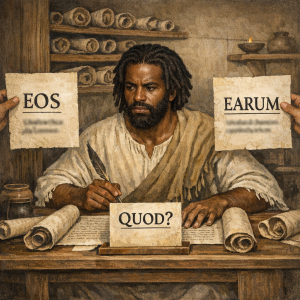
Primary Definition
Eos quod earum is not a documented Latin maxim, common-law term of art, biblical expression, governmental formula, military phrase, or established English idiom. It should therefore not be treated as a self-contained legal or spiritual term with a fixed dictionary meaning.
As written, the sequence appears to combine recognizable Latin forms without supplying the grammatical structure necessary for a complete translation. The most cautious dictionary definition is therefore:
An incomplete or non-idiomatic Latin-looking sequence composed of inflected pronouns and a conjunction; it has no reliable independent meaning unless restored to a larger, verified textual context.
The individual forms are capable of ordinary Latin analysis:
- eos commonly means “them” or “those,” specifically the masculine accusative plural of is, ea, id, a demonstrative pronoun meaning “that,” “he,” “she,” “it,” or “they.”
- quod can mean “because,” “that,” “which,” “what,” “insofar as,” or “as to which,” depending upon grammar and context.
- earum means “of them” or “their,” specifically the feminine genitive plural of is, ea, id.
Those possible glosses do not combine naturally into a settled English clause. A literal word-by-word attempt such as “them because of them” or “those which of them” is not a translation. Latin is an inflected language: meaning depends on agreement, syntax, omitted nouns, verbs, antecedents, and the surrounding sentence. The masculine accusative plural eos and feminine genitive plural earum may refer to entirely different persons or things. Without context, one cannot responsibly decide who is meant, what action is occurring, or whether quod means “because,” “which,” “that,” or another of its recognized functions. ([latin-is-simple.com](https://www.latin-is-simple.com/en/vocabulary/dempron/1/?utm_source=openai))
Accordingly, this entry does not assign the sequence a fabricated translation. The dictionary’s interpretive conclusion is that it is best classified as an incomplete fragment, probably drawn from placeholder or automatically generated pseudo-Latin material rather than from a conventional Latin source.
Etymology and Origin
The terms in the sequence have separate Latin histories, but the sequence itself has no demonstrated etymology as a phrase.
Eos
In ordinary Latin grammar, eos is an inflected form of is, ea, id, an ancient demonstrative pronoun. It is ordinarily masculine, plural, and accusative. It may function as the direct object of a verb, as in “I saw them,” or as an adjective modifying a masculine plural noun, as in “those men.” Its exact English rendering depends upon the noun or antecedent supplied by context. Latin declensional tables distinguish eos (“them,” masculine accusative plural) from eas (“them,” feminine accusative plural) and ea (“them” or “those things,” neuter accusative plural). ([latin-is-simple.com](https://www.latin-is-simple.com/en/vocabulary/dempron/1/?utm_source=openai))
The spelling Eos, when capitalized, can also identify the Greek goddess of dawn, known to Romans as Aurora. That proper-name use is distinct from the Latin pronoun eos. Capitalization alone does not establish that mythological meaning, especially where surrounding words are plainly susceptible to ordinary Latin grammatical analysis. The interpretive claim that this phrase invokes the goddess Eos would therefore be speculative and unsupported. ([perseus.tufts.edu](https://www.perseus.tufts.edu/hopper/text?doc=Perseus%3Atext%3A1999.04.0104%3Aentry%3Deos-bio-1&utm_source=openai))
Quod
Quod is a highly flexible Latin word. It is historically related to the relative and interrogative pronoun family represented by qui, quae, quod. In use, it may introduce a clause meaning “because” or “that”; it may refer to a preceding fact, circumstance, or proposition; and, in other constructions, it may mean “which” or “what.” Classical authorities record uses equivalent to “that,” “in that,” and “because,” among others. ([atlas.perseus.tufts.edu](https://atlas.perseus.tufts.edu/dictionaries/entry/urn%3Acite2%3Ascaife-viewer%3Adictionary-entries.atlas_v1%3Alat.ls.perseus-eng2-n40262/?utm_source=openai))
Because quod introduces or connects propositions, it normally requires more language around it. Its presence in a three-word fragment is one reason no complete interpretation can be safely inferred. A reader would need to know whether it begins a subordinate clause, resumes an earlier thought, functions as a relative pronoun, or forms part of a larger construction.
Earum
Earum is the feminine plural genitive form of is, ea, id. It may mean “of those women,” “of those things” when the things are grammatically feminine, “of them,” or “their.” It does not itself identify the feminine persons or objects in question. A noun may be expressed elsewhere, implied by the discourse, or understood from an antecedent.
The separate morphology of the component words is documented; what is not documented is an idiomatic phrase formed by placing these three forms together. A dictionary entry should preserve that distinction. A real word can occur in a meaningless or incomplete string, and grammatical appearance alone does not create a maxim, doctrine, or defined expression.
Cultural and Historical Context
The most plausible cultural context is modern pseudo-Latin or placeholder-text usage. The protected material associated with this entry contains language strongly resembling the vocabulary and cadence of Lorem ipsum filler text, including forms such as officiis, voluptatem, and earum. Much modern placeholder text is derived, directly or indirectly, from a passage in Cicero’s De finibus bonorum et malorum (“On the Ends of Good and Evil”), while many generators also rearrange, truncate, or augment Latin-looking words. ([ww1.thelatinlibrary.com](https://ww1.thelatinlibrary.com/cicero/fin1.shtml?utm_source=openai))
The relevant Ciceronian passage is philosophical, discussing pleasure, pain, error, choice, and human conduct. It includes phrases that became familiar through placeholder-text traditions, but that does not mean every group of familiar-looking words is a quotation from Cicero. The authentic text contains meaningful sentences in a continuous argument. By contrast, modern filler text may detach words from their syntax, mix material from nearby passages, substitute words, or generate sequences that merely resemble Latin.
This distinction matters historically. Cicero wrote in the first century BCE, in a highly developed literary Latin. Lorem ipsum as used in printing, publishing, web design, software mockups, and templates is a later typographic convention. A phrase appearing in generated filler material should not be back-projected into Roman philosophy, Roman religion, Roman law, or classical rhetoric without an identifiable edition and passage.
There is no reliable evidence that Eos quod earum was an ancient Roman saying, a medieval legal formula, a church motto, or a phrase preserved in canonical biblical manuscripts. The absence of a verifiable source is not proof that no similar arrangement ever appeared in Latin writing; it does mean that claims of a fixed historical meaning should not be made as fact.
Biblical / Torah Context
No direct Biblical or Torah context is established for this sequence. The Hebrew Bible/Torah was principally composed in Hebrew, with portions in Aramaic; the New Testament was principally composed in Koine Greek. Latin became important through translations and later Western ecclesiastical use, especially the Vulgate, but a Latin-looking phrase is not thereby biblical.
Some of the individual forms may occur in Latin biblical translations because demonstrative pronouns and conjunctions are ordinary features of Latin. Their occurrence as ordinary grammatical words does not turn the supplied sequence into a scriptural quotation. No verse reference should be assigned unless the exact wording is located in a reliable edition and shown in its complete textual setting.
Likewise, Eos should not be confused with a biblical divine name. In Greek religion, Eos is the personification or goddess of dawn; that separate mythological name has no demonstrated connection to the grammatical Latin use of eos in this fragment. ([perseus.tufts.edu](https://www.perseus.tufts.edu/hopper/text?doc=Perseus%3Atext%3A1999.04.0104%3Aentry%3Deos-bio-1&utm_source=openai))
Legal Implications
Eos quod earum has no known legal force in common law, equity, statutory law, modern American law, Roman law, canon law, admiralty law, military law, or governmental procedure. It does not identify a writ, remedy, cause of action, defense, rule of evidence, jurisdictional doctrine, constitutional principle, or maxim of interpretation.
This conclusion is especially important in legal research. Latin has historically supplied many legal expressions, but legal effect does not arise merely because words are Latin. A valid legal maxim ordinarily has a settled form, a traceable source, a recognized translation, and a history of judicial, legislative, or scholarly use. Examples of genuine legal Latin terms include habeas corpus, mens rea, res judicata, and stare decisis. Even these expressions derive their present legal consequences from particular legal systems, cases, statutes, constitutional provisions, and procedural rules—not simply from their literal translations.
Historically, Roman law developed its own technical vocabulary and should not be conflated with English common law. English common law developed through English courts and precedents, while equity developed through separate equitable institutions and principles. Modern United States law is additionally shaped by federal and state constitutions, statutes, regulations, judicial decisions, and procedural rules. No source demonstrates that the supplied sequence operates within any of these bodies of law.
Therefore, it should not be used in pleadings, affidavits, contracts, courtroom argument, notices, or claims of personal status as though it carries hidden legal authority. A court will generally require intelligible legal argument grounded in applicable law and evidence. A non-idiomatic Latin fragment is not a substitute for citation to a controlling statute, rule, case, treaty, or constitutional provision.
Spiritual Meaning
No inherent spiritual meaning can be reliably assigned to the sequence. Individual readers may find symbolic value in dawn imagery if they choose to focus on the proper name Eos, or they may draw moral themes from the larger Ciceronian discussion of pleasure and pain. Such readings are personal or literary interpretations, not dictionary definitions.
It is important to distinguish interpretive reflection from documented origin. The phrase itself does not establish a prayer, blessing, invocation, occult formula, sacred name, or spiritual doctrine. Claims that it encodes a hidden religious message, ancient ritual, divine authority, or binding metaphysical principle are unsupported unless accompanied by a credible primary source and a sound linguistic analysis.
For a spiritually responsible reading, the appropriate principle is context: determine the actual text, author, language, translation, and historical setting before deriving theological or moral conclusions. Where the wording is generated or fragmentary, the wiser course is to avoid attaching spiritual certainty to it.
Modern Usage
In modern use, this sequence is most likely encountered as sample text, database filler, website-template content, automated test material, or a fragment copied from a pseudo-Latin generator. Such material is designed primarily to imitate the visual texture of natural-language prose. It is often useful for demonstrating fonts, page layouts, columns, line spacing, form fields, and visual hierarchy without distracting readers with substantive content.
That functional use explains why a string may contain real Latin words while lacking a coherent proposition. Placeholder content does not have to obey the grammar, idiom, or rhetorical structure of classical Latin. Its design purpose is visual, not philological.
For editorial, legal, academic, or publishing work, the recommended practice is to replace pseudo-Latin before publication. If Latin is intentionally used, the phrase should be verified against a reliable Latin text or checked by a qualified Latinist. Machine translation alone may be inadequate because Latin word order, inflection, ellipsis, and historical usage require contextual interpretation.
Controversies / Criticisms
The principal controversy surrounding phrases of this kind is overinterpretation. Because Latin carries associations of antiquity, law, religion, education, and institutional authority, an incomplete Latin-looking string may be presented as more authoritative than it is. This can produce inaccurate translations, invented etymologies, and unsupported legal or spiritual claims.
A second issue is confusion between authentic Latin source text and Lorem ipsum-style text. The common placeholder tradition has a real historical connection to Cicero, but not every phrase generated under that label is a faithful quotation. A fragment may include words from different locations, altered forms, or wholly modern additions. It is therefore inaccurate to cite Cicero as the author of a particular phrase without locating the exact phrase in a reliable text.
A third issue concerns capitalization. “Eos” may invite a mythological interpretation because Eos is the Greek dawn deity. Yet lowercase eos is also an ordinary Latin pronoun form. In the absence of reliable context, identifying the word as the goddess rather than the pronoun is conjecture. Good dictionary practice records the possible ambiguity while refusing to convert possibility into fact.
Conclusion
The supplied sequence is not an established legal, biblical, governmental, military, spiritual, or historical expression. Its words can be analyzed individually as Latin forms, but they do not produce a reliable independent translation in the form presented. The most defensible interpretation is that it is an incomplete pseudo-Latin fragment, likely associated with placeholder-text conventions.
Accordingly, no legal right, spiritual authority, ancient maxim, or doctrinal significance should be inferred from it. Any attempt to translate or use the sequence should begin by locating its complete source context. Without that context, the accurate dictionary treatment is not to invent meaning, but to identify the grammatical possibilities and the limits of what the evidence supports.
Sources / Further Reading
- Scaife Viewer / Perseus Digital Library, Lewis and Short Latin Dictionary, entry for quod: https://atlas.perseus.tufts.edu/dictionaries/entry/urn:cite2:scaife-viewer:dictionary-entries.atlas_v1:lat.ls.perseus-eng2-n40262/
- Latin Is Simple, declension of is, ea, id: https://www.latin-is-simple.com/en/vocabulary/dempron/1/
- The Latin Library, Cicero, De finibus bonorum et malorum, Book I: https://ww1.thelatinlibrary.com/cicero/fin1.shtml
- Perseus Digital Library, A Dictionary of Greek and Roman Biography and Mythology, entry for Eos: https://www.perseus.tufts.edu/hopper/text?doc=Perseus:text:1999.04.0104:entry=eos-bio-1
- GNU Project archive, discussion of the relationship between Lorem ipsum and Cicero’s De finibus: https://lists.gnu.org/r/help-texinfo/2014-03/pdfdwD2znVQp9.pdf