Affidavit (n)
Primary Definition
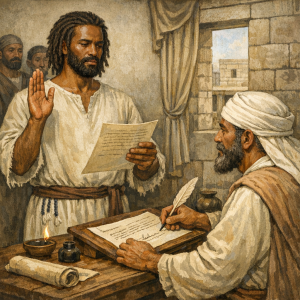
An affidavit is a written statement of facts voluntarily made by a person who swears or solemnly affirms that the statement is true before an officer authorized to administer an oath or affirmation. The person making the statement is commonly called the affiant and may also be called the deponent. Its essential character is not merely that it is signed or notarized, but that the affiant consciously adopts its factual contents under an authorized oath or affirmation.
An affidavit ordinarily contains assertions of fact rather than legal argument, speculation, or unsupported conclusions. Its legal effect depends on its purpose, the affiant’s competence and personal knowledge, compliance with applicable procedural rules, and the law of the jurisdiction in which it is offered. A sworn paper is therefore not automatically conclusive evidence, and placing the word “affidavit” in a title does not by itself give a document evidentiary force.
Essential Components
Although forms vary, a properly executed affidavit commonly includes:
- a caption or title identifying the proceeding or purpose;
- a venue stating the state, county, territory, or other place where the oath is administered;
- the affiant’s identity and, where relevant, capacity or qualifications;
- clear, preferably numbered statements of material fact;
- an indication that the statements are based on personal knowledge, or a careful identification of matters stated on information and belief;
- the affiant’s signature;
- an oath or solemn affirmation; and
- a jurat completed by the authorized officer, certifying that the statement was subscribed and sworn or affirmed before that officer.
A jurat should be distinguished from a notarial acknowledgment. In an acknowledgment, the signer generally acknowledges having executed a document; in a jurat, the officer administers an oath or affirmation concerning the truth of the statement. A notary ordinarily certifies the administration of the oath, the signer’s appearance, and related formalities—not the objective truth of every allegation in the document. Federal consular regulations similarly describe the jurat as the written certification that an oath or affirmation was administered and advise that material facts within the affiant’s knowledge should be alleged directly and positively. ([govinfo.gov](https://www.govinfo.gov/link/cfr/22/92?link-type=pdf§ionnum=22&year=mostrecent&utm_source=openai))
Related but Distinct Instruments
- Declaration: A written factual statement that may be unsworn but signed under penalty of perjury where legislation or procedural rules authorize that substitute.
- Deposition: Testimony taken under oath, usually through oral questioning, with an opportunity for examination by opposing parties.
- Verification: A certification that a pleading or other document is true, often based on knowledge, information, and belief as permitted by law.
- Certificate: A formal attestation to a fact, status, record, or official act; it is not necessarily sworn.
- Acknowledgment: A notarial act confirming that a person appeared and acknowledged executing an instrument, without necessarily swearing that its contents are true.
Etymology and Origin
The word comes from Medieval Latin affidavit, meaning “he has stated on oath” or “he has pledged his faith.” It is the third-person singular perfect form of affidare, associated with trust, faith, or the giving of assurance. The term became attached to sworn written statements because affidavit appeared as a conventional opening or certification in legal Latin. English use is documented from the late sixteenth and early seventeenth centuries. ([etymonline.com](https://www.etymonline.com/word/affidavit?utm_source=openai))
The Latin form does not establish that the modern affidavit is simply an institution of classical Roman law. Its name is Latin because Latin was long used in English legal records and professional practice. The recognizable English affidavit developed within English procedure, including judicial, chancery, administrative, bankruptcy, and revenue practice. It should therefore be distinguished both from Roman-law forms of written testimony and from the older common-law preference for live testimony in matters tried before a jury.
Cultural and Historical Context
In English legal history, affidavits became especially important in proceedings where courts decided preliminary, procedural, or equitable matters from written submissions. The Court of Chancery, administering equity rather than the strict forms of the common-law courts, made extensive use of written sworn evidence. Nineteenth-century descriptions accordingly observed that affidavit evidence was prominent in Chancery, bankruptcy, revenue administration, and certifications that required proof of formal acts. ([law.cornell.edu](https://www.law.cornell.edu/wex/chancery?utm_source=openai))
This history requires a careful distinction. The affidavit became part of the broader Anglo-American legal tradition, but it was not exclusively a creation of the common-law courts. Historically, common law, equity, ecclesiastical jurisdiction, admiralty, and statutory administration followed different procedures. Affidavit practice grew across several of these fields and was later integrated into unified systems of civil procedure.
William Blackstone described an affidavit as a voluntary oath made before a judge or other authorized officer. He also expressed concern about magistrates taking voluntary affidavits in criminal accusations outside proper legal authority, reflecting the principle that an oath should be connected to lawful jurisdiction and procedure rather than used as a private device for manufacturing official-looking accusations. ([lonang.com](https://lonang.com/wp-content/download/Blackstone-CommentariesBk4.pdf?utm_source=openai))
The history of affirmations is equally significant. Quakers and some other religious dissenters objected to swearing oaths, often reasoning that a person must speak truthfully at all times and should not create separate classes of ordinary and specially sworn speech. Their refusal produced fines, imprisonment, exclusion from testimony, and inability to hold certain offices until English and colonial statutes increasingly allowed solemn affirmation in place of an oath. Modern law generally gives an authorized affirmation the same legal effect as an oath. ([qfp.quaker.org.uk](https://qfp.quaker.org.uk/passage/20-48/?utm_source=openai))
Biblical / Torah Context
The Torah does not describe the modern notarized affidavit as a distinct legal instrument. Any claim that the contemporary form was directly created by Mosaic law would therefore exceed the evidence. Nevertheless, several Torah principles concern the moral and juridical foundations of sworn factual testimony.
Leviticus 19:12 prohibits swearing falsely by the name of God. Exodus 23:1 warns against carrying or joining in a false report, while Deuteronomy 19:15–21 addresses the need for adequate witnesses and the investigation and punishment of malicious testimony. These passages place truthfulness, corroboration, and responsibility before the tribunal at the center of justice. The two-witness rule in Deuteronomy belongs to its own ancient legal context and should not be mechanically treated as a universal rule governing every affidavit in modern civil or administrative practice.
Later biblical teaching also shaped disputes concerning oaths. Matthew 5:33–37 and James 5:12 have been interpreted by Quakers and other Christians as counseling against oath-taking and in favor of simple, unwavering truthfulness. Other traditions understand these passages as condemning manipulative or false swearing rather than every solemn judicial oath. The legal availability of affirmation accommodates the conscientious objector without reducing the obligation to tell the truth. The United States Constitution itself repeatedly uses the expression “oath or affirmation,” preserving legal accountability without requiring one religious form. ([constitution.congress.gov](https://constitution.congress.gov/browse/essay/artVI-C3-2-1/ALDE_00013638?utm_source=openai))
Legal Implications
Historical Common Law and Equity
At historical common law, disputed facts at trial were generally tested through oral testimony before the court and jury. Affidavits were more commonly used for applications, preliminary matters, proof of service, or proceedings in which written evidence was authorized. Equity made broader use of written sworn material. Modern procedural systems have combined much of law and equity, but the distinction remains useful when evaluating claims that affidavits were always conclusive “common-law evidence.” They were not.
Current Civil Procedure
In present federal civil practice, affidavits and declarations may support motions, including motions for summary judgment, temporary relief, and other applications involving facts outside the existing record. Federal Rule of Civil Procedure 56 requires a supporting or opposing affidavit or declaration to be based on personal knowledge, to contain facts that could be presented in admissible form, and to show that the affiant is competent to testify. Rule 43 permits courts to decide certain motions on affidavits while generally requiring trial testimony to be taken in open court unless another rule or statute provides otherwise. ([law.cornell.edu](https://www.law.cornell.edu/rules/frcp/rule_56?utm_source=openai))
An affidavit is not automatically admissible at trial merely because it was sworn. When offered to prove the truth of its assertions, it may constitute hearsay unless a statute, rule, stipulation, or recognized exception permits its admission. Live testimony may be required so that credibility can be tested through cross-examination. Courts may also disregard statements that are conclusory, speculative, outside the affiant’s personal knowledge, internally contradictory, or unsupported by admissible facts. ([law.cornell.edu](https://www.law.cornell.edu/rules/fre/rule_802?utm_source=openai))
Criminal and Governmental Use
Affidavits are central to many warrant applications. The Fourth Amendment requires probable cause supported by “Oath or affirmation” and a particular description of the place to be searched and persons or things to be seized. Under federal criminal procedure, a judge may issue a search warrant after receiving an affidavit or other sworn information establishing probable cause. Arrest warrants may likewise rest on a complaint and supporting affidavits. ([law.cornell.edu](https://www.law.cornell.edu/rules/frcrmp/rule_4?utm_source=openai))
A warrant affidavit does not merely record an officer’s demand; it presents facts to a neutral judicial officer who must independently determine whether probable cause exists. In Franks v. Delaware, the United States Supreme Court held that a defendant may, upon the required preliminary showing, obtain a hearing concerning a material false statement knowingly, intentionally, or recklessly included in a warrant affidavit. If the false material was necessary to probable cause, the warrant and resulting search may be invalidated. ([supreme.justia.com](https://supreme.justia.com/cases/federal/us/438/154/?utm_source=openai))
Military tribunals and agencies also use affidavits for investigative, administrative, and post-trial matters, but military use does not give the instrument a separate military origin. Military affidavits remain subject to governing statutes, rules of evidence, due-process requirements, and, where applicable, confrontation concerns. A court may accept uncontested sworn assertions in a particular procedural setting, yet it may also require a hearing when affidavits conflict or when the record undermines their credibility. ([armfor.uscourts.gov](https://www.armfor.uscourts.gov/newcaaf/digest/IIIC9.htm?utm_source=openai))
Perjury and False Statements
The oath or affirmation carries potential criminal consequences. Under 18 U.S.C. § 1621, a person commits federal perjury when, in an authorized setting, that person willfully makes a material statement under oath that the person does not believe to be true. The statute also reaches qualifying unsworn declarations made under penalty of perjury. Mistake, confusion, poor recollection, or immaterial inaccuracy is not necessarily perjury; the applicable law ordinarily requires willful falsity and materiality. State definitions and penalties vary. ([law.cornell.edu](https://www.law.cornell.edu/uscode/text/18/1621?utm_source=openai))
Unsworn Declarations
Federal law materially changed affidavit practice through 28 U.S.C. § 1746, enacted in 1976. In many federal matters, a dated written declaration subscribed as true under penalty of perjury may substitute for a notarized affidavit. The statute contains separate forms for declarations executed inside and outside the United States and excludes certain matters, including depositions and particular oaths required before specified officials. State laws may provide similar substitutes, but their wording and permitted uses differ. ([law.cornell.edu](https://www.law.cornell.edu/uscode/text/28/1746?utm_source=openai))
Spiritual Meaning
Spiritually, the affidavit symbolizes the union of speech, conscience, and accountability. Its deepest moral premise is that a person should not invoke truth casually. The affiant places reputation, legal standing, and potentially liberty behind the written word. In religious language, an oath may call upon God as witness; in a secular affirmation, conscience and the authority of law supply the solemn form.
The dictionary’s interpretive analysis is that an affidavit should represent disciplined testimony rather than rhetorical power. Its proper use requires humility about the limits of memory, separation of observed fact from inference, disclosure of uncertainty, and refusal to state as certain what the affiant merely suspects. The spiritual value lies not in seals, specialized phrases, or archaic formality, but in faithful correspondence between word and reality.
Modern Usage
Affidavits are used in litigation, probate, family proceedings, immigration matters, property transactions, service of process, identity and residency verification, business disputes, insurance claims, administrative applications, and criminal investigations. Common forms include affidavits of service, heirship, domicile, loss, support, probable cause, identity, and business records.
Electronic filing, electronic signatures, and remote notarization have altered the method of execution in many jurisdictions, but they have not eliminated the need to satisfy controlling law. Whether remote appearance, audiovisual communication, electronic seals, or out-of-state notarization is valid depends on the relevant statute, court rule, and intended use of the document. A form accepted by one agency or state may be defective in another.
Controversies / Criticisms
A recurring criticism is that affidavit practice may substitute polished written advocacy for testimony tested in open court. Lawyers often draft affidavits for clients or witnesses, creating questions about whether the language reflects the affiant’s own recollection. Boilerplate phrases such as “to the best of my knowledge, information, and belief” may conceal whether a statement is firsthand knowledge, hearsay, inference, or legal conclusion. Courts therefore examine substance rather than labels.
Another disputed claim is that an “unrebutted affidavit stands as truth in commerce” or automatically becomes a judgment, lien, contract, or binding determination when the recipient remains silent. No general rule of historical common law, commercial law, the Uniform Commercial Code, or modern evidence law gives a privately mailed affidavit that automatic effect. Silence may have consequences only when a recognized legal duty to respond exists, and a judgment ordinarily requires jurisdiction, lawful process, and judicial action. Courts have rejected filings asserting that a self-created, unrebutted affidavit becomes a commercial judgment merely through notice and nonresponse. ([law.justia.com](https://law.justia.com/cases/new-jersey/appellate-division-unpublished/2019/a2534-17.html?utm_source=openai))
The opposite overstatement should also be avoided. In a properly constituted proceeding, failure to contest a competent and admissible affidavit may leave its factual assertions undisputed and may contribute to summary judgment or another ruling. That consequence comes from procedural law and the evidentiary record—not from a universal maxim that every unanswered sworn statement is conclusively true.
Conclusion
An affidavit is a solemn form of written testimony, not a private decree. Its authority arises from the affiant’s oath or affirmation, the lawful authority of the officer or statutory declaration procedure, the relevance and admissibility of its facts, and the jurisdiction of the tribunal or agency receiving it. Historically associated with English legal Latin and developed through common-law, equitable, and statutory practice, it remains one of the principal means by which facts are formally presented outside live testimony.
Its legitimate power is substantial but limited. It can establish a record, support a motion, provide probable cause, prove service, or expose the signer to perjury liability. It cannot, solely by being notarized or left unanswered, create jurisdiction, transform allegations into a judgment, or make falsehood true. The enduring principle behind the instrument is that written testimony should be exact, accountable, and offered in good faith.
Sources / Further Reading
- Online Etymology Dictionary, “Affidavit”: https://www.etymonline.com/word/affidavit
- William Blackstone, Commentaries on the Laws of England, Book III: https://lonang.com/wp-content/download/Blackstone-CommentariesBk3.pdf
- Legal Information Institute, Federal Rule of Civil Procedure 56: https://www.law.cornell.edu/rules/frcp/rule_56
- Legal Information Institute, Federal Rule of Civil Procedure 43: https://www.law.cornell.edu/rules/frcp/rule_43
- Legal Information Institute, 28 U.S.C. § 1746: https://www.law.cornell.edu/uscode/text/28/1746
- Legal Information Institute, 18 U.S.C. § 1621: https://www.law.cornell.edu/uscode/text/18/1621
- Congress.gov, Constitution Annotated, Fourth Amendment: https://constitution.congress.gov/constitution/amendment-4/
- United States Supreme Court, Franks v. Delaware, 438 U.S. 154 (1978): https://www.govinfo.gov/content/pkg/USREPORTS-438/pdf/USREPORTS-438-154.pdf
- Electronic Code of Federal Regulations, 22 C.F.R. Part 92, notarial and affidavit practice: https://www.ecfr.gov/current/title-22/chapter-I/subchapter-J/part-92
- Massachusetts Archives, “Quakers in Massachusetts, 1656–1781”: https://digitalarchives.sec.state.ma.us/quakers/
- United States Courts, Glossary of Legal Terms: https://www.uscourts.gov/glossary