Affirmation and Sworn
Primary Definition
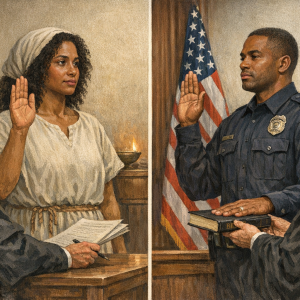
Affirmation is a positive assertion, confirmation, or solemn declaration that something is true. In legal proceedings, an affirmation is a formally authorized alternative to an oath. It permits a person to undertake the same duty of truthfulness without invoking God, a sacred text, or a religious formula. A person who makes such a declaration may be described as having affirmed, and sometimes as an affirmant.
Sworn is the past participle and adjectival form of swear. In its traditional legal sense, it describes a person, statement, testimony, duty, or office placed under the obligation of an oath. Thus, a sworn witness has undertaken to testify truthfully; a sworn statement has been verified through an oath or affirmation in the manner required by law; and a sworn officer has taken the oath or affirmation required for office.
Although ordinary speech sometimes contrasts “affirmed” with “sworn,” legislation and court practice frequently treat the two as legal equivalents. The religious or philosophical form may differ, but the legal obligation to speak truthfully ordinarily does not. Federal Rule of Evidence 603, for example, requires every witness to give an oath or affirmation in a form designed to impress the duty of truthful testimony upon the witness’s conscience. No single religious formula is universally required. ([uscourts.gov](https://www.uscourts.gov/forms-rules/current-rules-practice-procedure/federal-rules-evidence?utm_source=openai))
The expression does not itself identify a special class of evidence. Whether a declaration is legally sufficient depends upon the governing constitution, statute, procedural rule, notarial law, court order, or administrative requirement. A signed statement is not necessarily sworn, and a notarized signature is not necessarily a sworn verification.
Etymology and Origin
Affirm entered English through Anglo-French and Latin. Its Latin source, affirmare, combined a prefix meaning “to” or “toward” with firmare, meaning to strengthen or make firm. The earlier sense was therefore to establish, strengthen, confirm, or declare positively. Affirmation developed as the noun for such an assertion or confirmation. Its specialized legal use as an alternative to an oath became established in English during the period when statutes began accommodating people who conscientiously refused to swear. ([etymonline.com](https://www.etymonline.com/word/affirmation?utm_source=openai))
Sworn descends from the Old English verb commonly represented as swerian, meaning to take an oath or make a solemn declaration. The word belongs to the native Germanic vocabulary of English rather than to the Latin family from which affirm developed. Historically, “swearing” could mean calling upon God or another sacred authority as witness to the truth of a statement or the sincerity of a promise. Its later association with profanity is a separate development and should not be confused with the legal meaning.
An oath traditionally contains an appeal to divine witness or judgment. An affirmation deliberately omits that appeal while retaining solemnity, personal responsibility, and legal consequences. Modern enactments may also define “oath” broadly enough to include an affirmation unless the context requires otherwise.
Cultural and Historical Context
Oaths have long been used to reinforce testimony, loyalty, treaties, public duties, and promises. Their authority historically rested partly on the belief that false swearing exposed the speaker not only to human punishment but also to divine judgment. In societies where religious belief was closely connected with civil status, the prescribed form of oath could become a test of religious conformity as well as a means of securing truth.
English law inherited and developed formal oaths for witnesses, jurors, officeholders, rulers, and persons undertaking public responsibilities. After the English Reformation, certain oaths and declarations also served political and religious purposes. They could determine whether a person was eligible to sit in Parliament, hold an office, or exercise another public trust. Historical research shows that these requirements excluded various religious dissenters and nonconformists well into the nineteenth century. ([research.monash.edu](https://research.monash.edu/en/publications/oaths-and-affirmations-of-office-under-the-constitutions-of-the-u/?utm_source=openai))
The legal affirmation developed largely in response to conscientious objections among the Religious Society of Friends, commonly called Quakers, and later other dissenting communities. Quakers objected to oath-taking because they believed all speech should be truthful and that special sworn speech implied a lesser standard for ordinary speech. Their position drew upon biblical commands against swearing and upon the principle that a person’s simple “yes” or “no” should be reliable.
The Quakers Act associated with the parliamentary session of 1695–1696 permitted a prescribed solemn affirmation to be accepted in place of an ordinary oath in specified circumstances. This was not initially a complete declaration of universal secular equality. It was a limited statutory accommodation that developed through later enactments. Affirmation rights were gradually extended to additional groups and eventually to people who objected to oaths without having to establish membership in a favored religious denomination. ([catalog.folger.edu](https://catalog.folger.edu/record/145146?utm_source=openai))
Under the United Kingdom’s Oaths Act 1978, a solemn affirmation has the same force and effect as an oath. The statutory form begins with a declaration that the person solemnly, sincerely, and truly declares and affirms, after which the words of the applicable oath continue without language calling upon a divine witness. ([legislation.gov.uk](https://www.legislation.gov.uk/ukpga/1978/19/pdfs/ukpga_19780019_en.pdf?utm_source=openai))
The historical affirmation is therefore neither an ancient pagan ritual nor merely a modern invention. Its present legal form emerged from documented conflicts over conscience, religious tests, witness competency, and access to public life within the English legal tradition.
Biblical / Torah Context
Torah and Hebrew Scripture
The Torah treats vows, oaths, and the use of the divine name as serious matters. Leviticus 19:12 prohibits swearing falsely by the name of God. Numbers 30 teaches that a person who makes a vow or binds himself by an oath must not profane his word. Deuteronomy likewise warns against delaying the fulfillment of a vow. These passages do not present solemn speech as casual ornament; they connect it with truth, accountability, and fidelity to one’s word.
Within Jewish interpretation, this produced extensive distinctions among vows, oaths, careless expressions, judicial declarations, and wrongful invocation of the divine name. The general spiritual principle is that words create obligations and that sacred language must not be used deceptively. It would be inaccurate, however, to claim that the Torah universally forbids every oath. It regulates oaths, condemns false or vain swearing, and demands performance of lawful commitments.
New Testament and Christian Interpretation
Matthew 5:33–37 records Jesus’ warning against swearing by heaven, earth, Jerusalem, or one’s own head and concludes that a person’s “yes” and “no” should be sufficient. James 5:12 gives a closely related instruction. Some Christian traditions understand these teachings as prohibiting manipulative, evasive, or casual oaths while allowing solemn judicial oaths. Others—including historic Quakers, Mennonites, and certain other peace-church communities—have understood them as forbidding oath-taking altogether. ([biblegateway.com](https://www.biblegateway.com/verse/en/James_5%3A12?utm_source=openai))
The existence of these competing interpretations should be acknowledged. The affirmation arose not because every Christian body agreed that oaths were forbidden, but because civil law gradually recognized that a person should not be excluded from testimony or public responsibility merely for following a sincere interpretation against swearing.
Legal Implications
Historical Common Law and Statutory Reform
At historical common law, an oath was connected with witness competency and the perceived religious sanction supporting truthful testimony. Rules concerning who could swear, what beliefs a witness was required to hold, and which form was acceptable changed over time. Statutes permitting affirmations corrected some of the resulting exclusions. Consequently, the modern legal equivalence of oath and affirmation is not simply an unchanged rule of immemorial common law; it is also the product of constitutional and statutory reform.
Courts of common law, courts of equity, and ecclesiastical tribunals employed sworn testimony and written verified material in different procedural forms. Modern legal systems have merged or altered many of those procedural divisions. Current validity therefore must be determined under present constitutions, statutes, evidentiary rules, and court procedures rather than by invoking “common law” as though it were a single unchanging code.
United States Constitutional Usage
The United States Constitution repeatedly uses the formula “Oath or Affirmation.” The President must take an oath or affirmation before executing the office. Senators sitting in an impeachment trial act under oath or affirmation. Article VI binds federal and state legislative, executive, and judicial officers to support the Constitution by oath or affirmation while prohibiting a religious test for federal office. The Fourth Amendment requires probable cause supporting a warrant to be established by oath or affirmation. ([archives.gov](https://www.archives.gov/founding-docs/constitution-transcript?utm_source=openai))
This wording recognizes a solemn nonreligious or conscience-based declaration as constitutionally sufficient. It also separates the obligation to constitutional government from compulsory adherence to a particular theology.
Testimony, Affidavits, and Perjury
Before testifying, a witness ordinarily undertakes to tell the truth through an oath or affirmation. The essential legal purpose is to impress the duty of truthfulness upon the individual witness. Courts may adapt the wording for children, persons with disabilities, or people holding different religious or ethical convictions, provided the declaration meaningfully communicates that duty. Military evidentiary practice applies the same basic principle and does not insist upon one inflexible formula. ([armfor.uscourts.gov](https://www.armfor.uscourts.gov/digest/IIID7.htm?utm_source=openai))
An affidavit is generally a written factual statement made under oath or affirmation before an officer authorized to administer it. A jurat is the officer’s certificate showing that the statement was properly subscribed and sworn or affirmed before that officer. Typical wording states that the document was “subscribed and sworn to” on a particular date. ([law.cornell.edu](https://www.law.cornell.edu/wex/jurat?utm_source=openai))
A jurat must not be confused with an acknowledgment. An acknowledgment commonly establishes that the identified signer acknowledged signing a record voluntarily or for its stated purpose. A verification upon oath or affirmation adds the signer’s solemn declaration that the statement is true. State terminology and procedure vary, especially regarding personal appearance, identification, electronic notarization, and required certificate language.
Nor does a notary certify that every factual allegation is true. The notarial officer certifies performance of the authorized notarial act. California’s prescribed jurat disclaimer expressly states that the notary verifies the signer’s identity, not the truthfulness, accuracy, or validity of the document. The signer remains responsible for the factual assertions. ([sos.ca.gov](https://www.sos.ca.gov/notary/jurats?utm_source=openai))
Under 18 U.S.C. § 1621, a person may commit federal perjury by willfully making a material statement that the person does not believe to be true after taking an authorized oath. The statute also reaches qualifying written declarations made under penalty of perjury. Mistake, poor recollection, immaterial error, and deliberate material falsehood are not automatically identical; the elements of the applicable offense must be proved. ([uscode.house.gov](https://uscode.house.gov/view.xhtml?edition=prelim&num=0&req=granuleid%3AUSC-prelim-title18-section1621&utm_source=openai))
Unsworn Declarations
Federal law does not require notarization in every situation. Under 28 U.S.C. § 1746, many matters that could be supported by a sworn written declaration may instead be supported by a dated, signed declaration stating that the contents are true and correct under penalty of perjury. The statute contains different prescribed language for declarations executed inside and outside the United States and excludes certain matters, including depositions and particular oaths of office. ([law.cornell.edu](https://www.law.cornell.edu/uscode/text/28/1746?utm_source=openai))
Calling such a document “unsworn” does not mean it is legally casual. Its force comes from statutory language and exposure to perjury penalties rather than from administration of an oath by a notary or other officer. State laws may provide similar procedures, but federal language should not be assumed to satisfy every state or local requirement.
Governmental and Military Use
Public officers commonly swear or affirm that they will support a constitution and faithfully perform official duties. The undertaking creates a public and moral commitment, although the precise legal consequences of violating it depend upon applicable removal provisions, disciplinary rules, criminal statutes, and causes of action. The oath itself does not create unlimited governmental authority.
Federal military law prescribes an enlistment oath containing the alternative “swear (or affirm).” The undertaking includes support and defense of the Constitution, true faith and allegiance, and obedience to lawful authority under military regulations and the Uniform Code of Military Justice. The availability of affirmation accommodates conscience without eliminating the legal significance of enlistment. ([uscode.house.gov](https://uscode.house.gov/view.xhtml?req=%28title%3A10+section%3A502+edition%3Aprelim%29&utm_source=openai))
Naturalization practice similarly allows an applicant to substitute “solemnly affirm” for oath language and to omit “so help me God.” Separate rules govern requests to modify military-service clauses on the basis of religious training, deeply held moral conviction, or conscientious objection. ([uscis.gov](https://www.uscis.gov/sites/default/files/document/policy-manual-updates/20150721-OathModifications.pdf?utm_source=openai))
Spiritual Meaning
Spiritually, an affirmation may represent the deliberate alignment of speech, conscience, and conduct. Its deepest principle is not the ceremonial formula but integrity: the speaker accepts responsibility for saying what is believed to be true and for carrying out what has been promised.
From a biblical perspective, the power of an affirmation does not arise from verbal magic. Repeating “I affirm” does not make a false proposition true, create a lawful judgment, or bind another person who has not consented. The moral force lies in honest intention joined with truthful words and accountable action.
For those who reject religious oaths, affirmation can testify that all speech—not only courtroom speech—should be trustworthy. For those who accept oaths, the ceremony may serve as a reminder that truth and duty stand before an authority greater than personal convenience. Both forms can therefore express conscience when freely and sincerely undertaken.
Modern Usage
- Courts: witnesses swear or affirm before giving testimony.
- Documents: affidavits and verified pleadings may be sworn or affirmed before an authorized officer.
- Public office: officials swear or affirm constitutional loyalty and faithful performance.
- Military service: service members undertake prescribed duties by oath or affirmation.
- Citizenship: naturalization involves an oath or permitted affirmation of allegiance.
- Employment and professional life: “sworn officer” may identify a police, correctional, military, or other official who has taken an official oath.
- Ordinary speech: “sworn enemy,” “sworn duty,” and “I could have sworn” are figurative expressions and ordinarily do not indicate a legally administered oath.
- Personal development: “daily affirmations” are positive statements used for motivation or reflection. This psychological or devotional meaning is distinct from a legal affirmation.
Controversies / Criticisms
Historically, oath requirements have been criticized as religious tests that burden atheists, dissenters, and people whose faith prohibits swearing. Equal legal recognition of affirmations addresses much of this concern, but social pressure may remain when religious forms are treated as more credible or patriotic than secular ones.
Others argue that routine formulas have become ceremonial and do little to deter dishonesty. Modern evidence law responds by focusing less on a particular sacred object or phrase and more on whether the witness consciously accepts the duty of truthfulness.
A separate misunderstanding is the claim that any document labeled “sworn,” notarized, or declared “under penalty of perjury” automatically proves every allegation and becomes binding if unanswered. That proposition is not a general rule of common law or current American law. A sworn statement is evidence or a procedural submission whose admissibility, weight, relevance, foundation, and legal effect remain subject to governing law. Silence may have consequences in narrowly defined settings, but it does not universally transform a private affidavit into an incontestable judgment.
There is also continuing debate within religious communities over whether judicial oaths violate biblical commands. This is a theological disagreement rather than a settled rule shared by all Jews or Christians. Civil recognition of both oath and affirmation allows the legal system to secure accountability without deciding which theological interpretation is correct.
Conclusion
An affirmation and a sworn oath are different forms of solemn undertaking that usually carry equivalent legal responsibility. The oath traditionally invokes divine witness; the affirmation relies upon a solemn declaration of conscience without requiring religious language. “Sworn” may describe testimony, a written statement, an official, or a duty placed under such an undertaking.
The controlling question is never the label alone. Legal effect depends upon whether the proper person made the declaration, whether the required wording and procedure were followed, whether an authorized officer was necessary, and which constitution, statute, rule, or jurisdiction governs. Properly used, both oath and affirmation serve the same central purpose: to connect words with conscience, accountability, and the duty of truth.
Sources / Further Reading
- National Archives, Constitution of the United States: Transcript
- Congress.gov, Historical Background on Religious Tests for Government Office
- Congress.gov, Historical Background on the Fourth Amendment
- United States Courts, Federal Rules of Evidence
- Office of the Law Revision Counsel, 18 U.S.C. § 1621
- Legal Information Institute, 28 U.S.C. § 1746
- Office of the Law Revision Counsel, 10 U.S.C. § 502
- U.S. Citizenship and Immigration Services, Instructions for Form N-400
- United Kingdom, Oaths Act 1978
- Enid Campbell, “Oaths and Affirmations of Public Office Under English Law”
- Legal Information Institute, “Jurat”
- California Secretary of State, Jurats
- Online Etymology Dictionary, “Affirmation”
"Affirmation" and "Sworn" are legal terms often used in the context of legal proceedings, testimonials, depositions, or when signing certain documents.
-
Affirmation: An affirmation is a solemn and formal declaration that an individual's statements are true. This is often used as an alternative to an oath for those who may have religious or ethical objections to swearing an oath. An affirmation holds the same legal weight and consequences as an oath.
- Sworn: The term "sworn" refers to a statement or declaration that has been confirmed by the swearor, typically by oath. A sworn statement is assumed to be truthful under penalty of perjury. This means that if a person is found to have lied in a sworn statement, they can be legally punished for perjury. Sworn statements are often used in court cases, legal proceedings, and in some administrative processes.