Utter
Primary Definition
Utter is used principally as a verb and an adjective.
As a verb, it means to bring forth, express, pronounce, emit, or put into circulation. Its ordinary modern sense is to speak or make a sound: a person may utter a word, statement, prayer, cry, sigh, warning, oath, or protest. The word does not always require fully formed speech. A sound may be uttered even when it is inarticulate, as when someone utters a groan, gasp, or shout.
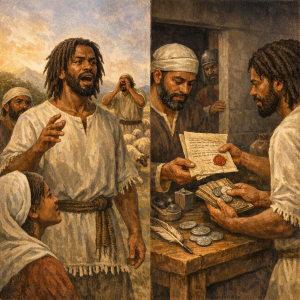
As a legal verb, especially in the law of forgery and counterfeiting, to utter means to offer, present, publish, pass, transfer, or put a writing, instrument, coin, note, security, or other item into circulation while representing it, expressly or by conduct, as genuine. In this specialized sense, uttering is not merely possessing a false instrument. It is the act of using, tendering, or attempting to use it as if it were authentic.
As an adjective, utter means complete, absolute, total, or unqualified: “utter nonsense,” “utter ruin,” “utter silence,” or “utter failure.” This adjective usually intensifies the noun it modifies. It conveys a condition without qualification or remainder.
The central idea connecting the common verbal senses is outward expression or issuance. A thought becomes audible when it is uttered; a document becomes operative in commerce when it is uttered as genuine. The adjective retains a different but related historical idea of being “outermost,” “most extreme,” or carried to the fullest extent.
Etymology and Origin
The history of utter is primarily Germanic and English. It should not be assigned a Roman, Greek, ecclesiastical, pagan, military, or governmental origin without evidence. The word is not derived from a Latin legal formula, nor is it originally a Biblical Hebrew or Greek term.
The adjective utter, meaning “outer” or “farthest out,” developed from Old English forms related to ūt, meaning “out.” It is historically connected with the idea expressed by modern English out and outer. Over time, “outermost” could suggest the furthest possible degree; from that development came the present adjectival meaning, “absolute,” “entire,” or “complete.” Thus, “utter destruction” does not literally mean destruction located outside something; it means destruction carried to an extreme or complete degree.
The verbal form developed in Middle English. Etymological authorities connect it with forms meaning to put forth, send out, disclose, express, or make known. The movement from “put out” to “give voice to” is understandable: a person utters speech by sending it outward from thought and breath into audible expression. The legal sense similarly developed from the act of sending an instrument outward into dealings with others.
The word’s history demonstrates a common pattern in English: a concrete spatial idea becomes an abstract idea. “Out” becomes “put forth”; “put forth” becomes “speak,” “issue,” or “circulate”; and “outermost” becomes “utter,” in the sense of complete or extreme.
English has retained several distinct but neighboring uses of the term:
- To utter speech: to pronounce or express aloud.
- To utter a sound: to emit a cry, sigh, laugh, groan, or similar sound.
- To utter an instrument: to issue, tender, circulate, or represent a document or object as genuine.
- Utter, adjective: complete, total, absolute, or unmitigated.
Care is necessary because the same spelling does not mean that every modern use has precisely the same legal consequence. Ordinary speech is usually protected, regulated, or evaluated under rules concerning context, truth, contracts, threats, defamation, perjury, and other doctrines. Legal uttering of a forged instrument concerns deception in a transaction or attempted transaction.
Cultural and Historical Context
In ordinary human affairs, utterance is the outward act by which inward thought becomes socially meaningful. Promises, commands, prayers, testimony, consent, confession, blessing, insult, warning, and proclamation all depend in some measure upon expression. Before widespread literacy, spoken utterance had particular importance in commerce, law, family arrangements, religious observance, and public government. A person’s spoken word could establish reputation, transmit news, bind an oath, or provoke conflict.
Written culture did not eliminate the importance of utterance. Instead, the word expanded. A written instrument may be “uttered” when it is issued or tendered to another. In this setting, utterance means more than physical delivery. A person who hands over a document in a transaction normally communicates an implied representation that it is what it purports to be. A check is presented as a valid order for payment; a deed is presented as authentic; currency is presented as genuine money.
The historical legal distinction between making a forged item and uttering it is significant. One person may create or alter a false instrument; another person may later circulate it. Common-law criminal doctrine treated these as distinguishable wrongs because each act creates a separate danger. The maker creates the false object; the utterer introduces it into the stream of reliance, exchange, and possible loss.
The word also appears in literary and rhetorical language. Writers use “utter” where “say” would be too plain or too narrow. “Say” generally refers to words. “Utter” may emphasize the physical or emotional act of expression: a character utters a cry, a curse, a prayer, an oath, or a final word. The adjective has likewise become a conventional intensifier in formal and literary prose.
Biblical / Torah Context
The English word utter appears in some English Bible translations, including the King James Version, but the English term itself is not a Hebrew, Aramaic, or Greek original-word doctrine. Readers should therefore avoid treating English occurrences of “utter” as proof that the Biblical languages contain one single technical word with all modern English meanings.
For example, Psalm 19:2 in the King James Version states: “Day unto day uttereth speech, and night unto night sheweth knowledge.” The verse poetically describes creation as continually communicating the glory, order, and knowledge of God. The point is not that days literally possess human vocal cords. Rather, the ordered succession of day and night bears witness. Modern Jewish translations render the underlying idea with expressions such as “makes utterance” or “pours forth speech.”
In this Biblical context, utterance concerns revelation, communication, and testimony. The created order is portrayed as declaring something true about its Maker. The passage should not be reduced to a claim that every spoken declaration is automatically true, powerful, or legally binding. Its immediate poetic setting concerns the testimony of the heavens and the instruction of God.
The Torah also gives serious attention to words that pass from the mouth into the sphere of obligation. Deuteronomy 23:24 directs a person to fulfill what has “crossed” or “gone out of” the lips when that person has voluntarily vowed to God. The passage joins speech with responsibility. An unmade vow is not treated the same as a vow actually spoken; once a voluntary commitment has been expressed, the speaker is called to perform it.
This is relevant to the dictionary meaning of utter because it illustrates a durable moral principle: outwardly expressed words may have consequences. Nevertheless, Biblical vow law, modern contract law, and criminal law are not interchangeable. A Biblical vow is a religious and moral undertaking before God. A modern civil contract ordinarily requires legally recognized elements such as assent, consideration or a valid substitute where applicable, capacity, and sufficiently definite terms. A criminal uttering offense involves the knowing use of a false instrument with fraudulent intent.
In Jewish and Christian ethical reflection, speech is often treated as morally weighty because it may bless, deceive, wound, instruct, bind, or reveal the condition of the speaker. That broad moral observation is distinct from any claim that words themselves mechanically create legal rights or physical reality.
Legal Implications
Common-Law Meaning
At historical common law, uttering was closely associated with forgery. The core idea was offering a forged instrument as genuine with intent to defraud. The instrument could include a writing capable of affecting legal rights or inducing reliance, such as a deed, note, bill, check, order, receipt, or other document of apparent legal or commercial significance.
Forgery and uttering were related but separate concepts. Forgery generally concerned falsely making, materially altering, or falsely completing an instrument with intent to defraud. Uttering concerned the later presentation or circulation of that instrument as genuine. A person may be guilty of uttering even if another person made the forgery, provided the necessary knowledge and fraudulent intent are proven under the law that applies.
The common-law principle was not that every inaccurate paper or defective signature constituted uttering. The law focused on falsity, representation of genuineness, and fraudulent purpose. An innocent person who unknowingly presents a forged document ordinarily lacks the required criminal knowledge and intent. Exact elements, defenses, burdens of proof, and available penalties depend upon the governing jurisdiction and statute.
Modern United States Law
In the United States, the term remains in federal and state criminal statutes, although statutory wording varies. Federal law expressly uses the term in connection with counterfeit obligations and securities of the United States. Under 18 U.S.C. § 472, a person who, with intent to defraud, passes, utters, publishes, sells, or attempts to do so with a falsely made, forged, counterfeit, or altered obligation or security of the United States may face a fine, imprisonment of up to twenty years, or both.
Federal statutes also separately address related conduct involving foreign obligations, coins, state and private securities, fictitious obligations, and other forms of counterfeiting or forgery. The statutory scheme confirms that “uttering” is not a mystical legal word and does not mean merely speaking. In the pertinent criminal context, it refers to putting a false item into circulation or offering it as genuine.
Courts commonly examine whether the accused knowingly used or attempted to use the instrument and whether there was an intent to defraud. The precise proof may be circumstantial. For example, knowledge may sometimes be inferred from conduct, inconsistent explanations, repeated attempts to pass false instruments, concealment, or other facts; however, no inference is automatic, and guilt must be established under the applicable standard of proof.
“Utter and Publish”
Older legal language often uses the phrase utter and publish. In this phrase, “publish” does not necessarily mean printing a book, posting material online, or communicating to the general public. It can mean presenting or declaring an instrument to another person as valid. To utter and publish a forged instrument is, in substance, to assert by words or conduct that it is good and genuine.
For this reason, silence can sometimes accompany an uttering offense. A person need not announce, “This is genuine,” if the act of tendering the item in a transaction itself carries that representation. Conversely, merely holding an item, without presenting it or attempting to circulate it, may involve different legal issues and may fall under a different statute, if any.
Not a Universal Formula
The term should not be misused as a universal accusation against governments, banks, courts, corporations, or private persons. Whether a particular transaction involves forgery, counterfeit currency, fraudulent securities, false identification, breach of contract, negligent misrepresentation, or no actionable wrong at all depends on facts and applicable law. A person’s disagreement with an institution, a disputed debt, an allegedly unfair policy, or the use of electronic records does not by itself establish “uttering” in the criminal-law sense.
Likewise, the legal meaning of uttering does not establish that all statutes, court orders, licenses, currency, contracts, or government documents are inherently fraudulent. Such broad claims are not supported merely by the historical definition of the word. Legal conclusions require competent evidence, applicable statutory text, and, where necessary, judicial interpretation.
Spiritual Meaning
In spiritual and moral reflection, to utter is to give outward form to what is held inwardly. Speech can reveal faith, fear, gratitude, anger, deception, repentance, wisdom, or confusion. This does not mean every utterance perfectly discloses the heart, but words are often treated as evidence of intention and character.
A constructive spiritual reading emphasizes truthfulness, restraint, fidelity to promises, and care in speech. To utter a vow, testimony, accusation, blessing, or prayer is not a trivial act. The speaker should consider whether the words are truthful, necessary, charitable, and capable of being honored.
Some religious and self-help teachings claim that words possess independent creative power by which a person may automatically create wealth, health, legal immunity, or desired outcomes. Those claims are interpretive and contested; they should not be presented as settled Biblical doctrine, historical common law, or modern legal fact. A more cautious reading recognizes that words influence conduct, relationships, commitments, and reputation, while rejecting the notion that verbal declaration alone overrides moral responsibility, evidence, natural conditions, or lawful authority.
Modern Usage
In contemporary English, utter is more formal than say or speak. It is especially common when the sound is brief, emotional, reluctant, solemn, or significant:
- “She uttered a warning.”
- “He could not utter a word.”
- “The witness uttered an oath.”
- “The child uttered a cry.”
- “The speaker uttered a prayer for peace.”
In legal writing, the noun form uttering survives more strongly than the ordinary verb. Criminal complaints, indictments, jury instructions, statutes, and legal treatises may refer to “uttering a forged instrument,” “uttering counterfeit obligations,” or “uttering and publishing.”
As an adjective, utter remains common in fixed expressions: utter confusion, utter contempt, utter impossibility, utter darkness, utter failure, and utter silence. It ordinarily precedes the noun. Unlike the verb, the adjective does not concern speaking, issuance, or circulation; it functions as an intensifier.
Controversies / Criticisms
The main controversy surrounding utter is not the ordinary dictionary definition but the misuse of its technical legal sense. Because legal language can sound archaic and authoritative, the term is sometimes lifted from its narrow context and applied to broad political, financial, or personal disputes. That usage can obscure rather than clarify the actual issue.
A second source of confusion is the mistaken equation of uttering with mere possession. In common-law and statutory analysis, possession, fabrication, concealment, transfer, circulation, and attempted circulation may be separate acts with separate elements. Whether possession alone is criminal depends upon the specific statute and facts. “Uttering” ordinarily adds an act of offering, passing, issuing, or representing the item as genuine.
A third confusion arises from the word’s multiple ordinary meanings. A person may utter a statement without committing any crime. Speech can be protected by constitutional principles, though protection is not unlimited and does not necessarily cover fraud, perjury, true threats, defamation, solicitation of crime, or other legally defined conduct. The specialized criminal meaning must therefore be read in its statutory and factual setting.
Conclusion
Utter is an old English word centered on outward expression. In ordinary language, it means to speak, pronounce, emit, or express. In legal usage, it may mean to offer or circulate a forged or counterfeit instrument as genuine, ordinarily with knowledge and intent to defraud. As an adjective, it means complete or absolute.
The word’s Biblical and spiritual relevance lies chiefly in the seriousness of speech, testimony, vows, and truthful expression. Its legal relevance lies in the distinction between creating a false instrument and presenting it to another as real. Sound use of the term requires attention to context: poetic utterance is not legal uttering; a spoken promise is not automatically a contract; and a disputed document is not automatically a forged instrument. Precision protects both language and justice.
Sources / Further Reading
- Merriam-Webster Dictionary, “Utter”
- Online Etymology Dictionary, “Utter”
- Cornell Legal Information Institute, “Utter”
- Cornell Legal Information Institute, “Uttering”
- Cornell Legal Information Institute, “Forgery”
- United States Code, 18 U.S.C. § 472, “Uttering Counterfeit Obligations or Securities”
- United States Code, Title 18, Chapter 25, “Counterfeiting and Forgery”
- Sefaria, Psalms 19
- Sefaria, Deuteronomy 23
- Bible Gateway, Psalm 19:2, King James Version