Caucus
Primary Definition
Caucus is a political meeting, organized group, or deliberative process in which members of the same party, faction, legislative body, or shared-interest coalition assemble to select leaders or candidates, formulate policy, coordinate strategy, or determine a collective position. The word may describe either the meeting itself or the body of people who participate in it.
As a noun, the term commonly carries several related meanings:
- Party meeting: a gathering of members of a political party or faction to discuss policy, choose leaders, or coordinate votes.
- Nominating caucus: a local or regional party meeting used to express candidate preferences and select delegates for later conventions.
- Legislative caucus: all legislators belonging to a particular party within a legislative chamber.
- Interest caucus: a coalition of legislators or organizational members united by an issue, region, identity, occupation, or policy objective.
- Informal strategic meeting: a private or restricted gathering held before a formal vote or public proceeding.
As a verb, to caucus means to meet for such deliberation: “The members caucused before the vote.” The verb does not necessarily imply that a binding vote occurred; participants may caucus merely to exchange information, test support, negotiate, or develop a common strategy.
A caucus should be distinguished from a primary election, in which voters ordinarily cast ballots through an election process; a convention, which is generally a larger assembly of delegates; and a legislative committee, which normally possesses formally assigned jurisdiction under the rules of a legislative body. A caucus may influence official action, but its internal decision is not ordinarily equivalent to an enacted law, judicial judgment, or formal vote of the full governmental body.
Etymology and Origin
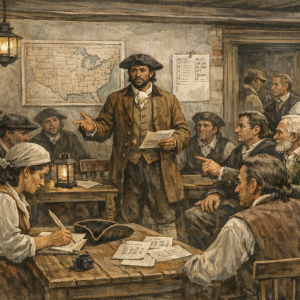
The precise origin of the word is unresolved. It is an American political term documented in colonial Massachusetts by the middle of the eighteenth century. In February 1763, John Adams wrote in his diary about a Boston “Caucas Clubb” that met in a garret, selected a moderator, voted on proposed officeholders, and coordinated with other political groups before the town’s formal elections. The Adams entry is important because it demonstrates that the term and the underlying practice were already familiar in Boston before the American Revolution. ([founders.archives.gov](https://founders.archives.gov/documents/Adams/01-01-02-0008-0001-0005?utm_source=openai))
Several etymologies have been proposed. One theory derives the word from an Algonquian expression associated with advising, counseling, or speaking to another person. Another connects it with meetings of Boston shipyard caulkers or a supposed “Caulkers’ Club.” A third proposal associates it with the medieval Latin caucus, a cup or drinking vessel, perhaps referring to a drinking club or tavern gathering. None of these explanations has been conclusively demonstrated. Major dictionaries therefore either identify the origin as unknown or present the Algonquian derivation only as a possibility. ([merriam-webster.com](https://www.merriam-webster.com/dictionary/caucus?utm_source=openai))
Accordingly, claims that the word has a proven Roman, Greek, pagan, military, Masonic, biblical, or ecclesiastical origin should be treated with caution. There is no established evidence that the political term descended from Roman law, a Greek council, a church tribunal, or a military command structure. Its documented history is rooted in colonial American political organization, even though its deeper linguistic ancestry remains disputed.
Cultural and Historical Context
Colonial and Early American Practice
Early caucuses functioned as mechanisms for political coordination before modern political parties, printed ballots, and regulated primary elections had fully developed. Local leaders could meet privately, agree on candidates, distribute responsibilities, and present a coordinated slate to the broader electorate. Such organization could promote efficiency and common purpose, but it could also permit a relatively small circle to decide public choices before ordinary voters formally participated.
By 1800, members of Congress associated with emerging national parties were using congressional nominating caucuses to choose presidential and vice-presidential candidates. Because the Constitution created no presidential nominating system and did not anticipate the later development of national political parties, these meetings supplied an extra-constitutional method of coordination. The system helped produce presidential nominations from the election of 1800 through the early 1820s. Critics condemned it as “King Caucus,” arguing that members of Congress were improperly controlling a decision that belonged to the people or the states. The congressional nominating caucus declined after 1824 as national party conventions and broader forms of participation developed. ([senate.gov](https://www.senate.gov/about/origins-foundations/parties-leadership/nominating-presidents.htm?utm_source=openai))
During the nineteenth century, the word expanded from the name of a particular kind of American meeting into a general term for disciplined party organization. In Britain, opponents applied the American label to the highly organized Birmingham Liberal system associated with Joseph Chamberlain and the National Liberal Federation in the 1870s. There, “the Caucus” could signify not merely one meeting but an organized political machine built through local committees and coordinated representation. ([liberalhistory.org.uk](https://liberalhistory.org.uk/history/chamberlain-joseph/?utm_source=openai))
From Caucuses to Primaries
In the United States, reformers of the late nineteenth and early twentieth centuries increasingly attacked closed caucuses and conventions as instruments of party bosses. Direct primary elections were promoted as a way to transfer candidate selection from insiders to a larger body of voters. The change did not eliminate caucuses, but it narrowed their role in many jurisdictions and contributed to the modern mixed system of primaries, caucuses, conventions, and party rules.
Iowa later became the best-known example of a presidential nominating caucus. Reforms following the disputed and turbulent 1968 Democratic National Convention produced a more extended and representative delegate-selection process. Because Iowa’s multi-stage process required time for precinct, county, district, and state proceedings, its opening meetings were scheduled early. Media attention to the 1972 and especially the 1976 contests then gave Iowa influence far beyond the number of delegates at stake. ([iowapbs.org](https://www.iowapbs.org/iowapathways/artifact/1825/history-iowa-caucus?utm_source=openai))
Biblical / Torah Context
The word does not occur as a political institution in the Torah or the biblical world, and no sound evidence makes Hebrew or biblical practice the source of the English term. Nevertheless, Scripture contains assemblies, councils, groups of elders, and deliberative bodies that provide useful points of comparison.
In Exodus 18, Jethro advises Moses to appoint capable and trustworthy judges so that responsibility will not remain concentrated in one person. Numbers 11 describes seventy elders gathered to share the burden of leadership, while Deuteronomy 1 recounts the appointment of wise and respected leaders to judge disputes. These passages concern delegated authority and ordered counsel, not party caucuses in the modern sense.
The Hebrew concepts commonly translated as assembly, congregation, or council should not automatically be translated as “caucus.” A biblical assembly might include the covenant community as a whole, whereas a caucus ordinarily represents one party or segment within a larger body.
Biblical wisdom recognizes the value of consultation: Proverbs 11:14 and 15:22 associate sound planning with a plurality of counselors. At the same time, Scripture warns against corrupt counsel, partiality, secret conspiracy, and factions formed for pride or rebellion. The account of Korah’s uprising in Numbers 16 illustrates how an organized faction can invoke the language of equality while pursuing power through rebellion. The biblical test is therefore not whether people meet privately, but whether their purpose, methods, and judgment conform to truth, justice, humility, and lawful authority.
Legal Implications
Common Law and Institutional Status
A caucus is not a distinct doctrine of historical English common law, Roman law, or equity. The term developed through political usage rather than as a technical category of substantive law. At common law, disputes involving voluntary political associations might implicate ordinary principles of contract, agency, membership, property, or organizational governance, but the mere designation “caucus” does not itself create governmental jurisdiction or legal authority.
A political caucus generally derives its internal authority from party rules, organizational bylaws, legislative customs, or the consent of its members. Its resolution may bind participants politically or under party rules, yet it ordinarily cannot substitute for the action required by a constitution, statute, legislative rule, or public election law. For example, legislators may agree in caucus to support a bill, but the bill becomes law only through the constitutionally prescribed legislative process.
Statutes and Legislative Organization
Modern statutes sometimes expressly recognize caucuses. Title 2, section 29a of the United States Code provides for organizational caucuses or conferences of incumbent House members and members-elect following an election. This recognition assists the organization of an incoming House, but it does not convert every caucus decision into an official act of the House itself. ([uscodeweb1.house.gov](https://uscodeweb1.house.gov/view.xhtml?edition=prelim&num=0&req=granuleid%3AUSC-prelim-title2-section29a&utm_source=openai))
Within Congress, a party caucus or conference consists of a party’s members in a chamber. It may elect party leaders, consider committee assignments, discuss legislative priorities, and coordinate strategy. The term also describes informal Congressional Member Organizations formed around interests such as agriculture, regional development, constitutional policy, race, veterans’ affairs, or particular industries. These interest groups must not be confused with standing committees possessing formal legislative jurisdiction. ([house.gov](https://www.house.gov/leadership?utm_source=openai))
State law varies concerning caucus administration, notice, records, public access, delegate selection, and the relationship between party rules and election statutes. Some caucuses are conducted principally by political parties rather than election officials. Therefore, legal conclusions about voting procedure, open-meeting requirements, ballot secrecy, or challenges to results must be based on the law and rules governing the particular jurisdiction and event.
Constitutional and Election-Law Questions
In the United States, political parties possess First Amendment associational interests, including a qualified right to define their membership and determine who may participate in selecting their nominees. In Democratic Party v. Wisconsin ex rel. La Follette (1981), the Supreme Court held that a state could not compel a national party to seat delegates selected under a process that violated the party’s participation rules. In Tashjian v. Republican Party of Connecticut (1986), the Court held that a state could not prohibit a party from inviting unaffiliated voters into its primary when the party wished to do so. These cases recognize party autonomy, but they do not make parties immune from all election regulation. ([supreme.justia.com](https://supreme.justia.com/cases/federal/us/450/107/?utm_source=openai))
Party rules, state election laws, federal constitutional protections, campaign-finance rules, and statutes such as the Voting Rights Act may all affect a nominating process. The governing balance depends on whether the event is private party deliberation, a state-administered election, or a hybrid process involving both public regulation and private associational rights.
There is no distinct military-law meaning inherent in the word. Military personnel, veterans, or lawmakers concerned with defense may form or attend caucuses, but a caucus is not a court-martial, council of war, command conference, or unit of military organization.
Spiritual Meaning
In spiritual interpretation, a caucus symbolizes the concentration of counsel within a smaller body before action is taken by a larger community. It can represent stewardship, preparation, mutual correction, and disciplined cooperation. A small group may examine facts more carefully than a large assembly and may enable otherwise scattered individuals to speak with an effective common voice.
The same structure can become spiritually dangerous when unity is purchased through deception, fear, favoritism, or suppression of conscience. A faction may mistake internal agreement for truth, or party loyalty for righteousness. Secrecy can protect candid deliberation, but it can also conceal manipulation and evade accountability.
From a biblical ethical perspective, the moral character of a caucus depends upon its fruit: whether it seeks wise counsel, deals honestly with outsiders, permits principled disagreement, and uses influence in service of justice rather than domination. Agreement among many people does not by itself make a decision righteous, and dissent by one person does not by itself make that person wrong.
Modern Usage
Modern usage is broader than presidential nomination meetings. In the United States Congress, “caucus” may refer to a party organization, while “conference” is preferred by some party organizations for the same general function. In Canada and Australia, the word commonly refers to the parliamentary members of a political party. In civic organizations, labor groups, professional associations, and activist movements, it may identify a subgroup organized around a shared interest or identity.
Common modern expressions include:
- Party caucus: the legislators or members belonging to one political party.
- Majority or minority caucus: the party group holding the greater or lesser number of seats.
- Presidential caucus: a party-administered stage in selecting convention delegates.
- Issue caucus: a coalition organized around a particular policy.
- Identity caucus: a group formed around a shared ethnic, religious, sex-based, cultural, or other identity.
- Bipartisan caucus: legislators from more than one party cooperating on a defined subject.
The term is also used loosely for any strategic faction meeting, even when the organization has not formally adopted caucus procedures. Context is therefore essential: the word may refer to an event, an enduring organization, a legislative party membership, or a stage of candidate selection.
Controversies / Criticisms
Caucuses have long produced tension between organized participation and popular control. Supporters argue that they encourage discussion, grassroots organizing, personal engagement, and coalition building. Unlike a ballot cast in isolation, a deliberative caucus may allow participants to question representatives, propose platform resolutions, persuade undecided members, and assume continuing responsibilities within the party.
Critics respond that attendance-based caucuses may burden people who work irregular hours, care for children, have disabilities, lack transportation, serve in the military, or cannot remain at a meeting for an extended period. When candidate preference is expressed publicly, participants may experience social pressure or lose the privacy associated with a secret ballot. Low attendance can also give highly organized activists influence disproportionate to their numbers.
Closed legislative caucuses raise a related transparency problem. Confidentiality may permit candid negotiation and prevent premature political posturing, but decisions of substantial public importance can effectively be settled before the formal public meeting. The familiar expression “smoke-filled room” reflects the enduring suspicion that insiders may arrange outcomes beyond meaningful public scrutiny.
Interest and identity caucuses are similarly disputed. Advocates consider them necessary for representation, expertise, and the protection of communities otherwise ignored by dominant institutions. Critics argue that they may intensify factionalism, encourage political classification by identity, or fragment a body into competing blocs. These criticisms do not establish that caucuses are inherently unlawful or corrupt; they identify risks that depend upon structure, conduct, transparency, and accountability.
Conclusion
A caucus is fundamentally an organized form of political counsel and collective action. Its documented history begins in colonial American politics, although the linguistic root remains uncertain. Over time, the term came to describe nominating meetings, legislative party organizations, political machines, and specialized coalitions.
A caucus can enlarge participation by giving people an organized voice, or restrict participation by placing power in a disciplined minority. It may deliberate wisely or merely ratify decisions made by influential insiders. Its legal effect depends upon applicable party rules, statutes, constitutional protections, and institutional procedures. Its ethical character depends not on the name of the meeting but on whether its members exercise counsel, influence, and authority truthfully and justly.
Sources / Further Reading
- John Adams, Diary, February 1763, Founders Online, National Archives: https://founders.archives.gov/documents/Adams/01-01-02-0008-0001-0005
- Merriam-Webster, “Caucus”: https://www.merriam-webster.com/dictionary/caucus
- Congressional Research Service, Congressional Member Organizations and Informal Member Groups: https://www.congress.gov/crs-product/R40683
- Congressional Research Service, Presidential Nominating Process: Frequently Asked Questions: https://www.congress.gov/crs-product/R48122
- United States House of Representatives, “Leadership”: https://www.house.gov/leadership
- United States Senate, “Nominating Presidents”: https://www.senate.gov/about/origins-foundations/parties-leadership/nominating-presidents.htm
- Iowa PBS, “History of the Iowa Caucus”: https://www.iowapbs.org/iowapathways/artifact/1825/history-iowa-caucus
- Democratic Party v. Wisconsin ex rel. La Follette, 450 U.S. 107 (1981): https://supreme.justia.com/cases/federal/us/450/107/
- Tashjian v. Republican Party of Connecticut, 479 U.S. 208 (1986): https://www.law.cornell.edu/supremecourt/text/479/208